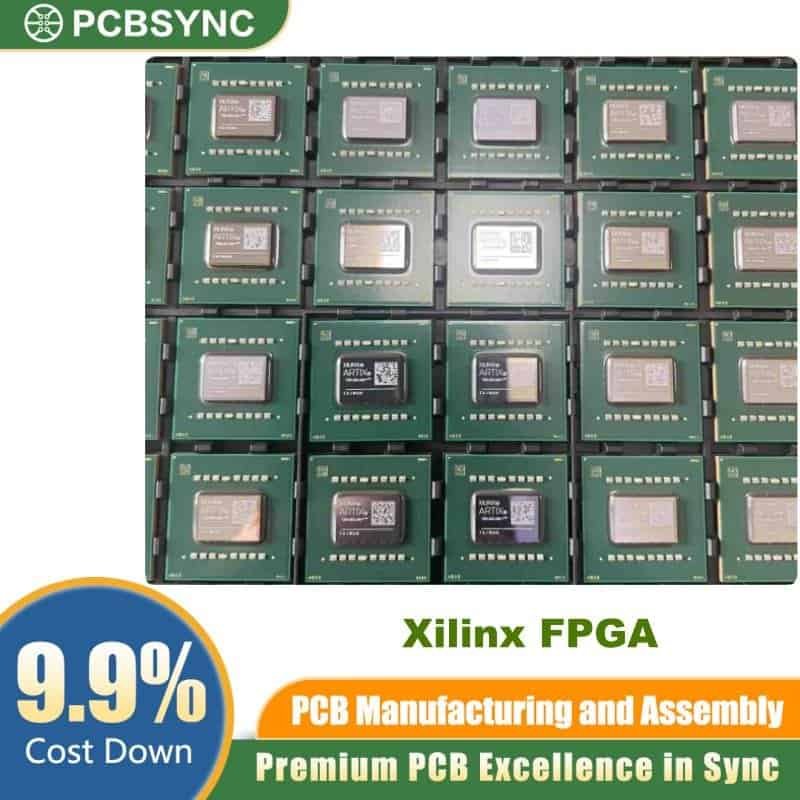
Overview of XCS10-4TQ144I FPGA Technology
The XCS10-4TQ144I represents a cornerstone solution in Xilinx FPGA technology, belonging to the proven Spartan family of field-programmable gate arrays. This industrial-grade FPGA delivers exceptional performance for high-volume production environments while maintaining cost-effective implementation strategies for ASIC replacement applications.
Manufactured by AMD (formerly Xilinx), this programmable logic device combines robust architecture with flexible design capabilities, making it an ideal choice for embedded systems, industrial automation, telecommunications equipment, and digital signal processing applications.
Key Technical Specifications
Core Architecture Features
| Specification |
Value |
| Logic Gates |
10,000 system gates |
| Logic Cells |
466 CLBs (Configurable Logic Blocks) |
| Maximum Frequency |
166 MHz |
| Operating Voltage |
5V |
| Package Type |
144-Pin TQFP (Thin Quad Flat Pack) |
| Temperature Grade |
Industrial (-40°C to +85°C) |
| Speed Grade |
-4 (High Performance) |
Memory and I/O Capabilities
| Feature |
Specification |
| On-Chip SelectRAM |
Embedded memory blocks |
| User I/O Pins |
Up to 112 I/O pins |
| Global Clock Networks |
8 low-skew clock/signal networks |
| 3-State Bus Support |
Internal 3-state bus capability |
| PCI Compliance |
Fully PCI 2.2 compliant |
Advanced FPGA Features and Benefits
High-Performance Processing Architecture
The XCS10-4TQ144I FPGA incorporates streamlined architecture derived from the proven XC4000 series, delivering system performance exceeding 80 MHz in typical applications. The dedicated high-speed carry logic ensures efficient arithmetic operations, while the configurable logic blocks provide maximum design flexibility for complex digital systems.
Industrial-Grade Reliability
Designed for demanding industrial environments, the XCS10-4TQ144I operates reliably across the full industrial temperature range. The robust 5V design ensures compatibility with legacy systems while providing noise immunity essential for industrial control applications.
Configuration and Programming
This FPGA supports multiple configuration modes including Master Serial and Slave Serial programming, enabling flexible system integration. The device features unlimited reprogrammability, allowing iterative design refinement and field updates without hardware modifications.
Technical Performance Characteristics
Timing and Speed Specifications
| Parameter |
Min |
Typ |
Max |
Unit |
| System Clock Frequency |
– |
100 |
166 |
MHz |
| Toggle Frequency |
– |
80 |
100 |
MHz |
| Internal Delay (typical path) |
– |
5.7 |
9.1 |
ns |
| Clock-to-Output Delay |
– |
9.4 |
12.0 |
ns |
Power Consumption Profile
The XCS10-4TQ144I demonstrates efficient power consumption characteristics suitable for embedded applications:
- Standby Current: Low static power dissipation
- Active Current: Dependent on design utilization
- I/O Drive Capability: Configurable output drive strength
- Power-Down Mode: Configuration retention with reduced power
Application Areas and Use Cases
Industrial Automation Systems
The XCS10-4TQ144I excels in programmable logic controller (PLC) applications, motor control systems, and industrial sensor interfaces. Its robust design withstands harsh industrial environments while delivering precise timing control.
Telecommunications Equipment
With integrated PCI compliance and high-speed performance, this FPGA serves telecommunications switching applications, protocol conversion, and data routing functions effectively.
Embedded Control Systems
The device provides ideal solutions for embedded processors, custom peripheral interfaces, and real-time control applications requiring deterministic performance.
Digital Signal Processing
Dedicated carry logic and configurable architecture enable efficient implementation of DSP algorithms, filtering operations, and data transformation functions.
Design and Development Support
Compatible Development Tools
| Tool Category |
Supported Software |
| Design Entry |
Xilinx ISE Classic, Schematic Capture |
| Synthesis |
XST (Xilinx Synthesis Technology) |
| Simulation |
ModelSim, ISim |
| Programming |
iMPACT, JTAG Programmer |
| Timing Analysis |
Static Timing Analyzer |
JTAG Boundary-Scan Support
The XCS10-4TQ144I implements IEEE Standard 1149.1/1532 boundary-scan architecture, enabling:
- In-system programming and configuration
- Production testing and board-level diagnostics
- Real-time debug and monitoring
- Configuration verification and readback
Package and Pin Configuration
TQFP-144 Package Details
| Package Specification |
Value |
| Package Type |
TQFP (Thin Quad Flat Pack) |
| Total Pins |
144 |
| Pin Pitch |
0.5 mm |
| Package Dimensions |
20mm x 20mm body |
| Lead Count per Side |
36 pins |
| Moisture Sensitivity Level |
MSL 3 |
Pin Function Categories
- Power Supply Pins: VCCINT, VCCIO, GND distribution
- Configuration Pins: CCLK, DONE, INIT, PROGRAM
- JTAG Interface: TDI, TDO, TMS, TCK
- User I/O: Configurable input/output pins
- Dedicated Inputs: Global clock inputs
Comparison with Related Devices
Spartan Family Variants
| Part Number |
Gates |
Voltage |
Speed Grade |
Key Difference |
| XCS10-4TQ144I |
10K |
5V |
-4 |
Industrial temp, high performance |
| XCS10-3TQ144I |
10K |
5V |
-3 |
Industrial temp, standard speed |
| XCS10XL-4TQ144I |
10K |
3.3V |
-4 |
Low voltage variant |
| XCS10-4TQ144C |
10K |
5V |
-4 |
Commercial temperature range |
Configuration and Programming Options
Configuration Memory Sources
The XCS10-4TQ144I accepts configuration data from multiple sources:
- Serial PROM: XC17S series configuration memory devices
- Microprocessor Interface: Slave serial or parallel loading
- JTAG Programming: In-circuit configuration and debug
- Remote Configuration: Through network or system interfaces
Configuration Time
Typical configuration timing characteristics:
- Master Serial Mode: Approximately 2-5 milliseconds
- Slave Serial Mode: Dependent on external clock frequency
- JTAG Configuration: Variable based on programming tool
Quality and Compliance Standards
Manufacturing and Testing
All XCS10-4TQ144I devices undergo comprehensive testing procedures:
- Functional Testing: 100% tested for functional correctness
- Timing Verification: Speed-grade validation
- Temperature Testing: Industrial range qualification
- Package Inspection: Mechanical and visual inspection
Environmental Compliance
- RoHS Compliance: Lead-free package options available
- Moisture Sensitivity: Proper handling and storage requirements
- ESD Protection: Built-in electrostatic discharge protection
- Latch-up Immunity: CMOS latch-up prevention design
Design Considerations and Best Practices
Power Supply Design
Proper power distribution ensures reliable FPGA operation:
- Provide adequate decoupling capacitors (0.1µF and 10µF)
- Separate VCCINT and VCCIO power domains
- Implement proper ground plane design
- Consider power sequencing requirements
Clock Distribution Strategy
Optimize clock network utilization:
- Use dedicated global clock inputs for high-fanout signals
- Minimize clock skew through proper routing
- Implement clock enable techniques for power reduction
- Consider regional clock resources for localized logic
Signal Integrity Guidelines
Maintain signal quality in board-level designs:
- Control impedance matching for high-speed signals
- Implement proper termination strategies
- Minimize crosstalk through adequate spacing
- Use appropriate PCB stackup configuration
Ordering Information and Availability
Standard Part Numbering
XCS10-4TQ144I breakdown:
- XCS10: Device family and gate count
- -4: Speed grade (performance level)
- TQ144: Package type and pin count
- I: Industrial temperature range
Package Marking
Device marking includes:
- Part number identification
- Manufacturing date code
- Country of origin
- Lot traceability information
Frequently Asked Questions
What is the difference between XCS10-4TQ144I and XCS10-4TQ144C?
The primary difference lies in the temperature range specification. The “I” suffix denotes industrial temperature range (-40°C to +85°C), while “C” indicates commercial temperature range (0°C to +70°C). Industrial-grade devices undergo additional testing and qualification.
Is the XCS10-4TQ144I suitable for new designs?
While the Spartan family represents mature technology, it remains suitable for cost-sensitive applications, legacy system maintenance, and designs requiring proven reliability. For new high-performance applications, consider current-generation Xilinx families like Spartan-7 or Artix-7.
What development tools are required?
The Xilinx ISE Classic development suite provides comprehensive support for Spartan family devices, including design entry, synthesis, implementation, and programming tools. Alternative tools like Vivado do not support legacy Spartan devices.
Can I replace a commercial-grade device with an industrial-grade version?
Yes, the XCS10-4TQ144I is pin-compatible and functionally equivalent to the XCS10-4TQ144C commercial version. The industrial variant offers extended temperature range capability, making it suitable for harsh environment applications.
Technical Support and Resources
Documentation and References
Access comprehensive technical documentation:
- Spartan Family Data Sheet
- Configuration User Guide
- Design Implementation Guide
- Application Notes and Technical Papers
Online Resources
Utilize available support channels:
- Xilinx Technical Support Forums
- Design Example Repository
- Reference Design Library
- Community Knowledge Base
Conclusion
The XCS10-4TQ144I FPGA delivers proven performance for industrial applications requiring reliable programmable logic solutions. With 10,000 system gates, 166 MHz operation, and industrial temperature qualification, this device serves diverse applications from industrial control to telecommunications equipment. Its mature architecture, comprehensive development tool support, and cost-effective implementation make it an enduring choice for embedded system designers.
For engineers seeking robust FPGA solutions with established design methodologies, the XCS10-4TQ144I represents a practical choice that balances performance, reliability, and total system cost. Whether implementing custom logic functions, replacing legacy ASICs, or developing specialized control systems, this Spartan family FPGA provides the flexibility and capability required for successful product deployment.