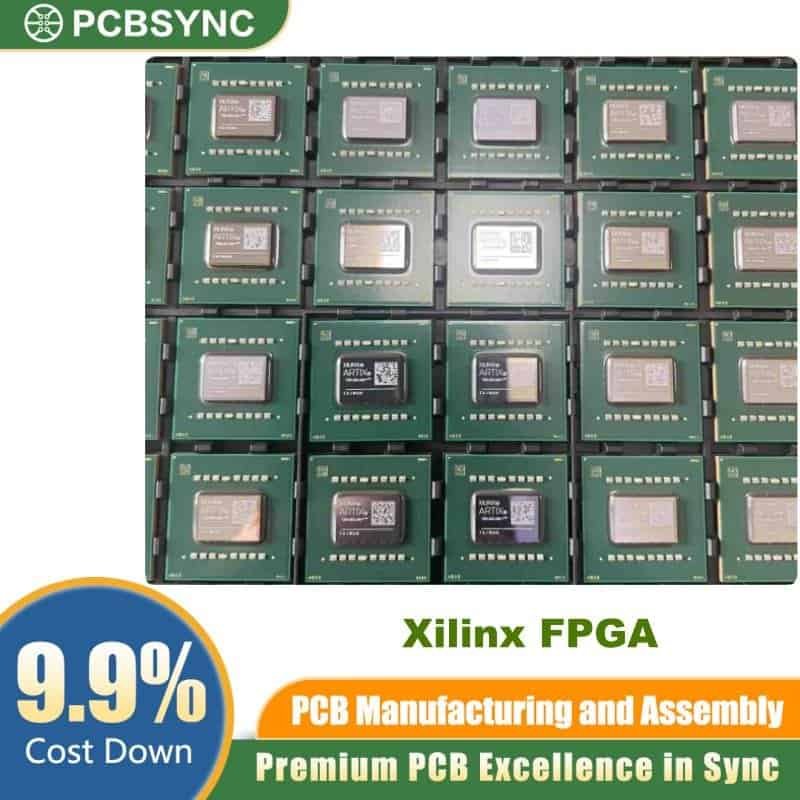
The AMD XCZU5EG-2SFVC784E is a powerful System on Chip (SoC) from the Zynq UltraScale+ MPSoC EG family, combining a feature-rich processing system with advanced programmable logic. This versatile device delivers exceptional performance for applications requiring heterogeneous computing, real-time processing, and hardware acceleration capabilities.
Whether you’re developing industrial automation systems, advanced driver-assistance systems (ADAS), video processing equipment, or 5G wireless infrastructure, the XCZU5EG-2SFVC784E provides the processing power and flexibility modern embedded designs demand.
XCZU5EG-2SFVC784E Key Features and Benefits
The XCZU5EG-2SFVC784E integrates multiple processing engines within a single chip, eliminating the need for multi-chip solutions while reducing power consumption and board space requirements. This SoC combines ARM processors, an integrated GPU, and UltraScale+ programmable logic to handle diverse workloads efficiently.
Integrated Processing System Architecture
The processing system (PS) includes a quad-core ARM Cortex-A53 application processor operating at up to 1.2GHz, delivering 64-bit computing performance for running Linux, RTOS, or bare-metal applications. Additionally, a dual-core ARM Cortex-R5F real-time processor provides deterministic performance for safety-critical and time-sensitive tasks.
For graphics and video processing, the device incorporates an ARM Mali-400 MP2 GPU, enabling hardware-accelerated rendering for user interfaces and display applications.
XCZU5EG-2SFVC784E Technical Specifications
| Specification |
Details |
| Manufacturer |
AMD (formerly Xilinx) |
| Part Number |
XCZU5EG-2SFVC784E |
| Family |
Zynq UltraScale+ MPSoC EG |
| Logic Cells |
256,200 (256K+) |
| CLB Flip-Flops |
234,240 |
| CLB LUTs |
117,120 |
| DSP Slices |
1,248 |
| Block RAM |
38 Mb |
| UltraRAM |
5.3 Mb |
| Speed Grade |
-2 (Standard Performance) |
| Temperature Range |
Extended (E): 0°C to +100°C |
| Core Voltage (VCCINT) |
0.85V |
| Process Technology |
16nm FinFET+ |
Package Specifications and Pin Configuration
| Package Parameter |
Value |
| Package Type |
784-FCBGA |
| Package Code |
SFVC784 |
| Ball Pitch |
0.8mm |
| Package Dimensions |
23mm x 23mm |
| Mounting Type |
Surface Mount |
| Max HP I/O |
156 |
| Max HD I/O |
48 |
| GTH Transceivers |
4 (up to 12.5 Gb/s) |
Processor and Memory Subsystem Specifications
Application Processing Unit (APU)
| Feature |
Specification |
| Processor Cores |
Quad-core ARM Cortex-A53 |
| Architecture |
64-bit ARMv8-A |
| Max Frequency |
1.2 GHz |
| L1 Cache |
32KB I-Cache + 32KB D-Cache per core |
| L2 Cache |
1MB shared |
| Virtualization |
Hardware support included |
Real-Time Processing Unit (RPU)
| Feature |
Specification |
| Processor Cores |
Dual-core ARM Cortex-R5F |
| Architecture |
32-bit ARMv7-R |
| Max Frequency |
600 MHz |
| Floating Point |
Single and double precision FPU |
| TCM |
256KB per core |
Graphics Processing Unit (GPU)
| Feature |
Specification |
| GPU Core |
ARM Mali-400 MP2 |
| Max Frequency |
500 MHz |
| Shader Cores |
2 fragment + 1 vertex |
| API Support |
OpenGL ES 2.0, OpenVG 1.1 |
Programmable Logic Resources
The XCZU5EG-2SFVC784E features extensive programmable logic based on the UltraScale architecture, providing high performance and flexibility for custom hardware acceleration.
Logic and Memory Resources
| Resource |
Quantity |
| System Logic Cells |
256,200 |
| CLB Slices |
14,640 |
| 6-Input LUTs |
117,120 |
| Flip-Flops |
234,240 |
| Distributed RAM |
1.8 Mb |
| Block RAM (36Kb) |
144 blocks |
| Block RAM Capacity |
38 Mb |
| UltraRAM (288Kb) |
24 blocks |
| UltraRAM Capacity |
5.3 Mb |
DSP Processing Capability
| Feature |
Specification |
| DSP Slices |
1,248 |
| Multiplier Size |
27×18 bit |
| Pre-adder |
27-bit |
| Accumulator |
48-bit |
| XOR Function |
96-bit wide |
High-Speed Connectivity and Interfaces
The XCZU5EG-2SFVC784E offers comprehensive connectivity options for modern system designs.
Integrated Peripheral Interfaces
| Interface |
Quantity/Specification |
| USB 3.0 |
2 ports (Host/Device/OTG) |
| Gigabit Ethernet |
4 MACs |
| PCIe Gen2 |
x4 lanes |
| SATA 3.1 |
2 ports |
| DisplayPort |
1 port (v1.2a) |
| CAN 2.0B |
2 controllers |
| I2C |
2 controllers |
| SPI |
2 controllers |
| UART |
2 controllers |
| GPIO |
78 MIO + 96 EMIO |
Memory Controller Support
| Memory Type |
Specification |
| DDR4 |
Up to 2400 MT/s, 64-bit + ECC |
| DDR3/DDR3L |
Up to 1866 MT/s |
| LPDDR4 |
Up to 2133 MT/s |
| LPDDR3 |
Up to 1866 MT/s |
| NAND Flash |
8-bit ONFI 3.1 |
| Quad SPI |
2 controllers |
| SD/eMMC |
2 controllers |
XCZU5EG-2SFVC784E Applications
The AMD XCZU5EG-2SFVC784E excels in applications that require a combination of software programmability and hardware acceleration.
Industrial and Automation Applications
Industrial control systems benefit from the real-time processing capabilities of the Cortex-R5F cores while leveraging programmable logic for custom I/O interfaces and protocol implementations. Motor control, machine vision, and robotics applications achieve precise timing and high-performance image processing.
Automotive and ADAS Systems
The EG variant’s processing capabilities support sensor fusion, object detection, and decision-making algorithms essential for advanced driver-assistance systems. The integrated GPU handles display rendering while the FPGA fabric processes camera and radar data in real-time.
Video and Broadcast Equipment
Professional video equipment leverages the XCZU5EG-2SFVC784E for real-time video processing, encoding, and switching applications. The high-bandwidth memory interfaces and DSP resources enable 4K video processing workflows.
Telecommunications Infrastructure
5G and LTE base stations utilize the device’s signal processing capabilities and high-speed transceivers for beamforming, channel coding, and protocol processing applications.
Medical Imaging Systems
Medical devices benefit from the processing power for image reconstruction and analysis while meeting regulatory requirements through the separation of safety-critical functions on dedicated processor cores.
Development Tools and Software Support
AMD provides comprehensive development resources for the XCZU5EG-2SFVC784E.
Vivado Design Suite
The Vivado Design Suite offers complete FPGA development including synthesis, implementation, and timing analysis specifically optimized for UltraScale+ devices.
PetaLinux and Vitis
PetaLinux provides customizable Linux distributions for the Cortex-A53 processors, while the Vitis unified software platform enables accelerated application development using high-level languages.
Reference Designs and IP Cores
AMD offers extensive IP libraries including video codecs, memory controllers, connectivity protocols, and processing accelerators compatible with the XCZU5EG device family.
Ordering Information and Part Number Breakdown
XCZU5EG-2SFVC784E decodes as follows:
| Code |
Meaning |
| XC |
Xilinx Commercial |
| ZU |
Zynq UltraScale+ |
| 5 |
Device size (mid-range) |
| EG |
EG variant (with GPU, without video codec) |
| -2 |
Speed grade (-2 standard performance) |
| SF |
0.8mm ball pitch package |
| VC |
Lidless flip-chip |
| 784 |
784 balls |
| E |
Extended temperature (0°C to +100°C) |
Related Devices and Migration Options
The Zynq UltraScale+ family offers footprint-compatible devices for design scalability. Devices sharing the same package suffix (C784) provide pin-compatible migration paths. The XCZU4EG, XCZU5CG, and XCZU5EV variants offer alternative resource configurations within the same package footprint.
For extensive Xilinx FPGA selection and technical support, engineers can access comprehensive component databases and documentation to support their design requirements.
Conclusion
The AMD XCZU5EG-2SFVC784E represents an optimal balance of processing performance, programmable logic resources, and power efficiency for mid-range embedded applications. With its quad-core Cortex-A53, dual-core Cortex-R5F, Mali-400 GPU, and 256K+ logic cells, this Zynq UltraScale+ MPSoC delivers the heterogeneous computing capabilities modern embedded systems require.
The device’s comprehensive peripheral integration, high-speed connectivity options, and robust development ecosystem make it an excellent choice for industrial automation, automotive, telecommunications, and multimedia applications demanding both software flexibility and hardware acceleration.