Inquire: Call 0086-755-23203480, or reach out via the form below/your sales contact to discuss our design, manufacturing, and assembly capabilities.
Quote: Email your PCB files to Sales@pcbsync.com (Preferred for large files) or submit online. We will contact you promptly. Please ensure your email is correct.
Notes: For PCB fabrication, we require PCB design file in Gerber RS-274X format (most preferred), *.PCB/DDB (Protel, inform your program version) format or *.BRD (Eagle) format. For PCB assembly, we require PCB design file in above mentioned format, drilling file and BOM. Click to download BOM template To avoid file missing, please include all files into one folder and compress it into .zip or .rar format.
After spending fifteen years designing audio amplifier boards and troubleshooting countless DIY builds, I’ve learned that the difference between a humming mess and a crystal-clear amplifier often comes down to PCB layout decisions. This guide shares everything I’ve learned about laying out TDA-series amplifier boards that actually work the first time.
You can have the perfect schematic, source premium components, and still end up with an amplifier that hums, oscillates, or distorts. The culprit? Poor PCB layout. I’ve seen builders spend hours debugging circuits when the real problem was a ground trace running the wrong way or decoupling caps placed inches from where they should be.
The TDA series from STMicroelectronics includes some of the most popular audio amplifier ICs ever made. The TDA2050, TDA7294, TDA7377, and TDA7388 each have specific layout requirements that, when followed, result in quiet, stable amplifiers. Ignore them, and you’ll spend weekends chasing noise.
TDA2050 PCB Layout: Getting 32 Watts Without the Hum
The TDA2050 delivers up to 32 watts RMS into 8 ohms and remains a favorite for bookshelf speaker amplifiers and guitar practice amps. Its relatively simple pinout (just 5 pins) makes it accessible for beginners, but the layout still needs careful attention.
TDA2050 PCB Layout Essentials
The TDA2050 operates with split supply rails (typically ±18V to ±22V), meaning you need to handle both positive and negative supply connections properly. The datasheet includes a recommended PCB layout for good reason: it works.
Critical placement rules for TDA2050 PCB layout:
Place decoupling capacitors as close as possible to pins 3 (+Vs) and 5 (-Vs). I’m talking millimeters, not centimeters. The inductance of even a 10mm trace can cause problems at high frequencies. Use low-ESR electrolytics (100µF minimum) paralleled with 100nF ceramic caps right at the pins.
The input ground (pin 4) and output ground need separate paths back to the power supply filter capacitors. Don’t daisy-chain grounds. Run dedicated traces that meet at a single star ground point near the main filter caps.
TDA2050 Component Values and Specifications
Component
Value
Notes
Input Capacitor (C1)
1µF
Film type recommended, blocks DC
Feedback Resistor (R1)
22kΩ
Sets gain with R2
Feedback Resistor (R2)
680Ω
Gain = 1 + (R1/R2) ≈ 33
Zobel Network (R)
2.2Ω
Prevents HF oscillation
Zobel Network (C)
100nF
Polyester or ceramic
Supply Decoupling
100µF + 100nF
Per rail, close to IC
Bootstrap Cap
22µF/35V
Critical for output swing
Avoiding Common TDA2050 Mistakes
The most frequent error I see in TDA2050 PCB layout is running input traces near output traces. The TDA2050 has a gain of around 30dB in typical configurations. That means any signal coupling from output to input gets amplified significantly. Keep input and output sections on opposite sides of the IC, and consider a ground pour between them.
TDA7294 PCB Layout: 100 Watts Done Right
The TDA7294 represents serious power: up to 100 watts into 8 ohms when properly configured. This Multiwatt15 package IC appears in high-end home stereo systems and self-powered PA speakers. The layout requirements are more demanding than the TDA2050, but the results justify the effort.
TDA7294 PCB Layout Fundamentals
The TDA7294 has 15 pins with separate power supply pins for the signal section (Vs+ and Vs-) and the power section (PW+, PW-, and multiple power grounds). This separation exists for a reason: it allows you to route high-current power paths separately from sensitive signal paths.
Essential TDA7294 layout considerations:
The datasheet specifies a 1:1 scale PCB layout that I strongly recommend following for your first build. The power ground pins (pins 11, 13) carry the speaker return current. These traces need to be wide (at least 2mm) and routed directly to the power supply filter capacitors.
The signal ground (pin 9) carries milliamps at most. Route it separately from power grounds, joining them only at the star ground point. Running high speaker currents through the signal ground path introduces hum proportional to the current and trace resistance.
TDA7294 Power Supply Requirements
Parameter
Value
Notes
Supply Voltage
±10V to ±40V
±35V typical for full power
Maximum Voltage
±50V
Absolute maximum
Quiescent Current
~30mA
Per channel
Output Current
Up to 10A peak
Proper heatsinking required
Minimum Load
4Ω
8Ω recommended
Power Dissipation
Up to 80W
Heatsink thermal resistance <1.5°C/W
TDA7294 Heatsink Mounting
The TDA7294 tab connects internally to the negative power supply rail. You must electrically isolate it from the heatsink unless your heatsink is dedicated to a single channel. Use mica insulators or silicone pads with thermal conductivity of at least 0.9 W/m·K. Apply thermal compound sparingly—a thin, even layer works better than a thick blob.
I’ve found that a heatsink with thermal resistance below 1.5°C/W keeps the junction temperature manageable during extended listening. For bridged configurations delivering 150+ watts, consider active cooling or significantly larger heatsinks.
TDA7377 PCB Layout: Four Channels From One IC
The TDA7377 packs four amplifier channels into a single 15-pin package, designed specifically for car audio. It operates from single-supply 12V to 18V, making it ideal for automotive applications and compact home systems running from switch-mode supplies.
Understanding TDA7377 Ground Structure
The TDA7377 has separate power ground (P-GND) and signal ground (S-GND) pins that are internally isolated at the chip level. The datasheet explicitly states these must be connected together on the PCB using “reasonably low-resistance tracks.”
TDA7377 grounding configuration:
Use a star-ground layout with the center point at the supply filtering electrolytic capacitor ground. Route separate traces from P-GND and S-GND to this star point. The P-GND trace carries speaker return currents and should be at least 1.5mm wide. S-GND carries milliamps and can be thinner, but keep it direct and short.
TDA7377 PCB Layout Best Practices
Design Element
Recommendation
Reason
Ground Trace Width
P-GND: 1.5mm minimum; S-GND: 0.5mm minimum
Carries speaker return current
Decoupling
470µF + 100nF at Vcc pins
Ripple rejection and HF bypassing
Input Coupling Caps
1µF to 2.2µF film
DC blocking without bass loss
Standby Pull-up
10kΩ to Vcc
Enables amplifier operation
SVR Capacitor
47µF
Supply voltage rejection
Trace Separation
Input/output: 5mm minimum
Prevents oscillation
TDA7377 Configuration Options
The TDA7377 supports multiple configurations:
Quad single-ended mode delivers approximately 6W per channel into 4Ω loads. Use this for compact 4-speaker systems where moderate power suffices.
Dual bridge mode combines pairs of outputs to deliver approximately 15W per channel into 4Ω loads. The bridged configuration cancels even-order harmonics and eliminates the need for large output coupling capacitors.
Stereo + bridge mode provides two 6W channels for satellites and one 15W bridged channel for a subwoofer, creating a compact 2.1 system from a single IC.
TDA7388 PCB Layout: Quad Bridge Power for Car Audio
The TDA7388 takes the car audio amplifier concept further with four bridged outputs, each delivering up to 45 watts into 4Ω loads. Packaged in the Flexiwatt25, this IC requires careful attention to thermal management and grounding.
TDA7388 PCB Layout Requirements
The TDA7388 includes separate power supply pins (Vcc1 and Vcc2) that should both connect to the positive supply through appropriate filtering. The datasheet shows a specific PCB layout at 1:1 scale—use it as your starting template.
Key TDA7388 layout elements:
The supply filtering requires both bulk capacitance (470µF) and high-frequency bypass (100nF). Place the bypass caps within 5mm of the Vcc pins. The bulk cap can be slightly further away but should still be close.
The SVR (Supply Voltage Rejection) pin requires a 10µF minimum capacitor to ground. This capacitor also controls the turn-on/off sequence, affecting pop noise at power up. Don’t skimp on this capacitor—use a quality electrolytic rated for at least 25V in 12V systems.
TDA7388 Specifications Summary
Parameter
Value
Notes
Supply Voltage
8V to 18V
14.4V nominal
Output Power
4 × 45W @ 4Ω max
At 10% THD
Continuous Power
4 × 26W @ 4Ω
At 14.4V, 1kHz, 10% THD
Output Peak Current
4.5A repetitive
5.5A non-repetitive
Input Impedance
50kΩ
Per channel
Standby Current
<1µA
Standby mode
Package
Flexiwatt25
Tab = GND
TDA7388 Thermal Considerations
The TDA7388 tab connects to ground internally, simplifying heatsink mounting—no isolation needed if the heatsink mounts to chassis ground. However, the combined power dissipation of four 45W channels means serious heat generation.
Calculate your heatsink requirements based on actual listening levels. Most car audio plays at average levels around 10-20% of peak power, so continuous dissipation is much lower than worst-case calculations suggest. That said, I recommend heatsinks with thermal resistance below 1°C/W for this IC.
P3A Amplifier PCB Layout: The DIY Standard
The P3A amplifier from Elliott Sound Products represents a different approach: discrete transistor design rather than integrated circuits. This 60-80W Class-AB amplifier has become a benchmark for DIY audio due to its excellent performance and well-documented design.
P3A Amplifier PCB Layout Principles
The P3A uses a complementary feedback pair (CFP/Sziklai) output stage, which requires careful attention to thermal tracking between the driver and output transistors. The VAS (Voltage Amplifier Stage) transistors should be positioned close to the output transistors on the heatsink to share thermal tracking.
Critical P3A layout considerations:
Signal path should flow logically from input to output without doubling back. The input stage sits at one end, the output stage at the other, with power supply connections entering near the output stage.
Ground returns from different circuit sections must remain separate until they meet at the star ground point near the main filter capacitors. The input stage ground, VAS ground, and output stage ground each need dedicated traces.
P3A Component Placement Guidelines
Section
Placement Requirement
Reason
Input Stage
Near input connector
Minimizes noise pickup
VAS Transistors
On or near heatsink
Thermal coupling with output
Output Transistors
Mounted to heatsink
Heat dissipation
Bias Trimpot
Accessible location
Adjustment access
Emitter Resistors
Near output transistors
Current sensing accuracy
Zobel Network
Close to output
HF stability
P3A Power Supply Decoupling
The P3A benefits from local decoupling beyond the main filter capacitors. Place 100µF electrolytics near the output stage power connections, with 100nF ceramics paralleled for high-frequency bypassing. The input stage can use smaller values (10µF + 100nF) as it draws minimal current.
Star Grounding: The Foundation of Low-Noise Amplifiers
Whether you’re building a TDA2050 project or a sophisticated P3A amplifier, grounding strategy makes or breaks your noise performance. Star grounding remains the gold standard for audio amplifiers, despite what some high-speed digital designers might argue.
Implementing Star Ground in TDA Amplifier Layouts
The concept is straightforward: every ground connection returns to a single point via its own conductor. In practice, this means:
Identify your star ground point. This should be at the negative terminal of the main filter capacitor, as close to the rectifier as practical.
Route separate ground traces from each circuit section to this point. Don’t let the input ground share a trace with the speaker return ground for any distance.
Power supply grounds (high current) and signal grounds (low current) need separate traces. If high currents flow through paths shared by low-level signal grounds, you get hum.
Ground Routing Priority Order
Priority
Ground Connection
Trace Width
1
Speaker return (output ground)
2mm+
2
Power supply negative
2mm+
3
Decoupling cap grounds
1mm
4
Bias/feedback network ground
0.5mm
5
Input ground
0.5mm
Connect these in order of decreasing current, with the highest-current path having the shortest, most direct route to the star point.
PCB Design Software Recommendations
Modern PCB design has become accessible to hobbyists thanks to capable free software. For TDA amplifier projects, consider:
KiCad offers full professional capabilities at zero cost. The learning curve is moderate, but the results justify the investment. Most TDA amplifier layouts available for download come in KiCad format.
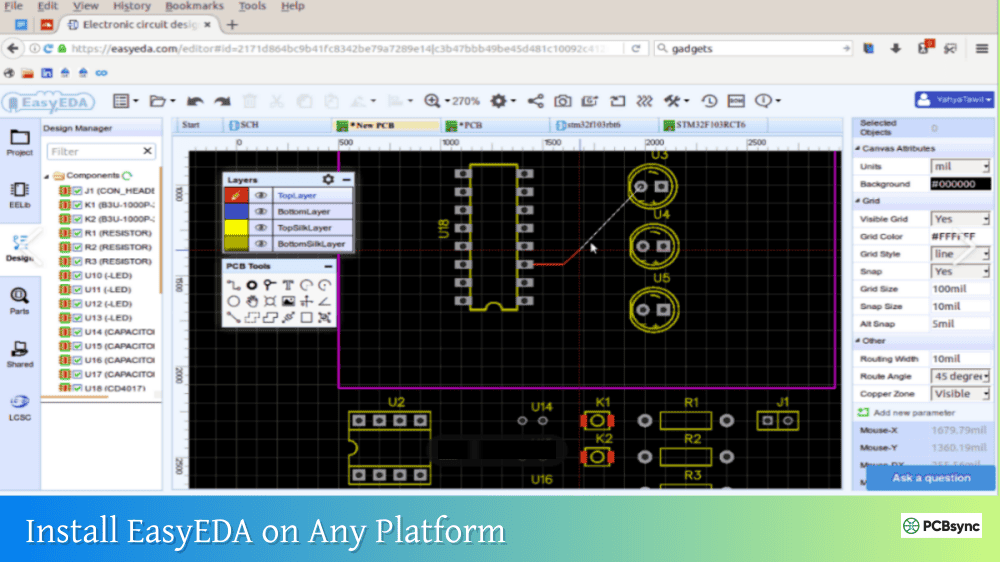
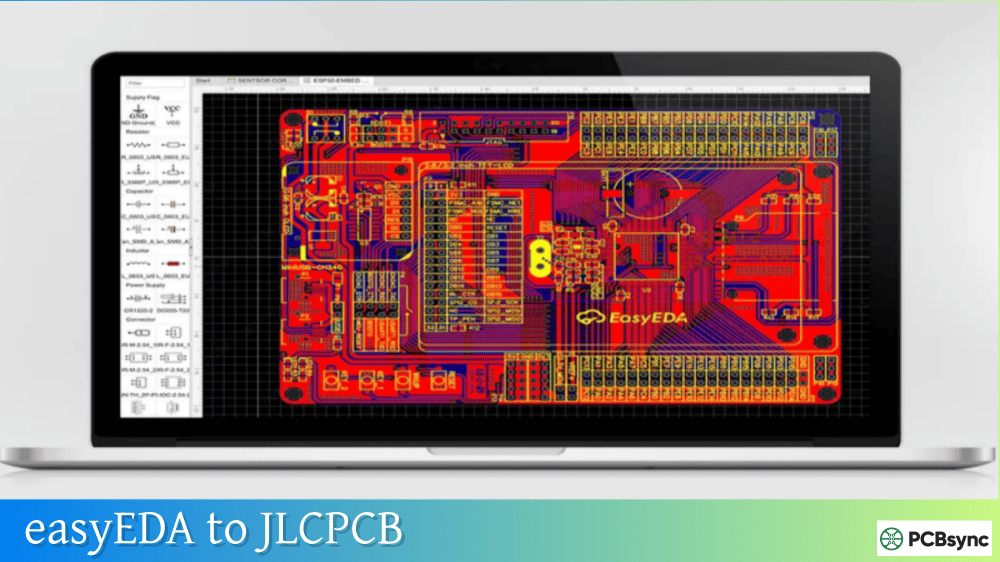
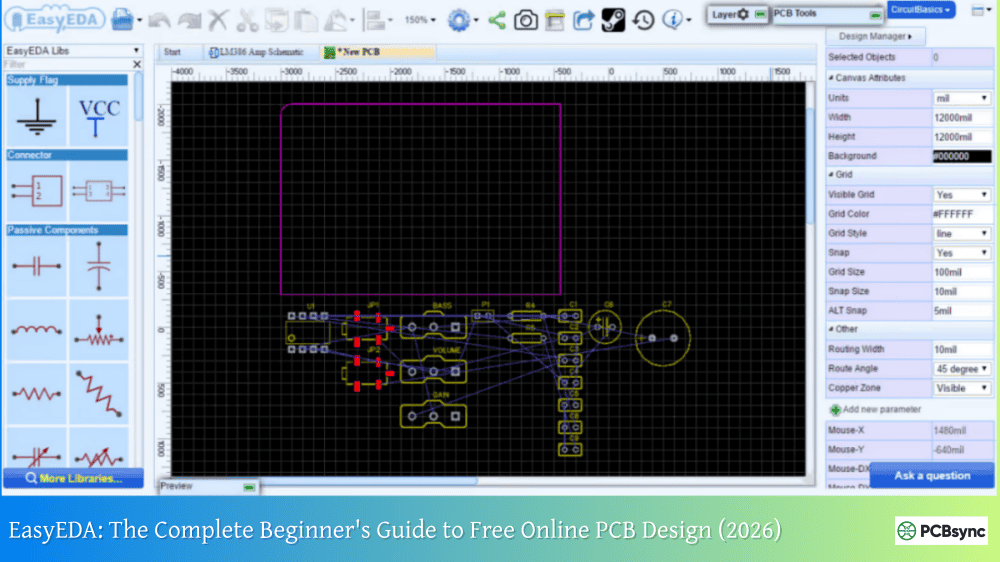
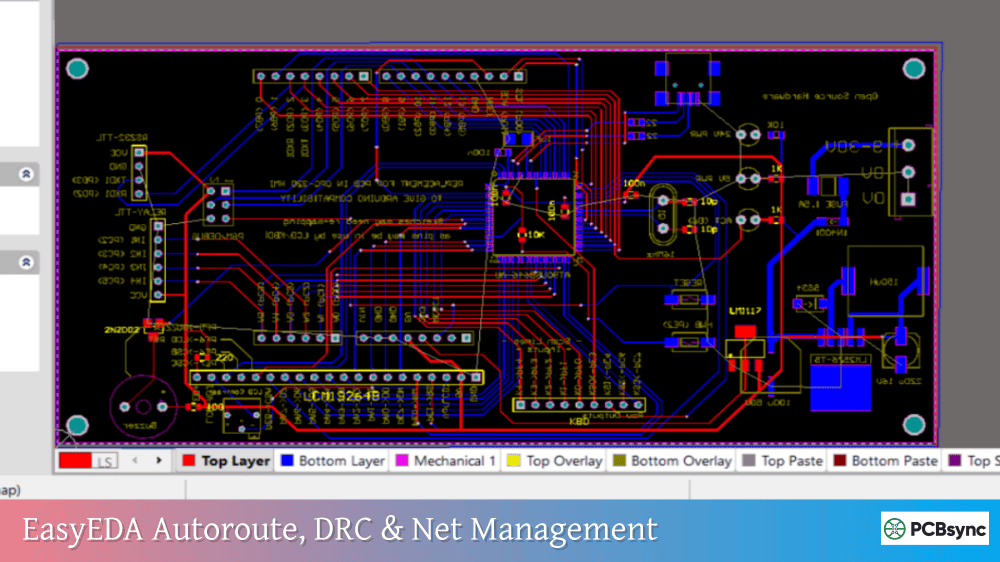
EasyEDA provides browser-based design with direct integration to JLCPCB manufacturing. Many community-shared TDA amplifier projects exist in this format, making it easy to order boards directly.
Eagle (now part of Autodesk) has a free tier sufficient for most amplifier projects. The extensive component libraries include many TDA-series ICs.
Useful Resources and Downloads
Official Datasheets
Direct links to manufacturer datasheets contain the most reliable information:
Community-shared PCB projects provide tested starting points:
PCBWay Project Share: Search “TDA2050” or “TDA7294” for downloadable Gerber files
EasyEDA/OSHWLAB: Numerous TDA amplifier projects with schematics and PCB layouts
DIYAudio Forums: Active community with verified designs and troubleshooting support
Recommended PCB Manufacturers
For prototype quantities (5-10 boards), these manufacturers offer quality results at reasonable prices:
JLCPCB: Excellent for standard 2-layer boards, 5 boards often under $5
PCBWay: Good for more complex boards, slightly higher quality options
AllPCB: Competitive pricing with fast turnaround options
Frequently Asked Questions
What trace width should I use for speaker outputs on TDA amplifier boards?
For TDA2050 and TDA7294 carrying up to 5A peak, use minimum 2mm trace width. For the TDA7377 and TDA7388 at 12V operation, 1.5mm suffices for most applications. Calculate using the IPC-2221 standard: 2A per mm of trace width for external layers is a conservative starting point.
Can I use single-sided PCBs for TDA amplifier projects?
Yes, but with compromises. Single-sided layouts require jumper wires for certain connections and make star grounding more challenging. The TDA2050 and TDA7377 work reasonably well on single-sided boards. The TDA7294 and P3A strongly benefit from double-sided boards with a ground plane.
How do I eliminate 60Hz hum in my TDA amplifier build?
Hum almost always indicates grounding problems. Verify that your star ground is truly star-shaped—no daisy chains. Check that input cables use shielded wire with the shield grounded only at the amplifier end. Ensure the power transformer’s magnetic field isn’t coupling into the input circuitry; physical separation helps.
What thermal interface material works best for TDA IC mounting?
For TDA ICs requiring isolation (TDA7294), use mica insulators with thermal compound or silicone thermal pads (0.9+ W/m·K conductivity). For TDA ICs with grounded tabs (TDA7388), thermal compound directly on the heatsink works fine. Avoid thick compound layers—thermal resistance increases with thickness.
How close should decoupling capacitors be to the IC power pins?
As close as physically possible. The inductance of PCB traces causes voltage spikes during current transients. Each centimeter of trace adds roughly 10nH of inductance. For a 100nF decoupling capacitor, keeping traces under 5mm maintains effective bypassing above 10MHz.
Troubleshooting Common PCB Layout Problems
Even experienced builders encounter issues. Here’s how to diagnose and fix the most common problems in TDA amplifier builds.
Oscillation and Instability
High-frequency oscillation manifests as excessive heat, distorted sound, or even destroyed output transistors. The TDA7294 and P3A amplifier are particularly susceptible when layout rules are violated.
Causes and solutions:
Long feedback paths create phase shift that can cause oscillation. Keep the feedback network (typically R1 and R2) physically close to the IC, with the connection to the output as short as practical.
Missing or inadequate Zobel networks allow high-frequency instability. Every TDA amplifier should include a Zobel network (typically 2.2Ω in series with 100nF) from output to ground, placed within 10mm of the output pin.
Insufficient decoupling causes power supply ripple that feeds back into the signal path. Verify both high-frequency (100nF ceramic) and low-frequency (100µF+ electrolytic) decoupling are present and properly placed.
DC Offset Problems
DC voltage at the speaker terminals wastes power, heats voice coils, and indicates circuit problems. More than 100mV DC offset requires investigation.
For TDA-series ICs, DC offset typically results from damaged components or incorrect biasing. The ICs include internal protection against most faults. Excessive offset usually indicates a failed IC requiring replacement.
For the P3A amplifier, adjust the bias trimpot (VR1) to minimize DC offset while setting quiescent current. If adjustment range is insufficient, verify all resistor values in the differential pair input stage.
Thermal Runaway Prevention
Class-AB amplifiers can experience thermal runaway if the bias circuit doesn’t track output transistor temperature. This matters most for discrete designs like the P3A.
Mount the bias transistor (or Vbe multiplier) in thermal contact with the output transistors. Many builders bolt a small transistor directly to the heatsink near the output devices. This thermal coupling reduces bias as the heatsink heats up, preventing runaway.
For TDA ICs, thermal protection is built-in. However, operation without adequate heatsinking triggers the thermal limiter repeatedly, reducing output power and potentially shortening IC life.
Upgrading and Modifying TDA Amplifier Designs
Once you’ve built a working amplifier, consider these modifications for improved performance.
Power Supply Improvements
The power supply often limits amplifier performance more than the amplifier circuit itself. Upgrading filter capacitance reduces ripple and improves bass response. Doubling the main filter capacitors from 4700µF to 10000µF per rail often produces audible improvements in bass definition.
Adding a small-signal regulated supply for the input stage isolates it from power supply variations. A simple zener diode regulator or LM317/337 variable regulator can provide ±15V for input circuitry even when main rails are ±35V.
Input Stage Refinements
The TDA2050 and TDA7294 accept modifications to their input networks. Replacing the input coupling capacitor with a film type (polypropylene or polyester) instead of electrolytic often improves clarity, particularly in the midrange.
For TDA7294, some builders add a discrete JFET buffer before the input pin. This reduces loading on the source and can improve high-frequency performance with high-impedance sources.
Output Stage Modifications
The TDA7294 datasheet shows a high-efficiency configuration using external power transistors that handle peak currents while the IC handles average power. This extends the practical power range significantly while improving thermal management.
For the P3A amplifier, output transistor selection affects sound character. The MJL21193/94 pair offers excellent linearity. The 2SA1943/2SC5200 pair provides slightly higher current capability. Both work well when purchased from reputable suppliers—counterfeit transistors remain a significant problem in the audio market.
Comparing TDA Amplifier ICs
Choosing between TDA amplifier ICs depends on your application requirements. This comparison helps match ICs to projects.
Parameter
TDA2050
TDA7294
TDA7377
TDA7388
Max Power
32W/8Ω
100W/8Ω
15W×2 or 30W×2
45W×4
Supply Type
Split (±18-22V)
Split (±10-40V)
Single (12-18V)
Single (8-18V)
Channels
1
1
4 (configurable)
4 (bridged)
Package
Pentawatt
Multiwatt15
Multiwatt15
Flexiwatt25
Primary Use
Home audio
Hi-Fi/PA
Car stereo
Car audio
Complexity
Low
Medium
Medium
Medium
Cost
Low
Medium
Low
Low
Application Recommendations
Desktop/bookshelf speakers: TDA2050 provides sufficient power with minimal complexity. A stereo pair drives efficient speakers to room-filling levels.
Home theater: TDA7294 offers the power headroom for dynamic movie soundtracks. Consider one IC per channel for best performance.
Car audio upgrade: TDA7377 in 2.1 configuration (stereo + bridged sub) provides significant improvement over factory systems with minimal complexity.
Car audio competition: TDA7388 quad bridged configuration delivers serious power from a compact package. Multiple ICs can be paralleled for extreme output.
High-fidelity system: P3A amplifier PCB layout offers performance rivaling commercial amplifiers costing many times more. Worth the additional complexity for critical listening systems.
Conclusion: Building Better Amplifiers Through Layout
The TDA2050, TDA7294, TDA7377, and TDA7388 remain excellent choices for audio amplifier projects when implemented correctly. The P3A amplifier PCB layout offers a discrete alternative with even higher performance potential.
Every successful amplifier build starts with understanding why layout matters as much as component selection. Star grounding, proper decoupling, adequate trace widths, and thermal management aren’t optional extras—they’re fundamental requirements for stable, quiet operation.
Start with the manufacturer’s recommended layouts when available. Understand why each design decision was made before modifying anything. When troubleshooting, suspect the layout before blaming components. Most amplifier problems I’ve diagnosed over the years trace back to layout issues that would have been avoided by following the datasheet recommendations.
Build carefully, test systematically, and enjoy the results. A well-designed TDA amplifier delivers remarkable performance for the investment, and the skills you develop transfer directly to more ambitious projects.
Inquire: Call 0086-755-23203480, or reach out via the form below/your sales contact to discuss our design, manufacturing, and assembly capabilities.
Quote: Email your PCB files to Sales@pcbsync.com (Preferred for large files) or submit online. We will contact you promptly. Please ensure your email is correct.
Notes: For PCB fabrication, we require PCB design file in Gerber RS-274X format (most preferred), *.PCB/DDB (Protel, inform your program version) format or *.BRD (Eagle) format. For PCB assembly, we require PCB design file in above mentioned format, drilling file and BOM. Click to download BOM template To avoid file missing, please include all files into one folder and compress it into .zip or .rar format.