Inquire: Call 0086-755-23203480, or reach out via the form below/your sales contact to discuss our design, manufacturing, and assembly capabilities.
Quote: Email your PCB files to Sales@pcbsync.com (Preferred for large files) or submit online. We will contact you promptly. Please ensure your email is correct.
Notes: For PCB fabrication, we require PCB design file in Gerber RS-274X format (most preferred), *.PCB/DDB (Protel, inform your program version) format or *.BRD (Eagle) format. For PCB assembly, we require PCB design file in above mentioned format, drilling file and BOM. Click to download BOM template To avoid file missing, please include all files into one folder and compress it into .zip or .rar format.
If you’ve ever cracked open a high-quality audio amplifier or scrolled through DIY audio forums, you’ve probably seen the LM3886 and LM1875 mentioned more times than you can count. These chips have earned legendary status in the audio community for good reason. They deliver exceptional sound quality with minimal external components, making them the go-to choice for both hobbyists and professional audio engineers.
I’ve designed dozens of amplifier PCBs over the years, and I keep coming back to these two ICs. The challenge isn’t the schematic—Texas Instruments provides solid reference designs in the datasheets. The real battle is the amplifier PCB design itself. Get the layout wrong, and you’ll end up with oscillation, hum, excessive heat, or that annoying high-frequency buzz that ruins an otherwise perfect build.
This guide walks through everything you need to know about LM3886 PCB layout and LM1875 PCB layout design. We’ll cover grounding strategies, thermal management, component placement, and the practical details that separate a mediocre build from an exceptional one.
Understanding the LM Series Audio Power Amplifiers
Before diving into PCB layout, let’s understand what makes these chips tick. Both the LM3886 and LM1875 belong to Texas Instruments’ Overture series of audio power amplifiers. They’re essentially high-power operational amplifiers designed specifically for audio applications.
LM3886 Overview
The LM3886 stands as the flagship of the series. It delivers 68W continuous average power into a 4Ω load and 38W into 8Ω with remarkably low distortion (0.03% THD+N across the audio spectrum). The chip features SPiKe (Self Peak Instantaneous Temperature) protection circuitry, which protects against overvoltage, undervoltage, thermal runaway, and short circuits.
What makes the LM3886 particularly appealing for PCB designers is its mute functionality and the 11-pin TO-220 package that provides excellent thermal performance. The chip can source over 11A peak current, making it suitable for demanding speaker loads.
LM1875 Overview
The LM1875 is the LM3886’s smaller sibling, but don’t let that fool you. This 20W amplifier punches well above its weight class in terms of audio quality. Many experienced builders actually prefer the LM1875’s sonic character for smaller systems, describing it as having more “definition” in the high frequencies.
The LM1875 uses a simpler 5-pin TO-220 package and requires fewer external components. This makes it an excellent choice for beginners while still delivering genuine hi-fi performance. The chip handles ±25V supplies comfortably and maintains less than 0.1% THD at rated output.
LM3886 vs LM1875: Key Specifications Comparison
Specification
LM3886
LM1875
Output Power (4Ω)
68W
30W (at ±30V)
Output Power (8Ω)
38W
20W
Supply Voltage Range
±20V to ±35V
±16V to ±30V
THD+N (Typical)
0.03%
0.015%
Signal-to-Noise Ratio
>92dB
>90dB
Slew Rate
19V/µs
18V/µs
Gain Bandwidth Product
8MHz
5.5MHz
Package
TO-220 (11-pin)
TO-220 (5-pin)
Mute Function
Yes
No
Minimum Stable Gain
10x (20dB)
10x (20dB)
Both chips are internally compensated and stable at gains of 10 or greater. The key difference lies in power handling and current capability. The LM3886’s higher current handling (up to 11.5A peak) makes it better suited for lower impedance loads and larger speaker systems.
Critical Principles for Amplifier PCB Design
Getting a chip amp to work is easy. Getting it to work well requires understanding a few fundamental principles that apply to both LM3886 PCB layout and LM1875 PCB layout design.
Why PCB Layout Matters in Audio Amplifiers
Audio amplifier circuits present unique challenges that standard PCB design rules don’t fully address. Consider what’s happening electrically: you’re amplifying tiny input signals (millivolts) to speaker-driving power levels while hundreds of milliamps (or even amps) flow through the output stage. Any noise or interference that couples into the input gets amplified along with your music.
The high gain requirements of audio amplifiers (typically 20-30x) mean that even small layout imperfections become audible. Ground loops create hum. Poor decoupling causes oscillation. Inadequate thermal design leads to thermal shutdown or reduced lifespan. These aren’t theoretical concerns—they’re the practical problems that forum posts and troubleshooting guides are filled with.
The Three Pillars of Audio Amplifier PCB Design
Every successful amplifier PCB design rests on three interconnected principles:
Signal Integrity: Keeping the audio path clean from input to output. This means short traces, proper shielding, and separation from noisy circuits.
Power Distribution: Ensuring stable, clean power reaches the amplifier with minimal noise and voltage drops. Decoupling capacitor placement is critical here.
Thermal Management: Removing heat efficiently to prevent thermal protection activation and ensure long-term reliability.
Neglect any one of these, and you’ll hear it in the output.
Grounding Strategies for LM3886 and LM1875 Boards
Grounding problems cause more audio amplifier issues than any other single factor. The LM3886 and LM1875 are particularly sensitive to grounding because of their high gain and the large currents flowing through the output stage.
Star Grounding Architecture
The star grounding scheme remains the gold standard for audio amplifier PCBs. The concept is simple: all ground connections return to a single point (the “star point”) rather than daisy-chaining from one component to the next.
Here’s why this matters. When speaker current flows through a ground trace, it creates a voltage drop across that trace’s resistance and inductance. If your input signal’s ground shares this trace, that voltage drop appears as a signal at the amplifier input—and gets amplified. The result is distortion, oscillation, or both.
For the LM3886 and LM1875, you’ll want to establish separate ground networks:
Power Ground: Handles the power supply decoupling capacitors, Zobel network, and the IC’s ground pin. This is your high-current ground.
Signal Ground: Serves the input coupling capacitor, gain-setting resistors, and feedback network. This carries minimal current but is most sensitive to noise.
Speaker Ground: Returns the load current from the speaker. This is the noisiest ground and must be kept isolated from signal ground.
These three ground networks should connect only at the main system ground point, located as close as possible to the reservoir capacitors on the power supply.
Practical Ground Plane Implementation
If you’re using a multi-layer PCB, dedicate one layer to a solid ground plane. This provides the lowest-impedance return path and excellent shielding. However, don’t just pour copper and call it done. You still need to think about where the return currents flow.
For two-layer boards (common in DIY projects), you can create pseudo-ground planes by using thick copper pours in specific areas. Keep the power ground pour near the supply pins and the signal ground pour near the input. Connect them at a single point near the input connector.
The key insight from successful LM3886 builds is that higher current grounds should be closer to the reservoir capacitors. Order your ground connections so that speaker ground is closest to the supply, followed by power ground, then signal ground.
Component Placement Guidelines for Audio Amplifier PCBs
Component placement determines 80% of your layout success. Get this right, and routing becomes straightforward. Get it wrong, and no amount of clever trace routing will save you.
Optimal LM3886 PCB Layout Placement
The LM3886 package presents a specific challenge: the chip must be mounted to a heatsink while maintaining good electrical connections to the PCB. Plan your layout with the heatsink position in mind from the start.
Position the LM3886 near the board edge closest to the heatsink mounting location. This minimizes the thermal path and simplifies mechanical mounting. The chip’s tab (which is at V- potential for non-isolated packages) will be in direct contact with the heatsink.
Place decoupling capacitors within 10mm of the supply pins. For the LM3886, use both a small ceramic (100nF) and a larger electrolytic (100µF or greater) at each supply pin. The ceramic handles high-frequency noise; the electrolytic provides charge reservoir capacity.
Keep the feedback network components as close as possible to pins 9 (inverting input) and 10 (output). The feedback resistors and any compensation capacitors in this network are extremely sensitive to stray capacitance and inductance.
Position the input coupling capacitor near the input connector, not near the chip. This prevents any noise picked up by input traces from being amplified.
Optimal LM1875 PCB Layout Placement
The LM1875’s simpler 5-pin package makes placement somewhat easier, but the same principles apply. The datasheet emphasizes returning the load ground, output compensation ground, and feedback/input grounds to the board ground point through separate paths.
Mount the LM1875 with the tab facing the heatsink mounting area. The 5-pin inline arrangement allows for a clean, linear component layout.
Place the output compensation components immediately adjacent to the chip. The 0.1µF supply decoupling capacitors and the output Zobel network should be as close as possible to minimize trace resistance and inductance.
Separate input and output traces physically. Current in the output leads can couple through the air to the amplifier input, causing high-frequency oscillation. Route these on opposite sides of the chip.
A clean power supply separates great amplifiers from mediocre ones. The LM3886 and LM1875 are both sensitive to power supply noise, and their high power output means they draw significant current pulses with each musical transient.
Decoupling Capacitor Selection
The traditional approach uses two capacitors at each supply rail: a small ceramic (100nF) for high-frequency noise and a larger electrolytic (100-470µF) for bulk energy storage. This works, but the details matter.
For the ceramic capacitors, use X7R or C0G (NPO) dielectrics. Standard Y5V ceramics lose significant capacitance under DC bias and temperature variation—exactly the conditions present in an audio amplifier.
For the electrolytic capacitors, low-ESR types make a measurable difference. Standard electrolytics can have ESR values of several ohms, which creates a voltage divider with the amplifier’s impedance. Low-ESR types (under 100mΩ) maintain their decoupling effectiveness at higher frequencies.
Power Trace Routing
Power traces need to be wide—much wider than many beginners expect. For a 68W LM3886 drawing 3-4A peak, you need traces capable of handling that current without excessive voltage drop.
A rule of thumb: use at least 100 mils (2.5mm) trace width for power rails, and consider 200 mils (5mm) for the main supply feeds. If space permits, flood the areas near the chip with copper power planes rather than using discrete traces.
Keep power supply traces separated from input traces. These traces carry the nonlinear, large currents that can inductively couple to sensitive inputs. Route them on opposite sides of the board, or use perpendicular orientations if they must cross.
Power Supply Recommendations Table
Parameter
LM3886
LM1875
Notes
Recommended Supply
±28V to ±30V
±25V
For rated power output
Minimum Supply
±10V
±10V
Reduced power
Maximum Supply
±35V (8Ω)
±30V
Check thermal limits
Reservoir Capacitance
10,000µF per rail
4,700µF per rail
Minimum recommended
Transformer VA Rating
120VA+
60VA+
For stereo operation
Thermal Design and Heat Dissipation
Both the LM3886 and LM1875 generate significant heat during operation. The LM3886 can dissipate over 40W internally at high output levels, while the LM1875 typically sees 10-15W of dissipation. Without proper thermal design, thermal protection will shut down your amplifier—or worse, reduce its lifespan.
Heat Sink Selection
The critical specification is thermal resistance (θSA), measured in °C/W. This tells you how many degrees the heat sink temperature rises for each watt of power dissipation.
For the LM3886, you need a heat sink with θSA below 1.5°C/W for continuous high-power operation. The non-isolated package (LM3886T) can dissipate more power because it has a lower case-to-sink thermal resistance, but it places V- directly on the heat sink.
The LM1875 is more forgiving but still requires adequate heat sinking. Even with its lower power rating, the chip will shut down thermally without at least a small heat sink. Plan for at least 2-3°C/W thermal resistance.
Thermal Via Implementation
Thermal vias provide a path for heat to travel from the component side of the PCB to internal planes or the opposite side. For surface-mounted variations of these chips (or auxiliary power components), thermal vias are essential.
Place thermal vias in a grid pattern directly under or adjacent to heat-generating components. A grid of 10-15 vias with 0.3mm diameter and 1.2mm pitch provides good thermal performance without excessive manufacturing cost.
Connect these vias to large copper planes on internal or bottom layers. The larger the copper area, the more effective the heat spreading.
Practical Thermal Considerations
Position the heat sink with good airflow access. Even passive convection requires air movement, so don’t bury the heat sink inside an enclosed chassis without ventilation.
Use thermal compound between the chip and heat sink. This fills microscopic air gaps that would otherwise insulate the junction. Standard silicone thermal compound works well; exotic compounds offer marginal improvements.
For the non-isolated LM3886T package, decide early whether to use an insulating washer. The washer adds thermal resistance (increasing junction temperature) but allows a grounded heat sink. The insulated LM3886TF package solves this with internal isolation but has slightly worse thermal performance.
Consider thermal derating at high ambient temperatures. If your amplifier will operate in hot environments, size the heat sink larger than calculations suggest.
PCB Design Software and Tools
The right software makes amplifier PCB design significantly easier. Modern EDA (Electronic Design Automation) tools offer simulation capabilities that can catch layout problems before you order boards.
Recommended Design Tools
KiCad: Free, open-source, and fully capable of professional audio amplifier designs. The integrated SPICE simulator can verify your schematic before layout.
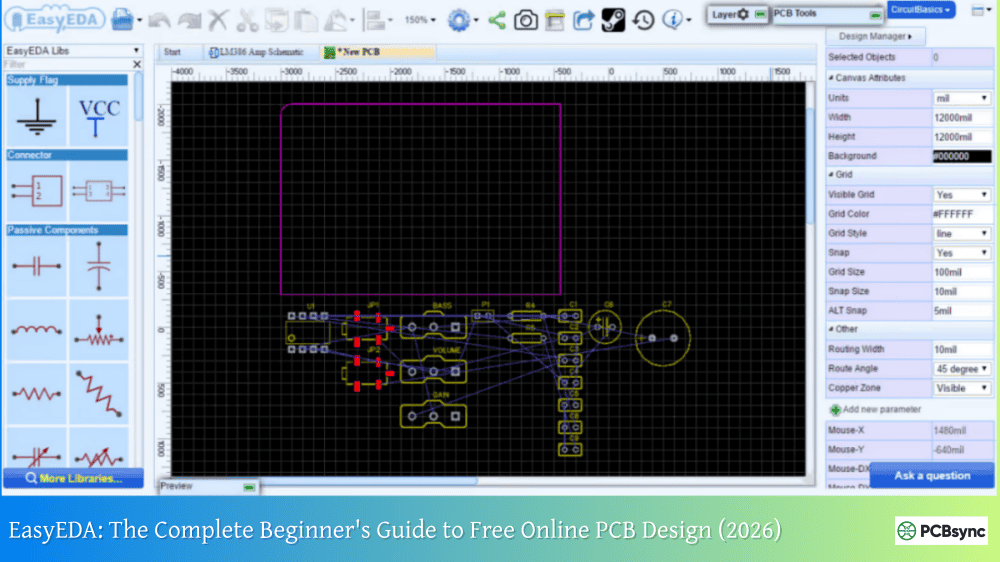
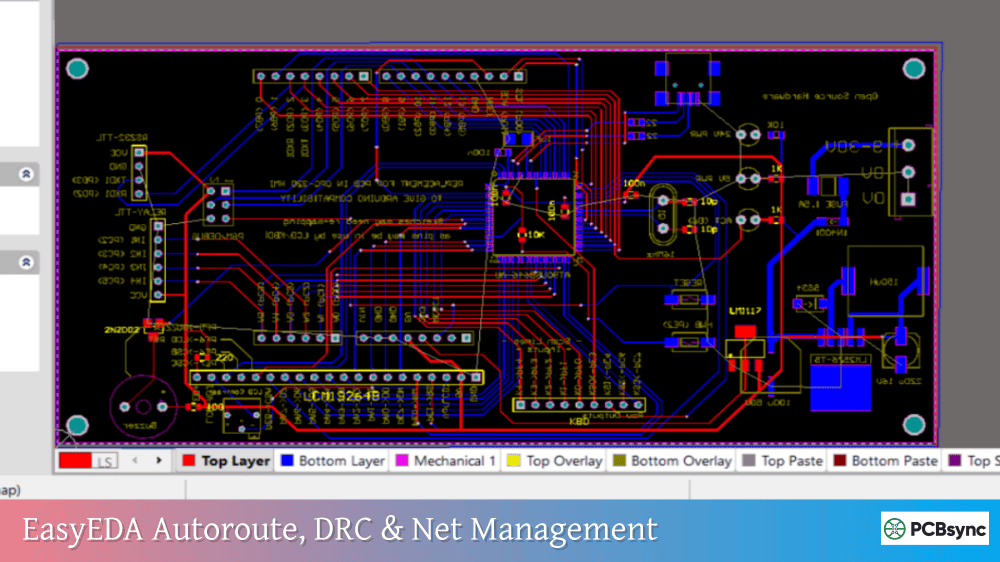
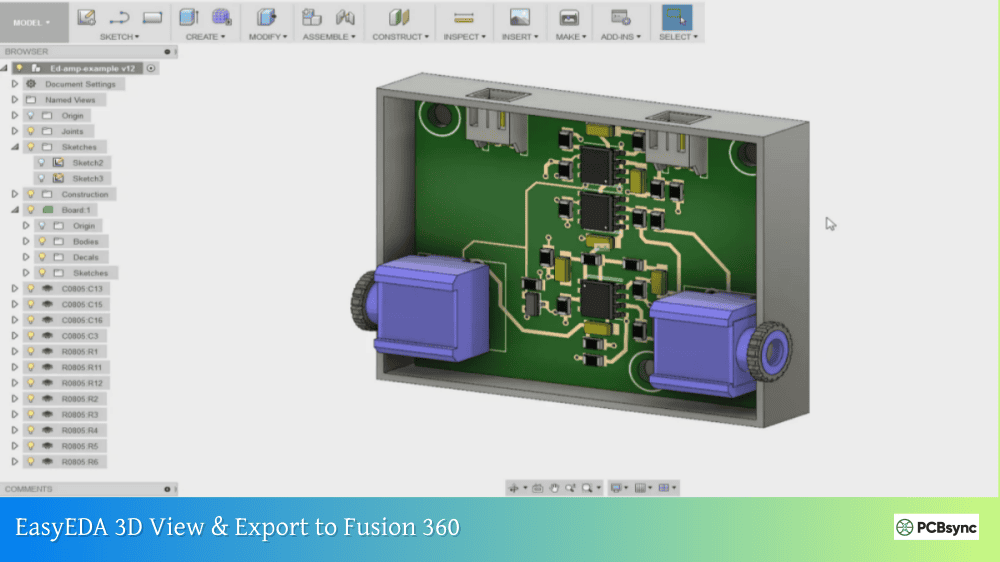
EasyEDA: Browser-based with tight integration to JLCPCB for ordering. The schematics for LM3886 and LM1875 are readily available in the community library.
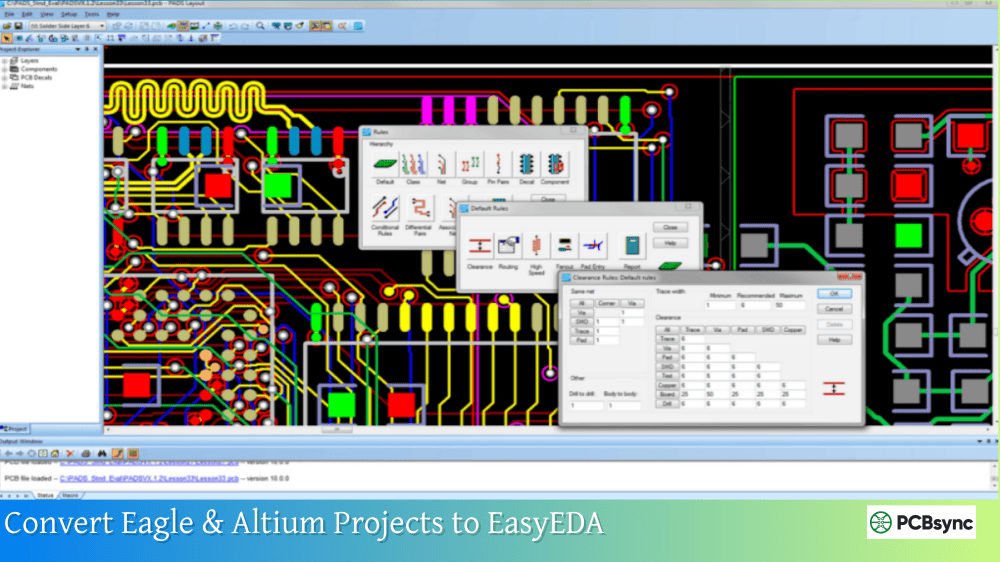
Altium Designer: The professional choice with advanced analog simulation and RF layout tools. Overkill for simple chip amp designs, but excellent if you’re doing this professionally.
Eagle: Long-standing favorite in the DIY community with extensive component libraries and community support.
Design Verification Checklist
Before sending your design for fabrication, verify these critical points:
Ground networks are properly separated and star-connected
Power traces are adequately wide for expected currents
Decoupling capacitors are within 10mm of supply pins
After reviewing hundreds of DIY amplifier builds online, certain mistakes appear repeatedly. Learning from others’ errors saves significant troubleshooting time.
Mistake 1: Ignoring Ground Loop Formation
The Problem: Connecting grounds wherever convenient creates loops that pick up magnetic interference from nearby transformers and power wiring.
The Solution: Always use star grounding. Sketch your ground connections before routing and verify that no loops exist.
Mistake 2: Inadequate Decoupling
The Problem: Using only a single electrolytic capacitor for decoupling, or placing capacitors too far from supply pins.
The Solution: Use the two-capacitor approach (ceramic plus electrolytic) at each supply pin, positioned as close to the IC as physically possible.
Mistake 3: Running Input Traces Near Output Traces
The Problem: Electromagnetic coupling from high-current output traces injects noise into the high-impedance input circuit.
The Solution: Route input and output on opposite sides of the board or perpendicular to each other. If they must be adjacent, place a ground trace between them.
Mistake 4: Undersized Heat Sinking
The Problem: The amplifier works fine at low volume but shuts down during demanding passages.
The Solution: Calculate the worst-case power dissipation and select a heat sink with adequate margin. Remember that specifications are often given at 25°C ambient.
Mistake 5: Omitting the Zobel Network
The Problem: Oscillation with certain speaker cables or inductive loads.
The Solution: Always include the Zobel network (typically 10Ω in series with 100nF) directly at the output. Some layouts omit this to save space, but it’s essential for stability with real-world loads.
Testing and Troubleshooting Your Amplifier PCB
A systematic approach to testing prevents damage and speeds up debugging.
Initial Power-Up Procedure
Step 1: Before inserting the IC, verify all supply rail voltages and polarities. Incorrect supply connection will destroy the chip instantly.
Step 2: Check for shorts between V+, V-, and ground. Use a multimeter in continuity mode.
Step 3: Insert the IC and power up with no input connected and no load attached. Measure the DC offset at the output (should be less than 50mV).
Step 4: Connect a dummy load (8Ω power resistor) and apply a small input signal. Verify the output is clean and at the expected amplitude.
Step 5: Connect actual speakers and test at increasing volume levels, monitoring for any signs of oscillation or thermal issues.
Common Problems and Solutions
Symptom
Likely Cause
Solution
Oscillation at power-up
Missing or inadequate decoupling
Add/reposition bypass capacitors
High-pitched squeal
Ground loop or layout coupling
Review grounding scheme
Hum at 50/60Hz or 100/120Hz
Power supply noise or ground loop
Improve power supply filtering
Thermal shutdown
Insufficient heat sinking
Add larger heat sink, improve airflow
DC offset at output
Component failure or layout issue
Check input bias resistors, IC integrity
Low output power
Power supply sagging
Check transformer and capacitor ratings
Useful Resources for LM Series Amplifier Projects
Official Documentation
Texas Instruments LM3886 Datasheet: The primary reference for specifications, application circuits, and layout recommendations. Available at: https://www.ti.com/lit/ds/symlink/lm3886.pdf
Application Note AN-1192: Overture Series amplifier design guide with additional stability and layout guidance. Available through Texas Instruments website.
EasyEDA: Browser-based design with integrated PCB ordering. Website: https://easyeda.com/
Overture Design Guide Spreadsheet: Excel calculator for component values across the LM1876, LM3875, LM3886, and other Overture chips. Available through community forums and electronics sites.
Component Suppliers
Mouser Electronics: Authentic Texas Instruments chips and high-quality passive components.
DigiKey: Wide selection with detailed specifications and datasheets.
LCSC: Cost-effective option for bulk passive components, especially for prototype runs.
Frequently Asked Questions
Can I use a single-layer PCB for an LM3886 or LM1875 amplifier?
Yes, but it requires more careful planning. Single-layer boards lack a ground plane, so you’ll need to create ground pours manually and be meticulous about trace routing to avoid coupling. Many successful builds use single-layer boards, but two-layer boards with a dedicated ground plane are easier to get right.
What’s the minimum gain I can use with these chips?
Both the LM3886 and LM1875 are specified as stable at gains of 10 or greater. Going below this can cause oscillation. The typical application circuit uses a gain of around 21-26 (about 27dB). For lower overall system gain, attenuate the input signal rather than reducing amplifier gain.
Why does my amplifier oscillate only when connected to speakers, not with a resistive load?
Speaker cables present an inductive load that can interact with the amplifier’s output impedance to cause oscillation. The Zobel network (10Ω + 100nF in series, connected from output to ground) compensates for this. Make sure it’s present and positioned directly at the amplifier output. Some builders also add an output inductor (1-2µH) in series with the output for additional stability.
Can I bridge two LM3886 chips for more power?
Bridged configurations are possible but require careful attention to phase relationships and additional protection circuitry. The LM4780 (which contains two LM3886 dies in one package) is specifically designed for bridged or parallel operation and may be a better choice if you need more power. Parallel operation is generally more stable than bridging.
What causes the “tick” or “thump” at power-on?
This is caused by the DC offset at the output during the chip’s startup sequence. The LM3886’s mute function, when properly implemented with a delay capacitor, suppresses this. For the LM1875 (which lacks a mute pin), you’ll need an external speaker protection circuit that delays speaker connection until the output has stabilized.
Final Thoughts on LM Series Amplifier PCB Design
The LM3886 and LM1875 represent the sweet spot in audio amplifier design: high performance, reasonable cost, and manageable complexity. Their longevity in the market (both have been available for decades) speaks to their fundamental quality.
Success with these chips comes down to respecting their requirements. Pay attention to grounding, give them the power supply they deserve, keep them cool, and layout your PCB with care. The reward is an amplifier that rivals commercial units costing many times more.
Whether you’re building your first chip amp or your fiftieth, the fundamentals covered here apply. Take your time with the layout, double-check your work before ordering boards, and don’t skip the initial testing procedures. The DIY audio community has decades of collective experience with these chips—take advantage of that knowledge when you encounter problems.
The best amplifier is one that disappears, leaving only the music. With careful amplifier PCB design, proper LM3886 PCB layout, and attention to the details of LM1875 PCB layout, that’s exactly what you can achieve.
Inquire: Call 0086-755-23203480, or reach out via the form below/your sales contact to discuss our design, manufacturing, and assembly capabilities.
Quote: Email your PCB files to Sales@pcbsync.com (Preferred for large files) or submit online. We will contact you promptly. Please ensure your email is correct.
Notes: For PCB fabrication, we require PCB design file in Gerber RS-274X format (most preferred), *.PCB/DDB (Protel, inform your program version) format or *.BRD (Eagle) format. For PCB assembly, we require PCB design file in above mentioned format, drilling file and BOM. Click to download BOM template To avoid file missing, please include all files into one folder and compress it into .zip or .rar format.