Inquire: Call 0086-755-23203480, or reach out via the form below/your sales contact to discuss our design, manufacturing, and assembly capabilities.
Quote: Email your PCB files to Sales@pcbsync.com (Preferred for large files) or submit online. We will contact you promptly. Please ensure your email is correct.
Notes: For PCB fabrication, we require PCB design file in Gerber RS-274X format (most preferred), *.PCB/DDB (Protel, inform your program version) format or *.BRD (Eagle) format. For PCB assembly, we require PCB design file in above mentioned format, drilling file and BOM. Click to download BOM template To avoid file missing, please include all files into one folder and compress it into .zip or .rar format.
After spending over a decade routing traces and debugging signal integrity issues at 3 AM, I can tell you that digital PCB design and digital integrated circuit design aren’t just technical skills—they’re an art form that separates functional prototypes from products that actually ship.
Whether you’re laying out your first microcontroller board or tackling a complex FPGA design, this guide covers everything I wish someone had told me when I started. We’ll walk through the practical techniques that work in real production environments, not just academic theory.
Understanding Digital Integrated Circuit Design Fundamentals
Before jumping into layout, let’s establish what we’re actually dealing with. Digital integrated circuit design involves creating circuits that process binary signals—those zeros and ones that make our modern world function. Unlike analog circuits that handle continuous signals, digital circuits work with discrete voltage levels representing logical states.
The foundation of any digital integrated circuit design project includes these core elements:
Logic Gates: AND, OR, NOT, NAND, NOR, and XOR gates form the building blocks. These combine to create more complex functions like flip-flops, counters, and eventually complete processors.
Timing Requirements: Every digital signal has setup time, hold time, and propagation delay requirements. Miss these, and your circuit becomes unpredictable.
Power Distribution: Digital ICs switch between states rapidly, creating current spikes that demand careful power planning.
Clock Networks: Synchronous digital designs rely on clock signals that must reach all components with minimal skew.
The Design Flow: From Concept to Silicon
The typical digital IC design flow moves through distinct phases:
Phase
Key Activities
Common Tools
Specification
Define functionality, performance, power targets
Documentation tools
RTL Design
Write Verilog/VHDL code describing behavior
ModelSim, Vivado
Synthesis
Convert RTL to gate-level netlist
Design Compiler, Genus
Place & Route
Physical layout of standard cells
Innovus, ICC2
Verification
Timing analysis, DRC, LVS checks
PrimeTime, Calibre
Fabrication
Manufacturing at foundry
GDSII output
Essential Digital PCB Design Principles
Now here’s where the rubber meets the road. Digital PCB design translates those beautiful schematics into physical reality—and that’s where things get interesting.
Layer Stack-Up Planning
Your layer stack-up decision affects everything downstream. For most digital designs, I recommend starting with at least four layers:
Layer
Purpose
Key Considerations
Top
Signal routing + components
Keep high-speed traces here with ground reference below
Ground
Solid reference plane
Avoid splits under high-speed signals
Power
VCC distribution
Use solid copper pour, strategic splits for multiple voltages
Bottom
Signal routing + components
Mirror top layer strategy
For high-speed designs running above 100 MHz, consider six or eight layers. The additional layer pairs give you better impedance control and reduce crosstalk between signal layers.
Component Placement Strategy
Here’s a rule I learned the hard way: get placement right first, or you’ll be rerouting for weeks. Group components by function, keeping related parts close together to minimize trace lengths.
Power Section Placement: Position voltage regulators near board edge for heat dissipation. Keep input and output capacitors tight to the regulator.
Digital Core Placement: Place your MCU, FPGA, or processor centrally. Clock sources should sit close to clock input pins—every millimeter matters at high frequencies.
Interface Placement: Connectors belong at board edges. Route their signals in straight shots without crossing through sensitive areas.
Thermal Considerations: Components generating significant heat need space. Don’t pack power stages next to temperature-sensitive analog circuitry.
Ground Plane Management
If there’s one thing that separates amateur PCB layouts from professional ones, it’s ground plane integrity. A solid, uninterrupted ground plane provides low-impedance return paths for your signals.
Avoid these common ground mistakes:
The “Swiss cheese” ground plane—too many vias create holes that force return currents to take longer paths, increasing inductance and EMI.
Split ground planes without purpose—unless you’re separating analog and digital grounds with intention, keep your ground continuous.
Ground traces instead of planes—for anything above a few kHz, traces can’t provide the low impedance that planes offer.
High-Speed Digital PCB Design Techniques
When your clock speeds push into the hundreds of megahertz or signal edges drop below a nanosecond, you’ve entered high-speed territory. The PCB traces stop being simple wires and become transmission lines with their own characteristic impedance.
Controlled Impedance Routing
Most high-speed interfaces specify impedance requirements. USB runs at 90 ohms differential, DDR memory uses 40-60 ohm single-ended traces, and PCIe expects 85 ohms differential.
Calculate your trace geometry using your board house’s stack-up data. Trace width, copper thickness, dielectric constant, and distance to reference plane all factor into the equation. Most PCB design tools include impedance calculators, or you can use standalone tools like the Saturn PCB Toolkit.
Differential Pair Routing
Modern high-speed protocols rely heavily on differential signaling. USB, HDMI, Ethernet, LVDS, and PCIe all use differential pairs because they reject common-mode noise effectively.
Key differential pair rules:
Keep both traces the same length—match to within 5 mils for most applications, tighter for multi-gigabit signals.
Maintain consistent spacing—the coupling between traces affects differential impedance.
Route pairs together—don’t split them around obstacles or onto different layers.
Avoid vias when possible—each via adds inductance. When vias are necessary, use via stitching nearby to maintain ground reference.
Memory interfaces like DDR3/DDR4 and parallel data buses require matched trace lengths to ensure signals arrive simultaneously. The tolerance depends on the interface speed:
Interface Type
Typical Matching Tolerance
Notes
DDR4 Memory
±25 mils within byte lane
Tighter for DQS pairs
Parallel Flash
±100 mils
More forgiving at lower speeds
LVDS Display
±50 mils
Per differential pair
High-Speed ADC
±10 mils
Extremely timing-sensitive
Use serpentine routing (accordion patterns) to add length to shorter traces. Place serpentines close to the source rather than spread along the trace.
Signal Integrity Essentials
Signal integrity problems manifest as data corruption, timing failures, or mysterious intermittent behavior. Understanding the root causes helps you prevent them during layout rather than chasing ghosts during debug.
Reflection Management
Reflections occur when signals encounter impedance discontinuities. Every via, connector, trace width change, and layer transition creates a potential reflection point.
Termination Strategies:
Series termination places a resistor near the driver, matching the source impedance to the transmission line. This works well for point-to-point connections and costs minimal power.
Parallel termination puts a resistor at the receiver, absorbing the signal energy to prevent reflections. The constant current draw increases power consumption but provides better signal quality for fast edges.
AC termination uses an RC network at the receiver—the capacitor blocks DC current while the resistor damps reflections.
Crosstalk Mitigation
Crosstalk happens when signals on adjacent traces couple energy to each other. Fast edge rates make this worse because the coupling increases with frequency.
The 3W rule provides a starting point: space traces at least three times the trace width apart to minimize coupling. For critical signals, increase this to 5W or use ground traces between sensitive nets.
Keep parallel run lengths short. When traces must run near each other, cross them at right angles rather than running parallel.
Power Integrity for Digital Circuits
Your digital ICs expect stable, clean power. Simultaneous switching of thousands of gates creates current transients that can collapse supply voltage if the power delivery network isn’t designed properly.
Decoupling Capacitor Strategy:
Bulk capacitors (10-100 µF) near voltage regulators handle low-frequency transients and provide energy storage.
Mid-range capacitors (0.1-1 µF) distributed around the board filter mid-frequency noise.
High-frequency capacitors (0.01-0.1 µF) placed directly at IC power pins filter the highest frequencies. Position these as close to the pins as physically possible—even 5mm of trace adds significant inductance.
Use multiple capacitor values in parallel. The different values provide low impedance across a wider frequency range than any single capacitor could achieve.
EMC and EMI Considerations
Passing EMC testing often separates products that ship from products that get redesigned. Building EMC compliance into your digital PCB design from the start saves enormous time and expense.
Reducing Radiated Emissions
Clock signals and their harmonics cause most radiated emissions problems. A 100 MHz clock has significant energy at 300 MHz, 500 MHz, and beyond.
Keep clock traces short and avoid routing them near board edges or across plane splits.
Use spread-spectrum clocking when the interface allows it—this trades a small amount of jitter for substantial EMI reduction.
Shield clock oscillators with grounded copper pours or metal cans.
Grounding for EMC
The ground system that works for signal integrity also helps with EMC. Add ground stitching vias around the board perimeter and near high-frequency circuits.
For mixed-signal boards, decide on your grounding strategy early. Single-point grounding at the ADC/DAC works for lower frequencies, while multi-point grounding with a shared ground plane works better above a few MHz.
PCB Design Software and Resources
Having the right tools makes complex digital integrated circuit design and PCB layout manageable. Here’s what professionals actually use:
Professional PCB Design Tools
Software
Best For
Price Range
Altium Designer
Full-featured professional work
$7,000+
Cadence Allegro
Enterprise high-speed design
$15,000+
OrCAD
Professional designs, simulation
$3,000+
Mentor PADS
Mid-range professional work
$5,000+
KiCad
Budget-conscious professional work
Free
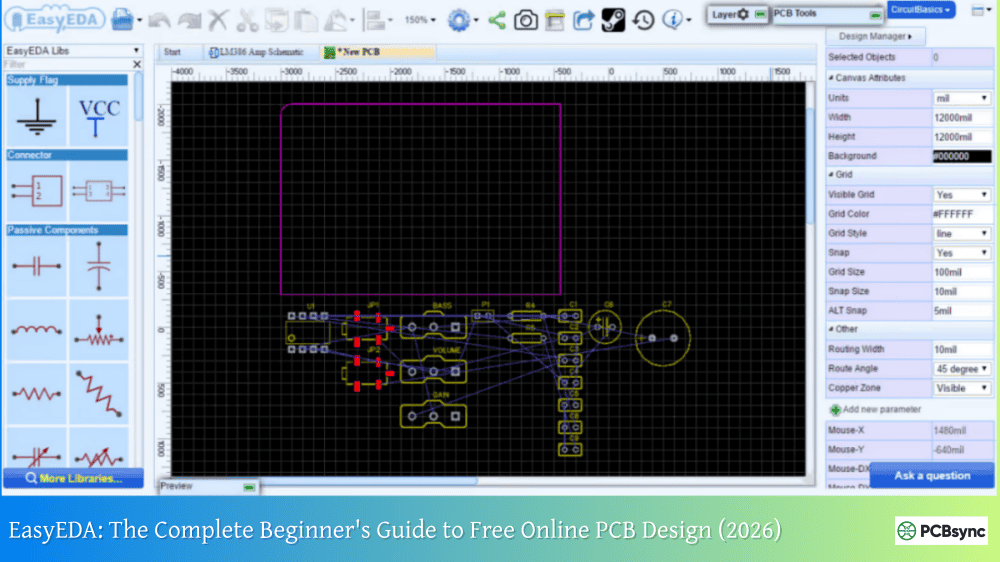
EasyEDA
Quick prototypes, collaboration
Free/Low-cost
Signal Integrity Analysis Tools
For high-speed designs, simulation becomes essential:
HyperLynx from Siemens provides pre-layout and post-layout signal integrity analysis.
Ansys SIwave handles complex electromagnetic simulation for power integrity and signal integrity.
Cadence Sigrity integrates with Allegro for seamless SI/PI analysis workflows.
After reviewing hundreds of board designs, these problems appear repeatedly:
Ignoring return paths: Every signal needs a return path. Cutting ground planes under high-speed signals or switching layers without via stitching creates EMI nightmares.
Insufficient decoupling: “I’ll add more caps later” never works. Plan your decoupling from the start with proper values and placement.
Thermal ignorance: Power dissipation calculations matter. Undersized traces carrying high current will heat up and potentially fail.
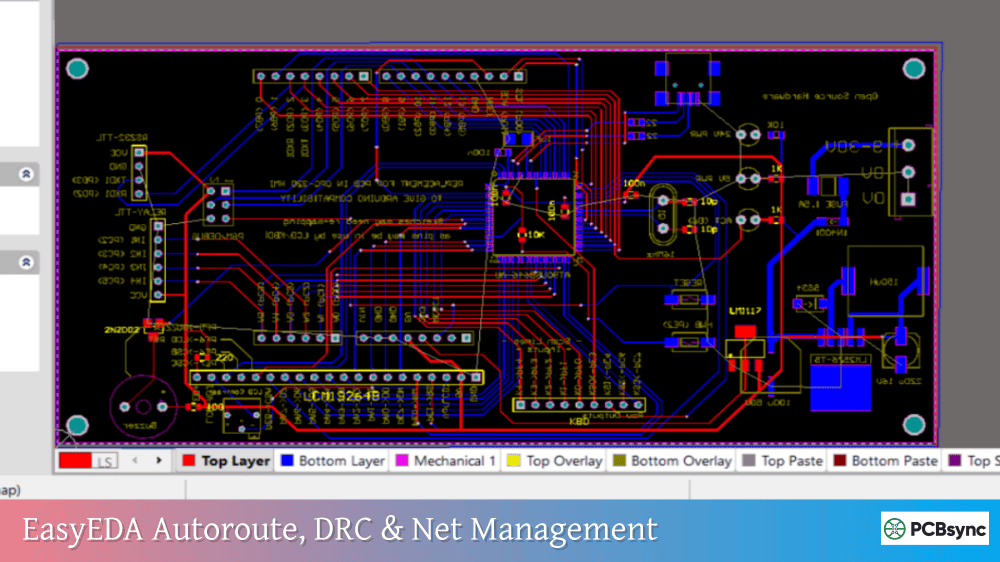
Assuming the autorouter knows best: Autorouters have improved dramatically, but they still can’t replace intelligent manual routing for critical signals. Use autorouting for fill-in work, not critical paths.
Skipping design reviews: Fresh eyes catch problems you’ve become blind to. Formal design reviews before fabrication save expensive respins.
FAQs
What’s the difference between digital PCB design and digital IC design?
Digital PCB design involves creating the circuit board that connects and supports integrated circuits and other components. You’re working with existing chips and designing how they interconnect. Digital integrated circuit design happens at the semiconductor level—you’re designing the actual silicon chip, defining transistor layouts, standard cell placement, and the internal logic that will be fabricated at a foundry. PCB designers work in mils and millimeters; IC designers work in nanometers.
How do I determine if my design qualifies as “high-speed”?
The traditional rule considers signal rise time rather than clock frequency. If your trace length exceeds one-sixth of the signal’s electrical wavelength, transmission line effects become significant. Practically, if your signals have edges faster than 1 nanosecond or your clock exceeds 50 MHz, you should apply high-speed design techniques. Modern components with sub-nanosecond edges make almost every digital design “high-speed” by this definition.
What layer count should I use for a typical microcontroller project?
Four layers handle most microcontroller projects comfortably—top signal, ground, power, bottom signal. This provides solid reference planes for signal integrity and adequate routing space. Two-layer boards work for simple, low-speed designs, but you sacrifice ground plane continuity and often spend more time routing around obstacles. Complex designs with DDR memory, multiple power domains, or high-density BGAs typically need six to eight layers.
How close should decoupling capacitors be to IC power pins?
As close as physically possible—ideally within 3mm of the power pin. The trace inductance between the capacitor and pin limits high-frequency effectiveness. For BGA packages, consider via-in-pad to place capacitors directly beneath the IC. Use multiple smaller capacitors rather than one large capacitor; the effective inductance of parallel capacitors decreases, improving high-frequency response.
Do I really need to match trace lengths for low-speed parallel interfaces?
Length matching matters when the timing margin becomes comparable to the propagation delay difference between traces. For a parallel interface running at 10 MHz with 50ns setup time requirements, you have plenty of margin—even 100mm of length difference creates only about 0.6ns of skew. However, matching lengths remains good practice because it prepares your layout techniques for faster designs and prevents problems if clock speeds increase in future revisions.
Wrapping Up
Successful digital PCB design and digital integrated circuit design require balancing theoretical knowledge with practical experience. The principles covered here—proper layer stack-ups, controlled impedance routing, solid grounding, and careful power distribution—form the foundation for reliable designs.
Start with good planning before placing a single component. Understand your signal requirements and design constraints upfront. Use simulation tools when designs push into high-speed territory, and never skip design reviews.
The difference between a prototype that sort of works and a production-ready design often comes down to attention to these fundamentals. Master them, and you’ll spend less time debugging and more time shipping products.
Inquire: Call 0086-755-23203480, or reach out via the form below/your sales contact to discuss our design, manufacturing, and assembly capabilities.
Quote: Email your PCB files to Sales@pcbsync.com (Preferred for large files) or submit online. We will contact you promptly. Please ensure your email is correct.
Notes: For PCB fabrication, we require PCB design file in Gerber RS-274X format (most preferred), *.PCB/DDB (Protel, inform your program version) format or *.BRD (Eagle) format. For PCB assembly, we require PCB design file in above mentioned format, drilling file and BOM. Click to download BOM template To avoid file missing, please include all files into one folder and compress it into .zip or .rar format.