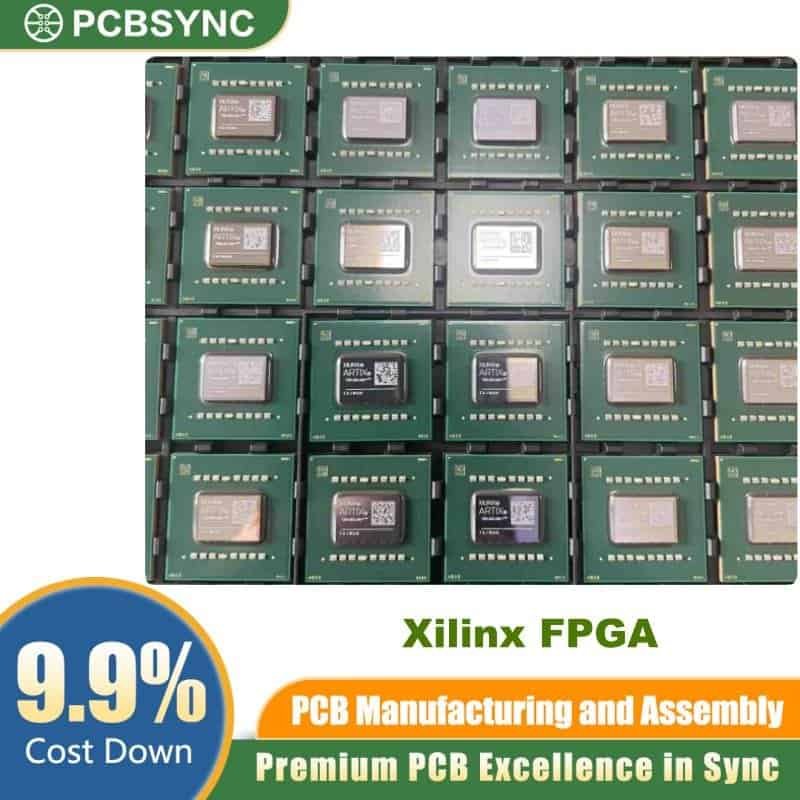
The XCS30-3PQ208C is a high-performance field programmable gate array (FPGA) from the Xilinx Spartan family, designed to deliver versatile programmable logic solutions for embedded systems, digital signal processing, and custom hardware applications. This FPGA combines cost-effectiveness with robust functionality, making it an ideal choice for engineers seeking reliable programmable logic devices.
What is the XCS30-3PQ208C?
The XCS30-3PQ208C represents a powerful member of the Xilinx Spartan FPGA family, offering 30,000 system gates in a compact 208-pin PQFP package. This programmable logic device provides engineers with flexible digital circuit implementation capabilities, suitable for applications ranging from industrial automation to communications systems.
Key Specifications and Technical Features
Core Architecture
| Specification |
Details |
| Part Number |
XCS30-3PQ208C |
| Manufacturer |
AMD/Xilinx |
| Product Family |
Spartan FPGA Family |
| System Gates |
30,000 gates |
| Logic Cells |
1,368 CLBs (Configurable Logic Blocks) |
| Typical Gate Range |
10,000-30,000 gates |
| Package Type |
208-Pin PQFP (Plastic Quad Flat Pack) |
| Speed Grade |
-3 (Standard Performance) |
| Operating Voltage |
5V Core Logic |
| Technology |
CMOS Process |
Performance Characteristics
| Feature |
Specification |
| Array Size |
24 x 24 CLB array |
| Total CLBs |
576 Configurable Logic Blocks |
| Flip-Flops |
1,536 available |
| Maximum User I/O |
192 pins |
| RAM Bits |
18,432 bits on-chip |
| Operating Frequency |
Up to 166 MHz typical |
XCS30-3PQ208C Applications and Use Cases
Industrial Control Systems
The XCS30-3PQ208C excels in industrial automation environments where customizable logic is essential. Engineers utilize this FPGA for:
- Motor control circuits
- Sensor interface management
- PLC (Programmable Logic Controller) implementations
- Factory automation systems
- Process control applications
Communications Equipment
This Xilinx FPGA provides excellent performance for communications applications:
- Protocol converters
- Data multiplexing
- Signal routing systems
- Network interface controllers
- Telecommunications infrastructure
Digital Signal Processing
The XCS30-3PQ208C offers sufficient resources for DSP applications:
- Digital filtering implementations
- Real-time data processing
- Audio/video signal manipulation
- Measurement instrumentation
- Test and measurement equipment
Technical Advantages of the XCS30-3PQ208C
Flexible Architecture
The configurable logic block architecture allows designers to implement custom digital circuits without the cost and time constraints of ASIC development. With 576 CLBs arranged in a 24×24 array, engineers can create complex logic functions tailored to specific application requirements.
On-Chip Memory Resources
The integrated 18,432 bits of RAM provide valuable on-chip storage for data buffering, lookup tables, and temporary data storage, reducing the need for external memory components and improving system performance.
Extensive I/O Capabilities
With 192 maximum user I/O pins, the XCS30-3PQ208C supports extensive interfacing requirements, enabling connections to multiple peripheral devices, sensors, actuators, and communication interfaces.
Cost-Effective Solution
As part of the Spartan family, this FPGA delivers ASIC-replacement capabilities at a fraction of the cost, making it ideal for high-volume production applications where both performance and budget matter.
Package and Pin Configuration
PQFP208 Package Details
| Package Characteristic |
Specification |
| Package Style |
Plastic Quad Flat Pack |
| Total Pins |
208 |
| Pin Pitch |
Standard PQFP spacing |
| Mounting Type |
Surface Mount |
| Form Factor |
Square, low-profile |
| Thermal Performance |
Excellent heat dissipation |
Pin Categories
The 208-pin configuration includes:
- Power pins (VCCINT, VCCIO, GND)
- I/O pins (programmable I/O buffers)
- Configuration pins (MODE, PROG, DONE, INIT)
- Clock inputs (dedicated global clock networks)
- Special function pins (JTAG boundary scan)
Programming and Configuration Options
Configuration Methods
The XCS30-3PQ208C supports multiple configuration modes:
- Master Serial Mode – FPGA controls configuration from external PROM
- Slave Serial Mode – External controller manages configuration
- JTAG Boundary Scan – IEEE 1149.1 compliant programming
- SelectMAP Mode – Parallel configuration for faster loading
Development Tools
Engineers can program the XCS30-3PQ208C using:
- Xilinx ISE Design Suite – Legacy design tools for Spartan family
- JTAG programmers – For in-system programming
- Serial PROM devices – For standalone configuration storage
- Platform Cable USB – Direct connection to development systems
Design Considerations and Best Practices
Power Supply Requirements
Ensure stable power delivery:
- Clean 5V supply for VCCINT (core logic)
- Appropriate voltage for VCCIO (I/O banks)
- Adequate decoupling capacitors near power pins
- Proper grounding techniques
Thermal Management
While the XCS30-3PQ208C has moderate power consumption, consider:
- Ambient operating temperature ranges
- Heat sink requirements for high-utilization designs
- Airflow considerations in enclosed systems
- Junction temperature monitoring
Signal Integrity
Maintain signal quality with:
- Controlled impedance traces for high-speed signals
- Proper termination of I/O lines
- Minimized crosstalk between adjacent signals
- Ground plane implementation
Comparison with Related Xilinx FPGAs
Spartan Family Options
| Model |
System Gates |
CLBs |
Package Options |
Key Difference |
| XCS10-3PQ208C |
10,000 |
196 |
208-PQFP |
Smaller capacity |
| XCS20-3PQ208C |
20,000 |
400 |
208-PQFP |
Mid-range option |
| XCS30-3PQ208C |
30,000 |
576 |
208-PQFP |
Standard choice |
| XCS40-3PQ208C |
40,000 |
784 |
208-PQFP |
Larger capacity |
Speed Grade Variations
The XCS30 is available in multiple speed grades:
- XCS30-3 (standard performance)
- XCS30-4 (enhanced performance)
- XCS30XL (low-power variant)
Where to Buy XCS30-3PQ208C
Authorized Distributors
Purchase authentic XCS30-3PQ208C units from:
- DigiKey Electronics
- Mouser Electronics
- Arrow Electronics
- Avnet
- Future Electronics
Procurement Considerations
When sourcing XCS30-3PQ208C devices:
- Verify manufacturer date codes
- Confirm packaging type (tubes, trays, tape & reel)
- Check for obsolescence status
- Request RoHS compliance documentation
- Compare pricing across multiple distributors
Note: The XCS30-3PQ208C is classified as an obsolete product by AMD/Xilinx. Consider newer FPGA families for new designs while this device remains suitable for legacy system maintenance and replacements.
Integration with Xilinx FPGA Ecosystem
The XCS30-3PQ208C works seamlessly with other Xilinx FPGA products, enabling scalable solutions across multiple product generations. Engineers familiar with Xilinx development tools can easily transition between Spartan family members while maintaining code compatibility and design methodology.
Frequently Asked Questions
Q: Is the XCS30-3PQ208C suitable for new designs?
While functional and reliable, this FPGA is now obsolete. For new projects, consider current Spartan-7 or Artix-7 families offering improved performance and modern feature sets.
Q: What programming cable do I need?
The XCS30-3PQ208C requires a Xilinx-compatible JTAG programming cable, such as Platform Cable USB or compatible third-party programmers supporting IEEE 1149.1 boundary scan.
Q: Can I replace XCS30-3PQ208C with a different speed grade?
Yes, XCS30-4PQ208C offers pin-compatible higher performance. However, timing analysis must be repeated to ensure design meets requirements with the different speed grade.
Q: What’s the difference between XCS30-3PQ208C and XCS30-3PQG208C?
The “G” suffix typically indicates a lead-free, RoHS-compliant package variant. Functionally, the devices are equivalent with different package materials meeting environmental regulations.
Q: How much power does the XCS30-3PQ208C consume?
Power consumption varies with utilization, clock frequency, and I/O activity. Typical designs consume 200-500mW, but high-utilization applications may require more. Use Xilinx power estimation tools for accurate calculations.
Conclusion
The XCS30-3PQ208C represents a proven FPGA solution delivering 30,000 gates of programmable logic in a compact 208-pin package. While newer FPGA families offer enhanced capabilities, the XCS30-3PQ208C remains valuable for legacy system support, replacement applications, and educational purposes where cost-effective programmable logic is essential.
For engineers maintaining existing equipment or seeking compatible replacements, the XCS30-3PQ208C continues to provide reliable performance backed by extensive documentation and proven track record in industrial applications.