Inquire: Call 0086-755-23203480, or reach out via the form below/your sales contact to discuss our design, manufacturing, and assembly capabilities.
Quote: Email your PCB files to Sales@pcbsync.com (Preferred for large files) or submit online. We will contact you promptly. Please ensure your email is correct.
Notes: For PCB fabrication, we require PCB design file in Gerber RS-274X format (most preferred), *.PCB/DDB (Protel, inform your program version) format or *.BRD (Eagle) format. For PCB assembly, we require PCB design file in above mentioned format, drilling file and BOM. Click to download BOM template To avoid file missing, please include all files into one folder and compress it into .zip or .rar format.
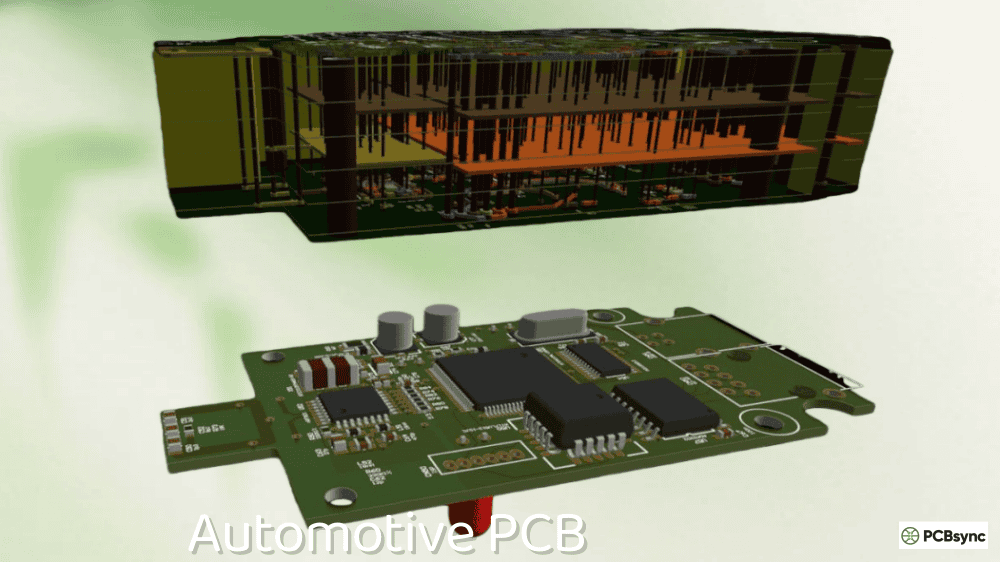
If you’ve ever cracked open an engine control unit or pulled apart a modern infotainment system, you know that automotive PCBs are nothing like your typical consumer-grade boards. I’ve spent over a decade working with these specialized circuits, and I can tell you that the gap between a standard PCB and an automotive-grade one is enormous—both in complexity and in the consequences of failure.
A faulty resistor in your TV remote? Annoying. A failed solder joint in your vehicle’s ABS controller? Potentially fatal.
This guide breaks down everything you need to know about automotive PCB design, manufacturing, and quality standards—from an engineer’s perspective, not a marketing brochure.
The automotive electronics market continues to grow rapidly. Electric vehicles, autonomous driving features, and increasingly sophisticated infotainment systems drive demand for more PCBs per vehicle. Industry analysts project the automotive PCB market will exceed $14 billion by 2030. For engineers and manufacturers looking to enter or expand in this sector, understanding the unique requirements is essential.
What Makes Automotive PCBs Different from Standard PCBs
An automotive PCB is a printed circuit board engineered specifically for vehicle applications. These boards power everything from engine control units (ECUs) and advanced driver-assistance systems (ADAS) to infotainment panels and electric vehicle battery management systems.
The fundamental difference comes down to three factors:
Environmental extremes. Your smartphone lives in a climate-controlled pocket. An automotive PCB in an engine compartment faces temperatures ranging from -40°C in a Minnesota winter to +150°C during summer operation. Add constant vibration, humidity cycling, and exposure to oils, fuels, and road salt.
Lifespan expectations. Consumer electronics are designed for 2-3 years of use. Automotive manufacturers expect their electronic systems to function flawlessly for 10-15 years and 150,000+ miles.
Safety criticality. When your laptop crashes, you lose unsaved work. When an automotive PCB fails, the consequences can range from inconvenient (dead infotainment system) to catastrophic (brake system malfunction).
Automotive PCB Applications in Modern Vehicles
The average modern vehicle contains 100-150 ECUs, and premium vehicles can have over 200. Here’s where these boards actually go:
The rapid growth of electric vehicles introduces specific challenges for automotive PCB designers. EV systems involve high voltages (400-800V in modern platforms), high currents, and critical safety requirements that differ from traditional automotive electronics.
Battery management systems (BMS): These PCBs monitor individual cell voltages, temperatures, and state of charge across battery packs containing hundreds of cells. They require exceptional measurement accuracy, robust isolation between high-voltage and control circuits, and communication interfaces to the vehicle’s main computer.
Traction inverters: Converting DC battery power to AC for the electric motor involves switching hundreds of amps at kilovolt levels. PCBs in these systems typically use heavy copper (6-20 oz per square foot) and often incorporate ceramic substrates or metal-core technology for thermal management.
Onboard chargers: These systems convert AC grid power to DC for battery charging. They operate at high power levels and require careful attention to EMI/EMC design to avoid interfering with vehicle communications or failing regulatory emissions tests.
High-voltage isolation: EV PCBs must maintain strict isolation between high-voltage circuits and low-voltage control systems. Creepage and clearance requirements often drive board size, and proper isolation barrier design is critical for safety certification.
Types of Automotive PCBs and When to Use Each
Not every automotive application needs the same board technology. Choosing the wrong PCB type wastes money at best and causes field failures at worst.
Rigid Automotive PCBs
Standard rigid boards using FR-4 or high-Tg FR-4 materials remain the workhorses of automotive electronics. Most ECUs, body control modules, and dashboard electronics use rigid multilayer PCBs with 4-8 layers.
When to use: Dashboard electronics, engine management systems, comfort control units.
Material considerations: Standard FR-4 (Tg ~170°C) works for cabin applications. Engine bay applications require high-Tg FR-4 (Tg ≥180°C) to resist warping during thermal cycling.
Flexible Automotive PCBs
Flex circuits built on polyimide substrates can bend and twist, making them ideal for tight spaces and areas with movement.
When to use: Door panels with moving components, instrument clusters, connections between rigid boards in different orientations.
Material considerations: Polyimide substrates offer temperature resistance from -200°C to +300°C and excellent chemical resistance.
Rigid-Flex Automotive PCBs
These hybrid boards combine rigid sections for component mounting with flexible sections for interconnection. They reduce connector count and improve reliability by eliminating cable assemblies.
When to use: Complex assemblies requiring 3D form factors, applications where connector reliability is critical.
Metal Core PCBs (MCPCBs)
Aluminum or copper core boards provide superior thermal conductivity compared to FR-4 (aluminum: ~1.0 W/m·K vs. FR-4: ~0.25 W/m·K).
When to use: LED lighting systems, motor drivers, onboard chargers, any application with significant heat dissipation requirements.
Decision rule: Use MCPCBs if thermal simulation predicts component temperatures exceeding 140°C with standard FR-4 solutions, or when space constraints prevent adequate thermal via arrays.
HDI (High-Density Interconnect) Automotive PCBs
HDI boards use microvias, blind vias, and buried vias to achieve higher component density in smaller form factors. Essential for modern ADAS controllers and compact sensor modules.
When to use: Space-constrained applications, high-speed digital circuits, fine-pitch BGA devices.
Automotive PCB Design Guidelines for Reliability
Good automotive PCB design starts before you place a single component. Here are the guidelines I follow on every automotive project.
Component Placement and Orientation
Similar components should face the same direction—this isn’t just aesthetics. Uniform orientation simplifies automated optical inspection (AOI) and reduces soldering defects.
For wave soldering: Orient components parallel to the direction of wave travel to prevent solder bridging.
Height considerations: Don’t place tall components (electrolytic capacitors) adjacent to shorter components. This causes shadowing during reflow and complicates conformal coating application.
Thermal zoning: Group high-heat components together and away from temperature-sensitive parts. This simplifies thermal management and prevents heat-induced failures.
Trace Routing for Automotive Applications
Automotive PCBs frequently handle both high-power and sensitive analog signals. Poor routing creates noise problems and potential safety issues.
Routing Parameter
Automotive Recommendation
High-current traces
Use shortest path, minimum 2-4 vias per layer for currents >2A
Signal traces
Minimum width 5-8 mil for <10mA, 10-20 mil for 10-20mA
Return current path: Always route the return current path near the main current path. This reduces current loop area and minimizes EMI emissions.
Design for Manufacturing (DFM) Considerations
Designing a board that works on paper is different from designing one that manufactures reliably at scale. DFM rules ensure your automotive PCB can be produced consistently.
Pad design for automotive reliability: Symmetric pads reduce tombstoning during reflow. For 0402 and smaller components, use slightly larger pads than IPC minimum recommendations—the small cost increase in board space improves manufacturing yield.
Fiducial placement: Include at least three fiducials per board for precise stencil and pick-and-place alignment. Position them in a triangle pattern, not in a line.
Panel utilization: Work with your manufacturer early to optimize panelization. Automotive production runs can reach hundreds of thousands of units—even 5% improvement in panel utilization translates to significant cost savings.
Test point accessibility: Include test points for ICT and functional testing. Test points should be at least 0.9mm diameter with 1.8mm center-to-center spacing for bed-of-nails testing.
Conformal coating considerations: If your assembly will receive conformal coating (common in automotive), keep-out areas around connectors and other areas that shouldn’t be coated need clear definition in your design.
Thermal Management Design
Heat kills automotive electronics faster than almost anything else. Every board needs a thermal strategy.
Thermal vias: Use arrays of thermal vias under power components to conduct heat to internal copper planes or the opposite side of the board. A typical configuration uses 0.3mm vias on 1.0mm pitch.
Copper pour: Maximize copper coverage on all layers. Not only does this improve heat spreading, but it also reduces etching time and board warpage.
Component derating: Specify components for 20-30% derating. If your analysis shows a resistor will see 80mA, select a 100mA-rated part.
EMC Design Considerations
Automotive PCBs must pass rigorous electromagnetic compatibility (EMC) testing. Poor EMC design means failed vehicle-level testing and expensive redesigns.
Grounding: Continuous, low-impedance ground planes are essential. Connect both terminals of any copper fills to ground using via arrays.
Filtering: Add filtering at every I/O connector. LC filters work well for power lines; ferrite beads with bypass capacitors suit signal lines.
Shielding: Consider local shielding cans for sensitive RF sections. Many ADAS radar modules require extensive shielding to meet emissions requirements.
Surface mount technology (SMT) dominates automotive electronics manufacturing. Understanding the process helps you design boards that assemble reliably.
The shift to SMT transformed automotive electronics manufacturing starting in the 1980s. Before SMT, through-hole technology required drilling hundreds of holes per board and manual component insertion. SMT enabled automated assembly, smaller form factors, and dramatically higher production throughput.
Today, automotive SMT assembly combines sophisticated equipment with rigorous process controls. A modern automotive SMT line represents millions of dollars in investment—but that investment pays off in reliability and consistency.
The SMT Assembly Workflow
Automotive PCB SMT assembly follows this sequence:
1. Incoming inspection. Every component and bare board undergoes verification against specifications. Components must match the BOM in package type, size, and marking. PCBs are checked for oxidation, warpage, and dimensional accuracy.
2. Material preparation. Stencils are fabricated based on Gerber files. PCBs and moisture-sensitive components undergo baking to remove absorbed moisture (typically 125°C for 24 hours for BGA packages).
3. Solder paste printing. A precision stencil aligns with the PCB, and solder paste is squeegeed through apertures onto pads. This step is critical—printing defects cause approximately 60-70% of SMT assembly problems.
4. Solder paste inspection (SPI). Automated systems measure paste volume, height, and position. SPI catches problems before component placement, when correction is still simple.
5. Component placement. Pick-and-place machines position components using X-Y coordinates from placement files. Modern machines achieve placement accuracy of ±25μm at speeds of 25,000-50,000 components per hour.
6. Reflow soldering. The assembled board passes through a reflow oven with a carefully controlled temperature profile. Peak temperatures typically reach 240-250°C for lead-free solder.
7. Automated optical inspection (AOI). Cameras inspect every solder joint for defects: insufficient solder, excess solder, bridging, tombstoning, misalignment.
8. X-ray inspection. Required for BGAs, QFNs, and other packages where solder joints are hidden beneath the component body.
9. Functional testing. The completed assembly undergoes electrical testing to verify proper operation.
Common SMT Defects in Automotive PCB Assembly
Even with sophisticated equipment, certain defects appear repeatedly. Knowing these helps you design boards that minimize them.
Temperature extremes. Automotive components must survive temperature cycling from -40°C to +125°C (or +150°C for engine compartment applications). This thermal cycling stresses solder joints and can cause fatigue cracking over thousands of cycles.
Moisture sensitivity. Components and PCBs absorb moisture from the air. During reflow soldering, this moisture vaporizes rapidly, causing “popcorn cracking” in plastic packages. Automotive assembly requires strict moisture control and baking protocols.
Vibration resistance. Automotive solder joints must withstand years of constant vibration. This requires proper pad design, appropriate solder paste alloys, and sometimes the use of underfill beneath large BGAs.
Zero-defect expectations. Consumer electronics might tolerate a 200 PPM defect rate. Automotive targets zero defects, requiring 100% inspection and extensive process controls.
Automotive PCB Quality Standards You Must Know
The automotive industry has developed comprehensive standards to ensure electronic reliability. Understanding these standards is essential for anyone designing or manufacturing automotive PCBs.
Without proper adherence to these standards, your products won’t make it past initial supplier qualification at major automakers. These standards evolved from decades of experience with field failures and recall events. They represent the collective knowledge of what makes automotive electronics survive real-world conditions.
AEC-Q100: The IC Qualification Standard
The Automotive Electronics Council developed AEC-Q100 as the qualification standard for integrated circuits used in vehicles. Chrysler, Ford, and GM originally established this standard in the 1990s to create uniform testing requirements across the industry.
Before AEC-Q100, each automaker had different qualification requirements. Component suppliers had to test parts multiple times to satisfy different customers. The unified standard reduced duplication while raising the overall quality bar.
AEC-Q100 defines four temperature grades based on operating range:
Grade
Temperature Range
Typical Applications
Grade 0
-40°C to +150°C
Engine compartment, transmission
Grade 1
-40°C to +125°C
Motor drive modules, underhood
Grade 2
-40°C to +105°C
Charging systems, body electronics
Grade 3
-40°C to +85°C
Cabin electronics, infotainment
Qualification testing includes:
Temperature cycling: 1,000 cycles between temperature extremes
High-temperature operating life (HTOL): 1,000 hours at maximum temperature under bias
Highly accelerated stress test (HAST): Accelerated humidity testing at elevated temperature and pressure
Electrostatic discharge (ESD): Testing per HBM and CDM models
Important: AEC-Q100 qualification applies to components, not complete PCB assemblies. A board using all AEC-Q100 qualified components isn’t automatically “automotive qualified”—the complete assembly still requires proper testing.
AEC-Q200: Passive Component Qualification
AEC-Q200 covers passive components: resistors, capacitors, inductors, filters, and other non-semiconductor parts. Similar to AEC-Q100, it defines stress test requirements to ensure passive components survive automotive conditions.
IPC-6012DA: Automotive PCB Fabrication Standard
IPC-6012 Class 3 addresses high-reliability PCB fabrication, and the DA addendum adds automotive-specific requirements. Key specifications include:
Hole position accuracy: ±100 μm tolerance
Via fill requirements for thermal management
Solder mask thickness and registration requirements
Surface finish specifications for automotive reliability
IATF 16949 is the quality management system standard specifically for automotive suppliers. It builds on ISO 9001 with additional automotive requirements:
Advanced Product Quality Planning (APQP) for new product launches
Production Part Approval Process (PPAP) before production begins
Failure Mode and Effects Analysis (FMEA) for risk identification
Measurement System Analysis (MSA) for inspection capability
Statistical Process Control (SPC) for ongoing quality monitoring
Registration to IATF 16949 is essentially mandatory for any company supplying to automotive OEMs. Without this certification, you won’t get past the initial supplier qualification process at most automakers.
ISO 26262: Functional Safety Standard
ISO 26262 addresses functional safety of electrical and electronic systems in road vehicles. It defines Automotive Safety Integrity Levels (ASIL) to classify risk:
Higher ASIL ratings require greater design rigor, more extensive testing, and often hardware redundancy. For PCB designers, ISO 26262 impacts layout requirements, component selection, and design review processes.
Testing and Inspection for Automotive PCBs
Automotive electronics require testing far beyond what consumer products receive.
In-Process Testing
Solder paste inspection (SPI): 3D measurement of solder paste deposits before component placement. Critical for catching printing defects early.
Functional testing: Powers up the assembly and verifies operation against specifications.
Boundary scan (JTAG): Tests digital interconnections without physical probe access.
Reliability Testing
Temperature cycling: Subjects assemblies to repeated temperature extremes per AEC-Q100 requirements.
Vibration testing: Simulates years of automotive vibration in accelerated timeframes.
HALT/HASS: Highly accelerated life testing and screening to find design weaknesses and production defects.
Material Selection for Automotive PCB Reliability
The right materials make the difference between a board that lasts 15 years and one that fails in the warranty period.
Substrate Materials
Material
Tg (°C)
Thermal Conductivity
Best For
Standard FR-4
130-140
0.25 W/m·K
Cabin electronics
Mid-Tg FR-4
150-170
0.30 W/m·K
Body electronics
High-Tg FR-4
180+
0.35 W/m·K
Engine bay, EV systems
Polyimide
250+
0.35 W/m·K
Flex circuits, high-temp
Ceramic (Al₂O₃)
N/A
24-28 W/m·K
Power modules, RF
Metal core (Al)
N/A
1.0-2.0 W/m·K
LED, motor drives
Solder Alloys
Lead-free solders dominate automotive manufacturing. Common alloys include:
SAC305 (Sn96.5/Ag3.0/Cu0.5): Standard lead-free alloy, melting point ~217°C
SAC387: Higher silver content for improved fatigue resistance
SN100C: Lower cost alternative for non-critical applications
Surface Finishes
ENIG (Electroless Nickel/Immersion Gold): Excellent shelf life, good solderability, flat surface for fine-pitch components. Most common for automotive.
Immersion Silver: Good solderability, lower cost than ENIG, but shorter shelf life.
Future Trends in Automotive PCB Technology
The automotive industry evolves rapidly, and PCB technology must keep pace. Understanding emerging trends helps you prepare for tomorrow’s requirements.
Increased Integration and Miniaturization
Modern vehicles consolidate multiple ECUs into powerful domain controllers. A single ADAS computer might replace five separate modules. This drives demand for HDI technology, embedded components, and higher layer counts.
Higher Operating Frequencies
Radar systems for ADAS operate at 77 GHz. V2X (vehicle-to-everything) communication uses 5.9 GHz bands. These frequencies demand specialized materials like PTFE-based laminates and careful attention to signal integrity.
Advanced Driver Assistance and Autonomy
As vehicles progress toward higher automation levels (SAE Levels 3-5), redundancy requirements increase. Safety-critical systems may require duplicate processing with comparison logic, demanding more complex PCB architectures.
Sustainable Manufacturing
Environmental regulations and corporate sustainability goals drive interest in lead-free solders (already standard), halogen-free laminates, and reduced water usage in manufacturing. Expect these requirements to become standard in automotive supplier contracts.
Software-Defined Vehicles
The trend toward over-the-air updates and software-defined features affects hardware design. PCBs must accommodate more processing power, memory, and connectivity while maintaining automotive reliability standards.
Useful Resources for Automotive PCB Engineers
These resources provide additional depth on automotive electronics development:
Selecting an Automotive PCB Manufacturing Partner
Choosing the right manufacturing partner is as important as the design itself. Not every PCB manufacturer can handle automotive requirements.
Certification requirements: At minimum, your manufacturer should hold IATF 16949 certification. For boards destined for safety-critical applications, additional certifications like ISO 26262 support capability matter.
Process capability: Request Cpk data for critical processes like drilling, plating, and solder mask registration. Automotive typically requires Cpk >1.67 for critical dimensions.
Traceability systems: Full material traceability from raw substrate to finished board is standard practice in automotive. Your manufacturer should be able to provide lot traceability for any board produced.
Change control: Automotive programs run for years. Ensure your manufacturer has robust change control processes to maintain consistency over long production runs and notify you of any material or process changes.
Geographic considerations: While cost matters, supply chain resilience has become increasingly important. Consider regional manufacturing options to reduce logistics risk and lead times.
What certification is required for automotive PCB manufacturing?
Manufacturing facilities supplying PCBs to automotive OEMs typically require IATF 16949 certification. This quality management system certification is essentially mandatory—without it, most automakers won’t qualify your facility as a supplier. Additionally, your products should be manufactured following IPC-6012 Class 3 or IPC-6012DA (automotive addendum) specifications for the PCB fabrication itself.
How does AEC-Q100 qualification differ from standard component testing?
AEC-Q100 imposes significantly more stringent testing than commercial component qualification. Components must pass 1,000 temperature cycles (vs. 200-500 for commercial), longer high-temperature operating life tests (1,000+ hours), and multiple stress tests including humidity, ESD, and latch-up testing. Components are tested across their full temperature range rather than just at room temperature. The goal is ensuring 15+ year reliability in harsh automotive environments.
Can I use consumer-grade components in automotive applications?
Technically possible but strongly discouraged for anything beyond low-risk cabin electronics. Consumer-grade components aren’t tested for automotive temperature ranges, vibration resistance, or long-term reliability. Using them creates significant liability risk. Even a 0.50 cost saving per component isn’t worth a potential 10 million recall. Always specify AEC-Q100/Q200 qualified components for automotive applications, and verify your component supplier maintains IATF 16949 certification.
What are the typical layer counts for automotive PCBs?
Most automotive ECUs and body control modules use 4-8 layer boards. Complex ADAS controllers and EV power electronics may require 10-16 layers or more. The trend is toward higher layer counts as systems integrate more functionality. HDI technology with microvias enables higher density without excessive layer counts, particularly important for compact sensor modules and camera systems.
How do I design for automotive temperature extremes?
Start with proper material selection—high-Tg FR-4 (Tg ≥180°C) for underhood applications. Use AEC-Q100 Grade 0 or Grade 1 components rated for your temperature requirements. Design generous thermal margins with adequate copper pour, thermal vias, and component derating. Avoid temperature-sensitive components like aluminum electrolytic capacitors in high-temperature zones—use ceramic or film alternatives. Finally, validate your design with thermal simulation before committing to prototypes.
Final Thoughts on Automotive PCB Design
Designing and manufacturing automotive PCBs isn’t about following a checklist—it’s about understanding that every decision impacts safety and reliability over a 15-year vehicle lifespan. The standards exist because failures in automotive electronics have real consequences.
The successful automotive PCB engineer combines technical knowledge with a mindset focused on reliability. That means conservative design margins, thorough testing, and never cutting corners on component quality or manufacturing processes.
The standards and processes discussed in this guide represent the accumulated wisdom of an industry that has learned from its failures. AEC-Q100 testing requirements evolved because components failed in the field. IATF 16949 documentation requirements exist because suppliers without proper process controls produced defective parts. ISO 26262 functional safety requirements developed because electronic failures caused accidents.
If you’re transitioning from consumer electronics to automotive, prepare for a culture shock. The automotive industry moves slower, demands more documentation, and requires more testing than you might expect. But that rigor exists for good reason—and understanding it makes you a better engineer.
For those already working in automotive electronics, continuous learning remains essential. Standards evolve, technologies advance, and customer expectations increase. Stay engaged with industry organizations, attend relevant conferences, and maintain relationships with suppliers who can help you navigate the complexity of automotive PCB design and manufacturing.
The automotive PCB market offers significant opportunities for engineers and manufacturers willing to meet its demanding requirements. Success comes from combining technical excellence with the discipline to follow established standards and the humility to learn from the industry’s collective experience.
Inquire: Call 0086-755-23203480, or reach out via the form below/your sales contact to discuss our design, manufacturing, and assembly capabilities.
Quote: Email your PCB files to Sales@pcbsync.com (Preferred for large files) or submit online. We will contact you promptly. Please ensure your email is correct.
Notes: For PCB fabrication, we require PCB design file in Gerber RS-274X format (most preferred), *.PCB/DDB (Protel, inform your program version) format or *.BRD (Eagle) format. For PCB assembly, we require PCB design file in above mentioned format, drilling file and BOM. Click to download BOM template To avoid file missing, please include all files into one folder and compress it into .zip or .rar format.