Inquire: Call 0086-755-23203480, or reach out via the form below/your sales contact to discuss our design, manufacturing, and assembly capabilities.
Quote: Email your PCB files to Sales@pcbsync.com (Preferred for large files) or submit online. We will contact you promptly. Please ensure your email is correct.
Notes: For PCB fabrication, we require PCB design file in Gerber RS-274X format (most preferred), *.PCB/DDB (Protel, inform your program version) format or *.BRD (Eagle) format. For PCB assembly, we require PCB design file in above mentioned format, drilling file and BOM. Click to download BOM template To avoid file missing, please include all files into one folder and compress it into .zip or .rar format.
If you’ve spent any time in an EMC test lab, you know the antenna switching drill. You start with a biconical for 30-300 MHz, swap to a log-periodic for 300 MHz to 1 GHz, then bring in a horn for the higher frequencies. Each switch means recalibrating, reconnecting cables, and hoping your antenna factors are still accurate. It’s time-consuming, introduces measurement uncertainty, and honestly, it’s annoying.
That’s why wideband PCB antenna designs have become increasingly popular for EMC pre-compliance testing and troubleshooting. A single printed antenna covering 500 MHz to 6 GHz—or even wider—can dramatically simplify your test setup. While they won’t replace calibrated reference antennas for final compliance testing, a well-designed wideband PCB antenna is invaluable for development work, EMI debugging, and getting your product ready before it hits the accredited lab.
I’ve used commercial EMC antennas for formal testing and built my own wideband PCB antennas for bench work. Both have their place. This guide covers what you need to know about wideband PCB antenna design for EMC applications—the antenna types that work, how antenna factor affects your measurements, and practical designs you can build or buy for your own pre-compliance setup.
Radiated emissions testing covers a wide frequency range. CISPR 32 and EN 55032 require measurements from 30 MHz to 1 GHz for most products, extending to 6 GHz for devices with intentional radiators above 1 GHz. MIL-STD-461 RE102 covers 2 MHz to 18 GHz depending on the platform. FCC Part 15 has similar requirements.
No single narrowband antenna can cover these ranges. Traditional EMC test setups use multiple antennas, each optimized for a portion of the spectrum. But wideband antenna technology has advanced significantly, and PCB-based designs now achieve bandwidths that were previously impossible without expensive commercial hardware.
Traditional EMC Antenna Coverage
Antenna Type
Frequency Range
Typical Application
Active Loop
9 kHz – 30 MHz
Magnetic field emissions (CISPR 15, MIL-STD-461)
Biconical
20 – 300 MHz
Low frequency radiated emissions
Log-Periodic (LPDA)
200 MHz – 2 GHz
Mid-frequency emissions and immunity
Horn (Ridged)
1 – 18 GHz
High frequency measurements
Bilog/Combilog
30 MHz – 3 GHz
Combined biconical + log-periodic
A wideband PCB antenna can potentially replace two or three of these antennas for pre-compliance work, significantly reducing setup time and equipment costs.
The Case for Wideband PCB Antennas in EMC
For pre-compliance and troubleshooting, wideband PCB antennas offer several advantages over traditional designs. They’re compact enough to use on a bench or in a small shielded room. They’re inexpensive—commercial PCB log-periodic antennas cost $30-100 versus $2,000+ for calibrated EMC-grade antennas. And they cover wide frequency ranges without the need to switch antennas mid-test.
The trade-offs are real though. PCB antennas typically have higher antenna factors (lower sensitivity) than full-size commercial antennas, especially at lower frequencies. They’re not calibrated to the accuracy required for formal compliance testing. And they may have pattern variations that affect measurement repeatability.
For development engineers trying to identify and fix EMI problems before formal testing, these trade-offs are usually acceptable. The goal is to find problems early, not to generate certification-ready data.
Wideband PCB Antenna Types for EMC Applications
Several antenna topologies achieve wideband operation on PCB substrates. Each has characteristics that make it more or less suitable for EMC testing.
Log-Periodic Dipole Array (LPDA) Antennas
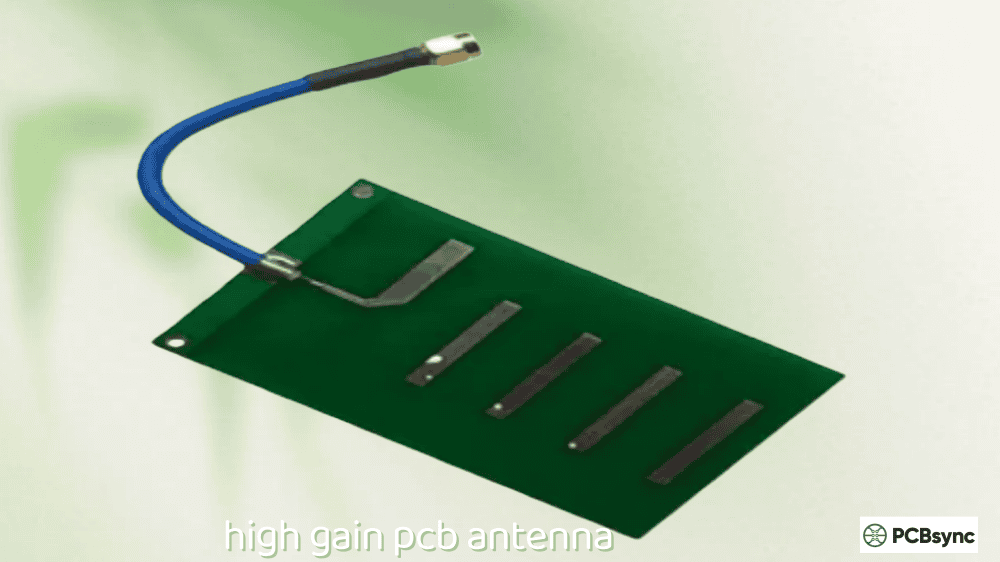
The log-periodic is the workhorse of EMC testing. It uses an array of dipole elements with lengths and spacings that scale by a constant ratio, creating a structure where different elements handle different frequencies. This provides relatively constant gain across the bandwidth—critical for EMC measurements where you need consistent sensitivity.
Key characteristics for EMC:
Bandwidth: 3:1 to 10:1 typical
Gain: 6-9 dBi, relatively flat with frequency
Pattern: Directional end-fire
Antenna factor: Increases with frequency but predictably
PCB log-periodic antennas are widely available. WA5VJB (Kent Britain) has published designs covering 400 MHz to 1 GHz and 850 MHz to 6.5 GHz that have been adopted by the SDR and EMC communities. These designs cost $10-50 and provide published antenna factor data suitable for pre-compliance work.
Best for: General EMC troubleshooting, radiated emissions scanning, situations requiring consistent gain across frequency.
Vivaldi (Tapered Slot) Antennas
The Vivaldi antenna uses an exponentially tapered slot to create traveling-wave radiation. It’s inherently wideband with good directivity, making it popular for UWB and radar applications. Several research papers have demonstrated Vivaldi designs specifically for EMC testing.
Key characteristics for EMC:
Bandwidth: 3:1 to 10:1 achievable
Gain: 4-10 dBi, increasing with frequency
Pattern: Directional end-fire
Antenna factor: Decreases with frequency (higher gain at high frequencies)
The Vivaldi’s gain variation with frequency means your effective sensitivity changes across the band. This complicates EMC measurements where you want consistent sensitivity. However, if you apply the antenna factor correction properly, this isn’t a problem—it just means lower frequencies require stronger signals to measure.
Recent research has shown Vivaldi antennas covering 0.5-6 GHz in PCB form factors suitable for EMC chamber use, with gain comparable to traditional horn antennas.
Best for: High-frequency EMC measurements, situations where directivity is important, UWB applications.
Biconical-Based PCB Antennas
True biconical antennas are 3D structures that don’t translate directly to PCB. However, bowtie antennas (the 2D planar version) and printed biconical dipole arrays combine biconical elements with log-periodic spacing to achieve wide bandwidth.
Research from 2022 demonstrated a printed log-periodic biconical dipole array (PLPBDA) covering 0.5-6 GHz with 50% size reduction compared to conventional log-periodic designs. The biconical (bowtie) elements provide wider bandwidth per element than straight dipoles.
Key characteristics for EMC:
Bandwidth: 3:1 to 10:1 with proper design
Gain: 4-7 dBi with low variation
Pattern: Directional end-fire
Size: More compact than equivalent straight-dipole designs
Best for: Situations requiring the best balance of bandwidth, gain flatness, and size.
Wideband PCB Antenna Comparison for EMC Testing
Parameter
Log-Periodic
Vivaldi
Biconical Array
Typical Bandwidth
400 MHz – 4 GHz
800 MHz – 10 GHz
500 MHz – 6 GHz
Gain Flatness
Excellent (±1.5 dB)
Moderate (±3 dB)
Good (±2 dB)
Antenna Factor Predictability
High
Moderate
High
Size (for 500 MHz low end)
300 × 250 mm
350 × 300 mm
170 × 160 mm
Complexity
Medium
Medium
Medium-High
Commercial Availability
Excellent
Good
Limited
EMC Suitability
Excellent
Good
Excellent
Understanding Antenna Factor for EMC Measurements
Antenna factor (AF) is the key parameter that connects your voltage measurement to the actual field strength. Without accurate antenna factor data, your EMC measurements are meaningless.
This field strength is then compared against the limit line for your applicable standard.
Antenna Factor vs. Frequency
Antenna factor typically increases with frequency for most antenna types. This means your sensitivity decreases at higher frequencies—you need stronger fields to produce the same voltage at your receiver.
Frequency
Typical LPDA AF
Typical Biconical AF
Typical Horn AF
100 MHz
N/A
10-15 dB/m
N/A
300 MHz
15-20 dB/m
20-25 dB/m
N/A
500 MHz
18-22 dB/m
N/A
N/A
1 GHz
22-26 dB/m
N/A
20-25 dB/m
3 GHz
28-32 dB/m
N/A
25-30 dB/m
6 GHz
32-36 dB/m
N/A
28-32 dB/m
For wideband PCB antennas, manufacturers should provide antenna factor data across the operating bandwidth. For DIY antennas, you’ll need to either measure the antenna factor yourself or use calculated values with appropriate uncertainty margins.
Calibration Requirements for EMC Antennas
For formal compliance testing, antennas must be calibrated according to CISPR 16-1-6 or ANSI C63.5. These standards specify the calibration methods, uncertainty requirements, and documentation needed.
For pre-compliance testing, you have more flexibility. Many engineers use:
Calculated antenna factors based on antenna theory
Comparative measurements against a known reference
The key is understanding your measurement uncertainty. Pre-compliance results with ±6 dB uncertainty are still valuable for identifying problems, even if they’re not suitable for certification.
Designing a Wideband PCB Antenna for EMC Testing
Let me walk through the practical considerations for designing or selecting a wideband PCB antenna for your EMC pre-compliance setup.
Defining Requirements
Start with your test requirements:
Frequency range: What standards are you testing to? CISPR 32 requires 30 MHz to 1 GHz minimum, extending to 6 GHz for high-frequency devices. MIL-STD-461 may require coverage to 18 GHz.
Sensitivity: What field strengths do you need to measure? Class B limits at 10 meters are around 30 dBμV/m at 100 MHz, dropping to 37 dBμV/m above 230 MHz. Your antenna and receiver combination must detect these levels with margin.
Pattern: Do you need omnidirectional coverage, or is directional acceptable? Directional antennas like log-periodic and Vivaldi provide better sensitivity but require rotating the antenna or EUT to find maximum emissions.
Size: How much space do you have? Lower frequencies require larger antennas—a half-wave dipole at 100 MHz is 1.5 meters long.
Log-Periodic Design Example for 400 MHz – 4 GHz
Here’s a practical design for a PCB log-periodic antenna suitable for EMC troubleshooting from 400 MHz to 4 GHz:
Design parameters:
Scale factor (τ): 0.88
Spacing factor (σ): 0.15
Number of elements: 10
Substrate: FR-4, 1.6 mm, εr = 4.4
Element dimensions:
Element
Length (mm)
Width (mm)
Spacing (mm)
1 (longest)
165
8.3
—
2
145
7.3
40
3
128
6.4
35
4
112
5.6
31
5
99
5.0
27
6
87
4.4
24
7
77
3.8
21
8
67
3.4
18
9
59
3.0
16
10 (shortest)
52
2.6
14
Feed design: Use a balanced microstrip feed along the center axis, with alternating elements connected to opposite sides. Terminate at the small end with a microstrip-to-coax transition using an SMA edge-launch connector.
Expected performance:
S11: < -10 dB from 400 MHz to 4 GHz
Gain: 5-7 dBi across band
Antenna factor: 18-32 dB/m (increasing with frequency)
Beamwidth: 60-80° (E-plane)
Substrate Selection for EMC Antennas
Substrate choice affects bandwidth, efficiency, and cost:
For pre-compliance testing up to 1 GHz, FR-4 is perfectly adequate. Above 1 GHz, substrate losses in FR-4 reduce antenna efficiency—consider Rogers or similar materials if high-frequency performance matters.
Feed Design Considerations
The feed transition from coax to antenna is critical for wideband performance. Poor feed design creates reflections that limit bandwidth.
For log-periodic antennas:
Use balanced feed along the center axis
Add a small inductor at the rear to ground the structure at DC (reduces static buildup and improves low-frequency response)
Use tapered microstrip or coplanar waveguide feed for smooth impedance transition
For Vivaldi antennas:
Microstrip-to-slotline transition with radial stub
Optimize stub dimensions for center-band match
Consider stripline feed for better isolation from ground plane
Building Your EMC Pre-Compliance Test Setup
A complete pre-compliance radiated emissions test setup using wideband PCB antennas requires more than just the antenna.
Essential Equipment
Component
Purpose
Budget Option
Professional Option
Antenna
Receive emissions
PCB LPDA ($30-100)
Calibrated bilog ($2,000+)
Receiver
Measure signal level
Spectrum analyzer ($500+)
EMI receiver ($20,000+)
Preamp
Boost sensitivity
LNA module ($50)
Low-noise preamp ($500+)
Cable
Connect antenna to receiver
RG-58 ($20)
Low-loss LMR-400 ($100+)
Tripod
Support antenna
PVC DIY mount ($30)
EMC-grade tripod ($500+)
LISN
Conducted emissions
Basic LISN ($300)
Calibrated LISN ($2,000+)
Test Environment Considerations
Radiated emissions measurements are sensitive to the environment. Reflections from walls, floors, and nearby equipment affect results. For pre-compliance testing:
Minimum requirements:
Test in a location with low ambient RF (basement, shielded room, rural area)
Use consistent test geometry (antenna distance, height, EUT position)
Document your setup so results are repeatable
Apply generous margin (6-10 dB) to account for site effects
Better options:
Small anechoic chamber or absorber-lined enclosure
TEM cell for small devices (provides shielded, controlled environment)
Outdoor test at maximum feasible distance from structures
Software and Data Analysis
Most spectrum analyzers include peak detection and marker functions adequate for pre-compliance testing. For more sophisticated analysis:
EMCView (free) – Limit line comparison and data logging
SignalVu-PC (Tektronix) – Advanced signal analysis
EMC32 (Rohde & Schwarz) – Professional EMC test software
The key is applying antenna factor, cable loss, and any preamp gain corrections to convert receiver readings to field strength, then comparing against applicable limits.
Commercial Wideband PCB Antennas for EMC
If building your own antenna isn’t appealing, several commercial options serve the EMC pre-compliance market:
Budget PCB Antennas ($10-100)
WA5VJB Log-Periodic Series:
LP0410: 400-1000 MHz, 5-6 dBi gain, $28
LP0965: 850-6500 MHz, 5-6 dBi gain, $33
Includes published antenna factor data
Available from Ettus Research, Passion Radio, and others
For formal compliance testing, you need individually calibrated antennas from manufacturers like:
A.H. Systems – Full range of calibrated EMC antennas
Com-Power – Biconical, log-periodic, horn antennas with calibration
ETS-Lindgren – Reference-grade EMC antennas
Schwarzbeck – High-precision calibrated antennas
These antennas come with calibration certificates traceable to national standards (NIST, PTB) and meet the requirements of CISPR 16-1-6 and ANSI C63.5.
Resources for Wideband PCB Antenna Design
Design Software and Calculators
OpenEMS – Free open-source EM simulator (works with MATLAB/Octave)
4nec2 – Free wire antenna simulator, good for log-periodic design
MATLAB Antenna Toolbox – Includes Vivaldi and LPDA catalog antennas
CST Studio Suite – Professional EM simulation (expensive but excellent)
Ansys HFSS – Industry standard for antenna simulation
Hexandflex Blog – hexandflex.com – Vivaldi and spiral antenna design tutorials
MDPI Electronics Journal – Open-access papers on printed EMC antennas
IEEE Xplore – Academic papers on antenna design (many paywalled)
EMC Testing Standards
CISPR 16-1-4 – Antenna requirements for EMC measurements
CISPR 16-1-6 – EMC antenna calibration methods
ANSI C63.4 – Methods for measuring radiated emissions (North America)
ANSI C63.5 – Antenna calibration (North America)
EN 55032 – Emissions limits for multimedia equipment
PCB Fabrication for Antennas
Standard PCB services work well for antenna prototypes:
JLCPCB, PCBWay – Low cost, adequate tolerances
OSH Park – Higher quality, good for precision work
Advanced Circuits – Fast turnaround, US-based
For production or high-frequency designs (>3 GHz), consider services offering Rogers materials:
Sierra Circuits – Rogers and other RF substrates
San Francisco Circuits – RF/microwave PCB specialist
Common Mistakes in Wideband EMC Antenna Design
From reviewing failed designs and my own early attempts, these mistakes appear repeatedly:
Ignoring Antenna Factor Variation
Assuming constant sensitivity across the band leads to incorrect field strength calculations. Always apply frequency-dependent antenna factor corrections. A 10 dB error in antenna factor means your measurement is off by a factor of 3 in field strength.
Inadequate Feed Design
Many DIY antennas fail because the coax-to-antenna transition creates reflections. Take time to design proper baluns and transitions. Test S11 across the full bandwidth before relying on the antenna for measurements.
Using FR-4 Above Its Limits
FR-4 works fine below 2-3 GHz, but losses increase rapidly above that. If your antenna is optimized for 6 GHz but built on FR-4, expect 2-3 dB efficiency loss compared to low-loss substrates.
Undersized Ground Planes
Log-periodic and Vivaldi antennas don’t need ground planes, but monopole-type wideband antennas do. Undersized ground planes detune the antenna and distort patterns. Size ground planes for the lowest operating frequency.
No Margin for Uncertainty
Pre-compliance measurements have inherent uncertainty from uncalibrated antennas, site effects, and cable variations. Apply 6-10 dB margin below limits to account for this. If you’re at the limit during pre-compliance, you’ll likely fail formal testing.
Frequently Asked Questions About Wideband PCB Antennas for EMC Testing
Can a wideband PCB antenna replace calibrated EMC antennas for compliance testing?
No. For formal compliance testing to standards like CISPR 32, EN 55032, or FCC Part 15, you need calibrated antennas with traceable calibration certificates. The antenna factor must be known to the accuracy specified in CISPR 16-1-4 (typically ±2 dB or better). Wideband PCB antennas are excellent for pre-compliance testing and troubleshooting, where the goal is finding problems rather than generating certification data. Use them during development, but send your product to an accredited lab with calibrated equipment for final compliance testing.
What frequency range can a single wideband PCB antenna cover for EMC testing?
Current PCB antenna technology can cover roughly 10:1 bandwidth ratios with acceptable performance. Practical examples include 400 MHz to 4 GHz (log-periodic) or 500 MHz to 6 GHz (Vivaldi/biconical array). Below about 200 MHz, PCB antennas become impractically large—a half-wave dipole at 100 MHz is 1.5 meters. For full EMC coverage from 30 MHz to 6 GHz, you’ll likely need at least two antennas: a traditional biconical for 30-300 MHz and a wideband PCB antenna for 300 MHz to 6 GHz.
How do I determine the antenna factor for a DIY wideband PCB antenna?
Three approaches: First, use published data if available—WA5VJB and other designers provide measured antenna factors for their published designs. Second, calculate theoretical antenna factor from gain using AF(dB/m) = 20log(f) – G(dBi) – 29.79, where f is in MHz. This gives reasonable estimates but doesn’t account for real-world losses. Third, measure against a calibrated reference antenna by comparing received power from a known source (like a signal generator with calibrated output). The difference, plus the reference antenna’s known factor, gives your DIY antenna’s factor.
What’s the minimum test distance for using wideband PCB antennas?
For far-field measurements, the minimum distance depends on frequency and antenna size. The far-field boundary is approximately 2D²/λ, where D is the largest antenna dimension. For a 300mm antenna at 1 GHz (λ=300mm), the far-field begins at 0.6 meters. At lower frequencies, the far-field extends further, but the small antenna size relative to wavelength means near-field effects dominate anyway. For pre-compliance testing, 1-3 meter distances are common. Results don’t directly translate to the 10-meter distances used in formal CISPR testing, so apply appropriate correlation factors or margin.
Should I use an active (amplified) or passive wideband PCB antenna for EMC testing?
For radiated emissions testing, passive antennas are generally preferred because they’re simpler, introduce no intermodulation or compression artifacts, and don’t require power. However, at frequencies above 1 GHz where antenna factors are high (30+ dB/m), a low-noise preamplifier near the antenna can improve sensitivity by boosting signals before cable losses degrade them. Active antennas with built-in LNAs are convenient but may compress on strong signals or introduce spurious responses. For troubleshooting unknown emissions, start with a passive antenna to avoid artifacts, then add amplification if sensitivity is insufficient.
Conclusion
Wideband PCB antennas have earned their place in the EMC engineer’s toolkit. They’re not replacements for calibrated commercial antennas—you still need those for formal compliance testing—but for development work, troubleshooting, and pre-compliance screening, they’re invaluable.
The log-periodic remains the best choice for general EMC work thanks to its flat gain characteristic and well-understood behavior. Vivaldi antennas offer excellent high-frequency performance and compact size. Biconical arrays provide a good balance of bandwidth and gain flatness.
Whatever antenna you choose, understand its limitations. Know your antenna factor across the full bandwidth. Apply cable loss corrections. Use appropriate margin to account for measurement uncertainty. And when your product passes pre-compliance testing with margin to spare, you can send it to the accredited lab with confidence.
The resources listed here will take you deeper into specific designs. The WA5VJB designs are particularly valuable as proven starting points with published antenna factor data. With careful design and realistic expectations, wideband PCB antennas can significantly streamline your EMC development process.
Inquire: Call 0086-755-23203480, or reach out via the form below/your sales contact to discuss our design, manufacturing, and assembly capabilities.
Quote: Email your PCB files to Sales@pcbsync.com (Preferred for large files) or submit online. We will contact you promptly. Please ensure your email is correct.
Notes: For PCB fabrication, we require PCB design file in Gerber RS-274X format (most preferred), *.PCB/DDB (Protel, inform your program version) format or *.BRD (Eagle) format. For PCB assembly, we require PCB design file in above mentioned format, drilling file and BOM. Click to download BOM template To avoid file missing, please include all files into one folder and compress it into .zip or .rar format.