Inquire: Call 0086-755-23203480, or reach out via the form below/your sales contact to discuss our design, manufacturing, and assembly capabilities.
Quote: Email your PCB files to Sales@pcbsync.com (Preferred for large files) or submit online. We will contact you promptly. Please ensure your email is correct.
Notes: For PCB fabrication, we require PCB design file in Gerber RS-274X format (most preferred), *.PCB/DDB (Protel, inform your program version) format or *.BRD (Eagle) format. For PCB assembly, we require PCB design file in above mentioned format, drilling file and BOM. Click to download BOM template To avoid file missing, please include all files into one folder and compress it into .zip or .rar format.
If you’ve been working with RF designs long enough, you know that antenna selection can make or break your project. I’ve spent years designing wireless systems, and PCB slot antennas remain one of my go-to solutions when space is tight and performance can’t be compromised. This guide covers everything you need to know about designing, calculating, and implementing slot antennas on your printed circuit boards.
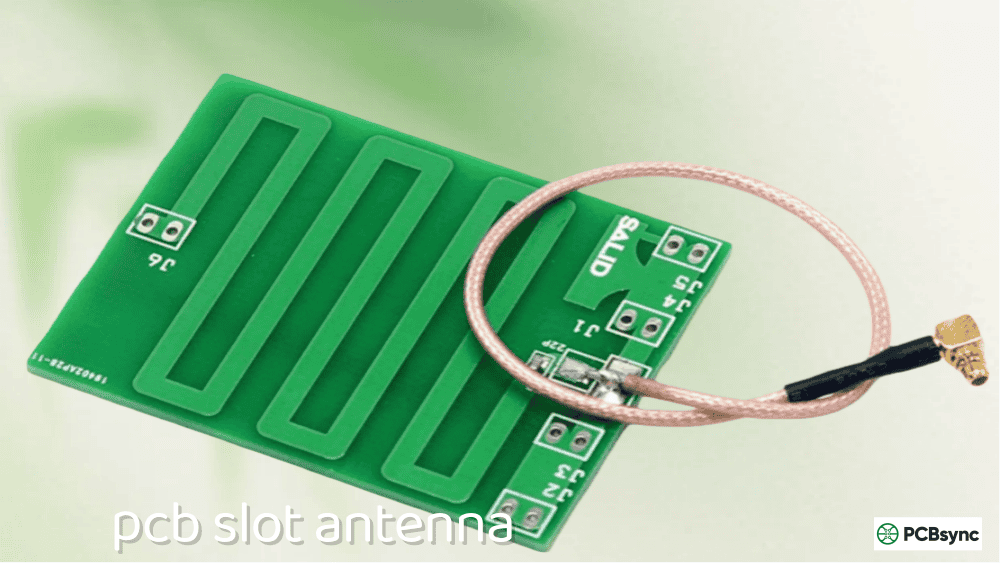
A PCB slot antenna is created by cutting a narrow slot or aperture into the ground plane of a printed circuit board. Unlike traditional antennas that radiate from a conductive element, slot antennas radiate electromagnetic energy from the slot itself. Think of it as the “negative” of a dipole antenna.
The concept dates back to the 1940s when H.G. Booker demonstrated that a slot cut in an infinite conducting plane radiates similarly to a dipole antenna. This relationship, known as Babinet’s Principle, forms the theoretical foundation for all slot antenna designs.
When you cut a half-wavelength slot into a ground plane and excite it properly, the electromagnetic fields concentrate around the slot edges and radiate outward. The beauty of this approach is that your PCB’s existing copper layers do most of the heavy lifting.
Why Engineers Choose PCB Slot Antennas
Here’s what makes slot antennas attractive for embedded designs:
Minimal footprint: The antenna uses existing ground plane copper
Flush mounting: No protruding elements means cleaner enclosure design
Bi-directional radiation: Radiates from both sides of the PCB
Cost-effective: No additional antenna components required
How PCB Slot Antennas Work
Understanding the physics helps you troubleshoot designs faster. A slot antenna operates on the principle of complementary antennas. According to Babinet’s Principle, if you have a conducting surface with a slot, the radiation pattern of that slot is identical to a dipole of the same dimensions—but with the electric and magnetic fields swapped.
The Electromagnetic Field Distribution
When RF energy excites a slot antenna:
Electric fields concentrate across the narrow dimension of the slot
Magnetic fields circulate around the slot edges
These oscillating fields create electromagnetic radiation perpendicular to the slot length
The radiation pattern resembles a figure-eight in the plane containing the slot
The slot’s length primarily determines the resonant frequency, while the width affects bandwidth and impedance. A narrower slot typically yields higher Q (lower bandwidth) and higher impedance.
Feeding Methods for PCB Slot Antennas
Proper feeding is critical for impedance matching. Common approaches include:
Feeding Method
Impedance Range
Bandwidth
Complexity
Best For
Microstrip Line
50-300Ω
Moderate
Low
General RF
Coplanar Waveguide (CPW)
50-100Ω
Wide
Moderate
UWB, High-freq
Coaxial Probe
30-100Ω
Narrow
High
Discrete designs
Aperture Coupling
50-150Ω
Wide
Moderate
Multi-layer PCBs
For most PCB designs, microstrip or CPW feeding works well. The feed position along the slot length controls the input impedance—moving toward the center increases impedance, while feeding near the edge lowers it.
Types of PCB Slot Antennas
Not all slot antennas look the same. Over the years, engineers have developed variations to optimize different parameters.
Rectangular Slot Antenna
The simplest form. A straight rectangular slot cut into the ground plane resonates when its length equals approximately half the guided wavelength. This is your starting point for most designs.
Folded Slot Antenna
When board space is limited, folding the slot into a meandering pattern maintains electrical length while reducing physical size. Expect some bandwidth and efficiency trade-offs with heavy folding.
Tapered Slot Antenna (Vivaldi)
The slot width gradually increases from feed point to aperture. Vivaldi antennas offer exceptional bandwidth (sometimes 10:1 or more) and directional radiation. Commonly used in UWB radar and imaging systems.
Cavity-Backed Slot Antenna
Adding a metallic cavity behind the slot eliminates back-radiation and improves front-to-back ratio. This is useful when you need unidirectional patterns or when back-radiation would interfere with other circuitry.
U-Slot and H-Slot Antennas
These variations introduce additional resonances for dual-band or wideband operation. Adding slots within slots or creating specific geometric patterns tailors the frequency response.
PCB Slot Antenna Design Parameters and Calculations
Here’s where theory meets practice. These formulas will get you to a working prototype, but expect some tuning.
Fundamental Slot Length Calculation
The resonant slot length relates to wavelength by:
L = λ / 2 = c / (2 × f)
Where:
L = slot length (meters)
λ = wavelength in free space
c = speed of light (3 × 10⁸ m/s)
f = operating frequency (Hz)
However, this assumes free space. On a PCB, the effective dielectric constant modifies this:
L_eff = c / (2 × f × √ε_eff)
Where ε_eff is the effective dielectric constant, which depends on your substrate and slot geometry.
Practical Calculation Example
Let’s design a PCB slot antenna for 2.4 GHz WiFi on FR-4 substrate.
Given parameters:
Operating frequency: 2.4 GHz
Substrate: FR-4 (εr = 4.4)
Substrate thickness: 1.6 mm
Step 1: Calculate free-space wavelength
λ₀ = c / f = (3 × 10⁸) / (2.4 × 10⁹) = 125 mm
Step 2: Estimate effective dielectric constant
For a slot in the ground plane with air above and substrate below:
ε_eff ≈ (εr + 1) / 2 = (4.4 + 1) / 2 = 2.7
Step 3: Calculate slot length
L = λ₀ / (2 × √ε_eff) = 125 / (2 × √2.7) = 125 / 3.29 = 38 mm
Step 4: Determine slot width
Slot width typically ranges from λ/50 to λ/10. For moderate bandwidth:
W = λ₀ / 20 = 125 / 20 = 6.25 mm (use 6 mm)
Key Design Parameters Summary
Parameter
Typical Range
Effect on Performance
Slot Length
0.4λ – 0.5λ
Resonant frequency
Slot Width
0.02λ – 0.1λ
Bandwidth, impedance
Feed Position
0 – L/2 from center
Input impedance
Ground Plane Size
> 1λ × 1λ
Pattern stability
Substrate εr
2.2 – 10
Size reduction
Substrate Height
0.5 – 3 mm
Bandwidth
Impedance Calculation
The input impedance of a half-wave slot antenna in free space is approximately:
Z_slot = (η₀² / 4) × (1 / Z_dipole)
Where η₀ = 377Ω (free space impedance) and Z_dipole ≈ 73Ω for a half-wave dipole.
This gives Z_slot ≈ 486Ω for an ideal slot. On a practical PCB, impedances between 100-400Ω are common, requiring matching networks for 50Ω systems.
Step-by-Step PCB Slot Antenna Design Process
After designing dozens of these, here’s the workflow that consistently delivers results.
Step 1: Define Requirements
Before touching any CAD software, nail down these specifications:
These antennas appear across numerous wireless applications.
RFID Systems
PCB slot antennas excel in UHF RFID reader designs. The slot configuration provides the wide bandwidth needed for frequency-hopping protocols while maintaining a compact form factor. NASA even developed a quarter-wavelength crossed-slot design for their HYDRA distributed RFID system.
WiFi and Bluetooth Devices
Consumer electronics often embed slot antennas for 2.4 GHz and 5 GHz WiFi bands. The flat profile integrates easily into slim device enclosures like laptops, tablets, and IoT sensors.
Automotive Radar
77 GHz automotive radar modules use slot arrays for beam steering. The planar construction suits high-volume automotive manufacturing processes.
Satellite Communications
Slot arrays in waveguide structures provide high-gain, electronically steerable beams for SATCOM terminals and phased array systems.
IoT and Wearable Devices
Space-constrained IoT nodes benefit from the minimal footprint. Wearable antennas use slot designs that tolerate proximity to the human body better than some alternatives.
Advantages and Limitations
Every antenna type has trade-offs. Understanding these helps you make informed design decisions.
You’ll need electromagnetic simulation tools to optimize designs efficiently.
Industry-Standard Options
Ansys HFSS dominates professional RF design. Its finite element method (FEM) solver handles complex geometries accurately. The automatic adaptive meshing saves significant time compared to manual mesh refinement. Expect to invest in training and licensing.
CST Microwave Studio offers multiple solver types including time-domain and frequency-domain options. Many engineers prefer CST for broadband antenna analysis due to its efficient transient solver.
Altium Designer integrates basic 3D EM simulation for PCB-integrated antennas. Convenient when your PCB layout tool and simulator share the same environment.
Cost-Effective Alternatives
MATLAB Antenna Toolbox provides parametric design capabilities and can export Gerber files for fabrication. Good for initial design exploration.
OpenEMS is an open-source FDTD simulator. Steep learning curve, but capable results for those willing to invest time.
QucsStudio offers free circuit and EM co-simulation. Suitable for educational purposes and simple designs.
Design Tips and Best Practices
Lessons learned from real projects save you debugging time.
Ground Plane Considerations
Minimum ground plane size should exceed one wavelength in each dimension
IEEE Xplore database for peer-reviewed antenna research
Antenna Engineering Handbook by Balanis (comprehensive reference)
Microstrip Antenna Design Handbook by Garg (practical focus)
Community Forums
EEVblog RF/Antenna section
Reddit r/rfelectronics
Altium community forums
Ansys Learning Forum
Frequently Asked Questions
What is the difference between a slot antenna and a patch antenna?
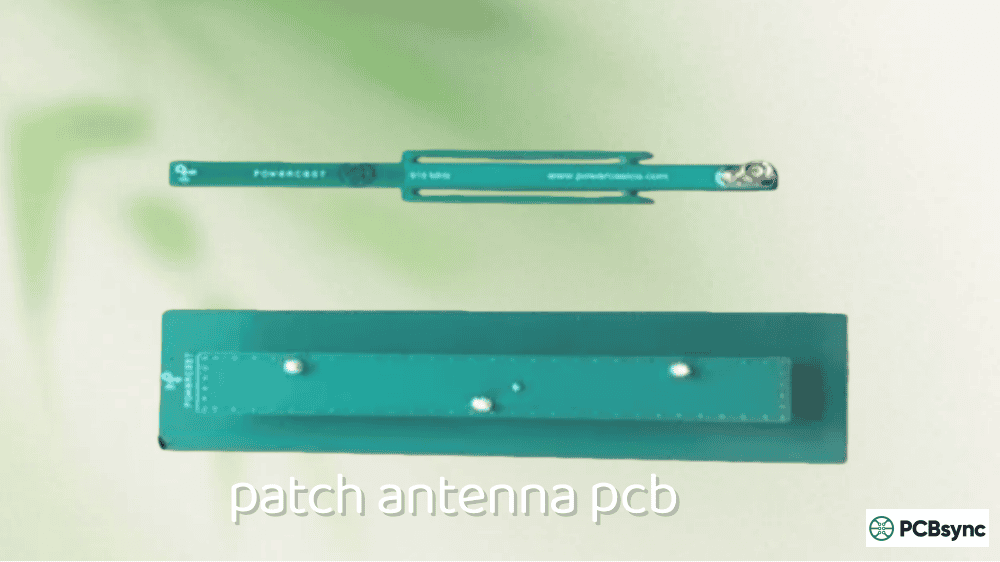
A patch antenna is a conductive element above a ground plane that radiates from its edges. A PCB slot antenna is an aperture cut into the ground plane that radiates from the slot itself. Slots typically have higher impedance and broader beamwidth. Patches offer easier impedance matching to 50Ω and more directional patterns.
How do I improve the bandwidth of my PCB slot antenna?
Several approaches increase bandwidth: widen the slot, use a thicker substrate, implement a tapered slot design, add parasitic elements, or employ a cavity backing with proper depth. Simulation helps optimize these parameters without excessive prototyping.
Can I design a dual-band PCB slot antenna?
Yes. Dual-band operation is achieved through multiple resonant structures. U-slot designs introduce a second resonance. Alternatively, two slots of different lengths can be fed from a common point. The coupling between elements requires careful optimization in simulation.
What causes a frequency shift from simulated to measured results?
Common culprits include: manufacturing tolerances, solder mask effects (2-5% shift), connector parasitics, cable coupling, proximity to test fixtures, and environmental conditions. Always account for 3-5% tuning margin in your initial design.
How small can I make a PCB slot antenna?
Physical size reduction comes with performance trade-offs. Meandering the slot or loading with reactive elements reduces size but decreases bandwidth and efficiency. Practical size reduction to 0.1λ is achievable with 10-20% bandwidth loss. Below this, antenna performance degrades significantly.
Common PCB Slot Antenna Design Mistakes to Avoid
After reviewing countless designs from colleagues and students, certain mistakes appear repeatedly.
Insufficient Ground Plane Size
Many designers underestimate how much the ground plane affects slot antenna performance. A slot in a ground plane smaller than one wavelength exhibits unstable impedance and distorted radiation patterns. The ground plane acts as the “other half” of the antenna system. Skimp here and your antenna won’t perform as simulated.
Ignoring Nearby Metal Objects
That mounting bracket, battery shield, or USB connector near your slot? They’re all coupling to your antenna. Every metal object within a quarter wavelength interacts electromagnetically with the slot. Map out all metal objects in your design early and maintain adequate clearance.
Overlooking Solder Mask Effects
Standard solder mask has a dielectric constant around 3.5-4.0. When it covers your slot, the effective dielectric environment changes. This shifts resonant frequency downward by 2-5% depending on mask thickness. Either account for this in simulation or specify solder mask removal over the slot area (NSMD – Non Solder Mask Defined).
Poor Feed Network Design
A beautifully designed slot antenna means nothing if your feed network introduces excessive loss or mismatch. Transmission line discontinuities, inadequate ground stitching, and improper impedance transitions all degrade system performance. Design the feed with the same care as the radiating element.
Neglecting Manufacturing Tolerances
PCB fabrication has tolerances. Slot width might vary ±10% on standard processes. This variation shifts bandwidth and impedance. Design with margin, and consider tighter tolerance processes for critical applications.
Real-World PCB Slot Antenna Design Example
Let me walk through a practical example from a recent IoT project.
Project Requirements
Frequency: 915 MHz (ISM band for LoRa)
Bandwidth: 26 MHz minimum (902-928 MHz)
Size constraint: Maximum 80mm × 50mm PCB
Substrate: Standard 1.6mm FR-4
Target S11: < -10 dB across band
Initial Calculations
Using the formulas discussed earlier:
Free-space wavelength at 915 MHz:
λ₀ = 3×10⁸ / 915×10⁶ = 328 mm
Effective dielectric constant for slot on FR-4:
ε_eff ≈ (4.4 + 1) / 2 = 2.7
Initial slot length:
L = 328 / (2 × √2.7) = 100 mm
This exceeds our 80mm PCB constraint. Solution: use a folded slot design to reduce physical length while maintaining electrical length.
Design Iteration
After simulation in HFSS:
Folded slot with two 40mm sections
3mm slot width for adequate bandwidth
CPW feed with 50Ω characteristic impedance
Feed position offset 8mm from center for impedance matching
Results Achieved
Measured S11: -15 dB at 915 MHz
10-dB bandwidth: 35 MHz (exceeds requirement)
Peak gain: 1.8 dBi
Efficiency: 78%
The design met all requirements after two prototype iterations. Key learning: the folded geometry introduced some mutual coupling between slot segments that required simulation to optimize.
Future Trends in PCB Slot Antenna Technology
The field continues evolving with new applications and manufacturing capabilities.
Millimeter-Wave Integration
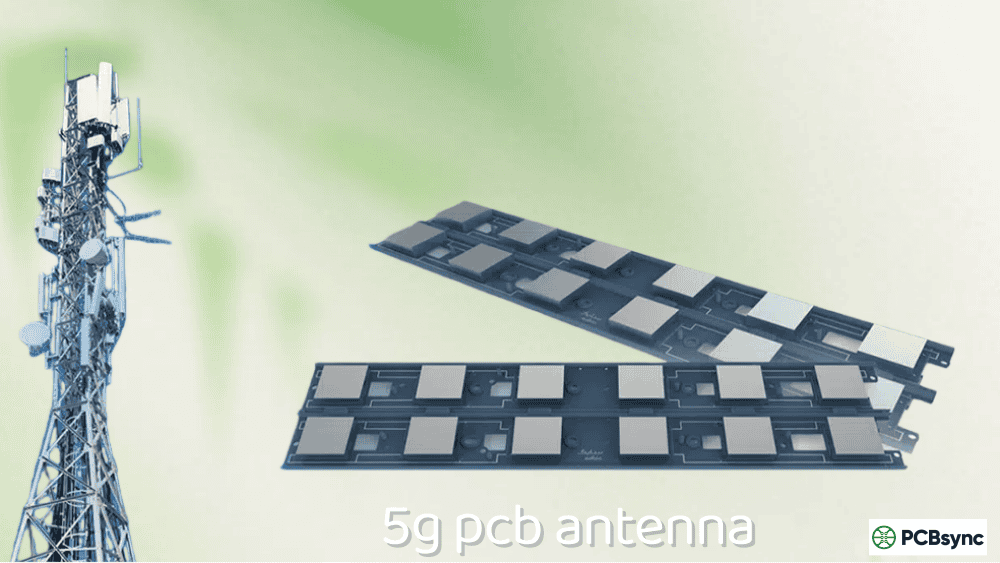
5G and automotive radar drive demand for slot antennas at 28 GHz, 39 GHz, and 77 GHz. At these frequencies, slots become tiny enough to integrate arrays with dozens or hundreds of elements on a single PCB. Advanced substrates and precision manufacturing enable these designs.
Reconfigurable Antennas
PIN diodes and varactors integrated with slot antennas create frequency-tunable and pattern-reconfigurable designs. Software-defined radios benefit from antennas that adapt to changing frequency allocations.
Additive Manufacturing
3D-printed electronics and direct-write metallization open possibilities for slot antennas on non-planar surfaces. Conformal antennas on curved enclosures maintain aerodynamic or aesthetic profiles while providing wireless connectivity.
Substrate-Integrated Waveguide (SIW)
SIW technology brings waveguide performance to PCB construction. Slot arrays fed by SIW structures achieve high gain and efficiency for point-to-point links and radar applications.
Final Thoughts
Designing PCB slot antennas combines electromagnetic theory with practical engineering constraints. Start with solid calculations, validate through simulation, and expect some iteration during prototyping. The payoff is a compact, integrated antenna solution that meets your wireless application requirements.
Whether you’re building an RFID reader, IoT sensor, or automotive radar module, slot antennas offer a proven approach to embedded wireless design. The techniques covered here apply across frequency bands from UHF through millimeter-wave.
Get your hands dirty with a simple design first. Nothing beats the experience of measuring a prototype you calculated and simulated yourself. The fundamentals in this guide will serve you well across many future projects.
The RF engineering community continues sharing knowledge through forums, conferences, and open-source tools. Engage with these resources, share your own experiences, and keep pushing the boundaries of what compact antennas can achieve.
Inquire: Call 0086-755-23203480, or reach out via the form below/your sales contact to discuss our design, manufacturing, and assembly capabilities.
Quote: Email your PCB files to Sales@pcbsync.com (Preferred for large files) or submit online. We will contact you promptly. Please ensure your email is correct.
Notes: For PCB fabrication, we require PCB design file in Gerber RS-274X format (most preferred), *.PCB/DDB (Protel, inform your program version) format or *.BRD (Eagle) format. For PCB assembly, we require PCB design file in above mentioned format, drilling file and BOM. Click to download BOM template To avoid file missing, please include all files into one folder and compress it into .zip or .rar format.