Inquire: Call 0086-755-23203480, or reach out via the form below/your sales contact to discuss our design, manufacturing, and assembly capabilities.
Quote: Email your PCB files to Sales@pcbsync.com (Preferred for large files) or submit online. We will contact you promptly. Please ensure your email is correct.
Notes: For PCB fabrication, we require PCB design file in Gerber RS-274X format (most preferred), *.PCB/DDB (Protel, inform your program version) format or *.BRD (Eagle) format. For PCB assembly, we require PCB design file in above mentioned format, drilling file and BOM. Click to download BOM template To avoid file missing, please include all files into one folder and compress it into .zip or .rar format.
Designing a 5G PCB antennais fundamentally different from anything we did in the 4G era. I spent months debugging my first 5G project because I approached it like an LTE design—same FR4 material, same antenna topology, same layout rules. That approach failed spectacularly at 28 GHz. The reality is that 5G spans two completely different worlds: sub-6 GHz frequencies that behave somewhat like 4G, and millimeter wave (mmWave) frequencies where signals act more like light than radio waves.
This guide covers both domains comprehensively. Whether you’re designing a 5G IoT sensor operating in the n78 band or a smartphone antenna module for mmWave, you’ll find practical dimensions, material recommendations, and layout rules that actually work. I’ve pulled together lessons from dozens of 5G projects and distilled them into actionable guidance.
Understanding 5G Frequency Bands for Antenna Design
Before designing any 5G PCB antenna, you need to understand which frequency bands you’re targeting. 5G NR (New Radio) operates across a massive spectrum range, and antenna requirements vary dramatically depending on where you land.
The wavelength difference between sub-6 GHz and mmWave is enormous. At 3.5 GHz, a quarter-wave antenna is about 21mm. At 28 GHz, it shrinks to under 3mm. This fundamentally changes every aspect of antenna design—from topology selection to PCB material requirements.
Sub-6 GHz 5G PCB Antenna Design
Sub-6 GHz 5G operates in frequency ranges somewhat familiar to 4G LTE designers, but with wider channel bandwidths (up to 100 MHz) and new band combinations. The antenna topologies that worked for LTE still apply, with modifications for the specific 5G NR bands.
Antenna Types for Sub-6 GHz 5G
Antenna Type
Typical Size
Bandwidth
Efficiency
Best For
IFA (Inverted-F)
18-25 mm
200-400 MHz
70-80%
IoT devices, sensors
MIFA (Meandered IFA)
10-15 mm
150-300 MHz
60-75%
Compact 5G modules
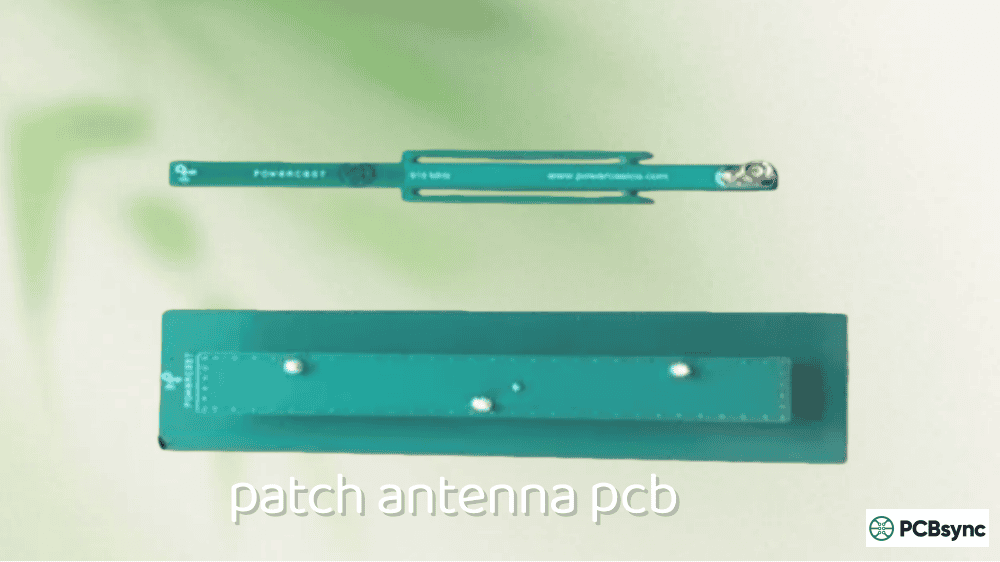
Patch Antenna
20-30 mm
100-200 MHz
75-85%
Base stations, CPE
Monopole
20-40 mm
300-500 MHz
80-90%
USB dongles, gateways
Loop Antenna
15-25 mm
150-250 MHz
65-75%
Wearables
For most sub-6 GHz 5G applications, the Inverted-F Antenna (IFA) or its meandered variant (MIFA) provides the best balance of size, performance, and ease of implementation.
Sub-6 GHz IFA Dimensions for 5G Bands
These dimensions assume 1.6mm FR4 substrate with εr = 4.4:
Parameter
n77/n78 (3.5 GHz)
n79 (4.7 GHz)
Tolerance
Radiating arm length
12.5 – 15.5 mm
9.5 – 12 mm
±0.5 mm
Radiating arm width
1.0 – 1.5 mm
0.8 – 1.2 mm
±0.1 mm
Feed arm length
3.0 – 4.5 mm
2.5 – 3.5 mm
±0.3 mm
Shorting arm width
0.8 – 1.2 mm
0.6 – 1.0 mm
±0.1 mm
Ground clearance
8 – 12 mm
6 – 10 mm
±1.0 mm
Keep-out zone
18 × 10 mm
15 × 8 mm
—
Sub-6 GHz Ground Plane Requirements
Board Type
Minimum Size
Recommended Size
Notes
5G IoT sensor
25 × 35 mm
30 × 45 mm
Single antenna
5G router/CPE
40 × 60 mm
50 × 80 mm
MIMO support
5G smartphone
70 × 140 mm
75 × 150 mm
Multiple antennas
USB 5G dongle
20 × 50 mm
25 × 60 mm
Compact form factor
The ground plane is half your antenna system. For sub-6 GHz bands, insufficient ground plane causes resonant frequency shifts and efficiency degradation. The minimum recommended ground plane length is approximately λ/4 at your lowest operating frequency.
mmWave 5G PCB Antenna Design
Millimeter wave frequencies (24-40+ GHz) require a fundamentally different approach. At these frequencies, traditional PCB antenna topologies don’t scale well, and standard FR4 material becomes unusable due to excessive losses.
Why mmWave is Different
Challenge
Sub-6 GHz
mmWave (28 GHz)
Impact
Wavelength
60-100 mm
8-12 mm
Tiny antenna elements
Path loss
Moderate
Severe
Requires high gain
FR4 loss tangent
Acceptable
Unacceptable
Need special materials
Feature size
1-3 mm traces
0.1-0.5 mm traces
Tight manufacturing tolerance
Beamforming
Optional
Essential
Phased arrays required
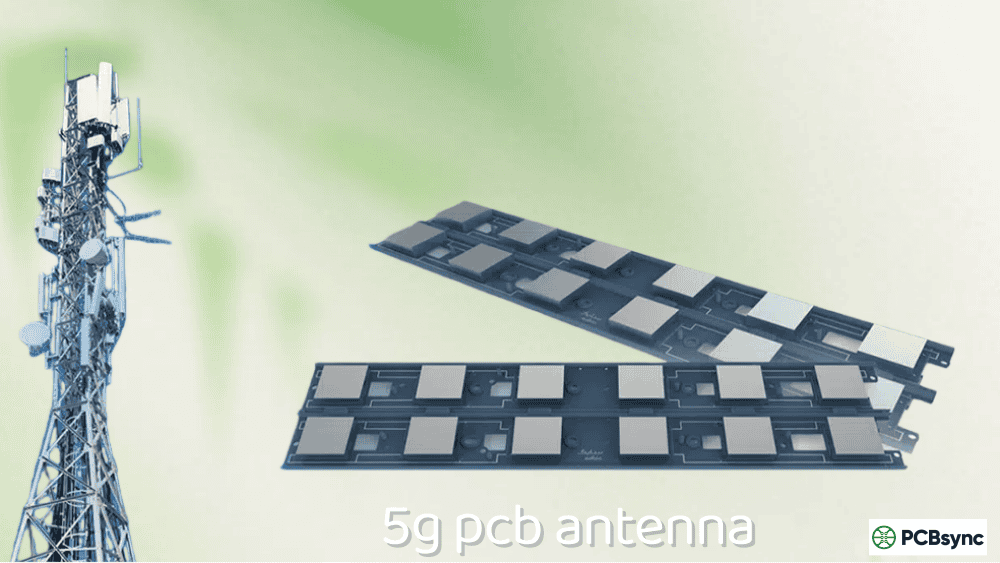
Patch Antenna Arrays for mmWave 5G
At mmWave frequencies, single-element antennas don’t provide enough gain to overcome path loss. The standard solution is patch antenna arrays—multiple radiating elements combined to form a high-gain beam.
Single Patch Element Dimensions (28 GHz on Rogers 4350B):
Parameter
Dimension
Notes
Patch width (W)
3.2 – 3.5 mm
Determines impedance
Patch length (L)
2.8 – 3.1 mm
Sets resonant frequency
Substrate thickness
0.254 – 0.508 mm
Thinner = wider bandwidth
Feed line width
0.35 – 0.45 mm
For 50Ω microstrip
Element spacing
5.0 – 5.5 mm
~λ/2 for grating lobe suppression
mmWave Antenna Array Configurations
Configuration
Elements
Typical Gain
Beam Width
Application
1×4 linear
4
10-12 dBi
20° × 80°
Simple beamforming
2×2 planar
4
11-13 dBi
40° × 40°
Compact devices
2×4 planar
8
13-15 dBi
20° × 40°
Smartphones
4×4 planar
16
16-18 dBi
20° × 20°
Fixed wireless, CPE
8×8 planar
64
22-24 dBi
10° × 10°
Base stations
Phased Array and Beamforming Basics
5G mmWave systems use phased arrays to electronically steer the antenna beam toward users. Each antenna element connects to a phase shifter that adjusts the signal timing, creating constructive interference in the desired direction.
Phased Array Architecture Options:
Architecture
Complexity
Cost
Performance
Typical Use
Analog beamforming
Low
Low
Good
Consumer devices
Digital beamforming
High
High
Excellent
Base stations
Hybrid beamforming
Medium
Medium
Very good
Advanced UE, small cells
For PCB-integrated phased arrays, analog beamforming with 4-8 elements is typical in consumer devices. The phase shifters and gain control are usually integrated into RF front-end ICs from Qualcomm, Samsung, or similar vendors.
PCB Materials for 5G Antenna Design
Material selection is critical for 5G PCB antenna performance, especially at mmWave frequencies where standard FR4 becomes unusable.
Key insight: At 28 GHz, FR4 with tan δ = 0.02 adds approximately 0.5-0.7 dB/cm loss in a microstrip line. Over a 3cm feed network, you lose 1.5-2 dB before the signal even reaches the antenna—that’s half your power gone to heat.
For products requiring both sub-6 GHz and mmWave support, consider a hybrid stackup:
Layer
Material
Purpose
L1 (Top)
Rogers 3003
mmWave antenna elements
L2
Rogers 3003
mmWave ground/feed
L3-L4
FR4 prepreg bond
Structural
L5-L6
FR4 core
Digital/power routing
L7
FR4
Sub-6 GHz antenna/ground
L8 (Bottom)
FR4
Components
This approach places low-loss material only where needed (mmWave layers) while using cost-effective FR4 for digital sections.
MIMO Antenna Layout for 5G
5G extensively uses MIMO (Multiple-Input Multiple-Output) technology to increase data rates and capacity. Antenna placement and isolation are critical for MIMO performance.
5G MIMO Configurations
Configuration
Antennas
Typical Use
Isolation Required
2×2 MIMO
4 total
Basic 5G IoT
> 15 dB
4×4 MIMO
8 total
Smartphones, routers
> 17 dB
8×8 MIMO
16 total
Advanced devices
> 20 dB
Massive MIMO
64-256
Base stations
> 25 dB
Achieving Antenna Isolation
Technique
Isolation Improvement
Implementation
Physical separation
5-10 dB per λ/4
Space antennas apart
Orthogonal polarization
15-20 dB
Cross-polarized elements
Ground slots/cuts
5-10 dB
Decoupling structures
Neutralization lines
8-15 dB
Coupling cancellation
Different antenna types
10-15 dB
IFA + loop combination
MIMO Antenna Placement Guidelines
For a typical smartphone-sized PCB (75 × 150 mm):
Position
Antenna Type
Band Coverage
Notes
Top left corner
IFA
Sub-6 GHz
Away from hand grip
Top right corner
IFA
Sub-6 GHz
Diversity antenna
Bottom left
Loop
Sub-6 GHz
Near charging port area
Bottom right
Loop
Sub-6 GHz
MIMO element
Top edge (3 modules)
Patch array
mmWave
Beamforming
Side edge (2 modules)
Patch array
mmWave
Side coverage
Critical rule: Maintain minimum λ/4 separation between MIMO elements operating in the same band. At 3.5 GHz, this means at least 21mm spacing.
RF Layout Rules for 5G PCB Antennas
Proper RF layout is essential for 5G PCB antenna performance. Poor layout can easily cost you 3-6 dB of efficiency.
Transmission Line Design
Microstrip Dimensions for 50Ω (Rogers 4350B, 0.508mm thickness):
Frequency
Trace Width
Effective εr
λ/4 Length
3.5 GHz
1.1 mm
2.9
12.6 mm
5 GHz
1.1 mm
2.9
8.8 mm
28 GHz
0.38 mm
2.8
1.6 mm
39 GHz
0.38 mm
2.8
1.1 mm
Critical Layout Rules
Rule
Sub-6 GHz
mmWave
Consequence of Violation
Keep-out zone
10-15 mm
3-5 mm
Detuning, pattern distortion
Via spacing (ground)
< λ/20
< λ/20
Slot radiation, resonances
Trace width tolerance
±10%
±5%
Impedance mismatch
Reference plane gaps
Avoid
Critical to avoid
Impedance discontinuity
Component clearance
8-10 mm
2-3 mm
Coupling, detuning
Ground Plane and Via Stitching
For mmWave designs, via stitching along transmission lines and around antenna elements is essential to prevent unwanted modes and slot radiation.
Frequency
Maximum Via Spacing
Via Diameter
Pad Size
3.5 GHz
4.3 mm (λ/20)
0.3 mm
0.6 mm
28 GHz
0.54 mm (λ/20)
0.15 mm
0.3 mm
39 GHz
0.38 mm (λ/20)
0.1 mm
0.25 mm
At mmWave frequencies, via spacing requirements often push the limits of standard PCB manufacturing. Discuss capabilities with your fabricator early in the design process.
Impedance Matching for 5G Antennas
Proper impedance matching ensures maximum power transfer between the transceiver and antenna. At 5G frequencies, even small mismatches cause significant performance degradation.
Target Specifications
Parameter
Sub-6 GHz Target
mmWave Target
Return loss (S11)
< -10 dB
< -10 dB
VSWR
< 2.0:1
< 2.0:1
Bandwidth
> 100 MHz
> 400 MHz
Efficiency
> 60%
> 50%
Matching Network Topologies
Topology
Components
Bandwidth
Best For
Series L
1 inductor
Narrow
Simple tuning
Shunt C
1 capacitor
Narrow
Capacitive loads
L-network
2 components
Medium
General purpose
Pi-network
3 components
Wide
Broadband matching
Stub matching
PCB traces
Wide
mmWave (no components)
At mmWave frequencies, lumped components become impractical. Use distributed matching elements (stubs, quarter-wave transformers) instead.
Quarter-Wave Transformer for mmWave:
For matching antenna impedance Za to 50Ω feed:
Za (Ω)
Transformer Z0 (Ω)
Trace Width (RO3003, 0.254mm)
75
61.2
0.52 mm
100
70.7
0.42 mm
150
86.6
0.28 mm
Testing and Verification
Proper testing ensures your 5G PCB antenna meets specifications before production.
Test Equipment Requirements
Measurement
Equipment
Sub-6 GHz
mmWave
S-parameters
VNA
Standard 6 GHz VNA
40+ GHz VNA required
Radiation pattern
Anechoic chamber
Standard chamber
mmWave chamber
Efficiency
Wheeler cap or pattern integration
Standard
Calibration critical
OTA performance
OTA chamber
Standard
mmWave OTA
Key Measurements
Parameter
Method
Pass Criteria
S11 (return loss)
VNA, calibrated
< -10 dB across band
Bandwidth
S11 -10 dB points
≥ required bandwidth
Peak gain
Pattern measurement
Per specification
Efficiency
Gain/directivity ratio
> 50% (mmWave), > 60% (sub-6)
Isolation (MIMO)
S21 between ports
> 15-20 dB
Common Issues and Solutions
Issue
Likely Cause
Solution
Frequency too low
Antenna too long, high εr
Trim length, check material
Frequency too high
Antenna too short, low εr
Extend length, add loading
Poor efficiency
Material loss, poor ground
Use lower-loss material
Narrow bandwidth
High Q, small ground
Increase ground, widen traces
Low isolation (MIMO)
Elements too close
Add decoupling structures
Useful Resources for 5G PCB Antenna Design
Reference Design Documents
Document
Source
Coverage
AN91445
Infineon
Sub-6 GHz antenna layout
5G NR Antenna Design Guide
Qualcomm
mmWave phased arrays
RO4000 Design Guide
Rogers Corp
High-frequency laminate design
mmWave Antenna Application Note
Taoglas
Commercial antenna integration
5G Antenna White Paper
Ignion
Antenna booster technology
Design Tools
Tool
Type
Use Case
HFSS (Ansys)
EM simulator
Full-wave antenna simulation
CST Studio
EM simulator
Antenna and array design
ADS (Keysight)
Circuit/EM
Matching network, co-simulation
openEMS
Free EM simulator
Budget-friendly simulation
Saturn PCB Toolkit
Calculator
Impedance, stackup calculations
PCB Material Resources
Resource
URL
Content
Rogers Corporation
rogers-corp.com
Laminate datasheets, design guides
Taconic
taconicadd.com
Alternative high-frequency materials
Isola
isola-group.com
Astra MT77 specifications
Frequently Asked Questions
Can I use FR4 for 5G antenna designs?
FR4 works acceptably for sub-6 GHz bands (n77, n78, n79) with careful design, though you’ll sacrifice some efficiency compared to low-loss materials. At 3.5 GHz, FR4’s loss tangent of 0.02 causes moderate insertion loss that’s often tolerable for cost-sensitive IoT applications. However, FR4 is completely unsuitable for mmWave frequencies above 10 GHz. At 28 GHz, FR4 losses become severe—expect to lose 0.5-0.7 dB per centimeter of trace length. For mmWave designs, use Rogers RO3003, RT/duroid 5880, or similar low-loss laminates.
What’s the minimum PCB size for a 5G antenna?
For sub-6 GHz bands around 3.5 GHz, the minimum practical PCB size is approximately 25mm × 40mm, which provides adequate ground plane for an IFA or MIFA antenna. Smaller boards require external antennas or chip antennas. For mmWave, the antenna elements themselves are tiny (3-5mm), but you need space for the array and feed network. A 4-element mmWave array might fit in 15mm × 15mm, but the complete module with RF front-end ICs typically requires 20mm × 25mm minimum. Remember that mmWave antennas are usually part of an integrated module, not standalone PCB elements.
How do I design an antenna that covers both sub-6 GHz and mmWave?
You don’t design a single antenna for both—the frequency difference is too extreme (10:1 ratio). Instead, use separate antenna systems on the same PCB. Place sub-6 GHz antennas (IFA, MIFA, or loop) at board corners using standard techniques. For mmWave, integrate patch array modules along board edges. The sub-6 GHz antennas use FR4 or Rogers 4350B substrate, while mmWave arrays require low-loss material like Rogers 3003. Modern 5G devices typically have 4-8 sub-6 GHz antenna elements plus 2-3 mmWave array modules positioned to cover different directions.
Why do mmWave 5G antennas need phased arrays?
Millimeter wave signals experience severe path loss—approximately 20-30 dB more than sub-6 GHz at the same distance. A single-element antenna doesn’t provide enough gain to overcome this loss for practical communication distances. Phased arrays solve this by combining multiple elements to create a high-gain beam (typically 15-20 dBi for consumer devices). Additionally, mmWave signals are easily blocked by obstacles including the user’s hand. Phased arrays with beamforming can electronically steer the beam around obstacles or toward base stations, maintaining connection without mechanical movement. This is why every mmWave 5G device uses phased arrays rather than simple antennas.
What isolation is needed between 5G MIMO antennas?
For 5G MIMO systems, minimum isolation requirements depend on the configuration and use case. Basic 2×2 MIMO requires at least 15 dB isolation between antenna ports. For 4×4 MIMO in smartphones and routers, target 17-20 dB isolation. Advanced 8×8 MIMO and massive MIMO systems need 20-25 dB or better. Insufficient isolation causes correlation between MIMO channels, reducing capacity gains. Achieve isolation through physical separation (λ/4 minimum), orthogonal polarization, ground plane modifications (slots, cuts), and neutralization lines. At sub-6 GHz frequencies, physical separation is the primary tool. For mmWave arrays, careful element spacing and feed network design maintain isolation.
Conclusion
Designing effective 5G PCB antennas requires understanding two distinct frequency domains. Sub-6 GHz bands use familiar topologies—IFA, MIFA, and patches—with dimensions scaled for the 3.3-5 GHz range. Standard FR4 works for cost-sensitive applications, though low-loss materials improve efficiency. The real challenge lies at mmWave frequencies where everything changes: tiny wavelengths demand precision manufacturing, severe path loss requires phased arrays, and material selection becomes critical.
My advice for engineers new to 5G: start with sub-6 GHz designs to build familiarity with 5G NR bands and their requirements. When you move to mmWave, expect a steep learning curve and budget time for simulation before fabrication. At 28 GHz, you can’t iterate quickly with hardware—simulation accuracy becomes essential.
The 5G landscape continues evolving with new bands and capabilities. Designs that accommodate both sub-6 GHz and mmWave while meeting size and cost constraints will define successful 5G products. Get the fundamentals right—proper materials, correct dimensions, adequate ground plane, and careful MIMO layout—and your 5G antenna designs will perform as intended.
Inquire: Call 0086-755-23203480, or reach out via the form below/your sales contact to discuss our design, manufacturing, and assembly capabilities.
Quote: Email your PCB files to Sales@pcbsync.com (Preferred for large files) or submit online. We will contact you promptly. Please ensure your email is correct.
Notes: For PCB fabrication, we require PCB design file in Gerber RS-274X format (most preferred), *.PCB/DDB (Protel, inform your program version) format or *.BRD (Eagle) format. For PCB assembly, we require PCB design file in above mentioned format, drilling file and BOM. Click to download BOM template To avoid file missing, please include all files into one folder and compress it into .zip or .rar format.