Inquire: Call 0086-755-23203480, or reach out via the form below/your sales contact to discuss our design, manufacturing, and assembly capabilities.
Quote: Email your PCB files to Sales@pcbsync.com (Preferred for large files) or submit online. We will contact you promptly. Please ensure your email is correct.
Notes: For PCB fabrication, we require PCB design file in Gerber RS-274X format (most preferred), *.PCB/DDB (Protel, inform your program version) format or *.BRD (Eagle) format. For PCB assembly, we require PCB design file in above mentioned format, drilling file and BOM. Click to download BOM template To avoid file missing, please include all files into one folder and compress it into .zip or .rar format.
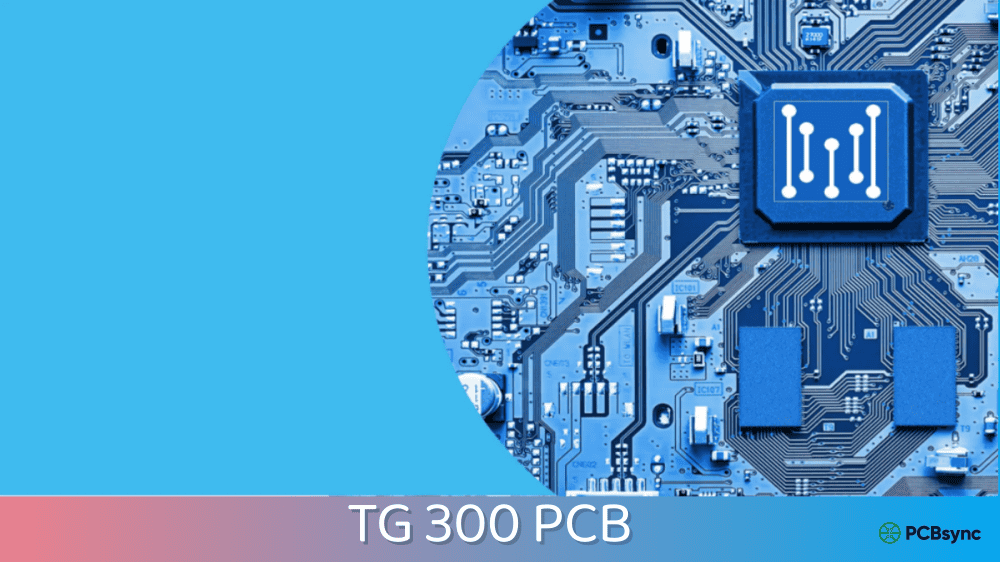
When standard high-Tg materials simply aren’t enough, you need a Tg 300 PCB. I’ve worked on projects where boards needed to survive satellite deployment, downhole drilling at 250°C, and military radar systems—environments where even polyimide at Tg 260°C falls short.
This guide explores the materials, specifications, and design considerations for circuit boards operating at the absolute edge of organic substrate capability—and when you might need to step beyond organic materials entirely into ceramic territory.
Tg 300 PCB refers to printed circuit boards manufactured with materials having a glass transition temperature of 300°C or higher. At this extreme range, you’re working with specialized PTFE (Teflon) laminates, certain advanced polyimides, or transitioning entirely to ceramic substrates that technically don’t have a Tg at all.
The glass transition temperature marks where a polymer substrate shifts from rigid and glassy to soft and rubbery. For a Tg 300 PCB, this transition point occurs at temperatures that would destroy virtually any standard electronics—meaning these boards maintain structural integrity in environments most materials simply cannot survive.
Why 300°C Matters
The 300°C threshold represents a critical boundary in PCB engineering. At this temperature:
Standard FR-4 (Tg 130-140°C) would have already failed catastrophically
Even high-Tg polyimide (Tg 260°C) is operating beyond its safe margin
Lead-free solder reflow peaks at 260°C, so 300°C provides substantial process headroom
The T300 delamination test (IPC-TM-650) evaluates material survival at exactly this temperature
When your application demands operation at 250°C ambient, continuous thermal cycling to extreme temperatures, or compatibility with high-temperature processing, a Tg 300 PCB becomes essential.
Tg 300 PCB Material Options
At the 300°C threshold, your material choices narrow considerably. Each option presents distinct tradeoffs between thermal performance, electrical properties, manufacturability, and cost.
PTFE (Teflon) Laminates
PTFE-based materials represent the highest Tg option among organic PCB substrates. Polytetrafluoroethylene offers exceptional thermal stability with Tg values reaching 280-327°C depending on formulation.
Popular PTFE materials for Tg 300 PCB applications include Rogers RT/duroid 5880 and RT6000 series, primarily used in military and aerospace RF applications.
Advanced Polyimide Materials
While standard polyimide sits at Tg 260°C, certain formulations push into the 300°C+ range. These materials combine high thermal stability with better mechanical properties than PTFE.
Polyimide advantages:
Tg values exceeding 300°C in some grades
Excellent dimensional stability
Good copper adhesion
Suitable for flex and rigid-flex applications
Lower cost than PTFE for non-RF applications
Materials like Taconic RF-35 achieve Tg of 315°C through organic-ceramic composite construction, bridging the gap between pure polymer and ceramic substrates.
Ceramic PCB Substrates
When organic materials reach their limits, ceramic substrates take over. Technically, ceramics don’t have a glass transition temperature since they’re not polymer-based. However, they operate reliably at temperatures far exceeding any organic material.
Ceramic Type
Max Operating Temp
Thermal Conductivity
CTE
Alumina (Al₂O₃)
800°C+
24-28 W/m·K
6.5-7.0 ppm/°C
Aluminum Nitride (AlN)
1000°C+
140-180 W/m·K
4.5 ppm/°C
Silicon Carbide (SiC)
1000°C+
120-270 W/m·K
4.0 ppm/°C
Beryllium Oxide (BeO)
1000°C+
170-280 W/m·K
6.0 ppm/°C
Ceramic PCBs manufactured using HTCC (High-Temperature Co-fired Ceramic) or LTCC (Low-Temperature Co-fired Ceramic) processes can operate continuously at 300°C while providing thermal conductivity 100-500x better than FR-4.
Tg 300 PCB Material Specifications Comparison
Selecting the right material requires understanding how each option performs across multiple parameters:
Property
PTFE (RT5880)
Polyimide (RF-35)
Ceramic (AlN)
Standard FR-4
Tg / Max Temp
280°C
315°C
1000°C+
130-140°C
Td (Decomposition)
500°C+
400°C+
N/A
300-330°C
Dk @ 10GHz
2.2
3.5
8.8
4.5
Df @ 10GHz
0.0009
0.0018
0.0003
0.020
Thermal Conductivity
0.20 W/m·K
0.40 W/m·K
170 W/m·K
0.30 W/m·K
CTE (Z-axis)
237 ppm/°C
50 ppm/°C
4.5 ppm/°C
60-70 ppm/°C
Moisture Absorption
<0.02%
0.10%
~0%
0.15%
Relative Cost
10-15x
5-8x
20-50x
1x
The data tells a clear story: PTFE excels for RF applications with its ultra-low Dk and Df, while ceramic dominates when thermal conductivity and absolute temperature capability matter most.
The term “Tg 300” is sometimes confused with “T300″—these are related but distinct concepts.
T300 refers to the time-to-delamination test at 300°C, defined by IPC-TM-650 Test Method 2.4.24.1. A sample is heated to 300°C and held until layer separation occurs. This test is typically applied to polyimide and other high-temperature materials where standard T260 or T288 testing would be insufficient.
For Tg 300 PCB materials, the T300 value indicates how long the board can survive at extreme process temperatures—critical for applications requiring multiple high-temperature reflow cycles or continuous elevated-temperature operation.
Typical T300 performance:
Quality polyimide: >60 minutes
PTFE materials: Material dependent (often not tested at T300)
Ceramic: Not applicable (no delamination mechanism)
When specifying materials for extreme-temperature applications, consider both Tg and T300 values to ensure complete thermal reliability.
Applications for Tg 300 PCB Technology
The extreme capabilities of Tg 300 PCB materials target specific demanding applications:
Satellite and Space Systems
Space electronics face the ultimate thermal challenge: rapid cycling between -150°C in shadow and +150°C in direct sunlight, plus exposure during launch vehicle separation. Satellite communication systems particularly benefit from PTFE’s combination of thermal stability and RF performance.
Design considerations for space applications:
Outgassing requirements (NASA ASTM E595)
Radiation resistance
CTE matching to minimize thermal stress
Lightweight construction priorities
Military and Defense Electronics
Radar systems, missile guidance, electronic warfare equipment, and ruggedized communication devices operate in conditions that destroy commercial electronics. Military specifications often mandate materials with Tg exceeding 250°C plus additional requirements for shock, vibration, and environmental resistance.
Downhole Drilling and Oil/Gas Exploration
Measurement-while-drilling (MWD) and logging-while-drilling (LWD) equipment operates kilometers underground at temperatures routinely exceeding 200°C with pressure reaching 25,000 psi. These conditions demand the absolute highest thermal capability available.
High-Power RF and Microwave Systems
Power amplifiers, radar transmitters, and base station equipment generate substantial internal heat while demanding excellent RF performance. PTFE materials satisfy both requirements—thermal stability plus low dielectric loss.
Automotive Under-Hood Extreme Applications
While most automotive electronics use Tg 170-180°C materials, certain applications positioned directly on engine blocks or exhaust systems may require Tg 300 PCB capability.
Design Guidelines for Tg 300 PCB
Working with extreme-temperature materials requires adapting your design approach.
Material Handling and Storage
PTFE laminates are soft and easily damaged. Unlike FR-4, they require careful handling to prevent gouging or tearing. Store materials at controlled room temperature away from direct sunlight to prevent surface oxidation.
For polyimide, moisture control is critical. These materials absorb atmospheric moisture that converts to steam during high-temperature processing, potentially causing delamination. Vacuum desiccation before lamination is standard practice.
Stack-up Design
High-temperature materials often have significantly different CTE values than standard substrates. When combining materials (hybrid stack-ups), carefully match expansion coefficients to prevent warping and stress during thermal cycling.
For multilayer PTFE boards:
Use specialized bonding films with compatible thermal properties
Consider ceramic-filled prepregs for improved dimensional stability
Plan for longer lamination cycles at elevated temperatures (370°C, 450-500 PSI typical)
Via and PTH Considerations
The high Z-axis CTE of PTFE materials (up to 237 ppm/°C above Tg) creates significant stress on plated through-holes. Mitigation strategies include:
For ceramic PCBs, via formation uses different processes entirely—laser drilling or punching with metallization through specialized techniques like thick-film or thin-film deposition.
Surface Finish Selection
Standard surface finishes may not survive continuous 300°C operation. Recommended options:
PTFE’s famous non-stick properties create PCB manufacturing difficulties:
Copper adhesion: Requires sodium etching or plasma treatment to activate surfaces
Drilling: Soft material causes smearing; specialized parameters needed
Plating: Difficult to achieve reliable PTH metallization
Solder mask application: Must be completed within 12 hours of etching
Not all fabricators can handle PTFE materials. Verify your supplier has documented experience and appropriate processing equipment before committing to a design.
Ceramic PCB Fabrication
Ceramic substrate manufacturing differs fundamentally from organic PCB processes:
HTCC: Firing at 1600°C+ with tungsten or molybdenum conductors
LTCC: Firing at 850-900°C, compatible with silver and gold conductors
DPC (Direct Plated Copper): Thin-film copper deposition on fired ceramic
Lead times for ceramic PCBs typically exceed organic boards by 2-4 weeks, with significantly higher tooling costs for new designs.
Thermomechanical Analysis (TMA): Measures dimensional changes versus temperature, directly determining Tg and CTE values. Essential for qualifying incoming materials and verifying fabricated boards meet specifications.
Differential Scanning Calorimetry (DSC): Detects phase transitions by measuring heat flow. Provides accurate Tg determination and identifies cure state of thermosetting materials.
Thermogravimetric Analysis (TGA): Measures mass loss versus temperature, determining decomposition temperature (Td). Critical for understanding material behavior at extreme temperatures.
Reliability Testing Protocols
For mission-critical applications, boards should undergo:
Thermal cycling: -65°C to +200°C (or application-specific range) for 500-1000 cycles
IST (Interconnect Stress Testing): Current-induced heating to evaluate via reliability
Humidity testing: 85°C/85% RH exposure for moisture resistance verification
Document all test results and maintain traceability for aerospace and military applications where failure analysis may be required years after deployment.
Cost Analysis for Tg 300 PCB
Expect substantial cost premiums for extreme-temperature materials:
Material Type
Material Cost
Processing Premium
Total vs. FR-4
Standard FR-4
1x
1x
1x
High-Tg FR-4 (170°C)
1.3x
1x
1.3x
Polyimide (260°C)
4-5x
1.5x
6-8x
PTFE (280°C+)
8-12x
2x
15-25x
Ceramic (LTCC)
15-30x
3-5x
30-50x+
For prototype quantities, the cost differential becomes even more pronounced due to minimum order quantities and setup charges for specialty materials.
When to Choose Tg 300 PCB vs. Ceramic
The decision between organic Tg 300 PCB materials and ceramic substrates depends on your specific requirements:
Choose PTFE/High-Tg Organic When:
RF/microwave performance is critical (low Dk, low Df)
IPC-4101: Specification for Base Materials for Rigid and Multilayer Boards
IPC-TM-650: Test Methods Manual (includes T260, T288, T300 procedures)
IPC-6012: Qualification and Performance Specification for Rigid PCBs
Frequently Asked Questions About Tg 300 PCB
What is the difference between Tg 300 and T300 in PCB specifications?
Tg 300 refers to a glass transition temperature of 300°C—the point where the material transitions from rigid to flexible. T300 is a test measuring time-to-delamination at 300°C, indicating how long a material survives at that temperature before layers separate. A material might have Tg of 260°C but still pass T300 testing by surviving the required duration at 300°C without delaminating.
Can standard PCB fabricators produce Tg 300 PCB?
Most standard fabricators cannot process Tg 300 PCB materials. PTFE requires specialized surface treatment, drilling parameters, and plating processes. Ceramic PCBs need entirely different manufacturing equipment. Always verify your fabricator has documented experience with your specific material before design commitment. Request sample boards or process qualification data.
What maximum continuous operating temperature can I expect from a Tg 300 PCB?
For organic materials like PTFE with Tg ~300°C, safe continuous operation typically stays 25-40°C below the Tg value—approximately 260-275°C maximum. Ceramic substrates can operate continuously at 300°C+ with some materials rated for 500°C or higher. Component temperature ratings usually become the limiting factor before the substrate reaches its thermal limit.
Is Tg 300 PCB compatible with lead-free soldering?
Yes, Tg 300 PCB materials are fully compatible with lead-free soldering. Lead-free reflow peaks at approximately 260°C—well below the capability of these materials. In fact, the high thermal stability is one reason engineers select Tg 300 materials: to provide substantial margin during assembly processes and allow multiple reflow cycles without degradation.
How does moisture affect Tg 300 PCB materials during processing?
Moisture is critical for polyimide-based Tg 300 materials. Absorbed moisture converts to steam during high-temperature processing, potentially causing delamination or blistering. Always bake polyimide boards before assembly—typically 4-24 hours at 125°C depending on thickness. PTFE materials absorb virtually no moisture (<0.02%) and rarely require prebaking. Ceramic substrates are essentially immune to moisture concerns.
Final Thoughts
Tg 300 PCB technology represents the frontier of thermal capability for printed circuit boards. Whether you’re engineering satellite communications, military radar, or downhole instrumentation, understanding the available materials and their tradeoffs is essential for successful design.
The choice between PTFE, advanced polyimide, and ceramic substrates depends on your specific thermal, electrical, and mechanical requirements—plus practical constraints like cost and manufacturability. For most extreme-temperature applications, consulting with both your material supplier and fabricator early in the design process prevents costly surprises later.
Remember that material selection is only part of the equation. Proper design practices, appropriate via structures, matched CTEs in your stack-up, and thorough testing all contribute to long-term reliability at extreme temperatures.
These materials exist because some applications genuinely need them. But they’re not a general-purpose solution—the cost, complexity, and manufacturing constraints make them appropriate only when standard high-Tg materials truly cannot meet your thermal requirements. When you do need Tg 300 PCB capability, invest the time to select the right material for your specific application rather than defaulting to the highest-performance option available.
Inquire: Call 0086-755-23203480, or reach out via the form below/your sales contact to discuss our design, manufacturing, and assembly capabilities.
Quote: Email your PCB files to Sales@pcbsync.com (Preferred for large files) or submit online. We will contact you promptly. Please ensure your email is correct.
Notes: For PCB fabrication, we require PCB design file in Gerber RS-274X format (most preferred), *.PCB/DDB (Protel, inform your program version) format or *.BRD (Eagle) format. For PCB assembly, we require PCB design file in above mentioned format, drilling file and BOM. Click to download BOM template To avoid file missing, please include all files into one folder and compress it into .zip or .rar format.