Inquire: Call 0086-755-23203480, or reach out via the form below/your sales contact to discuss our design, manufacturing, and assembly capabilities.
Quote: Email your PCB files to Sales@pcbsync.com (Preferred for large files) or submit online. We will contact you promptly. Please ensure your email is correct.
Notes: For PCB fabrication, we require PCB design file in Gerber RS-274X format (most preferred), *.PCB/DDB (Protel, inform your program version) format or *.BRD (Eagle) format. For PCB assembly, we require PCB design file in above mentioned format, drilling file and BOM. Click to download BOM template To avoid file missing, please include all files into one folder and compress it into .zip or .rar format.
When I first encountered a project requiring boards to operate reliably at 230°C continuous temperature, standard FR-4 was simply not an option. That’s when I dove deep into the world of Tg 260 PCB materials—and honestly, it changed how I approach high-temperature design challenges.
This guide covers everything you need to know about Tg 260 PCBs, from material selection to real-world applications. Whether you’re designing for aerospace, automotive under-hood electronics, or industrial equipment, understanding these ultra-high temperature materials is essential for building reliable products.
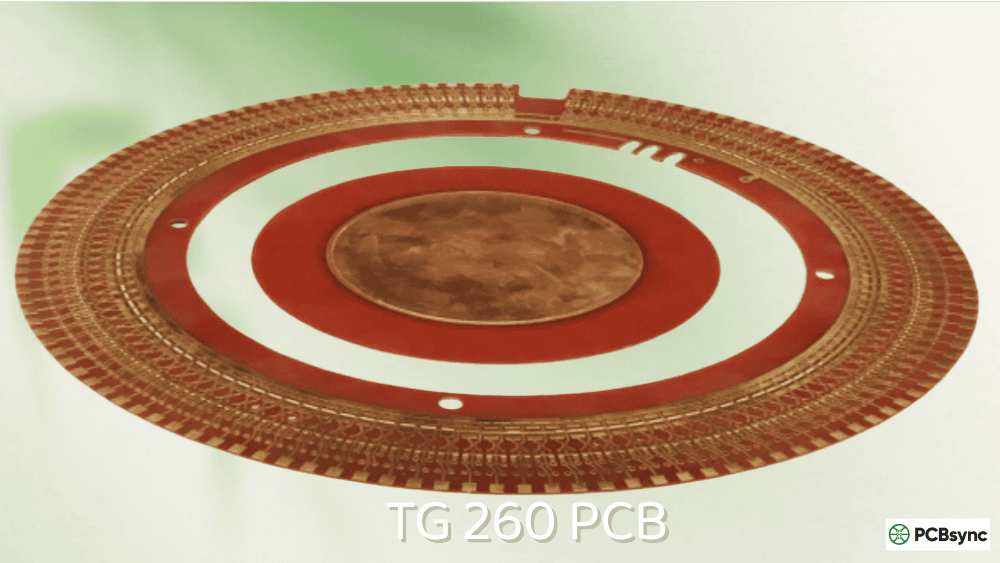
Tg 260 PCB refers to printed circuit boards manufactured with substrate materials that have a glass transition temperature (Tg) of 260°C or higher. The glass transition temperature is the point where the board’s resin system transitions from a rigid, glassy state to a soft, rubbery state.
For context, standard FR-4 materials typically have a Tg of 130-140°C. A Tg 260 PCB can withstand temperatures nearly twice as high before experiencing this transition—making it suitable for extreme operating environments where conventional boards would fail.
Understanding Glass Transition Temperature
Think of Tg like the softening point of butter. Below a certain temperature, butter stays solid and holds its shape. Above that point, it becomes soft and deformable. PCB laminates behave similarly.
When your board operates at temperatures approaching or exceeding its Tg value, several problems occur:
The laminate loses mechanical rigidity
Z-axis expansion accelerates dramatically
Plated through-holes (PTH) experience stress
Electrical properties begin degrading
Risk of delamination increases significantly
The rule of thumb I follow: always select a material with a Tg at least 20-25°C higher than your maximum operating temperature. For a device running at 200°C, a Tg 260 PCB provides adequate margin.
Tg 260 PCB vs. Standard and High-Tg Materials
Understanding where Tg 260 PCB fits in the spectrum of available materials helps with proper selection. Here’s how different Tg classifications compare:
A Tg 260 PCB falls into the “Extreme Tg” category—these are specialized materials designed for the most demanding thermal environments.
Key Properties of Tg 260 PCB Materials
Beyond the glass transition temperature itself, several other thermal parameters matter when evaluating Tg 260 PCB materials:
Decomposition Temperature (Td)
The Td indicates at what temperature the resin system begins to chemically decompose (typically measured at 5% weight loss). For Tg 260 materials like Isola P95/P25, the Td reaches 416°C—providing substantial headroom above the Tg.
Time to Delamination (T260/T288)
These IPC-defined tests measure how long a material can withstand sustained temperatures before layers separate. According to IPC-TM-650 Test Method 2.4.24.1, samples are heated to 260°C or 288°C and held until failure.
For lead-free assembly compliance, the IPC-4101B standard requires:
T260 ≥ 30 minutes
T288 ≥ 15 minutes
Quality Tg 260 PCB materials like polyimide typically exceed 60 minutes at T260 and 30+ minutes at T288.
Coefficient of Thermal Expansion (CTE)
CTE describes how much the material expands when heated. The critical measurement is Z-axis CTE (perpendicular to the board surface) because it affects PTH reliability.
Material Type
CTE Z-axis (pre-Tg)
CTE Z-axis (post-Tg)
Standard FR-4
50-70 ppm/°C
250-300 ppm/°C
High-Tg FR-4
40-50 ppm/°C
200-250 ppm/°C
Polyimide (Tg 260)
35-45 ppm/°C
150-200 ppm/°C
Lower CTE values in Tg 260 PCB materials translate directly to better PTH reliability during thermal cycling.
Dielectric Properties
For high-frequency applications, the electrical characteristics also matter:
Popular Tg 260 PCB Materials and Their Specifications
When specifying a Tg 260 PCB, you have several material options. Each has distinct characteristics suited to different requirements.
Isola P95/P25
This polyimide-based laminate system is my go-to for extreme temperature applications. Isola P95 (core material) and P25 (prepreg) use a thermoplastic-polyimide blend resin that cures without methylenedianiline (MDA), avoiding the brittleness issues of traditional thermoset polyimides.
Key Specifications:
Tg: 260°C (TMA)
Td: 416°C
Dk: 3.76 @ 1GHz
Df: 0.017 @ 1GHz
T300: >60 minutes
UL Rating: HB (P95/P25) or V-0 (P96/P26)
Shengyi SH260
A Chinese alternative offering similar performance at competitive pricing. SH260 provides ultra-high thermal performance suitable for military and aerospace applications.
Key Specifications:
Tg: >250°C (TMA)
Td: >405°C
Z-axis CTE: 1.20% (50-260°C)
T300: >60 minutes
Rogers RO4350B and RO4003C
While not pure polyimide, Rogers high-frequency materials achieve Tg values around 280°C with excellent RF performance. These are preferred for microwave and antenna applications requiring both thermal stability and controlled dielectric properties.
These represent the upper end of enhanced FR-4 materials, offering Tg values around 180-190°C. While not quite reaching 260°C, they provide a cost-effective middle ground for applications that don’t require full polyimide performance.
Not every project needs extreme temperature materials. Based on my experience, here are scenarios where Tg 260 PCB becomes necessary:
Aerospace and Aviation Electronics
Avionics, engine monitoring systems, and satellite electronics face wide temperature swings and must survive temperature extremes from -55°C to beyond 200°C. Failure is not an option—literally.
Automotive Under-Hood Applications
Engine control units (ECUs), transmission controllers, and sensors mounted near engines routinely experience temperatures above 150°C. Electric vehicle battery management systems also demand high thermal reliability.
Oil and Gas Downhole Instrumentation
Drilling equipment operates kilometers underground where temperatures can exceed 200°C. These boards must function reliably for extended periods without opportunity for repair.
Industrial High-Power Electronics
Power converters, motor drives, and welding equipment generate substantial heat. Boards must withstand both ambient temperatures and self-heating from high-current components.
Medical Device Sterilization
Medical electronics that undergo repeated autoclave sterilization (typically 121-134°C with steam) benefit from high-Tg materials to prevent degradation over time.
Military and Defense Systems
Radar systems, missile guidance, and communication equipment require materials meeting MIL-PRF-31032 specifications for thermal performance and reliability.
Design Guidelines for Tg 260 PCB
Designing with ultra-high Tg materials requires attention to several factors beyond standard PCB practice.
Stack-up Considerations
For multilayer Tg 260 PCBs, carefully balance copper distribution to prevent warping during thermal cycling. Symmetric stack-ups help maintain flatness. Consider using power/ground planes to act as heat spreaders.
Via Design
With higher operating temperatures, PTH reliability becomes critical. Follow these guidelines:
Use larger annular rings (minimum 8 mil recommended)
Consider via-in-pad with copper filling for thermal vias
Limit aspect ratios to 8:1 or lower for thick boards
Specify Class 3 IPC requirements for critical applications
Copper Weight Selection
Higher copper weights improve thermal dissipation but increase layer-to-layer stress during temperature cycling. Common choices for high-temperature applications:
Signal layers: 1 oz (35 μm)
Power/ground planes: 2 oz (70 μm)
High-current applications: 3-4 oz (105-140 μm)
Surface Finish Selection
Not all surface finishes perform equally at elevated temperatures. Recommended finishes for Tg 260 PCB:
Standard solder masks may not survive continuous temperatures above 150-175°C. For Tg 260 PCB applications:
Specify high-temperature solder mask (rated to 200°C+)
Consider bare board areas in hottest regions
Apply conformal coating after assembly for added protection
Material Selection Criteria for Different Industries
Choosing the right Tg 260 PCB material involves balancing multiple factors specific to your industry and application requirements.
Aerospace and Defense Requirements
Military and aerospace applications typically require materials meeting MIL-PRF-31032 or similar specifications. Beyond thermal performance, these standards mandate:
Isola P95/P25 with UL V-0 flame rating (P96/P26 version) is commonly specified for defense applications. The material’s MDA-free curing process also addresses workplace safety concerns on production lines.
Automotive Qualification (AEC-Q100)
Automotive applications face unique challenges beyond just temperature. Under-hood electronics must survive:
Vibration and mechanical shock
Thermal shock from engine start/stop cycles
Humidity and chemical exposure (oils, fuels, coolants)
Extended service life (15+ years)
For automotive Tg 260 PCB applications, verify your material supplier can provide PPAP (Production Part Approval Process) documentation and consistent lot-to-lot performance data.
High-Frequency Considerations
When your Tg 260 PCB also handles RF signals, electrical properties become equally important as thermal performance. Key parameters to evaluate:
Dielectric constant (Dk) stability across temperature range
Loss tangent (Df) at your operating frequency
Dk tolerance for impedance-controlled designs
Moisture absorption effects on electrical performance
For combined high-temperature and high-frequency requirements, Rogers RO4000 series or specialized materials like VT-47 may be preferable to standard polyimide despite slightly lower Tg values.
Fabricating Tg 260 PCB materials requires specialized processing that affects both cost and lead time.
Drilling Parameters
Polyimide and other high-Tg materials are harder and more abrasive than standard FR-4. Manufacturers must:
Use carbide drill bits with adjusted speeds and feeds
Expect faster bit wear and more frequent changes
Allow for tighter hole tolerances due to material hardness
Lamination Cycles
High-Tg materials typically require longer press cycles at higher temperatures. Isola P95/P25, for example, needs cure temperatures above 200°C with extended dwell times for proper crosslinking.
Routing and Profiling
Routing should be used rather than shearing for polyimide materials to minimize edge crazing. Slower feed rates help prevent delamination at panel edges.
Assembly Considerations for Tg 260 PCB
Even the best Tg 260 PCB material can fail if assembly processes aren’t properly controlled.
Pre-Assembly Baking
Polyimide and other high-Tg materials can absorb atmospheric moisture. During reflow, this moisture rapidly converts to steam, potentially causing delamination or “popcorning.” Always bake boards before assembly:
Board Thickness
Bake Temperature
Minimum Duration
< 1.0 mm
125°C
4 hours
1.0 – 2.0 mm
125°C
8 hours
2.0 – 3.0 mm
125°C
16 hours
> 3.0 mm
125°C
24 hours
Store baked boards in nitrogen cabinets or use them within 8 hours of removal from the oven.
Keep time above liquidus reasonable (60-90 seconds typical)
Limit peak temperature to what components require (don’t unnecessarily exceed 260°C)
Control cooling rate to minimize thermal shock (typically 3-4°C/second max)
Consider longer preheat zones for thick boards to ensure uniform heating
Component Selection
Your Tg 260 PCB capability is only useful if components can also survive the operating environment. Verify temperature ratings for:
Capacitors (standard MLCCs may derate significantly above 85-125°C)
Connectors and sockets
LEDs and optoelectronics
ICs (check junction temperature limits, not just ambient ratings)
Adhesives and underfills
Many projects specify high-Tg boards but forget that standard 85°C-rated capacitors won’t survive 150°C operation.
Conformal Coating
For harsh environments, conformal coating provides additional protection. Select coatings compatible with your operating temperature:
Coating Type
Max Temperature
Notes
Acrylic
125°C
Easy rework, limited high-temp
Silicone
200°C+
Excellent flexibility, good high-temp
Polyurethane
125°C
Good chemical resistance
Parylene
200°C+
Excellent protection, difficult rework
Epoxy
175°C
Rigid, hard to remove
For Tg 260 PCB applications, silicone or parylene coatings typically provide the best thermal compatibility.
Thermal Management Strategies
High-temperature operation demands effective thermal management beyond just selecting the right laminate material.
Heat Spreading Techniques
Distribute heat across larger board areas to reduce peak temperatures:
Use large copper pours connected to heat-generating components
Implement thermal vias arrays under hot components
Consider copper-filled vias for maximum heat transfer
Specify heavy copper (2-4 oz) for power planes in thermally critical areas
Thermal Via Design
Thermal vias conduct heat through the board to opposite-side heatsinks or ambient air. For Tg 260 PCB designs:
Via diameter: 0.3-0.5 mm typical for thermal applications
Via pitch: 1.0-1.5 mm center-to-center
Array configuration: Grid pattern under component thermal pad
Fill option: Copper-filled provides ~10x thermal conductivity versus air-filled
Interface Materials
Thermal interface materials (TIMs) between components and heatsinks must also handle elevated temperatures:
Thermal greases: Verify maximum operating temperature (often 150-200°C)
Gap pads: Select high-temperature grades
Phase-change materials: Check melting point compatibility
Metal TIMs (indium): Excellent for extreme temperatures
Cost Considerations
Expect Tg 260 PCB materials to cost 3-5 times more than standard FR-4. The total premium depends on:
Base material cost: Polyimide is inherently more expensive
Processing costs: Longer lamination cycles, more frequent tool changes
Lower yields: Tighter tolerances and harder materials increase scrap rates
Testing requirements: More extensive inspection and qualification testing
For a typical 4-layer board, here’s a rough cost comparison:
Material
Relative Cost
Standard FR-4 (Tg 130)
1.0x
High-Tg FR-4 (Tg 170)
1.3-1.5x
Ultra-High Tg (Tg 200)
2.0-2.5x
Polyimide (Tg 260)
3.5-5.0x
The cost premium is justified when reliability requirements demand it. A single field failure in aerospace or automotive applications can cost orders of magnitude more than the material premium.
Testing and Qualification
For critical applications, Tg 260 PCBs should undergo thorough qualification testing:
Thermal Cycling
Per IPC-TM-650 Method 2.6.7, thermal cycle testing subjects boards to repeated temperature extremes. A typical profile might run -65°C to +150°C for automotive or -55°C to +200°C for aerospace, with 500-1000 cycles minimum.
Interconnect Stress Testing (IST)
IST uses current-induced heating to stress PTH structures. This accelerated test identifies potential barrel crack failures before field deployment.
Highly Accelerated Life Testing (HALT)
HALT combines temperature extremes with vibration to identify design weaknesses quickly. While destructive, it reveals failure modes that might take years to appear in service.
Conductive Anodic Filament (CAF) Testing
High humidity and voltage gradients can cause copper migration between conductors. CAF testing verifies materials resist this failure mode—particularly important for fine-pitch designs.
Common Mistakes to Avoid
From reviewing numerous Tg 260 PCB designs, I’ve seen these recurring issues:
Specifying material by Tg alone. Tg is just one parameter. Always check Td, T260/T288, and CTE values to ensure complete thermal compatibility.
Ignoring moisture sensitivity. High-Tg materials can absorb moisture that turns to steam during reflow, causing delamination. Always bake boards before assembly (typically 125°C for 4-24 hours depending on thickness).
Using standard solder mask. The board material might handle 260°C, but standard solder mask will fail around 150-175°C continuous exposure.
Underestimating lead time. Polyimide materials are specialty products with longer lead times. Plan 4-6 weeks for material availability versus 1-2 weeks for standard FR-4.
Forgetting assembly constraints. Even with Tg 260 materials, you still need to consider component temperature ratings. The board surviving 260°C doesn’t help if your capacitors fail at 125°C.
Useful Resources and Data Sheets
For detailed technical specifications, consult these manufacturer resources:
IPC-4101: Specification for Base Materials for Rigid and Multilayer Printed Boards
IPC-TM-650: Test Methods Manual
IPC-6012: Qualification and Performance Specification for Rigid PCBs
Design Guidelines
IPC-2221: Generic Standard on Printed Board Design
IPC-2222: Sectional Standard on Rigid Organic Printed Board Design
Frequently Asked Questions About Tg 260 PCB
What temperature can a Tg 260 PCB actually operate at?
The maximum continuous operating temperature (MOT) should be approximately 20-25°C below the Tg value. For a Tg 260 PCB, this means safe continuous operation up to about 235-240°C. However, the board can briefly withstand temperatures at or slightly above Tg during reflow soldering without permanent damage.
Can I use standard lead-free solder with Tg 260 PCB materials?
Yes, Tg 260 PCB materials are fully compatible with lead-free soldering processes. In fact, they’re designed for exactly this purpose. Lead-free reflow typically peaks at 245-260°C—temperatures that would stress standard FR-4 but are well within range for polyimide materials. You can also use traditional tin-lead solder if your application permits.
How does Tg 260 PCB compare to ceramic substrates for high-temperature applications?
Ceramic substrates (alumina, aluminum nitride) offer even higher temperature capability but at significantly higher cost and with limited design flexibility. They’re brittle, difficult to machine, and don’t support fine-pitch traces as easily. Tg 260 PCB materials provide an excellent middle ground—substantially better thermal performance than FR-4 with conventional fabrication methods and reasonable cost.
Is polyimide the only option for Tg 260 PCB?
Polyimide is the most common choice, but alternatives exist. Some manufacturers offer specialized high-Tg epoxy blends approaching 200-210°C. For RF applications, certain PTFE and ceramic-filled materials achieve Tg values above 260°C. Material selection depends on balancing thermal performance with electrical properties, cost, and manufacturability.
How do I specify Tg 260 PCB on my fabrication drawing?
Specify the material by name and performance class rather than just Tg value. For example: “Material: Isola P95/P25 or equivalent polyimide meeting IPC-4101/126, Tg ≥260°C (TMA), Td ≥400°C, T260 ≥60 minutes.” This gives fabricators clear requirements while allowing material substitution if exact part numbers aren’t available.
Final Thoughts
Tg 260 PCB materials represent the high end of organic substrate technology—capable of operating in environments that would destroy conventional circuit boards. While they come with cost and manufacturing complexity premiums, the reliability benefits justify the investment for demanding applications.
The key is matching material capability to actual application requirements. Don’t specify Tg 260 polyimide when high-Tg FR-4 at 170°C would suffice. Conversely, don’t risk product failures by using standard materials in genuine high-temperature environments.
If you’re designing your first high-temperature board, work closely with your fabricator and laminate supplier. They can provide application-specific guidance on material selection, processing, and testing to ensure your product performs reliably throughout its service life.
Inquire: Call 0086-755-23203480, or reach out via the form below/your sales contact to discuss our design, manufacturing, and assembly capabilities.
Quote: Email your PCB files to Sales@pcbsync.com (Preferred for large files) or submit online. We will contact you promptly. Please ensure your email is correct.
Notes: For PCB fabrication, we require PCB design file in Gerber RS-274X format (most preferred), *.PCB/DDB (Protel, inform your program version) format or *.BRD (Eagle) format. For PCB assembly, we require PCB design file in above mentioned format, drilling file and BOM. Click to download BOM template To avoid file missing, please include all files into one folder and compress it into .zip or .rar format.