Inquire: Call 0086-755-23203480, or reach out via the form below/your sales contact to discuss our design, manufacturing, and assembly capabilities.
Quote: Email your PCB files to Sales@pcbsync.com (Preferred for large files) or submit online. We will contact you promptly. Please ensure your email is correct.
Notes: For PCB fabrication, we require PCB design file in Gerber RS-274X format (most preferred), *.PCB/DDB (Protel, inform your program version) format or *.BRD (Eagle) format. For PCB assembly, we require PCB design file in above mentioned format, drilling file and BOM. Click to download BOM template To avoid file missing, please include all files into one folder and compress it into .zip or .rar format.
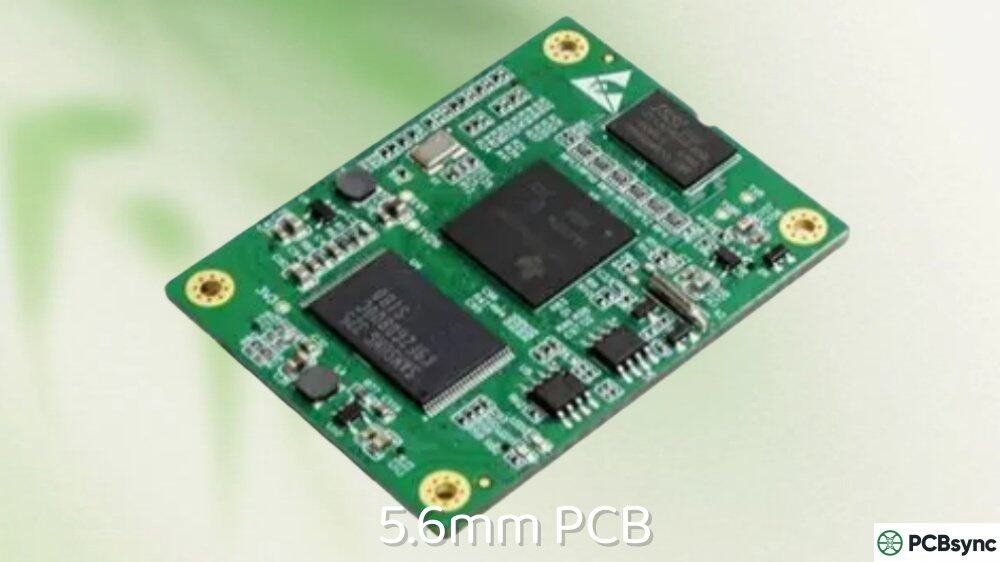
When you’ve pushed past the 5.0mm threshold but don’t need to jump all the way to 6.0mm, the 5.6mm PCB sits in a strategic middle ground that many engineers overlook. I’ve specified this thickness on several high-layer-count backplane projects where 5.0mm couldn’t deliver the layer density we needed, but jumping to 6.0mm would have triggered unnecessary cost escalation and lead time extensions.
A 5.6mm PCB (220 mil or 0.220″) occupies a critical position in the extreme backplane spectrum. You get significantly more routing capacity and mechanical strength than a 5.0mm board while avoiding the dramatic manufacturing complexity increase that comes at 6.0mm. Industry data shows that backplane thicknesses typically range from 4mm to 6mm, making the 5.6mm PCB a practical choice when your 40+ layer design demands more headroom than 5.0mm provides.
Why 5.6mm PCB Represents the Optimal Balance Point
The 5.6mm PCB thickness emerged as a practical solution for designs that outgrew 5.0mm capability but didn’t warrant 6.0mm complexity. Understanding where this thickness sits helps clarify when it becomes the right choice.
5.6mm PCB Positioning in Extreme Thickness Categories
Thickness
Classification
Layer Capability
Heavy Copper
Cost vs 5.0mm
Manufacturing Complexity
4.8mm
Heavy-duty
30-38 layers
6-10oz
-15%
Moderate
5.0mm
Major threshold
36-44 layers
10-12oz
Baseline
High
5.6mm
Sweet spot
40-50 layers
10-14oz
+12-18%
High
6.0mm
Extreme
44-56 layers
12-16oz
+35-50%
Very high
6.5mm+
Ultra-extreme
50+ layers
14oz+
+60-100%
Specialized only
The 5.6mm PCB provides approximately 12% more stack-up capacity than 5.0mm while adding only modest cost premium. In contrast, stepping to 6.0mm triggers substantially higher manufacturing costs and much longer lead times.
What Makes 5.6mm PCB the Manufacturing Sweet Spot
Manufacturing Factor
At 5.0mm
At 5.6mm PCB
At 6.0mm
Lamination equipment
Heavy-duty
Heavy-duty (same)
Enhanced heavy-duty
Diamond drilling
Mandatory
Mandatory (same)
Mandatory
Press cycle
180-240 min
210-270 min
270-360 min
Fabricator pool
~10-15 worldwide
~10-15 worldwide
<10 worldwide
Typical lead time
6-8 weeks
7-9 weeks
8-12 weeks
The 5.6mm PCB leverages the same manufacturing infrastructure as 5.0mm boards. Fabricators already tooled for 5.0mm can typically handle 5.6mm without major process changes, while 6.0mm often requires enhanced equipment and longer processing cycles.
When Your Design Demands a 5.6mm PCB
Engineers specify 5.6mm PCB thickness when their requirements exceed 5.0mm capability but don’t justify stepping to 6.0mm.
Modern telecom infrastructure, AI server interconnects, and data center switching fabric increasingly require 40-50 layer backplanes. The 5.6mm PCB accommodates these layer counts with proper dielectric spacing.
Layer Count Requirement
5.0mm Feasibility
5.6mm PCB Capability
6.0mm Approach
36-40 layers
Achievable
Comfortable
Overkill
40-44 layers
Very tight
Achievable
Comfortable
44-48 layers
Not recommended
Challenging
Achievable
48-50 layers
Not feasible
Maximum practical
Comfortable
For designs targeting 42-48 layers, the 5.6mm PCB provides the optimal balance between manufacturing feasibility and cost efficiency.
Ultra-Heavy Copper Integration in 5.6mm PCB
High-current backplanes supporting next-generation AI accelerators and network switches often require extreme copper weights on power distribution layers. The additional 0.6mm thickness compared to 5.0mm provides meaningful headroom for heavy copper integration.
Copper Configuration
Current Capacity (12mm trace width)
5.6mm PCB Suitability
8oz power layers
~192A maximum
Comfortable
10oz power layers
~240A maximum
Well suited
12oz power layers
~288A maximum
Optimal match
14oz power layers
~336A maximum
Maximum practical
The 5.6mm PCB supports heavier copper configurations than 5.0mm while maintaining signal layer integrity throughout the stack-up.
Extended Press-Fit Engagement Zone Benefits
Large backplane assemblies with 500+ press-fit connector pins benefit significantly from the extended copper barrel in a 5.6mm PCB. The longer engagement zone provides superior retention force and electrical reliability.
Press-Fit Parameter
At 5.0mm
At 5.6mm PCB
Improvement
Copper barrel length
~4.8mm
~5.4mm
+12.5%
Retention force
Baseline
+10-15%
Noticeable
Electrical reliability
Good
Excellent
Measurable
Insertion cycles
Standard
Extended
Enhanced
For high-reliability applications requiring multiple card insertion cycles, the 5.6mm PCB provides tangible retention improvement over 5.0mm.
5.6mm PCB Stack-Up Design Considerations
Designing an effective stack-up for a 5.6mm PCB requires balancing layer count, copper distribution, and signal integrity requirements.
At 5.6mm thickness, aspect ratio becomes a primary design constraint. Understanding the relationship between board thickness, via diameter, and plating reliability is essential.
5.6mm PCB Via Sizing Calculations
The aspect ratio formula directly determines minimum via diameter:
Aspect Ratio = Board Thickness ÷ Via Diameter
For 5.6mm PCB at various aspect ratios:
Target Aspect Ratio
Minimum Via Diameter
Manufacturing Notes
10:1 (industry max)
0.56mm (22 mil)
Maximum capability
9.3:1 (recommended)
0.60mm (24 mil)
Reliable production
8.6:1 (conservative)
0.65mm (26 mil)
Standard process
8.0:1 (relaxed)
0.70mm (28 mil)
Highest reliability
For 5.6mm PCB designs, specifying 0.60mm minimum via diameter provides a 9.3:1 aspect ratio with comfortable manufacturing margin.
In ultra-thick boards like a 5.6mm PCB, via stubs create severe signal degradation at high frequencies. Back-drilling becomes mandatory for virtually all modern high-speed protocols.
Via Stub Problem in 5.6mm PCB
When a via connects signal layers near the top of a 5.6mm PCB, the unused barrel extending through remaining layers creates a resonant stub. At 5.6mm thickness, these stubs can exceed 5mm in length.
Back-drilling adds approximately 25-35% to 5.6mm PCB fabrication cost but is essential for any design operating at 25 Gbps and above.
Manufacturing Process for 5.6mm PCB Production
Diamond Drilling: Essential for 5.6mm PCB
At 5.6mm thickness, diamond drilling (also called double-pass drilling or drill from both sides) becomes the standard approach. Single-pass mechanical drilling cannot achieve required accuracy at this depth.
Drilling Method
Maximum Depth
Tolerance
5.6mm PCB Application
Single-pass mechanical
~4.5mm
±0.10mm
Large holes only (>0.80mm)
Diamond drilling
8.0mm+
±0.05mm
All precision PTH
Laser drilling
~0.20mm
±0.02mm
Blind microvias only
Controlled-depth
Per design
±0.08mm
Back-drill, blind vias
Diamond drilling requires precise positioning systems and CCD camera alignment to ensure top and bottom drill paths meet accurately in the center of the board.
Electroplating Challenges in 5.6mm PCB
Achieving uniform copper distribution in high-aspect-ratio holes at 5.6mm thickness demands advanced plating technology.
Plating Technology
Aspect Ratio Limit
Uniformity
5.6mm PCB Suitability
Conventional DC
6:1
Fair
Not recommended
Pulse plating
8:1
Good
Marginal
Pulse-reverse
10:1
Excellent
Required standard
PPR (periodic pulse reverse)
12:1+
Superior
Premium applications
Pulse-reverse plating is required for reliable 5.6mm PCB production. The periodic reversal dissolves copper buildup at the hole mouth, allowing solution penetration to the center of deep holes.
Lamination Considerations for 5.6mm PCB
Process Parameter
5.0mm Board
5.6mm PCB
6.0mm Board
Press cycle duration
180-240 min
210-270 min
270-360 min
Peak temperature hold
Standard
+15-20 min
+30-45 min
Cooling rate
Standard
Controlled
Slow controlled
Layer registration
±0.05mm
±0.05mm
±0.04mm
Post-cure requirement
Recommended
Recommended
Often required
The extended press cycles and controlled cooling for 5.6mm PCB ensure complete resin cure and minimize internal stress.
Cost Analysis: 5.6mm PCB vs Alternatives
5.6mm PCB Cost Comparison
Cost Component
5.0mm Baseline
5.6mm PCB
6.0mm Board
Base laminate materials
100%
112%
130%
Processing labor
100%
110%
135%
Drilling operations
100%
108%
125%
Plating chemistry
100%
105%
118%
Quality inspection
100%
103%
115%
Total fabrication
100%
~112-118%
~140-155%
The 5.6mm PCB typically costs 12-18% more than 5.0mm, while 6.0mm can cost 40-55% more. This makes 5.6mm the economical choice when 5.0mm is insufficient.
Lead Time Expectations for 5.6mm PCB
Production Phase
5.0mm Board
5.6mm PCB
6.0mm Board
Engineering review
5-7 days
5-7 days
7-10 days
Material procurement
2-3 weeks
2-3 weeks
3-4 weeks
Fabrication
3-4 weeks
3.5-4.5 weeks
4-5 weeks
Testing/inspection
3-5 days
4-6 days
5-7 days
Total lead time
6-8 weeks
7-9 weeks
8-12 weeks
Selecting a Qualified 5.6mm PCB Fabricator
Not every PCB manufacturer can produce quality 5.6mm PCBs. Evaluating fabricator capabilities is essential.
Required Fabricator Capabilities for 5.6mm PCB
Capability
Minimum Requirement
Preferred
Maximum board thickness
6.0mm demonstrated
8.0mm+
Layer count capability
46+ layers
56+ layers
Aspect ratio certification
10:1
12:1
Diamond drilling
In-house standard
Automated positioning
Pulse-reverse plating
Standard process
PPR available
Back-drilling tolerance
±0.10mm
±0.05mm
Backplane experience
Multiple projects
Ongoing production
Key Questions for 5.6mm PCB Fabricator Evaluation
Before engaging a fabricator for 5.6mm PCB production, engineers should confirm these capabilities:
Question Area
Specific Questions
Thickness experience
“Monthly volume of boards >5mm thickness?”
Drilling capability
“Diamond drilling equipment and certification?”
Plating technology
“Pulse-reverse plating uniformity data?”
Back-drilling
“Guaranteed depth tolerance at 5.6mm?”
Quality evidence
“Recent microsection photos from 5.5-6.0mm boards?”
Lead time reality
“Actual delivery times for recent 46-layer orders?”
5.6mm PCB Applications in Modern Infrastructure
Telecom Switching Fabric
Modern 5G core network equipment and enterprise switches increasingly specify 5.6mm PCB for primary backplanes. The additional layer count enables higher-density interconnect between line cards while maintaining signal integrity at 56+ Gbps per lane.
Data Center and AI Server Midplanes
AI training clusters and inference servers require massive interconnect bandwidth between GPU/accelerator cards. The 5.6mm PCB provides the layer count and heavy copper capacity for these high-power, high-speed midplane applications.
High-Performance Computing (HPC) Interconnects
Supercomputer backplanes connecting hundreds of compute nodes specify 5.6mm PCB thickness to accommodate dense high-speed routing with robust power distribution.
Material Selection for 5.6mm PCB High-Speed Performance
Many 5.6mm PCB designs use hybrid material systems, placing expensive low-loss laminates only where needed for high-speed signals while using standard FR-4 for power distribution layers.
Layer Function
Material Selection
Rationale
Outer signal layers
Low-loss (Megtron 6)
Direct high-speed paths
Inner high-speed
Low-loss
Critical signal integrity
Power planes
Standard FR-4 Tg170
Cost optimization
Ground planes
Standard FR-4 Tg170
Cost optimization
The 5.6mm PCB Decision Framework
Choose 5.6mm PCB When:
Your design requirements match these criteria:
Requirement
5.0mm Limitation
5.6mm PCB Solution
Layer count
36-44 layers max
40-50 layers comfortable
Heavy copper
10-12oz maximum
10-14oz achievable
Stack-up margin
Tight or insufficient
Adequate headroom
Cost sensitivity
—
Moderate premium acceptable
Lead time
6-8 weeks
7-9 weeks acceptable
Consider 6.0mm Instead When:
Scenario
Why 6.0mm May Be Better
Layer count >50
Provides necessary stack-up depth
Heavy copper >14oz
More practical integration
Future-proofing
Allows design headroom
Cost is secondary
Maximum capability required
Frequently Asked Questions About 5.6mm PCB
What is the minimum via diameter for a 5.6mm PCB?
At 5.6mm thickness with a 10:1 aspect ratio limit, the minimum via diameter calculates to 0.56mm. However, for reliable production, I recommend specifying 0.60mm minimum via diameter, which provides a 9.3:1 aspect ratio with comfortable manufacturing margin. This accounts for plating thickness variations and ensures consistent copper deposition throughout the via barrel.
How much does a 5.6mm PCB cost compared to standard thickness?
A 5.6mm PCB typically costs 12-18% more than a 5.0mm board of similar complexity. Compared to a standard 1.6mm PCB, expect 300-400% higher cost due to the extreme layer count, specialized drilling, and pulse-reverse plating requirements. The cost premium over 5.0mm is primarily driven by extended lamination cycles and additional material volume.
Which fabricators can manufacture 5.6mm PCB?
The pool of capable fabricators for 5.6mm PCB is limited to perhaps 10-15 manufacturers worldwide with demonstrated backplane expertise. Look for fabricators with documented experience at 6.0mm+ thickness, 10:1 aspect ratio certification, in-house diamond drilling, and pulse-reverse plating capability. Major backplane specialists in Asia and select North American/European facilities can handle this thickness class.
Is back-drilling mandatory for every 5.6mm PCB design?
Back-drilling is mandatory for any 5.6mm PCB carrying signals at 10 Gbps or higher. At this thickness, via stubs can exceed 5mm in length, creating severe resonance and signal degradation. For lower-speed digital or power distribution applications only, back-drilling may be optional, but virtually all modern high-speed protocols (PCIe Gen 4+, 100G Ethernet, etc.) require back-drilled vias in boards of this thickness.
What layer count can a 5.6mm PCB support?
A 5.6mm PCB practically supports 40-50 layers depending on copper weight distribution and dielectric requirements. With standard 1oz signal layers and 4oz power layers, 46-48 layers is achievable. With thinner dielectrics and 0.5oz signal layers, 50 layers becomes possible. Layer counts above 50 typically require stepping to 6.0mm or greater thickness.
The 5.6mm PCB represents a practical solution for extreme backplane requirements that exceed 5.0mm capability without triggering the cost and complexity escalation at 6.0mm. When your design demands 40-50 layers with heavy copper integration and high-speed signal routing, this thickness class delivers the manufacturing sweet spot that balances performance, cost, and fabricator availability.
Inquire: Call 0086-755-23203480, or reach out via the form below/your sales contact to discuss our design, manufacturing, and assembly capabilities.
Quote: Email your PCB files to Sales@pcbsync.com (Preferred for large files) or submit online. We will contact you promptly. Please ensure your email is correct.
Notes: For PCB fabrication, we require PCB design file in Gerber RS-274X format (most preferred), *.PCB/DDB (Protel, inform your program version) format or *.BRD (Eagle) format. For PCB assembly, we require PCB design file in above mentioned format, drilling file and BOM. Click to download BOM template To avoid file missing, please include all files into one folder and compress it into .zip or .rar format.