Inquire: Call 0086-755-23203480, or reach out via the form below/your sales contact to discuss our design, manufacturing, and assembly capabilities.
Quote: Email your PCB files to Sales@pcbsync.com (Preferred for large files) or submit online. We will contact you promptly. Please ensure your email is correct.
Notes: For PCB fabrication, we require PCB design file in Gerber RS-274X format (most preferred), *.PCB/DDB (Protel, inform your program version) format or *.BRD (Eagle) format. For PCB assembly, we require PCB design file in above mentioned format, drilling file and BOM. Click to download BOM template To avoid file missing, please include all files into one folder and compress it into .zip or .rar format.
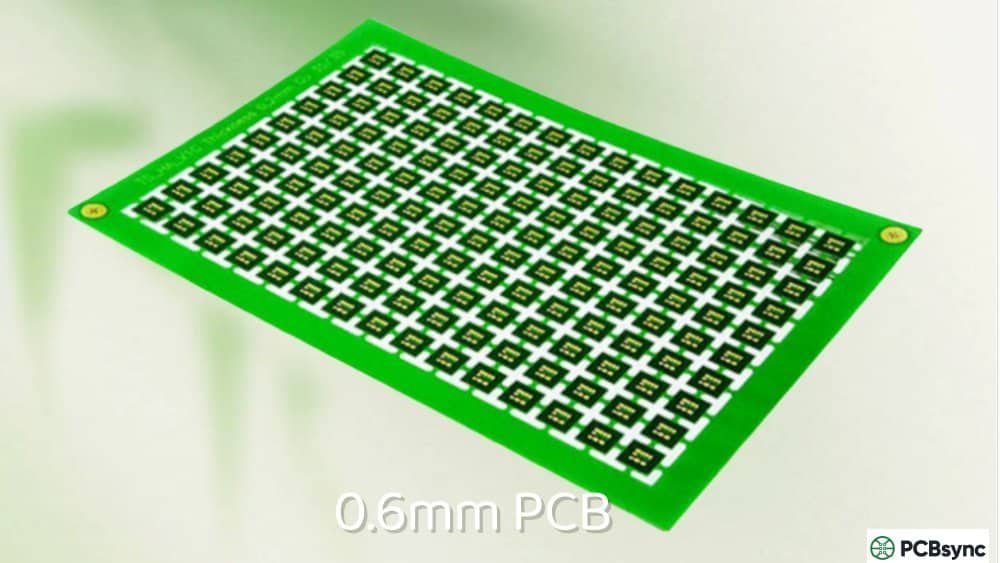
If you’ve been designing thin PCBs and running into surface finish restrictions, 0.6mm PCB is where those limitations finally disappear. After years of working with various board thicknesses, I can tell you that 0.6mm represents a critical threshold in PCB manufacturing—it’s the first thickness that supports every surface finish option, including Lead-Free HASL.
Most engineers don’t realize this until they spec a 0.4mm or 0.5mm board and discover their preferred finish isn’t available. I’ve seen this happen countless times: a designer submits files for a thin board with HASL specified, only to get a call from the fab house asking them to switch to ENIG or increase the thickness. With 0.6mm PCB, you never face that conversation.
This guide covers everything you need to know about 0.6mm PCB design and manufacturing—from why this thickness unlocks all surface finishes to detailed stack-up configurations for 4-layer and 6-layer designs.
The 0.6mm PCB (0.024 inches or 24 mils) sits at an important intersection in PCB manufacturing. It’s thin enough to fit in space-constrained applications like GPS modules, automotive sensors, and compact IoT devices, yet robust enough to withstand the thermal stress of Lead-Free HASL processing.
Here’s the practical significance: when you dip a PCB into molten solder during HASL processing, boards thinner than 0.6mm can warp, bend, or even crack. The high-temperature immersion (around 260°C for lead-free alloys) combined with the air knife leveling process puts significant mechanical stress on the substrate. At 0.6mm, the board has enough structural integrity to survive this process without deformation.
Specification
0.6mm PCB Value
Thickness (Metric)
0.6mm
Thickness (Imperial)
0.024 inches / 24 mils
Typical Layer Count
2-6 layers
Maximum Practical Layers
8 layers
Minimum Trace Width
3 mil (0.075mm)
Minimum Trace Spacing
3 mil (0.075mm)
Minimum Via Diameter
0.2mm
Via Aspect Ratio
Up to 8:1
Cost Premium vs 1.6mm
~5% additional
Why 0.6mm PCB is the Threshold for Lead-Free HASL
The relationship between board thickness and HASL compatibility comes down to physics. During the HASL process, your PCB goes through several stress-inducing steps: flux application, immersion in molten solder at 260°C+, rapid extraction, and hot air leveling. Each step creates thermal gradients and mechanical forces.
For Lead-Free HASL specifically, the situation is more demanding than traditional tin-lead HASL. Lead-free alloys like SAC305 (96.5% tin, 3% silver, 0.5% copper) have higher melting points—around 217°C compared to 183°C for eutectic tin-lead. This means higher process temperatures and greater thermal stress on the substrate.
At thicknesses below 0.6mm, boards simply cannot withstand Lead-Free HASL processing reliably. The substrate bends during solder immersion, leading to uneven coating—thick in the middle, thin or bare on the edges. In worst cases, the board cracks. This is why every major fabricator sets 0.6mm as the minimum for Lead-Free HASL.
Complete Surface Finish Options for 0.6mm PCB
One of the primary advantages of choosing 0.6mm PCB thickness is unrestricted access to all surface finish options. Here’s what becomes available at this thickness:
Hot Air Solder Leveling (HASL)
HASL remains one of the most cost-effective and reliable surface finishes. At 0.6mm, both tin-lead and lead-free variants are available.
HASL Type
Thickness Range
Shelf Life
RoHS Status
Tin-Lead HASL
1-50 µm
12+ months
Non-compliant
Lead-Free HASL
2.5-25 µm
12+ months
Compliant
Lead-Free HASL uses SAC305 or similar alloys and provides excellent solderability with good oxidation resistance. The finish is self-healing during reflow—if the surface oxidizes slightly during storage, the assembly process burns through it.
Electroless Nickel Immersion Gold (ENIG)
ENIG remains available at 0.6mm and offers superior flatness for fine-pitch components. The nickel barrier (2.5-5 µm) prevents copper diffusion while the gold layer (0.05-0.23 µm) protects against oxidation.
ENIG Parameter
Specification
Nickel Thickness
2.5-5.0 µm
Gold Thickness
0.05-0.23 µm
Shelf Life
12 months
Flatness
Excellent
Fine-pitch Capability
Down to 0.4mm pitch
Immersion Silver (IAg)
Immersion silver provides excellent solderability and signal integrity for high-frequency applications. The thin silver layer (0.12-0.40 µm) doesn’t add significant surface topology.
Immersion Tin (ISn)
At approximately 1.0 µm thickness, immersion tin offers good solderability for through-hole applications. The shorter shelf life (6 months) requires attention to storage and handling.
OSP (Organic Solderability Preservative)
OSP provides a thin organic coating (0.2-0.5 µm) that protects copper from oxidation. It’s the most economical finish but has limitations for multiple reflow cycles.
Surface Finish Comparison for 0.6mm PCB
Finish
Cost
Flatness
Shelf Life
Reflow Cycles
Best Application
Lead-Free HASL
Low
Poor
12+ months
Multiple
General purpose, automotive
ENIG
High
Excellent
12 months
Multiple
Fine-pitch, wire bonding
Immersion Silver
Medium
Excellent
6 months
2-3
RF/high-frequency
Immersion Tin
Medium
Excellent
6 months
2-3
Through-hole, press-fit
OSP
Lowest
Excellent
6 months
1-2
Cost-sensitive, single reflow
0.6mm PCB Materials and Substrate Options
The 0.6mm PCB thickness works with all standard substrate materials. Your material choice depends on the application requirements—thermal performance, dielectric properties, and cost constraints.
FR-4 Standard (Tg 130-140°C)
Standard FR-4 works for most 0.6mm PCB applications where the board doesn’t see extreme temperatures. It’s the most economical choice for consumer electronics and general-purpose designs.
FR-4 High-Tg (Tg 150-180°C)
For 0.6mm PCBs going through lead-free assembly, high-Tg FR-4 is strongly recommended. The higher glass transition temperature prevents delamination during the elevated reflow temperatures (peak 260°C+) required for SAC305 solder paste.
FR-4 Type
Glass Transition (Tg)
Decomposition (Td)
Recommended For
Standard
130-140°C
300°C
Tin-lead assembly
Mid-Tg
150°C
320°C
Lead-free assembly
High-Tg
170-180°C
340°C
Multiple reflow, harsh environments
High-Frequency Materials
For RF applications at 0.6mm thickness, specialized laminates provide lower loss and tighter dielectric constant control.
At 0.6mm PCB thickness, you can build 2-layer, 4-layer, and even 6-layer configurations. The layer count affects routing density, signal integrity, and power distribution capabilities.
2-Layer 0.6mm PCB Stack-Up
A 2-layer configuration at 0.6mm is straightforward and cost-effective for simpler designs.
Layer
Function
Thickness
Top Copper
Signal + Components
35 µm (1 oz)
Core
FR-4 Dielectric
0.51mm
Bottom Copper
Signal + Ground
35 µm (1 oz)
Total
0.6mm
4-Layer 0.6mm PCB Stack-Up
The 4-layer configuration provides dedicated power and ground planes, significantly improving signal integrity and EMI performance.
Layer
Function
Material
Thickness
L1 (Top)
Signal
Copper
18 µm (0.5 oz)
Prepreg
Dielectric
1080
0.075mm
L2
Ground
Copper
18 µm (0.5 oz)
Core
Dielectric
FR-4
0.36mm
L3
Power
Copper
18 µm (0.5 oz)
Prepreg
Dielectric
1080
0.075mm
L4 (Bottom)
Signal
Copper
18 µm (0.5 oz)
Total
0.6mm
This stack-up places signal layers adjacent to reference planes, enabling controlled impedance routing. The thin prepreg layers (0.075mm) allow tight coupling between signal and reference planes.
6-Layer 0.6mm PCB Stack-Up
A 6-layer configuration at 0.6mm thickness is possible but requires careful material selection and very thin dielectrics.
Layer
Function
Material
Thickness
L1 (Top)
Signal
Copper
12 µm (0.33 oz)
Prepreg
Dielectric
1080
0.05mm
L2
Ground
Copper
12 µm (0.33 oz)
Core
Dielectric
FR-4
0.12mm
L3
Signal
Copper
12 µm (0.33 oz)
Prepreg
Dielectric
1080
0.05mm
L4
Power
Copper
12 µm (0.33 oz)
Core
Dielectric
FR-4
0.12mm
L5
Ground
Copper
12 µm (0.33 oz)
Prepreg
Dielectric
1080
0.05mm
L6 (Bottom)
Signal
Copper
12 µm (0.33 oz)
Total
0.6mm
Note that 6-layer designs at 0.6mm require reduced copper weights (0.33 oz or 12 µm) and thin cores. This configuration is technically challenging and not all fabricators support it—confirm capabilities before committing to this stack-up.
Via sizing must account for the reduced board thickness. The aspect ratio (board thickness to via diameter) should generally stay below 8:1 for reliable plating.
For controlled impedance routing on 0.6mm PCB, the thin dielectric layers in multilayer configurations enable tight coupling but require narrower traces.
Impedance Target
4-Layer Microstrip
4-Layer Stripline
50 Ω Single-ended
4-5 mil trace
3-4 mil trace
100 Ω Differential
4 mil trace, 5 mil space
3 mil trace, 4 mil space
90 Ω Differential
5 mil trace, 6 mil space
4 mil trace, 5 mil space
Use your fabricator’s impedance calculator or tools like Saturn PCB Toolkit to verify exact dimensions based on your specific stack-up and materials.
0.6mm PCB Manufacturing Process
Manufacturing 0.6mm PCB follows standard rigid PCB processes with some adjustments for the thinner substrate.
Lamination Parameters
The lamination cycle for 0.6mm boards requires careful temperature and pressure control to prevent warping.
Parameter
0.6mm PCB
Standard 1.6mm
Lamination Pressure
250-300 psi
300-400 psi
Peak Temperature
180-190°C
180-190°C
Cure Time
60-90 minutes
60-90 minutes
Cool-down Rate
2-3°C/minute
3-4°C/minute
Drilling Specifications
Drilling Parameter
Specification
Minimum Mechanical Drill
0.15mm
Minimum Laser Drill
0.075mm
Stack Height
2-4 panels
Entry/Exit Material
Aluminum + phenolic
Spindle Speed
100,000-150,000 RPM
Registration Tolerance
Thinner boards are more susceptible to dimensional changes during processing. Account for this in your design margins.
Registration Parameter
Tolerance
Layer-to-Layer
±0.075mm
Hole-to-Copper
±0.1mm
Outer Layer Pattern
±0.05mm
Real-World Applications for 0.6mm PCB
The 0.6mm PCB thickness serves applications that need thin profiles combined with surface finish flexibility.
GPS and Navigation Modules
GPS tracking devices commonly use 0.6mm PCBs. The 6-layer blind via configuration enables compact routing for GPS receivers while maintaining signal integrity. Many automotive GPS modules specify Lead-Free HASL for reliability in harsh environments—a finish that requires 0.6mm minimum thickness.
Automotive Electronics
Automotive applications often mandate HASL finishes for their proven long-term reliability and multiple reflow capability. Dashboard instruments, sensor modules, and control units frequently use 0.6mm PCBs to meet space constraints while maintaining automotive-grade surface finish requirements.
Industrial IoT Sensors
Industrial sensors need robust surface finishes that survive harsh environments. Lead-Free HASL on 0.6mm PCB provides excellent oxidation resistance and reliable soldering even after extended storage.
Wearable Device Main Boards
While ultra-thin flex circuits handle the most space-constrained wearable components, the main processor boards in smartwatches and fitness trackers often use 0.6mm rigid PCBs. The full surface finish selection allows designers to optimize for their specific assembly process.
Application
Typical Layer Count
Preferred Surface Finish
GPS Modules
4-6 layers
Lead-Free HASL, ENIG
Automotive Sensors
4 layers
Lead-Free HASL
Industrial IoT
2-4 layers
Lead-Free HASL
Wearable Main PCB
4 layers
ENIG, Immersion Gold
Camera Modules
4-6 layers
ENIG
Smart Home Devices
2-4 layers
OSP, Lead-Free HASL
0.6mm PCB vs Other Thin Board Thicknesses
Understanding how 0.6mm PCB compares to other thin options helps you make the right thickness choice for your project.
Characteristic
0.4mm
0.5mm
0.6mm
0.8mm
Lead-Free HASL
No
Limited
Yes
Yes
Tin-Lead HASL
No
Yes
Yes
Yes
Maximum Layers
4
4-6
6-8
8-10
Handling Difficulty
High
Medium-High
Medium
Low
Mechanical Strength
Low
Medium
Good
Very Good
Cost Premium
20-25%
10-15%
~5%
Minimal
Warpage Risk
High
Medium
Low
Very Low
The 0.6mm thickness offers the best balance for most thin-board applications: full surface finish access, 6-layer capability, manageable handling, and minimal cost premium over standard thickness.
Challenges and Solutions for 0.6mm PCB Design
Handling and Assembly
Challenge: 0.6mm boards can flex during pick-and-place and reflow if not properly supported.
Solution: Use board carriers or pallets during assembly. Ensure your CM has proper handling procedures for thin boards. Consider adding breakaway rails that provide temporary rigidity.
Panelization
Challenge: Thin boards are more prone to damage from V-scoring and can warp in panels.
Solution: Use tab routing instead of V-scoring. Include mouse bites or breakaway tabs. Design panels with adequate frame width (minimum 5mm) for rigidity.
Panelization Method
Suitability for 0.6mm
V-Score
Not recommended
Tab Routing
Recommended
Mouse Bites
Good
Routed + Breakaway
Best
Warpage Control
Challenge: Thin boards can warp during thermal processes (lamination, reflow, wave solder).
Solution: Balance copper distribution across layers. Maintain symmetric stack-ups. Control reflow profiles carefully—slower ramp rates reduce thermal stress.
Component Selection
Challenge: Heavy components can stress thin substrates.
Solution: Avoid placing heavy connectors or transformers on 0.6mm boards. If unavoidable, add mechanical support through enclosure mounting or underfill.
How to Order 0.6mm PCB: Specification Checklist
When ordering 0.6mm PCB from your fabricator, include these specifications to avoid miscommunication:
Can I use Lead-Free HASL on boards thinner than 0.6mm?
No. Lead-Free HASL requires a minimum board thickness of 0.6mm. Boards thinner than this cannot withstand the thermal stress of the molten solder immersion process (260°C+) without warping or cracking. For thinner boards, use ENIG, OSP, immersion silver, or immersion tin instead.
How many layers can I fit in a 0.6mm PCB?
A 0.6mm PCB can accommodate 2, 4, or 6 layers depending on your copper weight and dielectric requirements. Four-layer designs are most common at this thickness, using 0.5 oz copper and thin prepreg layers. Six-layer designs are possible but require reduced copper weights (0.33 oz) and very thin dielectrics—confirm capability with your fabricator before designing.
Is 0.6mm PCB more expensive than standard 1.6mm thickness?
The cost premium for 0.6mm PCB is approximately 5% compared to standard 1.6mm boards. This is significantly less than thinner options like 0.4mm (20-25% premium) or 0.5mm (10-15% premium). The minimal cost increase combined with full surface finish access makes 0.6mm an economical choice for thin-board applications.
What applications typically use 0.6mm PCB?
Common applications include GPS and navigation modules, automotive sensor boards, industrial IoT devices, wearable device main boards, and camera modules. These applications require thin profiles for space constraints but also need robust surface finishes like Lead-Free HASL for reliability—requirements that 0.6mm PCB uniquely satisfies.
How do I prevent warpage in 0.6mm PCB during assembly?
To minimize warpage during assembly: use board carriers or pallets during pick-and-place and reflow; ensure symmetric copper distribution across layers; use slower reflow ramp rates (1-2°C/second); avoid heavy components where possible; and consider adding temporary breakaway rails for additional rigidity. High-Tg FR-4 (Tg 150°C+) also improves thermal stability during lead-free reflow.
Summary: Why Choose 0.6mm PCB for Your Next Design
The 0.6mm PCB thickness represents the sweet spot for thin-board designs that require surface finish flexibility. As the first thickness supporting all surface finishes including Lead-Free HASL, 0.6mm eliminates the finish restrictions that complicate thinner designs.
Key advantages of 0.6mm PCB:
Complete access to all surface finishes, including Lead-Free HASL
Support for up to 6-layer designs with proper stack-up planning
Only ~5% cost premium over standard 1.6mm thickness
Adequate mechanical strength for standard handling and assembly
Proven reliability in automotive, GPS, and industrial applications
Whether you’re designing GPS tracking modules, automotive sensors, or compact IoT devices, 0.6mm PCB delivers the thin profile you need without compromising on surface finish options or manufacturing quality.
Inquire: Call 0086-755-23203480, or reach out via the form below/your sales contact to discuss our design, manufacturing, and assembly capabilities.
Quote: Email your PCB files to Sales@pcbsync.com (Preferred for large files) or submit online. We will contact you promptly. Please ensure your email is correct.
Notes: For PCB fabrication, we require PCB design file in Gerber RS-274X format (most preferred), *.PCB/DDB (Protel, inform your program version) format or *.BRD (Eagle) format. For PCB assembly, we require PCB design file in above mentioned format, drilling file and BOM. Click to download BOM template To avoid file missing, please include all files into one folder and compress it into .zip or .rar format.