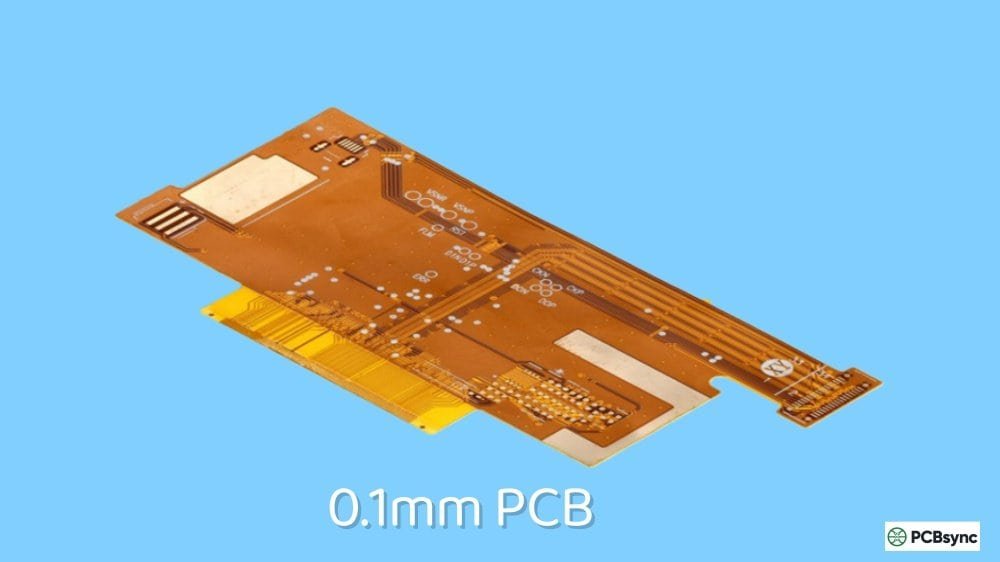
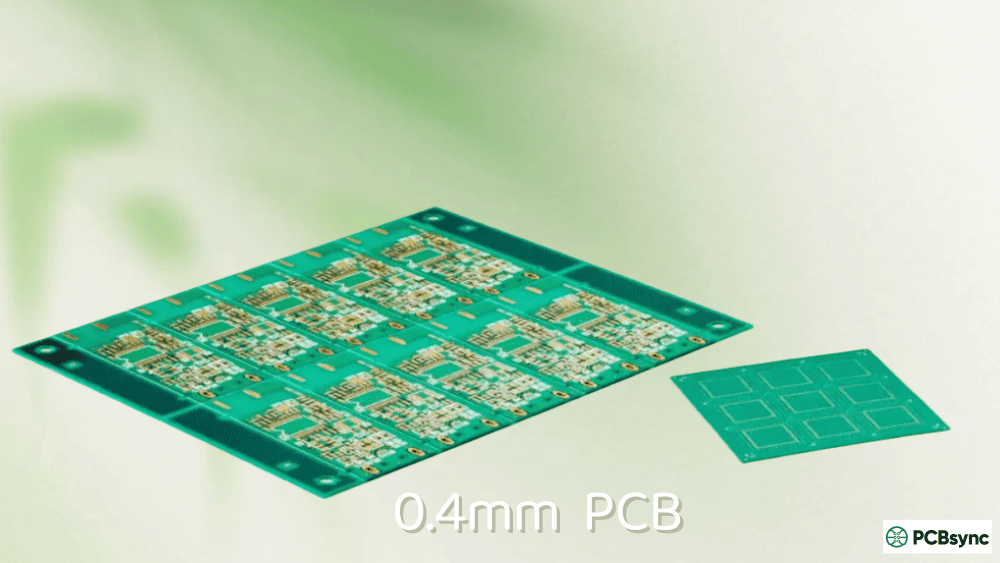
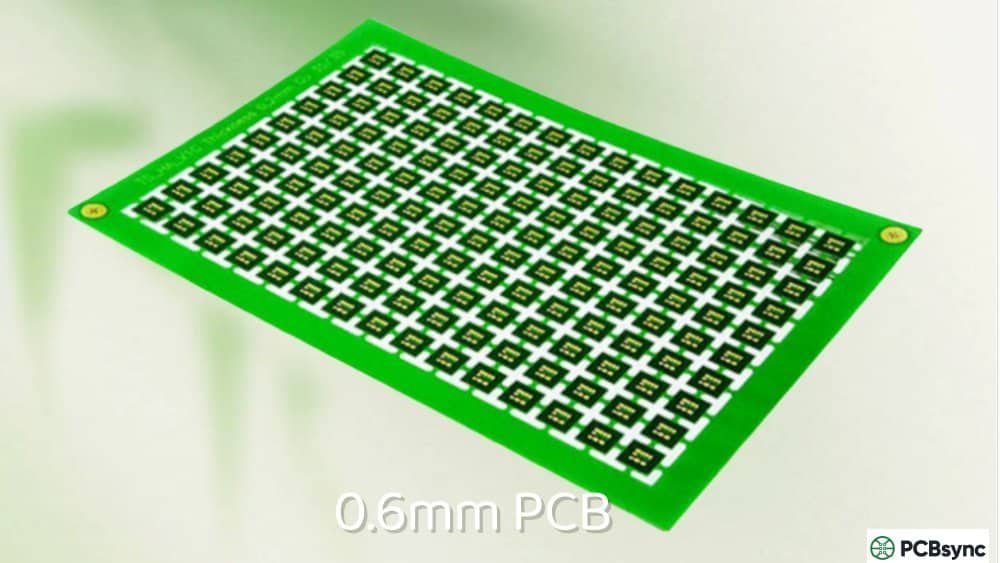
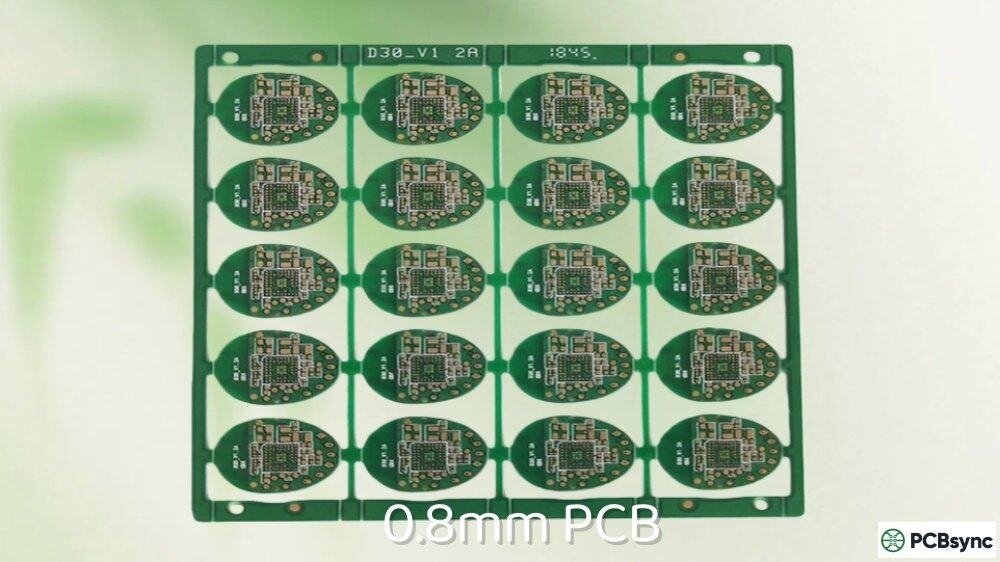
Inquire: Call 0086-755-23203480, or reach out via the form below/your sales contact to discuss our design, manufacturing, and assembly capabilities.
Quote: Email your PCB files to Sales@pcbsync.com (Preferred for large files) or submit online. We will contact you promptly. Please ensure your email is correct.
Notes: For PCB fabrication, we require PCB design file in Gerber RS-274X format (most preferred), *.PCB/DDB (Protel, inform your program version) format or *.BRD (Eagle) format. For PCB assembly, we require PCB design file in above mentioned format, drilling file and BOM. Click to download BOM template To avoid file missing, please include all files into one folder and compress it into .zip or .rar format.
When engineers ask me about thin PCB options, the conversation often comes down to finding the right balance. Go too thin and you’re fighting warpage, limited surface finishes, and assembly headaches. Go too thick and you waste precious space in compact products. That’s why 0.5mm PCB has become my go-to recommendation for many projects—it delivers the thinness modern devices demand while avoiding the manufacturing complications of ultra-thin boards.
This guide covers everything you need to know about 0.5mm PCB design, from stack-up configurations to surface finish options. Whether you’re developing wearables, IoT sensors, or portable consumer electronics, understanding this versatile thickness will help you make smarter design decisions.
A 0.5mm PCB is a printed circuit board with a total finished thickness of 0.5 millimeters (approximately 0.020 inches or 20 mils). This measurement encompasses all layers—substrate material, copper, plating, solder mask, and surface finish—combined into the final board.
The 20-mil imperial equivalent makes 0.5mm a convenient specification that’s easy to communicate across international teams. Unlike 0.4mm (16 mils) or 0.6mm (24 mils), the round number simplifies documentation and reduces specification errors.
Specification
Value
Finished Thickness
0.5mm (±0.1mm tolerance)
Raw Material Thickness
0.4mm typical
Imperial Equivalent
0.020″ / 20 mils
Maximum Practical Layers
4-6 layers
Minimum Via Diameter
0.15mm mechanical
When you order a 0.5mm finished thickness board, manufacturers typically start with 0.4mm raw material. The additional 0.1mm comes from copper plating, surface finish, and solder mask layers applied during fabrication.
Why 0.5mm PCB is the Practical Thin Board Choice
The 0.5mm thickness occupies a strategic position in the PCB thickness spectrum. It’s thin enough to fit space-constrained designs while thick enough to avoid the PCB manufacturing challenges that plague thinner boards.
Better handling than ultra-thin options. Boards at 0.4mm and below require special carriers and careful handling throughout manufacturing and assembly. At 0.5mm, standard production equipment handles the boards without significant modification.
All surface finishes available. Unlike 0.4mm boards (which can’t use some finishes) or 0.3mm boards (which are limited to ENIG and OSP), 0.5mm thickness supports virtually every surface finish except lead-free HASL, which requires 0.6mm minimum.
Comfortable multilayer capability. You can reliably build 4-layer and even 6-layer boards at 0.5mm without pushing manufacturing limits. The extra 0.1mm over 0.4mm provides meaningful flexibility in stack-up design.
0.5mm PCB Materials and Substrate Options
Material selection significantly impacts the performance and reliability of thin PCBs. At 0.5mm, you have access to most standard materials, though some consideration of thermal and mechanical properties is necessary.
FR-4 for 0.5mm PCB Production
Standard FR-4 remains the workhorse material for 0.5mm PCB fabrication. Thin FR-4 cores in 0.2mm, 0.3mm, and 0.1mm thicknesses combine with prepreg layers to achieve target thickness while maintaining good electrical and mechanical properties.
FR-4 Property
Standard
Mid-Tg
High-Tg
Glass Transition (Tg)
130-140°C
150-160°C
170-180°C
Dielectric Constant (Dk)
4.2-4.5
4.2-4.5
4.2-4.5
Dissipation Factor (Df)
0.020-0.025
0.018-0.022
0.016-0.020
CTE (Z-axis)
50-70 ppm/°C
45-55 ppm/°C
40-50 ppm/°C
Decomposition Temp (Td)
300°C
320°C
340°C
For lead-free assembly processes, specify at least mid-Tg FR-4 (Tg 150°C+). The higher reflow temperatures of SAC305 and similar alloys can stress standard FR-4, particularly in thin constructions where heat penetrates quickly through the board.
Alternative Materials for Thin PCB Applications
When standard FR-4 won’t meet your requirements, several alternatives work well at 0.5mm thickness:
High-Speed Laminates: Materials like Isola FR408HR or Panasonic Megtron offer lower Dk (3.6-3.8) and reduced loss tangent for high-frequency applications. These are common in 5G devices and high-speed digital designs where signal integrity is critical.
BT Resin (Bismaleimide Triazine): With Dk around 3.4-3.6 and excellent dimensional stability, BT resin is popular for smartphone and tablet applications. Many IC substrate manufacturers standardize on BT for chip-scale packages.
Polyimide: For applications requiring extreme temperature cycling or semi-flex capability, polyimide substrates offer Tg above 250°C and excellent fatigue resistance. Common in automotive and aerospace applications.
Stack-up design determines what you can achieve with your 0.5mm board. The extra thickness compared to 0.4mm provides more flexibility in layer arrangement and dielectric spacing.
2-Layer 0.5mm PCB Stack-Up
For simpler designs, a 2-layer 0.5mm board offers excellent value. The single core provides good mechanical stability while keeping costs low.
Layer
Function
Material
Thickness
Top
Signal/Component
Copper (1oz)
35μm
–
Solder Mask
LPI
20μm
–
Core
FR-4
0.4mm
–
Solder Mask
LPI
20μm
Bottom
Signal/Component
Copper (1oz)
35μm
This configuration works well for:
LED lighting modules
Simple sensor boards
Power distribution boards
Low-frequency analog circuits
4-Layer 0.5mm PCB Stack-Up
The 4-layer configuration is where 0.5mm thickness really shines. You get dedicated ground and power planes with room for comfortable dielectric spacing.
Yes, you can fit 6 layers into 0.5mm, though it requires thinner materials and careful design. This configuration suits high-density designs that need additional routing layers.
Layer
Function
Material
Thickness
L1
Signal
Copper (0.5oz)
18μm
–
Prepreg
1080
0.065mm
L2
Ground
Copper (0.5oz)
18μm
–
Core
FR-4
0.1mm
L3
Signal
Copper (0.5oz)
18μm
–
Core
FR-4
0.1mm
L4
Signal
Copper (0.5oz)
18μm
–
Core
FR-4
0.1mm
L5
Power
Copper (0.5oz)
18μm
–
Prepreg
1080
0.065mm
L6
Signal
Copper (0.5oz)
18μm
Note the reduced copper weight (0.5oz) to accommodate more layers. This limits current capacity, so verify power distribution requirements carefully.
Manufacturing 0.5mm boards requires attention to process parameters, though the challenges are less severe than with ultra-thin boards. Understanding these factors helps you design boards that fabricators can build reliably.
Drilling and Via Formation
Via design in 0.5mm PCBs follows standard practices with some consideration for aspect ratio. The board thickness allows reasonable hole sizes without pushing manufacturing limits.
0.2mm holes give a 2.5:1 aspect ratio (easy for most fabricators)
0.15mm holes give a 3.3:1 aspect ratio (within standard capability)
0.1mm holes give a 5:1 aspect ratio (requires advanced process)
My recommendation: use 0.2mm minimum hole size for standard production. Reserve smaller holes for HDI designs where you’re already paying for advanced processes.
Lamination Considerations
Thin board lamination requires controlled pressure and temperature profiles to prevent resin starvation and ensure proper layer bonding.
Parameter
Standard (1.6mm)
Thin (0.5mm)
Lamination Pressure
250-350 psi
200-300 psi
Cure Temperature
175-185°C
175-185°C
Pressure Ramp
Standard
Slower ramp
Thickness Tolerance
±0.1mm
±0.08mm
Warpage Spec
<0.75%
<1.0%
The lower pressure for thin boards prevents excessive resin squeeze-out while still achieving proper bonding. Some fabricators use vacuum lamination for better void elimination in thin constructions.
Registration and Tolerances
Layer alignment in 0.5mm boards follows similar tolerances to standard boards, though thermal expansion during processing can affect registration more noticeably in thin material.
Design with 0.1mm annular ring minimum to provide manufacturing margin. This means pad diameters should be at least 0.2mm larger than drill size.
Design Guidelines for 0.5mm PCB
Good design practices ensure your 0.5mm PCB can be manufactured reliably and assembled without issues. These guidelines reflect real production experience.
Trace Width and Spacing Rules
At 0.5mm thickness, standard trace rules apply. You’re not forced into fine-line territory unless your density requires it.
Feature
Minimum (Standard)
Minimum (Advanced)
Recommended
Trace width
0.1mm (4 mil)
0.075mm (3 mil)
0.125mm (5 mil)
Trace spacing
0.1mm (4 mil)
0.075mm (3 mil)
0.125mm (5 mil)
Pad-to-trace
0.1mm
0.075mm
0.1mm
Copper-to-edge
0.25mm
0.2mm
0.3mm
Via Design Parameters
Via sizing for 0.5mm boards balances density needs against manufacturing reliability.
Via Type
Drill Size
Pad Size
Annular Ring
Use Case
Standard PTH
0.25mm
0.5mm
0.125mm
General routing
Small PTH
0.2mm
0.4mm
0.1mm
Dense areas
Fine PTH
0.15mm
0.35mm
0.1mm
BGA fanout
Microvia
0.1mm
0.25mm
0.075mm
HDI designs
Impedance Control in 0.5mm Stack-Ups
Controlled impedance is achievable in 0.5mm boards, though trace widths will be narrower than in thicker constructions for the same target impedance.
Target Impedance
Dielectric Height
Trace Width (1oz Cu)
50Ω single-ended
0.1mm
0.18mm
50Ω single-ended
0.08mm
0.14mm
100Ω differential
0.1mm
0.12mm/0.12mm, 0.15mm gap
90Ω differential
0.1mm
0.14mm/0.14mm, 0.18mm gap
Always verify impedance calculations with your fabricator’s actual material Dk values. Published values vary between manufacturers and even between production lots.
Surface Finish Options for 0.5mm PCB
One of the advantages of 0.5mm over thinner boards is broader surface finish compatibility. Most finishes work well at this thickness.
ENIG (Electroless Nickel Immersion Gold): The most popular choice for 0.5mm PCBs. Provides flat surface for fine-pitch components, excellent shelf life, and good solderability. Watch for black pad issues with cheap suppliers.
Immersion Silver: Good alternative to ENIG at lower cost. Excellent for high-frequency applications due to silver’s conductivity. Requires careful handling and storage to prevent tarnishing.
Immersion Tin: Works well for press-fit applications and automotive electronics. The 0.5mm thickness meets the 0.4mm minimum requirement. Watch for tin whisker formation in long-term storage.
OSP (Organic Solderability Preservative): Lowest cost option with excellent flatness. Best for high-volume production where boards are assembled quickly after fabrication. Not suitable for multiple reflow cycles.
Applications for 0.5mm PCB
The 0.5mm thickness enables compact designs across numerous market segments. Here’s where this thickness excels:
Wearable Devices and Medical Electronics
Fitness Trackers and Smartwatches: The slim profile fits modern wearable enclosures while providing enough rigidity for component mounting. A typical 4-layer 0.5mm board accommodates Bluetooth, sensors, and power management in a compact footprint.
Medical Monitoring Patches: Continuous glucose monitors, ECG patches, and other body-worn sensors benefit from 0.5mm boards that conform to curved surfaces without excessive flexibility. The thickness provides a good balance between compliance and structural stability.
Hearing Aids: Modern hearing devices require extremely compact PCBs. The 0.5mm thickness allows complex circuitry in minimal space while maintaining handleability during assembly.
IoT and Sensor Applications
Environmental Sensors: IoT sensor nodes deployed in tight spaces benefit from thin PCBs. A 0.5mm 4-layer board easily accommodates microcontroller, wireless module, sensors, and power management.
Smart Home Devices: Light switches, thermostats, and other in-wall devices need thin PCBs to fit standard electrical boxes. The 0.5mm thickness provides routing density for WiFi/Zigbee/Z-Wave connectivity.
Industrial IoT: Edge computing devices in industrial settings need compact PCBs that still handle temperature extremes. High-Tg FR-4 at 0.5mm meets these requirements.
Consumer Electronics
True Wireless Earbuds: The tiny PCBs in earbud cases use 0.5mm or thinner boards to maximize battery space. Complex audio processing and Bluetooth fit in remarkably small areas.
Portable Gaming Devices: Handheld gaming systems need thin main boards to accommodate larger batteries and displays. A 6-layer 0.5mm board can handle modern ARM processors and memory.
Camera Modules: Smartphone camera modules often use 0.5mm flex-rigid PCBs to connect image sensors to main boards while fitting behind thin lens assemblies.
Comparison: 0.5mm PCB vs Other Thicknesses
Parameter
0.3mm
0.4mm
0.5mm
0.6mm
0.8mm
Max Practical Layers
4
4-6
4-6
6-8
8-10
Surface Finishes
Limited
Most
All except HASL
All
All
Via Options
Limited
Standard
Standard
All
All
Relative Cost
+40-60%
+20-30%
+10-15%
+5-10%
Baseline
Warpage Risk
High
Moderate
Low-Moderate
Low
Very Low
Handling
Difficult
Moderate
Easy
Easy
Easy
Best For
Ultra-compact
Multilayer thin
Balanced thin
Standard thin
General
Challenges and Solutions for 0.5mm PCB Production
Managing Warpage
While 0.5mm boards warp less than thinner options, attention to warpage prevention remains important:
Design-level mitigation:
Maintain symmetric copper distribution across all layers
Balance copper pours on opposing layers
Avoid large unbroken copper areas on single layers
Use cross-hatched fills instead of solid pours where possible
Manufacturing considerations:
Specify proper panel support during storage and handling
Request fabricator’s thin-board process for panels
Consider stiffeners for very large boards (>100mm in any dimension)
Assembly Process Adjustments
Assembling 0.5mm boards requires some process modifications:
Reflow profile optimization:
Reduce ramp rates to 1.5-2°C/second (versus 2.5-3°C/second for standard boards)
Use longer soak zones to equalize temperature
Consider reduced peak temperature if component mass is low
Board support during reflow:
Use edge rails in reflow oven
Consider bottom-side support for boards >80mm width
Standard stencil thickness (0.12mm) works for most components
Reduce to 0.1mm for 0.4mm-pitch fine-pitch devices
Aperture modifications may help prevent bridging on fine-pitch
How to Order 0.5mm PCB: Specification Checklist
When requesting quotes or placing orders for 0.5mm PCB production, include these specifications to ensure accurate pricing and avoid manufacturing issues:
Parameter
Common Options
Finished thickness
0.5mm ±0.08mm
Layer count
2 / 4 / 6
Material
FR-4 Standard / High-Tg / BT Resin
Copper weight (outer)
1oz / 0.5oz
Copper weight (inner)
1oz / 0.5oz
Minimum trace/space
0.1mm/0.1mm / 0.075mm/0.075mm
Minimum drill size
0.2mm / 0.15mm
Surface finish
ENIG / Imm Ag / Imm Sn / OSP
Solder mask
Green / Black / White / Other
Impedance control
Yes (specify values) / No
Panelization
Tab-routed / V-scored / Individual
Request the fabricator’s standard stack-up document for 0.5mm boards and verify layer thicknesses meet your impedance requirements before finalizing design.
Useful Resources for 0.5mm PCB Design
Industry Standards
IPC-2221B: Generic Standard on Printed Board Design
IPC-6012: Qualification and Performance Specification for Rigid PCBs
IPC-4101: Specification for Base Materials for Rigid PCBs
What is the maximum layer count possible in a 0.5mm PCB?
The practical maximum is 6 layers for a 0.5mm PCB. While 8 layers are theoretically possible, the resulting dielectric spacing becomes too thin for reliable impedance control and manufacturing. Most 0.5mm designs use 4 layers, which provides dedicated power and ground planes while leaving comfortable dielectric spacing between layers. For designs requiring more than 6 layers, consider increasing thickness to 0.6mm or 0.8mm, which significantly expands layer count options.
Can I use HASL surface finish on a 0.5mm PCB?
No, standard HASL (Hot Air Solder Leveling) requires a minimum board thickness of 0.6mm. The thermal shock from molten solder contact causes unacceptable warpage in boards thinner than 0.6mm. For 0.5mm PCBs, use ENIG, Immersion Silver, Immersion Tin, or OSP instead. These finishes provide flat surfaces suitable for fine-pitch component assembly and operate at lower process temperatures that 0.5mm boards can tolerate without warping.
How does 0.5mm PCB compare to 0.4mm in terms of cost and manufacturability?
A 0.5mm PCB typically costs 5-10% less than equivalent 0.4mm boards and offers better manufacturability. The extra 0.1mm thickness reduces handling damage, improves lamination yield, and allows more surface finish options. While both thicknesses support similar layer counts (4-6 layers), 0.5mm provides more comfortable dielectric spacing for impedance control. Choose 0.4mm only when the additional 0.1mm thickness genuinely won’t fit your enclosure—for most applications, 0.5mm delivers better overall value.
What applications are best suited for 0.5mm PCB thickness?
The 0.5mm thickness excels in wearable devices (smartwatches, fitness trackers, hearing aids), IoT sensors, medical monitoring equipment, camera modules, and portable consumer electronics. It’s particularly well-suited for products that need thin profiles but don’t require the extreme thinness of 0.3mm or 0.4mm boards. The thickness provides enough rigidity for standard assembly processes while fitting compact enclosures. Automotive and industrial applications also use 0.5mm for daughterboards and sensor modules where space is constrained but reliability requirements are high.
How do I prevent warpage in 0.5mm PCB during assembly?
Preventing warpage requires attention throughout design and manufacturing. During design, ensure symmetric copper distribution across all layers and balance copper pours between top and bottom surfaces. During assembly, reduce reflow ramp rates to 1.5-2°C/second and use board support rails in the oven. Store boards flat in controlled humidity before assembly. For larger boards (>100mm), consider edge stiffeners or request your assembler’s thin-board handling procedure. Specifying proper panelization with adequate support rails also helps maintain flatness through the assembly process.
Conclusion
The 0.5mm PCB represents a practical sweet spot for thin circuit board applications. It delivers the compact profile that modern devices demand while avoiding many of the manufacturing complications associated with ultra-thin boards. With support for up to 6 layers, compatibility with most surface finishes, and reasonable handling characteristics, this thickness works well across a wide range of applications.
For wearables, IoT devices, medical electronics, and portable consumer products, 0.5mm provides an excellent balance of thinness, manufacturability, and cost. The 10-15% cost premium over standard 1.6mm boards is often justified by the space savings and design flexibility it enables.
When deciding between 0.5mm and thinner options like 0.4mm, consider whether the extra 0.1mm genuinely impacts your product design. In many cases, the improved manufacturability and broader finish options at 0.5mm outweigh the minimal thickness difference. Save the ultra-thin specifications for applications where every tenth of a millimeter truly matters.
Work with your fabricator early in the design process. Request their standard 0.5mm stack-ups, verify impedance calculations against their material parameters, and confirm their process capabilities. This collaboration ensures your boards meet requirements while remaining manufacturable at acceptable yields and costs.
Inquire: Call 0086-755-23203480, or reach out via the form below/your sales contact to discuss our design, manufacturing, and assembly capabilities.
Quote: Email your PCB files to Sales@pcbsync.com (Preferred for large files) or submit online. We will contact you promptly. Please ensure your email is correct.
Notes: For PCB fabrication, we require PCB design file in Gerber RS-274X format (most preferred), *.PCB/DDB (Protel, inform your program version) format or *.BRD (Eagle) format. For PCB assembly, we require PCB design file in above mentioned format, drilling file and BOM. Click to download BOM template To avoid file missing, please include all files into one folder and compress it into .zip or .rar format.