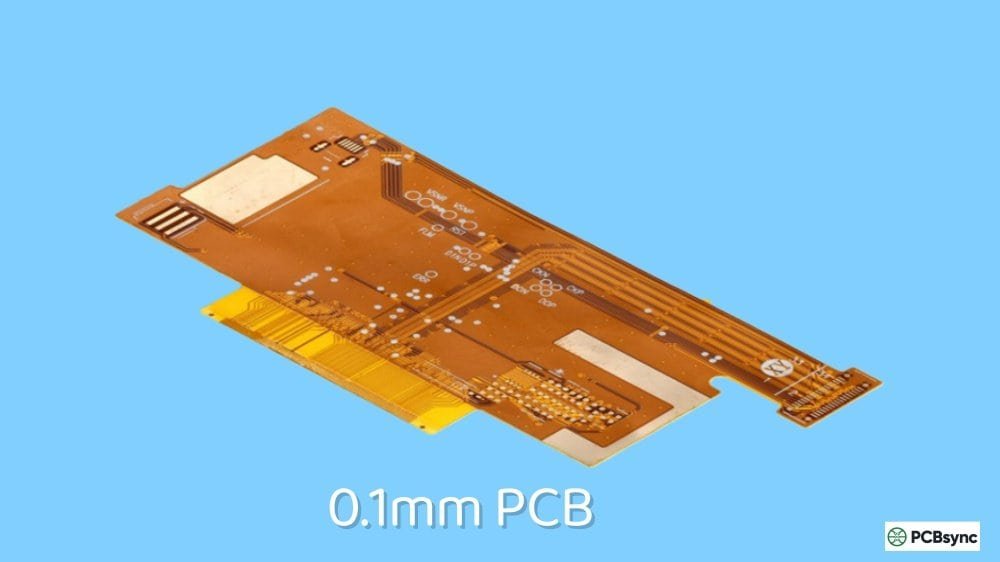
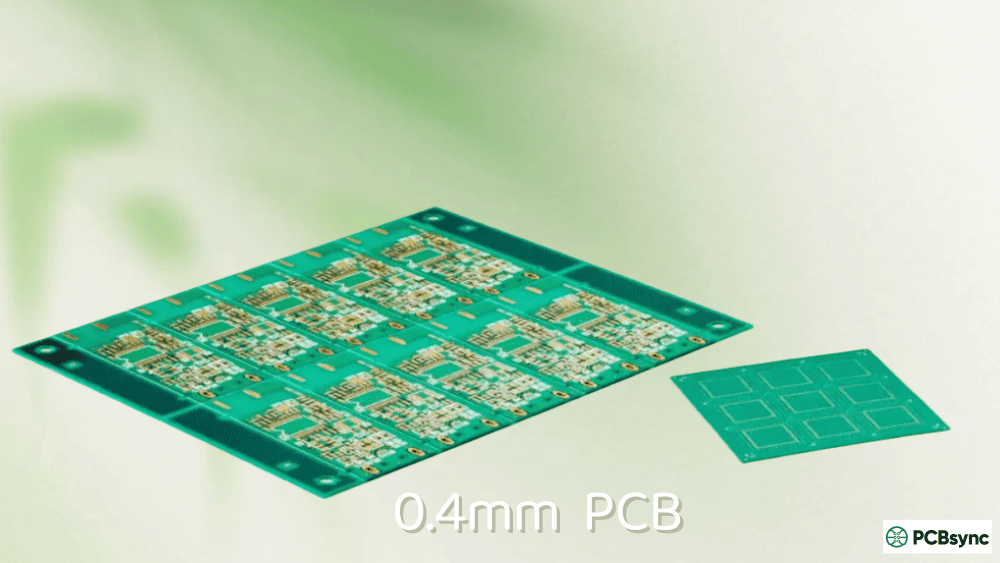
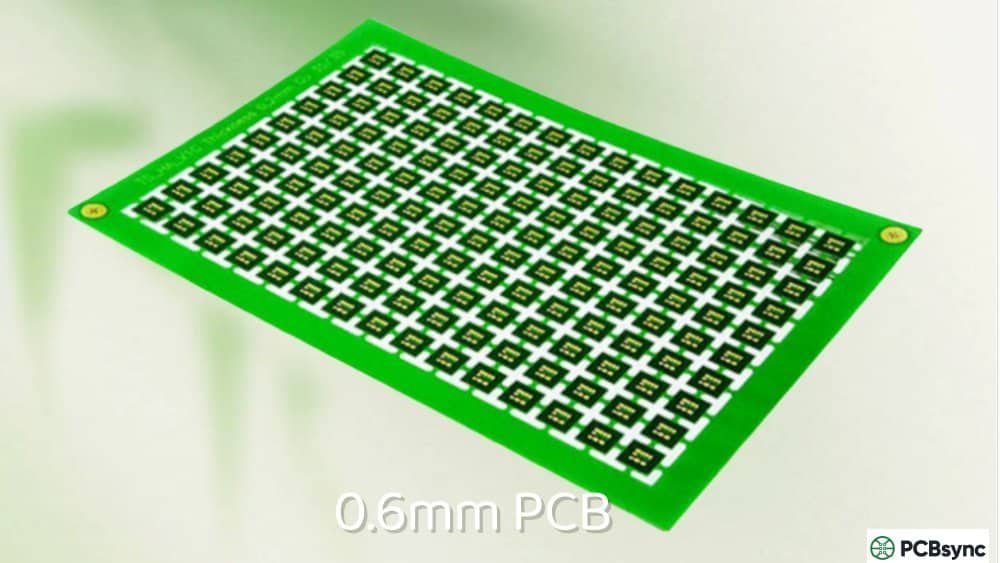
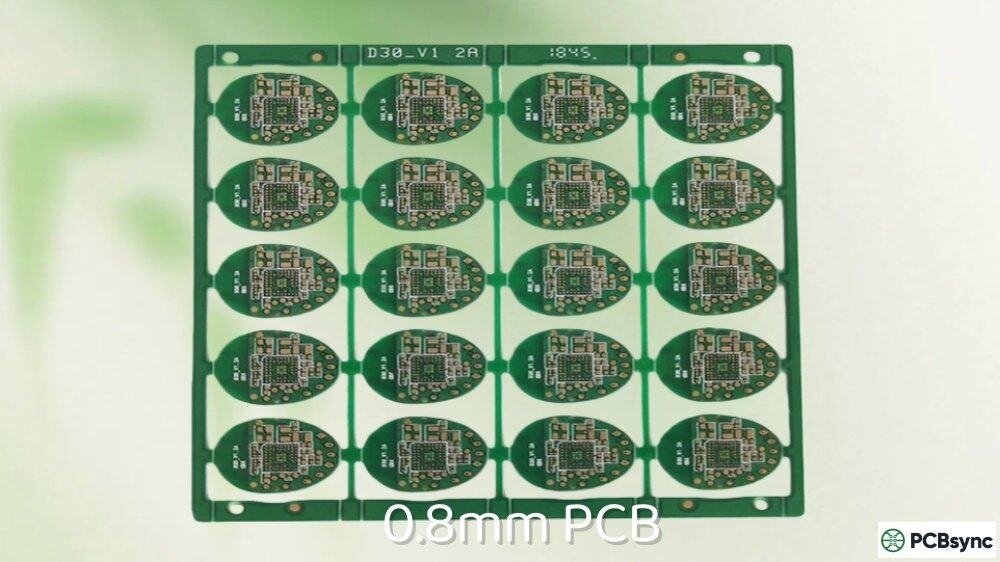
Inquire: Call 0086-755-23203480, or reach out via the form below/your sales contact to discuss our design, manufacturing, and assembly capabilities.
Quote: Email your PCB files to Sales@pcbsync.com (Preferred for large files) or submit online. We will contact you promptly. Please ensure your email is correct.
Notes: For PCB fabrication, we require PCB design file in Gerber RS-274X format (most preferred), *.PCB/DDB (Protel, inform your program version) format or *.BRD (Eagle) format. For PCB assembly, we require PCB design file in above mentioned format, drilling file and BOM. Click to download BOM template To avoid file missing, please include all files into one folder and compress it into .zip or .rar format.
If you’ve ever tried designing a multilayer PCB thinner than 0.4mm, you know the headaches involved. Registration issues, warping during lamination, via reliability concerns—the list goes on. That’s why 0.4mm PCB has become the industry-recognized threshold where multilayer designs become practical and manufacturable. After working with thin PCBs across dozens of projects, I can tell you this thickness hits the sweet spot between miniaturization demands and production feasibility.
This guide covers everything you need to know about 0.4mm PCB design, manufacturing, and applications. Whether you’re developing compact consumer electronics or high-density interconnect boards, understanding this critical thickness will help you make better design decisions.
A 0.4mm PCB is a printed circuit board with a total finished thickness of 0.4 millimeters (approximately 0.016 inches or 16 mils). This measurement includes the substrate material, copper layers, plating, and solder mask—everything that makes up the final board.
Here’s something that trips up newer engineers: when you specify 0.4mm finished thickness, your fabricator will typically start with 0.3mm raw material. The additional thickness comes from copper plating, surface finish, and solder mask layers added during manufacturing.
Specification
Value
Finished Thickness
0.4mm (±0.1mm tolerance)
Raw Material Thickness
0.3mm typical
Imperial Equivalent
0.016″ / 16 mils
Maximum Practical Layers
4-6 layers
Minimum Via Diameter
0.15mm mechanical, 0.1mm laser
Why 0.4mm is the Multilayer Starting Point
The phrase “starting point for multilayer PCB” appears repeatedly in manufacturer specifications, and there’s solid engineering reasoning behind it. At 0.4mm, you have just enough material to:
Accommodate internal plane layers. A 4-layer board needs two internal copper layers sandwiched between prepreg and core materials. Below 0.4mm, achieving proper dielectric spacing between layers becomes extremely difficult.
Maintain via integrity. Through-hole vias in thinner boards have aspect ratios that push PCB manufacturing limits. At 0.4mm with 0.2mm drill holes, you get a 2:1 aspect ratio—challenging but achievable for most fabricators.
Control warpage. Thinner boards warp more easily during thermal cycling in reflow soldering. The 0.4mm threshold provides enough structural rigidity for reliable assembly.
0.4mm PCB Materials and Substrate Options
Material selection becomes more critical as boards get thinner. The substrate must maintain dimensional stability through lamination, drilling, and thermal cycling while providing adequate electrical performance.
FR-4 for 0.4mm PCB Applications
Standard FR-4 remains the most common choice for 0.4mm PCB production. Most fabricators stock thin FR-4 cores in 0.2mm and 0.1mm thicknesses that combine with prepreg layers to achieve the target thickness.
For lead-free assembly (which most projects require today), specify high-Tg FR-4 with Tg above 170°C. The higher reflow temperatures of lead-free solder can cause delamination in standard FR-4 thin cores.
Alternative Materials for Thin PCB Applications
When FR-4 won’t meet your performance requirements, consider these alternatives:
BT Resin (Bismaleimide Triazine): Lower Dk (around 3.5) and better high-frequency performance than FR-4. Common in smartphone and tablet PCBs where signal integrity matters.
Polyimide: Excellent thermal stability with Tg above 250°C. Used in flex-rigid combinations and applications requiring extreme temperature cycling. Higher cost but necessary for automotive and aerospace applications.
Rogers Laminates: For RF and high-speed applications requiring precise impedance control. The Rogers 4000 series offers Dk values from 3.0 to 3.6 with extremely low loss tangent.
Stack-up design determines your routing capabilities, impedance control options, and manufacturability. At 0.4mm, you’re working with tight constraints that require careful planning.
4-Layer 0.4mm PCB Stack-Up
The most common configuration for 0.4mm boards is a 4-layer design. Here’s a typical stack-up that I’ve used successfully on multiple projects:
Layer
Function
Material
Thickness
L1
Signal/Component
Copper (1oz)
35μm
–
Prepreg
1080
0.08mm
L2
Ground Plane
Copper (1oz)
35μm
–
Core
FR-4
0.2mm
L3
Power Plane
Copper (1oz)
35μm
–
Prepreg
1080
0.08mm
L4
Signal/Component
Copper (1oz)
35μm
This stack-up provides:
Dedicated ground and power planes for excellent signal integrity
Signal layers adjacent to reference planes for controlled impedance
Symmetric construction to minimize warpage
Approximately 0.4mm total thickness after lamination
6-Layer 0.4mm PCB Stack-Up
Yes, you can fit 6 layers into 0.4mm, but it requires thin cores and careful material selection. This configuration is more challenging to manufacture and typically costs 30-50% more than 4-layer boards.
Layer
Function
Material
Thickness
L1
Signal
Copper (0.5oz)
18μm
–
Prepreg
1080
0.065mm
L2
Ground
Copper (0.5oz)
18μm
–
Core
FR-4
0.1mm
L3
Signal
Copper (0.5oz)
18μm
–
Prepreg
1080
0.065mm
L4
Signal
Copper (0.5oz)
18μm
–
Core
FR-4
0.1mm
L5
Power
Copper (0.5oz)
18μm
–
Prepreg
1080
0.065mm
L6
Signal
Copper (0.5oz)
18μm
Notice the reduced copper weight (0.5oz instead of 1oz) to fit more layers. This limits current-carrying capacity, so power distribution requires careful analysis.
Manufacturing Process for 0.4mm PCB
Manufacturing thin PCBs requires tighter process controls than standard 1.6mm boards. Understanding these challenges helps you design boards that fabricators can actually build reliably.
Drilling Considerations
Drilling is where many thin PCB projects run into trouble. The aspect ratio (board thickness divided by hole diameter) must stay within manufacturing capabilities.
0.2mm holes give a 2:1 aspect ratio (easy for any fab)
0.15mm holes give a 2.67:1 aspect ratio (standard capability)
0.1mm holes give a 4:1 aspect ratio (requires advanced process)
My recommendation: stick with 0.2mm minimum hole size for through-holes unless you’re working with a manufacturer experienced in thin-board production.
Lamination Process
Thin boards are more susceptible to lamination defects. The fabricator must control:
Pressure distribution: Even pressure across the panel prevents thickness variations. Target tolerance is ±0.05mm for 0.4mm boards.
Temperature profile: Proper cure temperature (typically 170-190°C for FR-4) ensures complete resin crosslinking without damaging thin cores.
Resin flow: Too much flow causes voids; too little leaves unfilled gaps. Prepreg selection is critical for thin constructions.
Registration Accuracy
Layer-to-layer registration tolerance directly impacts via reliability. For 0.4mm multilayer boards, expect:
Parameter
Typical Tolerance
Layer-to-layer registration
±0.075mm
Drill-to-copper registration
±0.05mm
Solder mask registration
±0.05mm
These tolerances affect minimum annular ring requirements. I recommend 0.1mm annular ring minimum for 0.4mm PCBs, which means your pad diameter should be at least 0.2mm larger than your drill size.
Design Guidelines for 0.4mm PCB
Good design practices become essential when working at the thin end of the thickness spectrum. These guidelines will help you avoid common pitfalls.
Trace Width and Spacing
Thin boards often use finer features, but don’t push limits unnecessarily. Here’s what most fabricators can reliably produce:
Feature
Minimum (Standard)
Minimum (Advanced)
Trace width
0.1mm (4 mil)
0.075mm (3 mil)
Trace spacing
0.1mm (4 mil)
0.075mm (3 mil)
Pad-to-trace clearance
0.1mm
0.075mm
Copper-to-edge
0.25mm
0.2mm
Via Design for Thin PCBs
Via design significantly impacts yield and reliability in 0.4mm PCBs.
Via Type
Diameter
Pad Size
Use Case
Standard PTH
0.2mm
0.45mm
General routing
Small PTH
0.15mm
0.35mm
Dense areas
Microvia
0.1mm
0.25mm
HDI, BGA fanout
Blind via
0.1mm
0.25mm
Layer transitions
Buried vias (connecting internal layers only) are possible in 0.4mm boards but add significant cost due to sequential lamination requirements.
Impedance Control
Achieving controlled impedance in thin stack-ups requires careful calculation. The thinner dielectric spacing between signal and reference layers affects trace width requirements.
Target Impedance
Dielectric Height
Trace Width (1oz Cu)
50Ω single-ended
0.08mm
0.12mm
50Ω single-ended
0.1mm
0.15mm
100Ω differential
0.08mm
0.09mm/0.09mm, 0.15mm gap
100Ω differential
0.1mm
0.11mm/0.11mm, 0.18mm gap
Always verify impedance calculations with your fabricator’s actual material parameters. Dk values vary between manufacturers and even between production lots.
Surface Finish Options for 0.4mm PCB
Not all surface finishes work well on thin boards. The thermal stress during some finishing processes can cause warpage or delamination.
For 0.4mm PCBs, I recommend ENIG or OSP as first choices. HASL (Hot Air Solder Leveling) introduces too much thermal stress and creates uneven surfaces—avoid it for thin boards.
The 0.4mm thickness enables products that wouldn’t be possible with standard 1.6mm boards. Here are the primary application areas:
Consumer Electronics
Smartphones and Tablets: The main logic boards in modern phones often use 0.4mm or thinner PCBs to maximize battery space. Apple, Samsung, and other manufacturers specify thin multilayer boards for their flagship devices.
Wearable Devices: Smartwatches and fitness trackers require the smallest possible PCB footprint. A 0.4mm 4-layer board provides enough routing density for Bluetooth, sensors, and power management in minimal space.
True Wireless Earbuds: The tiny PCBs in earbuds push the limits of miniaturization. 0.4mm boards with 4 layers accommodate the necessary audio processing and wireless connectivity.
Industrial and IoT Applications
Sensor Modules: Industrial IoT sensors need small form factors for installation in tight spaces. 0.4mm PCBs allow compact designs while maintaining signal integrity for sensor interfaces.
Camera Modules: Smartphone camera modules typically use 0.4mm flexible-rigid PCBs to connect image sensors to main boards. The thin profile fits behind the lens assembly.
RFID Tags and Smart Cards: Many RFID applications require thin, flexible circuits that can embed in cards or labels. The 0.4mm thickness provides structural support while maintaining flexibility.
Comparison: 0.4mm PCB vs Other Thicknesses
Parameter
0.2mm
0.3mm
0.4mm
0.8mm
1.6mm
Max Layers
2
4 (difficult)
4-6
8-10
12+
Surface Finishes
ENIG, OSP
ENIG, OSP, ISn
All except HASL
All
All
Via Options
Limited
Standard
Standard + HDI
All
All
Relative Cost
+50-80%
+30-50%
+15-25%
Standard
Baseline
Warpage Risk
Very High
High
Moderate
Low
Very Low
Handling Difficulty
Extreme
High
Moderate
Easy
Easy
Challenges and Solutions for 0.4mm PCB Production
Warpage Control
Thin boards warp more than thick ones—it’s physics. Mitigation strategies include:
Symmetric stack-up: Ensure copper distribution is balanced between top and bottom halves of the board.
Copper balancing: Add copper pours to layers with sparse routing to balance thermal expansion.
Panel design: Work with your fabricator on optimal panelization. Larger panels with appropriate support structures reduce handling warpage.
Storage: Store thin PCBs flat, in controlled humidity environments. Moisture absorption causes warpage.
What is the maximum number of layers possible in a 0.4mm PCB?
The practical maximum is 6 layers for a 0.4mm PCB. Achieving 6 layers requires thin cores (0.1mm), reduced copper weights (0.5oz), and careful prepreg selection. Most designs use 4 layers, which provides a better balance of routing density and manufacturability. Some specialized manufacturers can produce 8-layer 0.4mm boards, but costs increase dramatically and yield drops significantly.
Can I use HASL surface finish on a 0.4mm PCB?
No, HASL (Hot Air Solder Leveling) is not recommended for 0.4mm PCBs. The thermal shock from molten solder contact causes excessive warpage in thin boards. Additionally, HASL creates uneven surface topology that interferes with fine-pitch component placement. For 0.4mm boards, use ENIG, OSP, Immersion Silver, or Immersion Tin instead. These processes operate at lower temperatures and produce flatter surfaces suitable for thin-board applications.
How does 0.4mm PCB cost compare to standard 1.6mm boards?
Expect to pay 15-25% more for 0.4mm PCBs compared to standard 1.6mm boards of equivalent complexity. The cost increase comes from specialized materials (thin cores and prepregs), tighter process controls during lamination, increased handling requirements, and typically lower manufacturing yields. For 6-layer 0.4mm designs, the premium can reach 40-60% due to the additional manufacturing complexity involved in sequential lamination and thin-core processing.
What applications require 0.4mm PCB thickness?
The primary applications for 0.4mm PCBs include smartphones, tablets, wearable devices (smartwatches, fitness trackers), true wireless earbuds, camera modules, IoT sensors, and RFID/smart card electronics. Any application where space constraints demand maximum component density in minimum volume benefits from 0.4mm PCB technology. The thickness also suits HDI (High Density Interconnect) designs requiring microvias and fine-pitch BGA components.
How do I prevent warpage in 0.4mm PCB during assembly?
Preventing warpage requires attention throughout design and manufacturing. Design with symmetric copper distribution across all layers—use copper pours to balance sparse routing areas. During assembly, reduce reflow ramp rates to 1-2°C/second, use board supports or carriers in the reflow oven, and ensure proper storage conditions (flat, humidity-controlled). Specify panelization with adequate support rails. Work with your assembler to verify their thin-board handling procedures, including vacuum pickup for component placement and proper stencil thickness selection for paste deposition.
Conclusion
The 0.4mm PCB represents a critical capability threshold in modern electronics manufacturing. It’s thin enough to enable compact product designs while still supporting practical multilayer constructions. Understanding its capabilities and limitations helps you make informed decisions about when this thickness makes sense for your project.
For most applications requiring miniaturization with multilayer routing, 0.4mm delivers the best balance of size reduction, manufacturing feasibility, and cost. Thinner options exist but come with significant tradeoffs in layer count, yield, and price. Thicker boards provide more routing freedom but consume valuable product space.
Work closely with your fabricator during the design phase. Request their standard 0.4mm stack-ups, verify impedance calculations with their actual material parameters, and understand their process capabilities for thin-board production. This collaboration will help you design boards that meet your requirements while remaining manufacturable at acceptable yields and costs.
Inquire: Call 0086-755-23203480, or reach out via the form below/your sales contact to discuss our design, manufacturing, and assembly capabilities.
Quote: Email your PCB files to Sales@pcbsync.com (Preferred for large files) or submit online. We will contact you promptly. Please ensure your email is correct.
Notes: For PCB fabrication, we require PCB design file in Gerber RS-274X format (most preferred), *.PCB/DDB (Protel, inform your program version) format or *.BRD (Eagle) format. For PCB assembly, we require PCB design file in above mentioned format, drilling file and BOM. Click to download BOM template To avoid file missing, please include all files into one folder and compress it into .zip or .rar format.