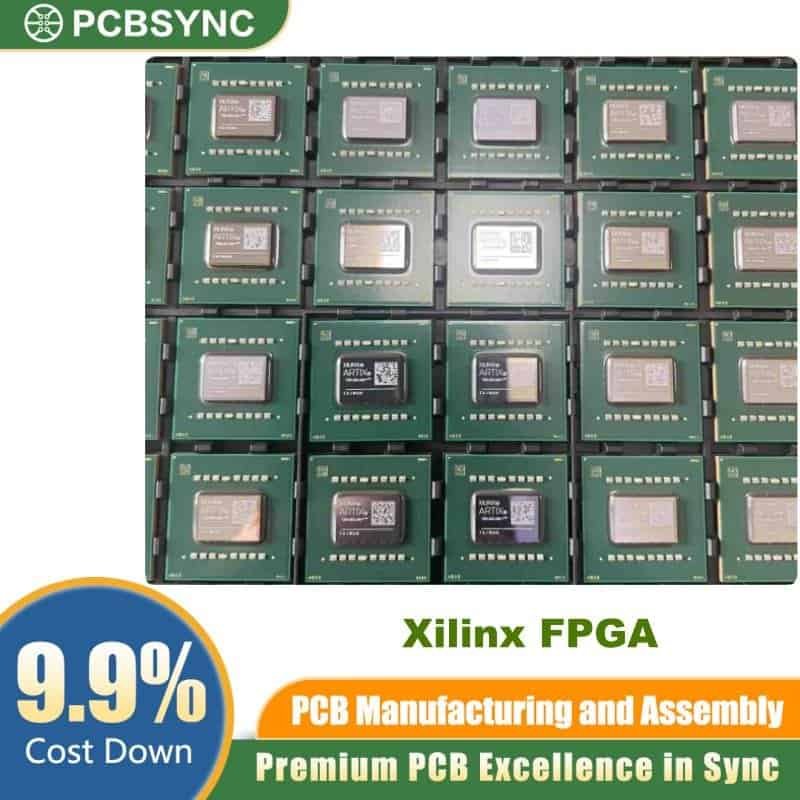
Overview of the XC3SD1800A-4FG676I FPGA Chip
The XC3SD1800A-4FG676I is a cutting-edge Field-Programmable Gate Array (FPGA) from AMD (formerly Xilinx), specifically designed to deliver exceptional digital signal processing performance in cost-sensitive, high-volume applications. This powerful chip belongs to the renowned Spartan-3A DSP family and represents the perfect balance between advanced functionality, energy efficiency, and economic viability for modern embedded system designs.
As part of AMD’s legacy Xilinx product line, the XC3SD1800A-4FG676I offers 1.8 million system gates, making it an ideal solution for applications ranging from broadband communications to consumer electronics, industrial automation, and automotive systems. The device combines proven 90nm process technology with innovative architectural enhancements that set new industry standards for programmable logic performance.
For developers and engineers seeking reliable Xilinx FPGA solutions, this Spartan-3A DSP device delivers unmatched value through its comprehensive feature set and robust design capabilities.
Key Technical Specifications
| Specification |
Details |
| Part Number |
XC3SD1800A-4FG676I |
| Manufacturer |
AMD (Xilinx) |
| Product Family |
Spartan-3A DSP |
| System Gates |
1,800,000 (1.8M gates) |
| Logic Cells |
37,440 cells |
| Configurable Logic Blocks (CLBs) |
4,160 CLBs |
| DSP48A Slices |
84 dedicated 18×18 multipliers |
| Maximum Frequency |
667 MHz |
| Block RAM |
Enhanced with output registers, 250 MHz operation |
| Process Technology |
90nm CMOS |
| Supply Voltage |
1.2V (1.14V – 1.26V range) |
| Operating Temperature |
Industrial (-40°C to +100°C) |
| Package Type |
676-Pin Fine-Pitch Ball Grid Array (FBGA/FGG676) |
| Number of I/O Pins |
519 user I/O |
| Speed Grade |
-4 (standard commercial speed) |
Architecture and Core Features
Advanced DSP Capabilities
The XC3SD1800A-4FG676I incorporates 84 XtremeDSP DSP48A slices, which represent a significant enhancement over traditional FPGA multiplier blocks. These specialized DSP blocks are derived from the proven Virtex-4 architecture and offer:
- 18×18 bit multiplier-accumulator (MAC) units
- Pre-adder for efficient filter implementations
- 48-bit accumulator with pattern detection
- Cascade capability for complex DSP algorithms
- 250 MHz operation in the -4 speed grade
Configurable Logic Architecture
| Logic Resource |
XC3SD1800A-4FG676I |
| Slice Count |
16,896 slices |
| Distributed RAM |
422 Kb |
| Total Block RAM |
3,456 Kb (432 KB) |
| Block RAM Blocks |
84 blocks (18 Kb each) |
| Maximum User I/O |
519 pins |
| Digital Clock Managers (DCMs) |
4 DCMs |
Memory Resources
The device features enhanced block RAM with dedicated output registers, enabling 250 MHz operation for memory-intensive applications. This architectural improvement significantly boosts throughput for applications requiring high-bandwidth data access, such as video processing, packet buffering, and data acquisition systems.
I/O Interface Standards
The XC3SD1800A-4FG676I supports multiple I/O standards, providing flexibility for interfacing with various components:
- LVTTL (Low-Voltage TTL)
- LVCMOS (Low-Voltage CMOS) at 3.3V, 2.5V, 1.8V, 1.5V, 1.2V
- HSTL (High-Speed Transceiver Logic)
- SSTL (Stub Series Terminated Logic)
- Differential signaling support
Package Information: 676-Pin FBGA
Physical Characteristics
| Package Attribute |
Specification |
| Package Type |
Fine-pitch Ball Grid Array (FBGA) |
| Pin Count |
676 pins |
| Package Code |
FG676 / FGG676 |
| Body Size |
27mm × 27mm |
| Ball Pitch |
1.0 mm |
| Mounting Type |
Surface Mount Device (SMD) |
| Termination Style |
Solder balls |
Package Benefits
The 676-pin FBGA package offers several advantages for high-density applications:
- Compact footprint for space-constrained designs
- Superior thermal performance with efficient heat dissipation
- High I/O density with 519 user-accessible pins
- Excellent signal integrity through short interconnect paths
- Reliable mechanical structure for automotive and industrial applications
Performance Characteristics
Speed Grade Analysis
The -4 speed grade indicates this is a standard commercial-grade device optimized for cost-sensitive applications while maintaining robust performance:
| Performance Metric |
Value |
| Maximum System Frequency |
667 MHz |
| DSP Block Performance |
250 MHz |
| Block RAM Speed |
250 MHz |
| Typical Logic Propagation Delay |
Optimized for -4 grade |
| Clock-to-Output Time |
Industry-standard timing |
Power Consumption
Built on 90nm process technology, the XC3SD1800A-4FG676I delivers excellent power efficiency:
- Core voltage: 1.2V nominal
- I/O voltage: Multiple standards (1.2V to 3.3V)
- Low static power consumption
- Dynamic power scales with utilization
- Power-optimized for portable and battery-operated applications
Application Areas
Industrial and Embedded Systems
The XC3SD1800A-4FG676I excels in industrial automation applications:
- Motor control systems with precise PWM generation
- Industrial networking protocols (EtherCAT, PROFINET, Modbus)
- Machine vision processing for quality inspection
- Sensor data acquisition and signal conditioning
- Real-time control systems with deterministic response
Communications and Networking
Ideal for communications infrastructure:
- Software-defined radio (SDR) implementations
- Baseband processing for wireless systems
- Digital up/down converters for RF applications
- Protocol processing for networking equipment
- Packet inspection and routing functions
Consumer Electronics
Perfect for consumer product designs:
- Digital television and set-top boxes
- Home networking equipment
- Display controllers and video processing
- Audio DSP applications
- Smart home automation systems
Medical and Scientific Instrumentation
Suitable for precision measurement systems:
- Medical imaging equipment
- Signal analysis instruments
- Data acquisition systems
- Laboratory automation devices
- Diagnostic equipment processing
Development Tools and Resources
Design Software
| Tool |
Purpose |
| Xilinx ISE Design Suite |
Complete FPGA development environment |
| ISE WebPACK |
Free entry-level design software |
| System Generator for DSP |
MATLAB/Simulink integration for DSP design |
| PlanAhead |
Design planning and floor-planning tool |
| ChipScope Pro |
On-chip logic analyzer for debugging |
IP Cores and Libraries
AMD/Xilinx provides extensive IP core libraries:
- Signal processing cores (FIR filters, FFT, DFT)
- Communication protocols (Ethernet, PCI Express, USB)
- Memory controllers (DDR, DDR2 interfaces)
- Video processing functions
- Math functions and arithmetic cores
Development Boards
Several evaluation platforms support the XC3SD1800A family:
- Spartan-3A DSP Starter Kit – Complete evaluation platform
- Third-party development boards – Custom solutions
- Prototyping modules – Rapid development platforms
Design Considerations
Thermal Management
| Temperature Range |
Application |
| Commercial (0°C to +85°C) |
Standard office/indoor use |
| Industrial (-40°C to +100°C) |
XC3SD1800A-4FG676I rating |
| Extended |
With proper thermal design |
For optimal thermal performance:
- Ensure adequate PCB copper area for heat spreading
- Consider active cooling for high-utilization designs
- Monitor junction temperature during operation
- Follow AMD/Xilinx thermal design guidelines
PCB Design Guidelines
Critical considerations for successful board design:
- Power supply decoupling – Multiple capacitors at each power pin
- Ground plane integrity – Solid ground reference
- Signal routing – Maintain controlled impedance for high-speed signals
- Configuration interface – Proper layout for programming circuits
- ESD protection – Appropriate protection on exposed I/O
Configuration Options
The XC3SD1800A-4FG676I supports multiple configuration modes:
- Master Serial – FPGA controls configuration PROM
- Slave Serial – External microcontroller manages configuration
- JTAG – For development and debugging
- Master/Slave Parallel – High-speed configuration options
Comparison with Alternative Devices
Within Spartan-3A DSP Family
| Feature |
XC3SD1800A |
XC3SD3400A |
| System Gates |
1.8M |
3.4M |
| Logic Cells |
37,440 |
53,712 |
| DSP48A Slices |
84 |
126 |
| Block RAM |
3,456 Kb |
5,328 Kb |
| User I/O (FG676) |
519 |
519 |
Speed Grade Variants
The XC3SD1800A is available in multiple speed grades:
- -4 grade (this device) – Standard commercial applications
- -5 grade – Higher performance (770 MHz system frequency)
- Temperature variants – Commercial and Industrial ranges
Quality and Reliability
Manufacturing Standards
AMD/Xilinx devices meet stringent quality requirements:
- ISO 9001 certified manufacturing
- Automotive-grade options available (AEC-Q100)
- RoHS compliant construction
- Conflict-free sourcing policies
Testing and Validation
Each device undergoes comprehensive testing:
- Electrical parametric testing
- Functional pattern verification
- Temperature stress screening
- Quality assurance protocols
Ordering Information and Availability
Part Number Breakdown
XC3SD1800A-4FG676I decodes as:
- XC3SD1800A – Device family and density
- -4 – Speed grade
- FG676 – Package type (676-pin FBGA)
- I – Industrial temperature range (-40°C to +100°C)
Package Marking
Devices are clearly marked with:
- Part number
- Speed grade
- Date code
- Traceability information
Availability and Lead Time
The XC3SD1800A-4FG676I is available through authorized distributors:
- Major electronic component distributors
- Direct from AMD/Xilinx
- Typical lead times vary by quantity and market conditions
- Engineering samples available for qualified customers
Environmental and Export Compliance
Export Control Classification
| Classification |
Details |
| ECCN |
3A001.a.2.c |
| Jurisdiction |
U.S. Export Administration Regulations (EAR) |
| License Requirements |
May apply for certain destinations |
Environmental Compliance
- RoHS compliant – Lead-free construction
- REACH compliant – No substances of very high concern
- Halogen-free options – Available upon request
Support and Documentation
Technical Documentation
AMD/Xilinx provides comprehensive documentation:
- Data Sheet (DS610) – Complete electrical specifications
- User Guide – Implementation guidelines and best practices
- Application Notes – Design examples and solutions
- Reference Designs – Proven implementation examples
- Packaging Information – Mechanical specifications and pinouts
Technical Support Channels
- AMD/Xilinx Technical Support Portal
- Community Forums and Discussion Groups
- Field Application Engineers (FAEs)
- Authorized Design Services Partners
Advantages of XC3SD1800A-4FG676I
Key Benefits Summary
- Cost-Effective DSP Solution – Superior performance per dollar ratio
- Proven 90nm Technology – Reliable and mature process
- Flexible Architecture – Adaptable to diverse applications
- Low Power Consumption – Ideal for portable devices
- Rich DSP Resources – 84 dedicated DSP48A slices
- Extensive I/O Options – 519 user I/O with multiple standards
- Comprehensive Tool Support – Industry-standard design software
- Strong Ecosystem – Extensive IP cores and reference designs
Competitive Advantages
Compared to alternative solutions:
- ASIC Alternative – Lower NRE costs, shorter time-to-market
- Processor-Based DSP – Higher parallel processing capability
- Competitor FPGAs – Optimized DSP-to-logic ratio
- Field Upgradeable – In-system reprogramming capability
Conclusion
The XC3SD1800A-4FG676I represents an excellent choice for engineers developing high-performance digital signal processing applications where cost, flexibility, and reliability are paramount. With its combination of 1.8 million system gates, 84 DSP48A slices, comprehensive I/O capabilities, and industrial-grade temperature performance, this FPGA delivers exceptional value across a wide range of applications.
Whether you’re designing communications equipment, industrial control systems, consumer electronics, or medical devices, the XC3SD1800A-4FG676I provides the processing power, flexibility, and reliability needed to bring innovative products to market quickly and cost-effectively.
For more information about AMD/Xilinx FPGA solutions and to explore the complete Spartan-3A DSP family, visit authorized distributors or contact AMD/Xilinx directly.