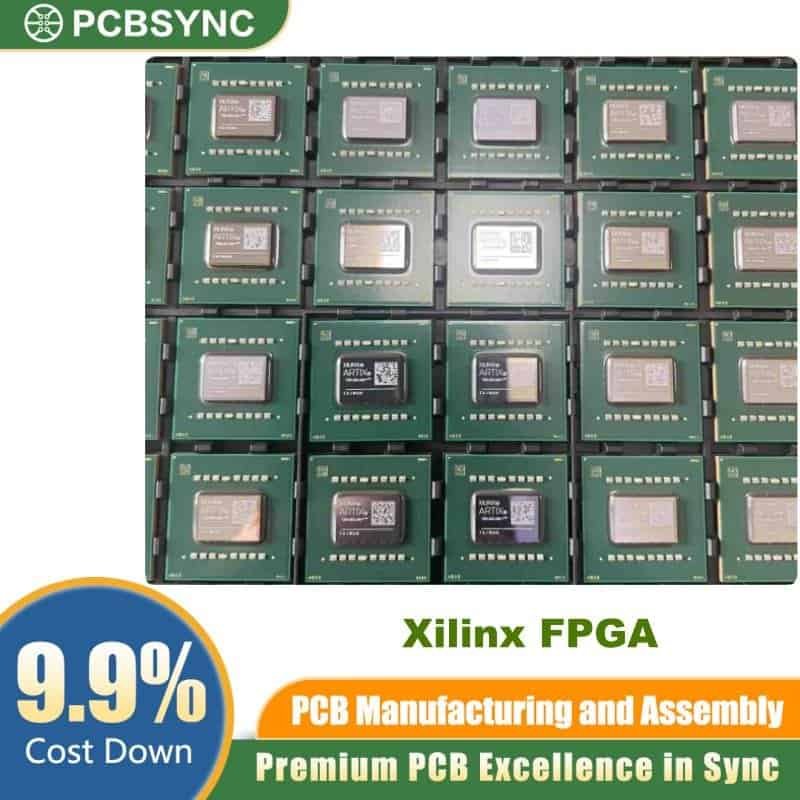
Overview of the XC3SD3400A-4CS484C FPGA
The XC3SD3400A-4CS484C is a powerful Field-Programmable Gate Array (FPGA) from AMD/Xilinx’s Spartan-3A DSP family, designed to deliver exceptional performance for cost-sensitive digital signal processing applications. This advanced FPGA combines high logic density with specialized DSP capabilities, making it the ideal choice for engineers developing complex embedded systems, communication protocols, and signal processing solutions.
Built on proven 90nm process technology, the XC3SD3400A-4CS484C offers 3.4 million system gates and 53,712 logic cells in a compact 484-pin CSPBGA package. This Xilinx FPGA represents an excellent balance between functionality, performance, and cost-effectiveness for high-volume production environments.
Key Technical Specifications
Core Performance Features
| Specification |
Value |
| Logic Cells |
53,712 cells |
| System Gates |
3.4 Million (3,400,000) |
| Maximum Frequency |
667 MHz |
| Process Technology |
90nm |
| Operating Voltage |
1.14V ~ 1.26V (Core: 1.2V) |
| Speed Grade |
-4 (Standard Performance) |
Package and I/O Configuration
| Parameter |
Details |
| Package Type |
484-FBGA, CSPBGA (CS484) |
| Mounting Type |
Surface Mount |
| Total I/O Pins |
309 user I/O pins |
| Maximum User I/O |
Up to 469 I/O lines |
| Operating Temperature Range |
0°C to 85°C (TJ) – Commercial Grade |
Memory and DSP Resources
| Resource Type |
Capacity |
| Total Distributed RAM |
2,322,432 bits |
| Block RAM |
126 blocks (18Kb each) |
| DSP48A Slices |
126 XtremeDSP slices |
| Configurable Logic Blocks (CLBs) |
Advanced architecture with flexible LUTs |
| Maximum Distributed RAM |
Approximately 288 KB |
Advanced Features and Capabilities
XtremeDSP Technology
The XC3SD3400A-4CS484C incorporates 126 DSP48A slices, providing hardware-accelerated signal processing capabilities that deliver superior performance for:
- Digital filters and FFT implementations
- Image and video processing algorithms
- Software-defined radio (SDR) applications
- High-speed data acquisition systems
- Real-time control systems
Programmable Logic Architecture
The Spartan-3A DSP architecture features five fundamental programmable elements:
- Configurable Logic Blocks (CLBs) – Flexible Look-Up Tables implementing custom logic functions
- Block RAM – Dual-port 18Kb memory blocks for data buffering and storage
- DSP48A Slices – Dedicated multiply-accumulate units for signal processing
- Digital Clock Managers (DCMs) – Advanced clock management and distribution
- I/O Blocks (IOBs) – High-speed differential and single-ended I/O support
Memory Architecture Benefits
The enhanced memory-to-logic ratio in the XC3SD3400A-4CS484C provides significant advantages:
- Increased bandwidth for data-intensive applications
- Reduced external memory requirements lowering system cost
- Improved system performance through on-chip data storage
- Flexible configuration options for various application needs
Target Applications and Use Cases
Digital Signal Processing
The XC3SD3400A-4CS484C excels in DSP applications requiring:
- Real-time signal filtering and conditioning
- Adaptive algorithms and machine learning inference
- Audio and speech processing systems
- Radar and sonar signal processing
- Medical imaging equipment
Communication Systems
Ideal for communication infrastructure including:
- Protocol handling and packet processing
- Software-defined networking (SDN)
- Wireless base station implementations
- Fiber-optic communication systems
- 5G and advanced wireless standards
Embedded Systems Development
Perfect for custom embedded solutions:
- Industrial automation and control
- Motor control and power electronics
- Automotive electronics systems
- Aerospace and defense applications
- Custom computing accelerators
High-Speed Data Acquisition
Optimized for measurement systems:
- Multi-channel data acquisition
- Test and measurement equipment
- Oscilloscopes and logic analyzers
- Scientific instrumentation
- Quality control systems
Design and Development Resources
Programming and Configuration
The XC3SD3400A-4CS484C supports multiple configuration modes:
- Master Serial Mode – Direct configuration from SPI flash
- Slave Serial Mode – Configuration from external processor
- JTAG Mode – Development and debugging interface
- Boundary-Scan Testing – IEEE 1149.1 compliance
Development Tools Compatibility
Compatible with industry-standard Xilinx tools:
- Vivado Design Suite – Modern FPGA design environment
- ISE Design Suite – Legacy tool support for Spartan-3A devices
- IP Core Libraries – Pre-verified functional blocks
- Simulation Tools – ModelSim, QuestaSim integration
- Hardware Co-Simulation – ChipScope Pro for debugging
Electrical Characteristics and Power Management
Power Supply Requirements
| Supply Rail |
Voltage Range |
Description |
| VCCINT |
1.14V – 1.26V |
Core logic supply |
| VCCAUX |
2.375V – 2.625V |
Auxiliary supply |
| VCCO |
1.2V – 3.3V |
I/O bank supply |
Thermal Performance
- Junction Temperature Range: 0°C to 85°C (Commercial)
- Package Thermal Resistance: Optimized for thermal management
- Power Consumption: Varies with design utilization and frequency
- Recommended Cooling: Heat sink or forced air cooling for high-performance applications
Quality and Reliability Standards
Environmental Compliance
- RoHS Status: RoHS non-compliant (legacy product)
- Lead-Free Options: Check with distributor for availability
- Moisture Sensitivity Level: MSL 3 (per JEDEC J-STD-020)
- ESD Protection: Human Body Model (HBM) Class 1C
Manufacturing and Testing
- Process Node: 90nm CMOS technology
- Quality Assurance: 100% factory tested
- Reliability Testing: Per JEDEC standards
- Traceability: Full lot traceability available
Comparison with Alternative Solutions
Advantages Over Competitive FPGAs
| Feature |
XC3SD3400A-4CS484C |
Alternative FPGAs |
| DSP Performance |
126 dedicated DSP slices |
Fewer or software-based DSP |
| Memory Density |
High RAM-to-logic ratio |
Lower memory availability |
| Cost-Effectiveness |
Optimized for volume production |
Higher cost per gate |
| Proven Technology |
Mature 90nm process |
Newer processes with higher cost |
| Tool Support |
Extensive documentation |
Limited resources |
Migration and Upgrade Paths
For future designs requiring enhanced capabilities, consider:
- Artix-7 Series – Next-generation low-power FPGAs
- Kintex-7 Series – High-performance DSP applications
- Zynq-7000 Series – Integrated ARM processor + FPGA
- Spartan-7 Series – Cost-optimized modern alternative
Packaging and Ordering Information
Package Dimensions and Footprint
- Package Size: 23mm x 23mm nominal
- Ball Pitch: 1.0mm
- Pin Count: 484 balls
- Package Height: Low-profile design
- PCB Footprint: Standard JEDEC footprint
Ordering Code Breakdown
XC3SD3400A-4CS484C
- XC3SD3400A: Device family and density
- -4: Speed grade (standard performance)
- CS484: Package type (484-pin CSPBGA)
- C: Commercial temperature range (0°C to 85°C)
Availability and Lead Times
- Product Status: Active
- Manufacturer: AMD (formerly Xilinx)
- Standard Lead Time: 30 weeks (check with distributors)
- Volume Availability: Suitable for high-volume production
- Alternative Sources: Available from authorized distributors worldwide
Installation and PCB Design Guidelines
PCB Layout Recommendations
For optimal performance when integrating the XC3SD3400A-4CS484C:
- Power Distribution: Use dedicated power planes for clean supplies
- Decoupling Capacitors: Place 0.1µF and 10µF capacitors near each power pin
- Signal Integrity: Match trace impedances for high-speed signals
- Thermal Management: Provide adequate copper pour for heat dissipation
- Ground Planes: Implement solid ground planes to minimize noise
Critical Design Considerations
- Via Placement: Minimize vias in high-speed signal paths
- Power Sequencing: Follow recommended power-up sequence
- Configuration Interface: Design JTAG and configuration circuits per guidelines
- I/O Standards: Select appropriate LVTTL, LVCMOS, or differential standards
- EMI Mitigation: Follow best practices for electromagnetic compatibility
Technical Support and Resources
Documentation Available
- Product Data Sheet: Complete electrical and timing specifications
- User Guide: Detailed architecture and programming information
- Application Notes: Design examples and reference implementations
- Errata Sheets: Known issues and workarounds
- PCB Design Guide: Layout recommendations and best practices
Community and Support Resources
- Xilinx Forums: Active community for troubleshooting
- Technical Support: Direct support from AMD/Xilinx
- Reference Designs: Open-source projects and examples
- Training Materials: Online courses and webinars
- Third-Party Tools: Compatible with various EDA tools
Frequently Asked Questions
Q: What makes the XC3SD3400A-4CS484C ideal for DSP applications?
The FPGA features 126 dedicated DSP48A slices with built-in multipliers and accumulators, providing hardware acceleration for signal processing tasks with significantly better performance and lower power than software implementations.
Q: Can I use modern Vivado Design Suite with this FPGA?
While the XC3SD3400A-4CS484C is primarily supported by ISE Design Suite, you can use Vivado for IP generation and simulation. For synthesis and implementation, ISE Design Suite version 14.7 is recommended.
Q: What is the difference between -4 and -5 speed grades?
The -4 speed grade offers standard performance suitable for most applications, while the -5 speed grade (if available) provides higher maximum frequencies for timing-critical designs. The -4 grade balances performance with cost-effectiveness.
Q: How much power does the XC3SD3400A-4CS484C consume?
Power consumption depends on design utilization, clock frequency, and I/O activity. Use Xilinx Power Estimator (XPE) tool to calculate accurate power requirements for your specific application.
Q: Is the XC3SD3400A-4CS484C suitable for industrial applications?
The commercial temperature range version (-C suffix) operates from 0°C to 85°C. For extended industrial temperature ranges (-I: -40°C to 100°C), check availability of the XC3SD3400A-4CS484I variant.
Conclusion: Why Choose the XC3SD3400A-4CS484C
The XC3SD3400A-4CS484C represents an exceptional value proposition for engineers developing sophisticated digital signal processing systems. With its combination of high logic density, dedicated DSP resources, and cost-effective pricing, this FPGA enables the creation of complex systems while meeting strict budget constraints.
Whether you’re designing communication systems, implementing advanced DSP algorithms, or developing custom embedded solutions, the XC3SD3400A-4CS484C provides the flexibility and performance needed to bring your innovative designs to market successfully. Its proven 90nm technology ensures reliable operation, while extensive tool support and documentation streamline the development process.
For volume production environments where cost-per-unit matters, the Spartan-3A DSP family continues to offer unmatched value, making the XC3SD3400A-4CS484C an intelligent choice for today’s competitive electronics market.