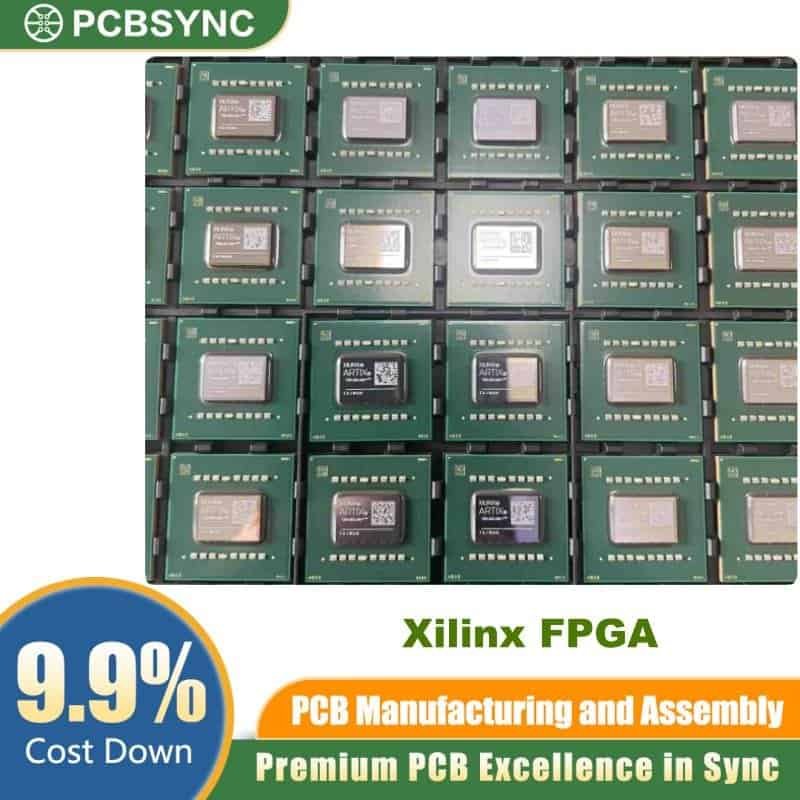
The XC3SD3400A-4FG676C is a powerful field-programmable gate array (FPGA) from AMD’s (formerly Xilinx) Spartan-3A DSP family, engineered to deliver exceptional digital signal processing performance for embedded systems and telecommunications applications. This advanced FPGA combines high logic density, dedicated DSP resources, and cost-effectiveness in a 676-pin fine-pitch ball grid array package.
Key Features and Specifications of XC3SD3400A-4FG676C
Core Architecture and Logic Capacity
| Specification |
Value |
| System Gates |
3.4 Million gates |
| Logic Cells |
53,712 cells |
| CLBs/LABs |
5,968 configurable logic blocks |
| Block RAM |
283.5 kB |
| Distributed RAM |
Integrated within CLBs |
DSP Performance Capabilities
The XC3SD3400A-4FG676C features robust DSP functionality that sets it apart from standard FPGAs:
| DSP Feature |
Specification |
| 18×18 Multipliers |
126 dedicated multipliers |
| DSP Slices |
Optimized for multiply-accumulate operations |
| 48-bit Accumulator |
Supports complex MAC operations |
| DSP Performance |
250 MHz minimum in -4 speed grade |
| Block RAM Speed |
280 MHz operation minimum |
Electrical and Physical Characteristics
| Parameter |
Details |
| Core Voltage |
1.2V |
| I/O Voltage |
1.2V / 2.5V / 3.3V (dual-range VCCAUX) |
| Package Type |
676-pin FBGA (Fine-pitch Ball Grid Array) |
| Pin Count |
676 pins |
| User I/O |
469 I/O pins |
| Process Technology |
90nm CMOS |
| Operating Frequency |
667 MHz maximum |
| Height Seated |
2.6 mm maximum |
| Mounting Type |
Surface Mount |
Advanced I/O and Clock Resources
High-Speed I/O Standards
The XC3SD3400A-4FG676C FPGA supports multiple I/O standards for versatile connectivity:
- LVDS (Low-Voltage Differential Signaling)
- RSDS (Reduced Swing Differential Signaling)
- Mini-LVDS
- HSTL/SSTL differential I/O
- Integrated differential termination resistors
Clock Distribution Network
| Clock Resource |
Quantity |
| Global Clock Networks |
8 low-skew networks |
| Regional Clock Networks |
8 additional clocks per half device |
| Clock Management |
Advanced routing with minimal skew |
XC3SD3400A-4FG676C Applications and Use Cases
Primary Application Areas
The XC3SD3400A-4FG676C excels in demanding digital signal processing applications:
Telecommunications Equipment
- Base station signal processing
- Software-defined radio (SDR) platforms
- Channel coding and modulation systems
- Protocol conversion and packet processing
Industrial Automation Systems
- Motor control with complex algorithms
- Machine vision processing
- Real-time data acquisition systems
- Programmable logic controllers (PLCs)
Audio/Video Processing
- Digital audio workstations
- Video compression and decompression
- Image enhancement and filtering
- Multi-channel audio processing
Medical Instrumentation
- Ultrasound imaging systems
- Patient monitoring equipment
- Diagnostic signal analysis
- Medical imaging processing
Technical Advantages of the Spartan-3A DSP Family
DSP-Optimized Architecture
The XC3SD3400A-4FG676C incorporates specialized DSP features that dramatically improve arithmetic performance:
- Dedicated 18×18 Multipliers: Enables parallel multiplication operations without consuming general logic resources
- Pipelined Processing: Multiple pipeline stages support operation at 250+ MHz
- Integrated Adders: Facilitates complex multiply-add and multiply-accumulate operations
- MAC Operations: 48-bit accumulator optimized for continuous multiply-accumulate functions
Memory Architecture
| Memory Type |
Configuration |
| Block RAM |
283.5 kB total capacity |
| RAM Configuration |
Dual-port, single-port, or FIFO modes |
| Distributed RAM |
Flexible allocation within CLBs |
| RAM Performance |
Registered outputs at 280+ MHz |
Programming and Development Ecosystem
Supported Design Tools
The XC3SD3400A-4FG676C integrates seamlessly with AMD’s comprehensive FPGA development suite:
- Vivado Design Suite: Modern synthesis and implementation platform
- ISE Design Suite: Legacy support for existing projects
- IP Core Libraries: Pre-verified intellectual property blocks
- Simulation Tools: ModelSim, Questa, and Vivado Simulator support
Development Board Compatibility
Popular development platforms for Spartan-3A DSP evaluation:
- Spartan-3A DSP Starter Kit
- Custom carrier boards with FG676 socket
- Third-party evaluation platforms
Speed Grade and Performance Specifications
The -4 speed grade designation indicates:
- Commercial temperature range operation
- Optimized balance of performance and power consumption
- Guaranteed timing specifications for production deployment
- Maximum operating frequency of 667 MHz
Temperature and Operating Conditions
| Parameter |
Range |
| Commercial (-4C) |
0°C to +85°C junction temperature |
| Speed Grade |
-4 (standard commercial) |
| Power Supply Tolerance |
±5% typical |
Package Information: 676-Pin FBGA
Physical Package Details
The FG676 package offers high-density interconnect in a compact footprint:
- Package Body Size: Optimized for high pin density
- Ball Pitch: Fine-pitch for maximum routing capability
- Thermal Management: Efficient heat dissipation design
- PCB Requirements: Standard FR-4 compatible with proper stackup
Pin Assignment
| Pin Category |
Count |
| Total Pins |
676 |
| User I/O Pins |
469 |
| Power/Ground |
Distributed for optimal signal integrity |
| Configuration |
Dedicated programming pins |
Why Choose XC3SD3400A-4FG676C for Your Design?
Cost-Effective DSP Performance
The XC3SD3400A-4FG676C delivers exceptional value:
- Lower System Cost: Integrates multiple functions on a single chip
- Reduced Board Space: High integration minimizes component count
- Development Efficiency: Mature toolchain accelerates time-to-market
- Proven Reliability: Established production record in demanding applications
Competitive Advantages
| Advantage |
Benefit |
| 126 DSP Slices |
Superior arithmetic performance vs. standard FPGAs |
| 90nm Technology |
Mature, reliable manufacturing process |
| Flexible I/O |
Supports legacy and modern interface standards |
| Large Block RAM |
Eliminates need for external memory in many designs |
Integration with Xilinx FPGA Design Ecosystem
The XC3SD3400A-4FG676C is part of AMD’s comprehensive Xilinx FPGA portfolio, offering designers access to extensive resources, reference designs, and technical support. The Spartan-3A DSP family provides an excellent migration path from lower-density Spartan-3E devices while maintaining pin and software compatibility where possible.
Compliance and Environmental Standards
RoHS Compliance
- RoHS Certified: Compliant with Restriction of Hazardous Substances directive
- Lead-Free: Uses lead-free solder ball attachment
- Environmental Safety: Meets global electronics environmental standards
Export Considerations
- Subject to U.S. Export Administration Regulations (EAR)
- May require export licenses for certain destinations
- Technology transfer restrictions apply
Ordering Information and Availability
Part Number Breakdown
XC3SD3400A-4FG676C:
- XC3SD3400A: Device family and density
- -4: Commercial speed grade
- FG676: 676-pin fine-pitch BGA package
- C: Commercial temperature range
Package Marking
Standard package marking includes:
- Device part number
- Date code
- Lot traceability code
- Country of origin
Design Considerations for XC3SD3400A-4FG676C Implementation
Power Supply Design
| Supply Rail |
Voltage |
Purpose |
| VCCINT |
1.2V |
Core logic power |
| VCCAUX |
2.5V/3.3V |
Auxiliary logic |
| VCCO |
1.2V to 3.3V |
I/O banks (configurable) |
Thermal Management
Proper thermal design ensures reliable operation:
- Junction Temperature: Monitor under full load conditions
- Heatsink Requirements: Calculate based on power dissipation
- Airflow Considerations: Forced convection may be required for high-utilization designs
PCB Layout Guidelines
Critical design practices for optimal performance:
- Power Plane Design: Solid power and ground planes minimize noise
- Decoupling Strategy: Multiple bypass capacitors per power bank
- Signal Integrity: Controlled impedance for high-speed signals
- BGA Routing: Careful via placement and escape routing
Comparison with Alternative FPGAs
vs. Spartan-3E Family
| Feature |
XC3SD3400A-4FG676C |
Spartan-3E |
| DSP Slices |
126 dedicated |
Limited multiplier resources |
| DSP Performance |
Optimized for 250+ MHz |
Lower arithmetic throughput |
| Application Focus |
Signal processing intensive |
General purpose logic |
vs. Artix-7 Family
| Feature |
XC3SD3400A-4FG676C |
Artix-7 |
| Technology Node |
90nm |
28nm |
| Power Efficiency |
Good |
Superior |
| Maturity |
Proven, long-term availability |
Newer architecture |
| Tool Support |
ISE/Vivado |
Vivado only |
Documentation and Technical Resources
Essential Reference Materials
- Product Datasheet: Complete electrical specifications and timing data
- User Guide: Detailed architecture description and programming information
- Application Notes: Design guidelines and best practices
- Errata Documents: Known issues and workarounds
Online Resources
- AMD/Xilinx support forums
- Technical documentation library
- Reference design downloads
- IP core catalogs
Summary: XC3SD3400A-4FG676C FPGA Highlights
The XC3SD3400A-4FG676C represents an excellent choice for engineers developing digital signal processing systems that require:
- High-performance arithmetic processing with 126 dedicated multipliers
- Substantial logic capacity with 53,712 logic cells
- Flexible I/O capabilities supporting 469 user pins and multiple standards
- Proven reliability in commercial applications
- Cost-effective integration of DSP and control functions
With its mature 90nm technology, comprehensive development tool support, and extensive application heritage, the XC3SD3400A-4FG676C continues to serve as a reliable foundation for demanding embedded systems across telecommunications, industrial, medical, and consumer electronics markets.
Frequently Asked Questions About XC3SD3400A-4FG676C
What is the difference between XC3SD3400A-4FG676C and XC3SD3400A-5FG676C?
The speed grade designation (-4 vs -5) indicates timing performance, with -5 offering faster maximum operating frequencies and tighter timing specifications.
Can XC3SD3400A-4FG676C be programmed multiple times?
Yes, as an SRAM-based FPGA, the device can be reprogrammed unlimited times, making it ideal for development and field updates.
What configuration memory options are available?
The XC3SD3400A-4FG676C supports Master Serial mode, Slave Serial mode, JTAG boundary scan, and SPI configuration interfaces.
Is the XC3SD3400A-4FG676C suitable for safety-critical applications?
While not specifically certified for functional safety, the device can be used in safety systems with appropriate external monitoring and redundancy as part of a certified design.