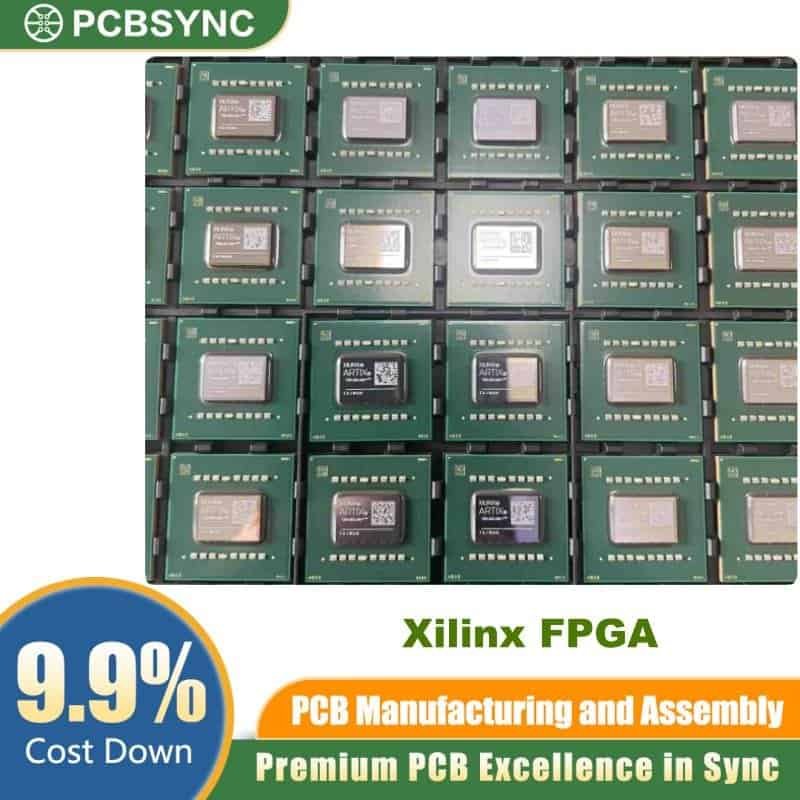
Product Overview: AMD Xilinx XC3SD3400A-5FG676C FPGA
The XC3SD3400A-5FG676C is a powerful field programmable gate array from AMD’s Spartan-3A DSP family, featuring 3.4 million gates, 53,712 logic cells, and operating at speeds up to 770MHz with 90nm technology and 1.2V core voltage in a 676-pin FBGA package. This advanced FPGA solution delivers exceptional performance for cost-sensitive, high-performance DSP applications across telecommunications, industrial automation, and embedded systems.
As part of the proven Xilinx FPGA ecosystem, the XC3SD3400A-5FG676C combines programmability with dedicated DSP capabilities, making it ideal for engineers seeking flexibility without the high costs and long development cycles of traditional ASICs.
Key Technical Specifications
Core Architecture Features
| Specification |
Value |
| Part Number |
XC3SD3400A-5FG676C |
| Manufacturer |
AMD (formerly Xilinx Inc.) |
| FPGA Family |
Spartan-3A DSP |
| System Gates |
3.4 Million |
| Logic Cells |
53,712 |
| Configurable Logic Blocks (CLBs) |
5,968 |
| I/O Pins |
469 user I/O |
| Package Type |
676-FBGA (Fine-pitch Ball Grid Array) |
| Process Technology |
90nm CMOS |
| Core Voltage |
1.2V |
| Maximum Frequency |
770MHz |
Memory and DSP Resources
| Resource Type |
Capacity |
| Block RAM |
2,268 Kbit (283.5 KB) |
| XtremeDSP DSP48A Slices |
Dedicated DSP blocks |
| Distributed RAM |
Configurable LUT-based |
| Speed Grade |
-5 (High performance) |
Electrical Characteristics
| Parameter |
Specification |
| Supply Voltage (VCC) |
3.3V / 5.0V I/O compatible |
| Core Voltage (VCCINT) |
1.2V |
| Operating Temperature |
0°C to +85°C (Commercial) |
| Storage Temperature |
-65°C to +150°C |
| Humidity Range |
5% to 95% (non-condensing) |
Product Description: What Makes XC3SD3400A-5FG676C Stand Out
Advanced DSP Capabilities
The XC3SD3400A-5FG676C builds on the Spartan-3A FPGA success by increasing memory per logic ratio and incorporating XtremeDSP DSP48A slices, delivering more functionality and bandwidth per dollar. These enhancements make it particularly suitable for:
- Digital Signal Processing Applications: Real-time audio/video processing, filtering, and transforms
- Communications Systems: Protocol processing, modulation/demodulation, and baseband processing
- Industrial Control: High-speed motor control, sensor fusion, and process automation
- Consumer Electronics: DTV, DVD, and multimedia applications
Programmability Advantages
Unlike traditional ASICs, this FPGA offers:
- Field Upgradability: Update designs in the field without hardware replacement
- Reduced Development Time: Eliminate lengthy ASIC fabrication cycles
- Lower Initial Costs: No expensive mask sets or minimum order quantities
- Design Flexibility: Iterate and optimize designs post-deployment
Pin Configuration and Package Details
FBGA-676 Package Characteristics
The 676-ball Fine-pitch Ball Grid Array package provides:
- High I/O Density: 469 user-configurable I/O pins
- Excellent Thermal Performance: Efficient heat dissipation for high-performance applications
- PCB Design Compatibility: Standard footprint for automated assembly
- Surface Mount Technology: Compatible with pick-and-place and reflow soldering
I/O Standards Support
| I/O Standard |
Voltage Level |
| LVCMOS |
3.3V, 2.5V, 1.8V, 1.5V, 1.2V |
| LVTTL |
3.3V compatible |
| SSTL |
Multiple classes |
| HSTL |
High-speed standards |
| Differential |
LVDS, mini-LVDS, RSDS |
Development Tools and Design Resources
Compatible Software Tools
Xilinx Vivado Design Suite
- Modern synthesis and implementation environment
- User-friendly interface for rapid development
- Advanced timing analysis and optimization
ISE Design Tools (Legacy Support)
- Backward compatibility for existing projects
- Comprehensive simulation capabilities
- ChipScope Pro debugging integration
Available Design Resources
| Resource Type |
Description |
| Datasheets |
Complete technical specifications (101 pages) |
| Application Notes |
DSP implementation guides and best practices |
| Reference Designs |
Example implementations and starter projects |
| ECAD Models |
Symbols for Altium, EAGLE, KiCad, OrCAD |
| 3D STEP Models |
Mechanical design files for PCB layout |
| PCB Footprints |
Standard FBGA-676 footprint libraries |
Application Areas and Use Cases
Telecommunications and Networking
- Software-defined radio (SDR) implementations
- Channel coding and error correction
- Digital up/down converters
- Network protocol processing
Industrial and Automotive
- Real-time control systems
- Machine vision processing
- Sensor data acquisition and processing
- Motor control algorithms
Consumer Electronics
- DTV and DVD applications with surface mount compatibility and reflow soldering support
- Audio/video codec implementations
- Display controllers and graphics processing
- Gaming and multimedia systems
Medical and Scientific
- Medical imaging processing
- Laboratory instrumentation
- Data acquisition systems
- Signal analysis equipment
Technical Considerations and Design Guidelines
Power Management
Optimal Power Supply Design
- Dedicated 1.2V core voltage rail with low-noise regulation
- Separate 3.3V/5.0V I/O voltage supplies
- Proper decoupling capacitors (0.1µF and 10µF recommended)
- Power sequencing considerations for reliable startup
Thermal Management
Proper thermal management is essential, including adequate heatsinks, stable voltage supply, appropriate ambient temperatures, and quality thermal interface materials. Key considerations:
- Calculate total power dissipation based on resource utilization
- Select appropriate heatsink based on thermal resistance
- Ensure adequate airflow in enclosed systems
- Monitor junction temperature during operation
Signal Integrity Best Practices
To ensure reliable high-speed operation:
- Controlled impedance routing for critical signals
- Proper termination for high-speed I/O standards
- Ground plane continuity for reduced EMI
- Careful JTAG interface design and programming voltage verification
- Length-matched differential pairs for LVDS signals
Configuration and Programming
Configuration Methods
| Method |
Interface |
Description |
| JTAG |
Boundary-scan |
Development and debugging |
| Master Serial |
SPI Flash |
Most common production method |
| Slave Serial |
External controller |
System-level integration |
| Parallel |
Byte-wide |
Fastest configuration option |
Configuration File Requirements
- .bit file: Standard binary configuration file
- .mcs file: PROM programming file for serial flash
- Proper bitstream generation settings in design tools
- Verification of configuration voltage levels (1.2V core)
Quality and Compliance Information
Regulatory Compliance
| Standard |
Status |
| RoHS Compliance |
Not RoHS compliant (legacy product) |
| Lead Content |
Contains lead in solder and package |
| Restriction Status |
Restricted for new EU designs requiring RoHS |
| Legacy Support |
Available for existing designs and non-RoHS applications |
Export Control Classification
- ECCN: 3A991.d (US Export Control)
- USHTS: 8542390001 (Harmonized Tariff Schedule)
- TARIC: 8542399000 (EU Tariff Code)
- Subject to US export administration regulations
Ordering Information and Availability
Part Number Breakdown
XC3SD3400A-5FG676C
- XC3SD3400A: Device family and density
- -5: Speed grade (highest performance)
- FG676: Package type (Fine-pitch BGA, 676 pins)
- C: Commercial temperature range (0°C to +85°C)
Related Part Numbers
| Part Number |
Difference |
| XC3SD3400A-4FG676C |
Lower speed grade (-4) |
| XC3SD3400A-5FGG676C |
Alternative package marking (FGG vs FG) |
| XC3SD3400A-4FG676I |
Industrial temperature range (-40°C to +100°C) |
Troubleshooting Common Issues
Programming Failures
Common programming issues include incorrect voltage settings, faulty JTAG connections, corrupted bitstreams, insufficient power supply, or improper clock configuration. Solutions include:
- Verify VCCINT at 1.2V ±5% during programming
- Check JTAG chain continuity and pull-up resistors
- Regenerate bitstream with correct device settings
- Ensure stable power supply during configuration
Communication Problems
If experiencing I/O communication issues:
- Verify I/O standard configuration matches external devices
- Check signal integrity with oscilloscope or logic analyzer
- Confirm timing constraints are properly met
- Validate voltage levels match interface requirements
- Review pinout and ensure correct pin assignments
Competitive Advantages
Why Choose XC3SD3400A-5FG676C
Cost-Effectiveness
- Lower total cost compared to ASIC development
- No NRE (Non-Recurring Engineering) charges
- Suitable for medium to high volume production
Performance
- 770MHz maximum operating frequency
- Dedicated DSP48A slices for efficient math operations
- Large block RAM capacity for data buffering
Flexibility
- Reprogrammable for design iterations
- In-field updates for feature additions
- Multi-function designs on single device
Ecosystem Support
- Extensive documentation and application notes
- Active developer community
- Third-party IP core availability
- Comprehensive development board options
Conclusion: Ideal FPGA for DSP-Intensive Applications
The XC3SD3400A-5FG676C represents a proven solution for demanding digital signal processing applications requiring high performance, flexibility, and cost-effectiveness. With its comprehensive feature set, extensive development ecosystem, and proven 90nm technology, it offers an excellent balance of capability and value.
Whether you’re developing telecommunications equipment, industrial control systems, or consumer electronics, this FPGA provides the resources and performance needed to succeed in today’s competitive marketplace. The combination of 53,712 logic cells, dedicated DSP blocks, and 469 I/O pins makes it suitable for complex, multi-function designs.
For engineers seeking a reliable, well-supported FPGA platform with strong DSP capabilities, the XC3SD3400A-5FG676C continues to be a solid choice for both new designs and legacy product support.