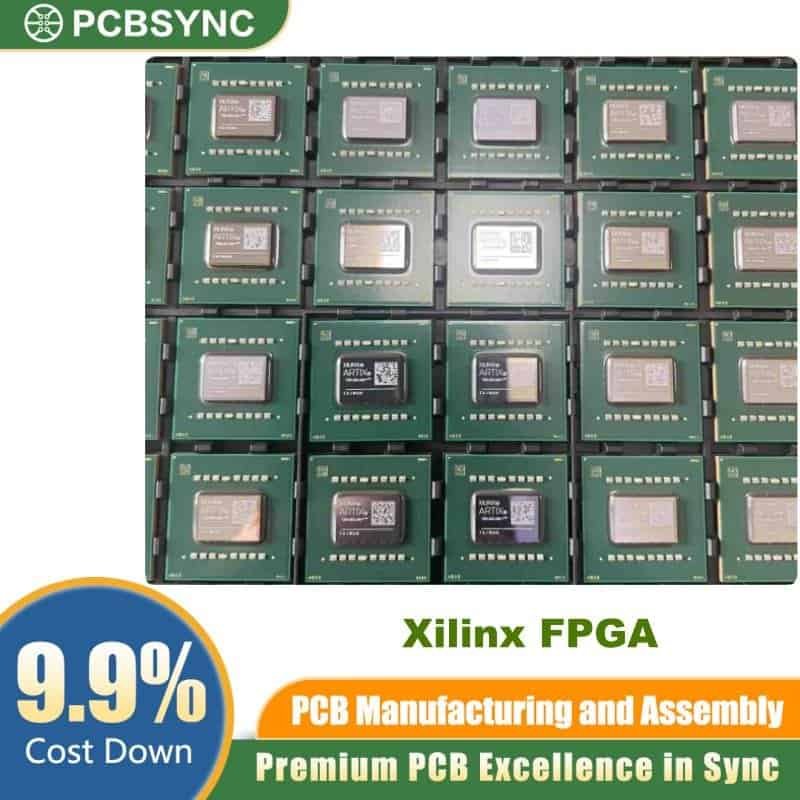
Overview of XC3SD3400A-4FG676I FPGA
The XC3SD3400A-4FG676I from AMD Xilinx represents a cutting-edge Field Programmable Gate Array (FPGA) solution designed for complex digital signal processing and high-performance computing applications. As part of the renowned Spartan-3A DSP family, this FPGA delivers exceptional processing power, flexibility, and cost-effectiveness for demanding embedded system designs.
This industrial-grade FPGA combines 3.4 million system gates with advanced DSP capabilities, making it an ideal choice for aerospace, defense, telecommunications, medical equipment, and industrial automation applications. The device operates reliably across the extended temperature range (-40°C to +100°C), ensuring consistent performance in challenging environmental conditions.
Key Technical Specifications
Core Performance Parameters
| Specification |
Value |
| Part Number |
XC3SD3400A-4FG676I |
| Manufacturer |
AMD (Xilinx) |
| Product Family |
Spartan-3A DSP FPGA |
| System Gates |
3.4 Million |
| Logic Cells |
53,712 |
| Block RAM |
4 Mbit (512KB) |
| DSP48A Slices |
126 |
| Maximum Clock Frequency |
667 MHz |
| I/O Pins |
469 user I/O |
Package and Operating Conditions
| Parameter |
Specification |
| Package Type |
676-pin FBGA (Fine-pitch Ball Grid Array) |
| Package Designation |
FG676 |
| Manufacturing Technology |
90nm CMOS process |
| Core Voltage (VCCINT) |
1.2V |
| I/O Voltage (VCCO) |
1.2V to 3.3V (selectable banks) |
| Operating Temperature |
Industrial (-40°C to +100°C) |
| Speed Grade |
-4 (standard performance) |
Advanced Features and Architecture
DSP Processing Capabilities
The XC3SD3400A-4FG676I incorporates 126 DSP48A slices, providing dedicated hardware acceleration for complex mathematical operations. Each DSP48A slice features an 18-bit x 18-bit multiplier combined with a 48-bit accumulator, enabling high-throughput signal processing operations essential for:
- Digital filtering and convolution
- Fast Fourier Transform (FFT) operations
- Matrix multiplication and linear algebra
- Error correction algorithms
- Software-defined radio (SDR) applications
Memory Resources
| Memory Type |
Capacity |
Configuration |
| Block RAM |
4,032 Kbits |
126 x 18Kbit blocks |
| Distributed RAM |
Variable |
Configurable from CLB resources |
| Total RAM Bits |
2,322,432 bits |
Including block and distributed RAM |
I/O Capabilities
The device provides 469 user-accessible I/O pins organized into configurable I/O banks, supporting multiple industry-standard interfaces:
- High-speed serial interfaces: Up to 1.25 Gb/s differential signaling
- LVDS, LVPECL, and HSTL standards: For high-speed data transmission
- SSTL and HSTL memory interfaces: Compatible with DDR and DDR2 SDRAM
- Single-ended standards: 3.3V LVCMOS, 2.5V LVCMOS, 1.8V LVCMOS, 1.5V LVCMOS, and 1.2V LVCMOS
Application Areas and Use Cases
Industrial Automation and Control
The XC3SD3400A-4FG676I excels in industrial environments requiring real-time processing, precise timing control, and reliable operation. Common applications include:
- Motor control systems: Advanced servo and stepper motor control with encoder feedback
- Machine vision processing: Real-time image processing for quality inspection and defect detection
- Industrial networking: Implementation of EtherCAT, PROFINET, and Modbus protocols
- PLC functionality: Programmable logic controller replacement with enhanced flexibility
Telecommunications and Networking
Telecommunications infrastructure benefits from the FPGA’s high-speed processing and flexible I/O configuration:
- Base station processing: LTE, 5G, and wireless backhaul signal processing
- Network packet processing: Routing, switching, and deep packet inspection
- Protocol conversion: Translation between different communication standards
- Channel coding: Implementation of turbo codes, LDPC, and convolutional codes
Medical and Healthcare Equipment
Medical device manufacturers leverage this Xilinx FPGA for critical healthcare applications:
- Medical imaging: Ultrasound beam forming, CT scan reconstruction, and MRI signal processing
- Patient monitoring: Real-time vital sign processing and analysis
- Diagnostic equipment: Signal acquisition and filtering for ECG, EEG, and EMG devices
- Laboratory instruments: DNA sequencing, mass spectrometry, and chemical analysis
Aerospace and Defense Systems
Military and aerospace applications demand the reliability and performance of the XC3SD3400A-4FG676I:
- Radar signal processing: Pulse compression, Doppler processing, and target tracking
- Software-defined radio: Multi-band, multi-mode communication systems
- Navigation systems: GPS/GNSS signal processing and inertial measurement integration
- Avionics: Flight control computers, data acquisition, and sensor fusion
Consumer Electronics and Automotive
Modern consumer and automotive electronics utilize FPGAs for advanced features:
- Advanced driver assistance systems (ADAS): Camera processing, LiDAR interpretation, and sensor fusion
- Infotainment systems: Audio/video processing and interface management
- High-definition video processing: 4K/8K video encoding, decoding, and transcoding
- Gaming and graphics: Hardware acceleration for complex rendering algorithms
Development Tools and Design Resources
Xilinx ISE Design Suite
The XC3SD3400A-4FG676I is supported by the comprehensive Xilinx ISE Design Suite, which provides:
- HDL synthesis: Verilog and VHDL support with advanced optimization
- Implementation tools: Place and route with timing-driven algorithms
- Simulation environment: ModelSim integration for functional and timing verification
- Constraint management: User Constraint File (UCF) editor for pinout and timing specifications
- IP core library: Pre-verified intellectual property for common functions
Programming and Configuration
Multiple configuration options ensure flexibility in system deployment:
| Configuration Mode |
Description |
Typical Application |
| JTAG |
Standard boundary scan programming |
Development and debugging |
| Master Serial |
SPI flash boot mode |
Production deployment |
| Slave Serial |
External controller programming |
System-level integration |
| Master SelectMAP |
Parallel configuration |
High-speed reconfiguration |
| Slave SelectMAP |
Parallel external control |
Embedded system updates |
Performance Benchmarks and Comparisons
Processing Throughput
The XC3SD3400A-4FG676I delivers exceptional processing performance across various benchmarks:
| Operation |
Performance |
Specifications |
| Multiply-Accumulate (MAC) |
Up to 21 GMAC/s |
126 DSP slices @ 667 MHz |
| FIR Filter Taps |
Up to 500 taps |
Parallel processing with block RAM |
| FFT Operations |
1024-point FFT in <2μs |
Optimized butterfly operations |
| Data Throughput |
Up to 1.25 Gb/s per I/O pair |
High-speed LVDS interfaces |
Power Consumption Characteristics
Efficient power management makes the XC3SD3400A-4FG676I suitable for power-constrained applications:
- Static power: Typically 250-400 mW (design-dependent)
- Dynamic power: Proportional to clock frequency and resource utilization
- Low-power modes: Clock gating and resource shutdown capabilities
- Thermal management: Compatible with standard heatsinks and thermal solutions
Package and PCB Design Considerations
FBGA Package Details
The 676-pin Fine-pitch Ball Grid Array (FBGA) package offers:
- Dimensions: 27mm x 27mm body size
- Ball pitch: 1.0mm for optimal routing density
- Total balls: 676 solder balls arranged in a grid pattern
- Height: Low-profile design for space-constrained applications
- Material: Industry-standard substrate with RoHS compliance
PCB Layout Recommendations
For optimal performance and reliability, follow these PCB design guidelines:
- Power distribution: Use dedicated power planes with multiple bypass capacitors (0.1μF and 10μF near each power pin)
- Signal integrity: Route high-speed signals on inner layers with controlled impedance (typically 50Ω single-ended, 100Ω differential)
- Thermal management: Include thermal vias beneath the package center for heat dissipation
- Ground planes: Maintain continuous ground planes to minimize EMI and ensure signal return paths
- Configuration circuit: Place configuration memory and support components close to the FPGA
Quality and Reliability Standards
Compliance and Certifications
The XC3SD3400A-4FG676I meets stringent international standards:
- RoHS Directive 2011/65/EU: Lead-free and environmentally compliant
- REACH regulation: Substance of Very High Concern (SVHC) compliant
- Military temperature grade: Extended operating range (-40°C to +100°C)
- ESD protection: Human Body Model (HBM) Class 1C (1000V-2000V)
- Latch-up immunity: Exceeds 200mA per JEDEC standard
Reliability Metrics
AMD Xilinx ensures exceptional reliability through rigorous testing:
- Mean Time Between Failures (MTBF): >1,000,000 hours under normal operating conditions
- Qualification testing: AEC-Q100 Grade 2 equivalent for automotive applications
- Moisture sensitivity: Level 3 (168 hours at 30°C/60% RH)
- Lifecycle support: Long-term availability guarantee for industrial applications
Ordering Information and Support
Part Number Nomenclature
Understanding the part number structure helps in selecting the correct device:
XC3SD3400A-4FG676I
- XC: Xilinx commercial FPGA
- 3S: Spartan-3A family
- D3400A: DSP variant with 3400K system gates
- -4: Speed grade (standard performance)
- FG676: 676-pin Fine-pitch BGA package
- I: Industrial temperature grade (-40°C to +100°C)
Available Variants
| Part Number |
Speed Grade |
Temperature Range |
Key Difference |
| XC3SD3400A-4FG676I |
-4 (standard) |
Industrial (-40°C to +100°C) |
Standard offering |
| XC3SD3400A-5FG676I |
-5 (enhanced) |
Industrial (-40°C to +100°C) |
Higher maximum clock frequency |
| XC3SD3400A-4FG676C |
-4 (standard) |
Commercial (0°C to +85°C) |
Commercial temperature range |
Technical Support and Resources
AMD Xilinx provides comprehensive support resources:
- Datasheet downloads: Complete technical specifications and electrical characteristics
- Application notes: Design guidelines for specific implementations
- Reference designs: Pre-built solutions for common applications
- Technical forums: Community support and expert assistance
- FAE support: Direct access to Field Application Engineers
- Training programs: Online courses and certification programs
Competitive Advantages and Market Position
Superior Performance/Cost Ratio
The XC3SD3400A-4FG676I delivers exceptional value through:
- High integration: Reduces external component count and system complexity
- Proven technology: Mature 90nm process ensures consistent yields and availability
- Cost-effective DSP: Dedicated DSP slices eliminate need for external signal processors
- Flexible I/O: Eliminates need for level shifters and interface bridges
Advantages Over Alternative Solutions
Compared to traditional ASIC and microprocessor approaches:
- Design flexibility: Reconfigurable architecture allows post-deployment updates
- Time-to-market: Rapid prototyping and iterative development reduce project timelines
- Risk mitigation: No NRE costs or minimum order quantities
- Future-proofing: Field upgradable firmware extends product lifecycle
Frequently Asked Questions (FAQ)
Q: What is the maximum operating frequency of the XC3SD3400A-4FG676I?
The XC3SD3400A-4FG676I with -4 speed grade supports internal clock frequencies up to 667 MHz, depending on the specific design implementation and resource utilization. Critical path timing and routing complexity affect achievable clock rates.
Q: How many DSP blocks are available in this FPGA?
This device contains 126 DSP48A slices, each capable of performing 18-bit x 18-bit multiplication followed by accumulation. These dedicated DSP resources provide high-performance arithmetic operations for signal processing applications.
Q: What configuration memory is required?
The XC3SD3400A-4FG676I requires approximately 13 Mbits of configuration data. Common configuration memory options include:
- SPI serial flash (e.g., Micron M25P64 or equivalent)
- Parallel NOR flash for SelectMAP modes
- JTAG programming for development
Q: Is this device suitable for automotive applications?
While the XC3SD3400A-4FG676I industrial temperature grade (-40°C to +100°C) meets temperature requirements for many automotive applications, it is not specifically AEC-Q100 qualified. For automotive-grade FPGAs, consider the Xilinx Automotive XA Spartan-3A DSP family variants.
Q: What power supply voltages are required?
The device requires:
- Core voltage (VCCINT): 1.2V ±5%
- Auxiliary voltage (VCCAUX): 2.5V ±5%
- I/O voltages (VCCO): Selectable per bank (1.2V, 1.5V, 1.8V, 2.5V, or 3.3V)
- Configuration voltage: 2.5V or 3.3V depending on mode
Q: How does this compare to newer FPGA families?
The Spartan-3A DSP family offers mature, proven technology with excellent cost-performance ratios. Newer families (e.g., Spartan-6, Spartan-7) provide:
- Lower power consumption (45nm/28nm process)
- Higher performance (faster clock speeds)
- Additional features (DDR3 support, PCIe) However, the XC3SD3400A-4FG676I remains ideal for applications prioritizing cost, stability, and long-term availability.
Conclusion and Recommendations
The XC3SD3400A-4FG676I represents a versatile, high-performance FPGA solution suitable for demanding digital signal processing and embedded system applications. Its combination of 53,712 logic cells, 126 DSP48A slices, and 469 I/O pins provides exceptional processing capability while maintaining cost-effectiveness.
Engineers selecting this Xilinx FPGA benefit from mature development tools, extensive documentation, and proven reliability across industrial, telecommunications, medical, and aerospace applications. The industrial temperature grade (-40°C to +100°C) ensures reliable operation in challenging environmental conditions.
For optimal results, leverage the comprehensive ISE Design Suite, follow recommended PCB layout practices, and utilize available reference designs to accelerate development. The device’s reconfigurable architecture provides future-proofing capabilities, allowing field updates and feature enhancements throughout the product lifecycle.
Whether implementing complex signal processing algorithms, high-speed data acquisition systems, or sophisticated control applications, the XC3SD3400A-4FG676I delivers the performance, flexibility, and reliability required for next-generation embedded systems.