Inquire: Call 0086-755-23203480, or reach out via the form below/your sales contact to discuss our design, manufacturing, and assembly capabilities.
Quote: Email your PCB files to Sales@pcbsync.com (Preferred for large files) or submit online. We will contact you promptly. Please ensure your email is correct.
Notes: For PCB fabrication, we require PCB design file in Gerber RS-274X format (most preferred), *.PCB/DDB (Protel, inform your program version) format or *.BRD (Eagle) format. For PCB assembly, we require PCB design file in above mentioned format, drilling file and BOM. Click to download BOM template To avoid file missing, please include all files into one folder and compress it into .zip or .rar format.
When you’re staring at a complex BGA fanout with 2000+ pins and your routing software keeps telling you there’s no solution on a 16-layer board, you know it’s time to step into the world of ultra-high layer count PCBs. A 38 layer PCB represents the cutting edge of printed circuit board technology, pushing the boundaries of what’s possible in electronic design.
I’ve spent years working with high layer count boards for data centers and aerospace systems, and I can tell you that moving beyond 30 layers isn’t just about adding more copper. It’s a completely different engineering discipline that requires careful consideration of materials, manufacturing processes, and signal integrity.
This guide covers everything you need to know about 38 layer PCB design and manufacturing, from stack-up planning to choosing the right fabrication partner.
A 38 layer PCB is an ultra-high layer count printed circuit board containing 38 separate conductive copper layers, each separated by dielectric insulating material. These boards fall into the category of high layer count (HLC) PCBs, which typically refers to boards with 12 or more layers.
To put this in perspective, your typical consumer electronics device uses 4 to 8 layer boards. High-performance smartphones might use 10 to 12 layers. A 38 layer PCB is reserved for the most demanding applications where routing density, signal integrity, and power distribution requirements exceed what lower layer counts can achieve.
The construction involves laminating multiple double-sided cores with prepreg (pre-impregnated fiberglass sheets) under extreme heat and pressure. Each lamination cycle must maintain precise alignment, with tolerances as tight as ±2 mils for layer-to-layer registration.
Key Characteristics of 38 Layer PCBs:
Parameter
Typical Specification
Layer Count
38 copper layers
Total Thickness
3.0mm to 6.0mm
Minimum Trace Width
3 mil (0.076mm)
Minimum Trace Spacing
3 mil (0.076mm)
Via Types
Through-hole, blind, buried, microvias
Aspect Ratio
Up to 15:1 or higher
Impedance Tolerance
±8% to ±10%
Material Options
High-Tg FR4, low-loss, ultra-low-loss laminates
Why Would You Need a 38 Layer PCB?
Before jumping into a 38 layer design, you should understand when this level of complexity is actually necessary. High layer count boards aren’t just expensive—they introduce manufacturing challenges that can impact yield and reliability.
High-Speed Digital Interfaces
Modern processors and FPGAs use BGA packages with pin counts exceeding 2000. Routing out these devices requires multiple signal layers with dedicated ground reference planes. When you have DDR5 memory interfaces running at 6.4 Gbps alongside PCIe 5.0 lanes at 32 GT/s, you need the layer real estate to maintain proper impedance control and signal separation.
Complex Power Distribution Networks
High-performance computing systems require multiple voltage rails. A typical server processor might need a dozen different voltages, each requiring its own power plane or split-plane arrangement. Adding power integrity capacitor placements and proper current return paths quickly consumes layers.
EMI/EMC Requirements
For aerospace, medical, and military applications, electromagnetic compatibility isn’t optional. Shielding high-speed signals between ground planes, isolating sensitive analog circuits from noisy digital sections, and creating proper return current paths all demand additional layers.
Space Constraints
Sometimes you simply can’t make the board bigger. When the form factor is fixed and the circuit complexity keeps growing, the only direction to expand is vertically through additional layers.
38 Layer PCB Stack-Up Design Principles
Stack-up design is where your 38 layer PCB project will succeed or fail. A poorly planned stack-up leads to signal integrity problems, manufacturing difficulties, and potential reliability issues.
Symmetry Is Non-Negotiable
For a 38 layer board, maintaining symmetry around the center is critical. Asymmetric stack-ups cause differential thermal expansion during lamination and reflow, resulting in warpage that can exceed IPC specifications. Your stack-up should be essentially a mirror image from the center outward.
Layer Type Distribution
A typical 38 layer stack-up might include:
Layer Type
Quantity
Purpose
Signal Layers
16-20
High-speed routing, general interconnect
Ground Planes
10-12
Reference planes, shielding, return paths
Power Planes
6-8
Multiple voltage distribution
Mixed Layers
2-4
Split planes or routed power
Reference Plane Strategy
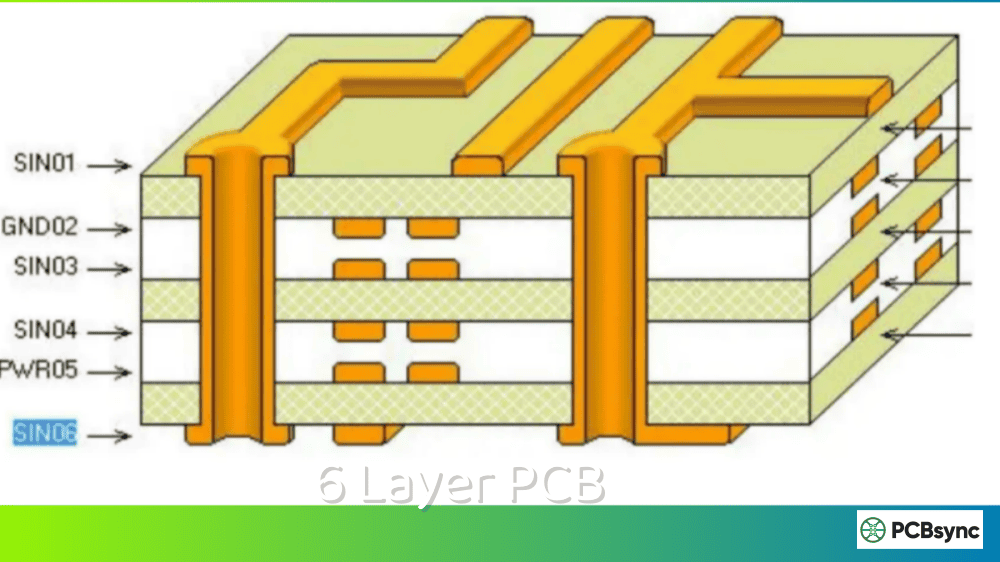
Every high-speed signal layer should be adjacent to a solid reference plane. This provides controlled impedance, reduces crosstalk, and ensures clean return current paths. Avoid placing two signal layers adjacent to each other—the coupling between them will cause crosstalk that’s extremely difficult to filter out.
Core and Prepreg Selection
For a 38 layer board, you’ll typically use thin cores (2-4 mils) and prepreg sheets (2-3 mils) to keep the total thickness manageable. Work with your PCB manufacturing partner early to confirm material availability and lamination capabilities.
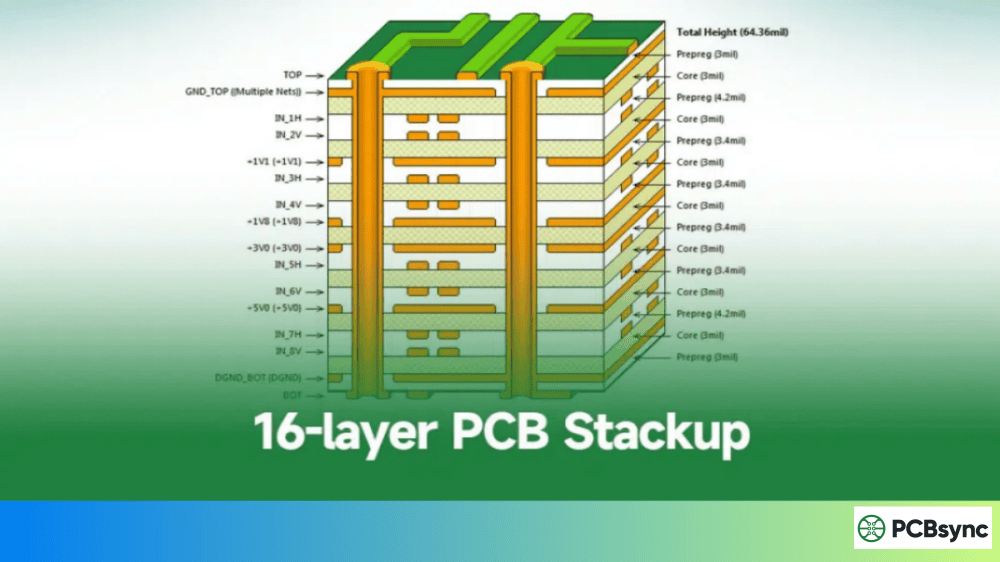
Sample 38 Layer Stack-Up Configuration:
Layer
Type
Thickness
Material
L1
Signal (Top)
1 oz Cu
–
PP
Prepreg
3.5 mil
2116
L2
Ground
0.5 oz Cu
–
Core
Dielectric
3 mil
High-Tg FR4
L3
Signal
0.5 oz Cu
–
PP
Prepreg
3 mil
1080
L4
Power
1 oz Cu
–
…
…
…
…
L38
Signal (Bottom)
1 oz Cu
–
Materials for 38 Layer PCB Manufacturing
Material selection directly impacts signal integrity, reliability, and manufacturability. At 38 layers, you can’t use standard FR4 and expect good results.
High-Tg Laminates
Standard FR4 has a glass transition temperature (Tg) around 130-140°C. For high layer count boards that undergo multiple lamination cycles and lead-free reflow temperatures, you need High-Tg materials with Tg values of 170°C or higher. Common options include:
Very High-Tg (Tg 180°C+): Isola 370HR, Panasonic Megtron 4
Low-Loss Materials for High-Speed Signals
When your signals exceed 5 GHz, standard FR4’s dielectric loss becomes problematic. Low-loss and ultra-low-loss materials maintain signal integrity at high frequencies:
Material Category
Typical Dk
Typical Df
Use Case
Standard FR4
4.2-4.5
0.020-0.025
General purpose
Mid-Loss
3.8-4.0
0.010-0.015
5-10 GHz applications
Low-Loss
3.3-3.6
0.004-0.008
10-25 GHz applications
Ultra-Low-Loss
3.0-3.3
0.002-0.004
25+ GHz applications
Copper Foil Types
For fine-line etching required in high layer count boards, standard electrodeposited copper may not provide the edge definition you need. Consider:
Reverse Treated Foil (RTF): Better adhesion for thin dielectrics
HVLP (Hyper Very Low Profile): Reduced skin effect losses at high frequencies
Ultra-Low Profile: For the finest trace geometries
Manufacturing a 38 layer PCB requires specialized equipment and processes that not all fabricators can provide. Understanding the process helps you design for manufacturability and select the right production partner.
Sequential Lamination
A 38 layer board cannot be manufactured in a single lamination cycle. The process typically involves multiple sequential laminations:
First lamination: Bond cores together to form sub-assemblies
Subsequent laminations: Continue building up layers in stages
Final lamination: Complete the full stack-up
Each lamination cycle introduces potential for layer misregistration and dimensional changes. Manufacturers use optical and X-ray alignment systems to maintain accuracy.
Via Formation Challenges
With 38 layers, via design becomes complex:
Through-Hole Vias: Connect all layers but consume routing real estate on every layer. The aspect ratio (board thickness to hole diameter) becomes challenging—a 4mm thick board with 0.2mm holes yields a 20:1 aspect ratio, which many fabricators cannot plate reliably.
Blind Vias: Connect outer layers to inner layers without penetrating the full board. Require sequential drilling and plating.
Buried Vias: Connect inner layers only, created before final lamination. Add cost but preserve outer layer routing space.
Microvias: Laser-drilled vias typically 0.1mm or smaller, used in HDI structures. Can be stacked or staggered across multiple layers.
Registration and Alignment
Layer-to-layer registration tolerance is critical. For a 38 layer board, cumulative misregistration errors can cause shorts, opens, or impedance variations. Expect:
Layer-to-layer registration: ±3 mils typical, ±2 mils for high-precision
Annular ring minimums: 3-4 mils after registration tolerance
Pad-to-trace clearances: Account for registration in your design rules
Back-Drilling
High-speed signals suffer from via stubs that act as resonant antennas. Back-drilling removes the unused portion of through-hole vias, leaving only the section that connects active layers. For a 38 layer board with signals on layers 3 and 35, back-drilling from both sides removes the stubs above and below the active connections.
Stub length targets for high-speed designs:
Below 10 Gbps: 20 mil stub acceptable
10-25 Gbps: 10 mil stub maximum
Above 25 Gbps: 5 mil or less
Design Guidelines for 38 Layer PCBs
Designing a 38 layer board requires attention to details that don’t matter on simpler boards. These guidelines come from hard-learned lessons in the field.
Trace Routing Rules
Impedance Control: Define your impedance requirements early and work with your fabricator to establish trace widths. A 50-ohm single-ended trace might be 4 mils wide on a low-loss material with a 4 mil dielectric, but 5 mils wide on standard FR4 with the same dielectric.
Length Matching: For DDR, PCIe, and other parallel interfaces, match trace lengths within the specified tolerance. Tools like Altium Designer and Cadence Allegro have built-in length tuning features.
Differential Pairs: Maintain consistent spacing throughout the route. Avoid changing layers unnecessarily—each via transition adds impedance discontinuity.
Via Design Strategy
Via Type
When to Use
Cost Impact
Through-hole
Low-speed signals, power connections
Lowest
Blind
Signals needing outer layer components
Moderate
Buried
Inner layer connections, dense BGA escape
High
Microvias
Ultra-high density, HDI designs
Highest
Power Integrity Considerations
Place decoupling capacitors close to IC power pins
Use multiple vias for each capacitor connection
Consider embedded capacitance materials for critical applications
Perform power integrity simulation before finalizing the stack-up
Thermal Management
A 38 layer board has significant thermal mass, which can be both advantage and disadvantage:
Advantage: Better heat spreading across multiple copper planes
Disadvantage: Longer thermal equalization time during reflow
Design thermal relief patterns on power planes to balance thermal management with manufacturability.
Applications of 38 Layer PCBs
Ultra-high layer count boards serve specific industries where performance requirements justify the cost and complexity.
Data Center and Server Infrastructure
Modern AI servers use motherboards with 18-24+ layers as standard, with some specialized compute boards pushing higher. These systems handle:
Multi-core processors with thousands of BGA pins
DDR5 memory channels running at maximum speeds
PCIe Gen 5 interconnects
High-speed networking interfaces
Telecommunications and 5G Infrastructure
5G base station equipment requires boards that handle high-frequency signals while managing thermal loads. The combination of RF circuits, digital processing, and power management often pushes layer counts into the 30+ range.
Aerospace and Defense Systems
Avionics computers, radar systems, and satellite electronics demand extreme reliability and performance. These applications often combine:
CT scanners, MRI machines, and other medical imaging devices use high layer count boards for their data acquisition and processing systems. Signal integrity is critical when processing medical diagnostic data.
High-Performance Computing
Supercomputers and HPC clusters use specialized compute blades with the highest density interconnects. These systems push PCB technology to its limits in both layer count and routing density.
Cost Factors for 38 Layer PCBs
Let’s be direct: 38 layer PCBs are expensive. Understanding the cost drivers helps you make informed decisions and potentially optimize your design.
Layer Count Impact
Cost doesn’t scale linearly with layer count. Each additional layer pair adds approximately 30-40% to the fabrication cost in low volumes. A 38 layer board might cost 8-10x more than an equivalent 12 layer board.
What is your typical lead time for 38 layer prototypes?
Can you handle sequential lamination with buried vias?
DFM Review Process
Any competent high layer count fabricator should offer a Design for Manufacturability review. This catches issues before production:
Stack-up feasibility and material availability
Via structure manufacturability
Impedance calculation verification
Panelization and routing optimization
Drill aspect ratio validation
Testing and Quality Assurance
A 38 layer board requires thorough testing to verify both fabrication quality and electrical performance.
Fabrication Testing
Automated Optical Inspection (AOI): Scans each inner layer before lamination to catch opens, shorts, and trace defects.
X-Ray Inspection: Verifies via registration, layer alignment, and internal defects that aren’t visible externally.
Electrical Test (Flying Probe or Bed-of-Nails): Verifies all connections and checks for shorts. Flying probe is more common for prototypes; bed-of-nails for production volumes.
What is the maximum layer count possible for a PCB?
While theoretical limits extend beyond 100 layers, practical manufacturing typically caps around 60-64 layers for production boards. Some specialized applications have pushed to 80+ layers, but these require extremely specialized fabrication processes. Most high-end applications are well-served by 32-48 layer boards.
How thick is a 38 layer PCB?
A 38 layer PCB typically ranges from 3.0mm to 6.0mm thick, depending on the dielectric materials and copper weights used. Thinner constructions (around 3.0mm) use ultra-thin cores and prepregs but are more challenging to manufacture. Thicker boards (5-6mm) are easier to fabricate but create challenges for drilling aspect ratios.
What is the lead time for a 38 layer PCB prototype?
Expect 4-6 weeks for prototype quantities from capable manufacturers. Rush services may reduce this to 3-4 weeks at significant additional cost. Production quantities typically require 6-8 weeks including tooling and volume ramp-up.
Can any PCB manufacturer produce 38 layer boards?
No. High layer count fabrication requires specialized equipment, materials expertise, and process controls that many fabricators lack. Even among capable manufacturers, some have higher yields and better quality than others. Always verify a manufacturer’s track record with similar layer counts before committing to production.
How do I reduce costs on a 38 layer PCB design?
Several strategies can help control costs: minimize the use of blind and buried vias where through-hole vias will work; use standard high-Tg FR4 instead of exotic low-loss materials unless signal integrity demands it; optimize your layer count—sometimes dropping to 36 or 34 layers is possible with creative routing; design for larger trace/space where possible to improve yields; and order in larger quantities to benefit from volume pricing.
Conclusion
Designing and manufacturing a 38 layer PCB requires a systematic approach that considers signal integrity, power distribution, thermal management, and manufacturing constraints from the earliest design stages. The complexity involved demands close collaboration between design engineers and fabrication partners.
While the cost and lead time for ultra-high layer count boards can seem daunting, these boards enable the advanced electronic systems that drive modern computing, communications, and aerospace technology. When your application truly requires 38 layers, there’s no substitute.
Start your next high layer count project by establishing clear requirements, engaging with capable fabricators early, and building in time for proper design verification and testing. The investment in upfront planning pays dividends in reduced respins and faster time to production.
Inquire: Call 0086-755-23203480, or reach out via the form below/your sales contact to discuss our design, manufacturing, and assembly capabilities.
Quote: Email your PCB files to Sales@pcbsync.com (Preferred for large files) or submit online. We will contact you promptly. Please ensure your email is correct.
Notes: For PCB fabrication, we require PCB design file in Gerber RS-274X format (most preferred), *.PCB/DDB (Protel, inform your program version) format or *.BRD (Eagle) format. For PCB assembly, we require PCB design file in above mentioned format, drilling file and BOM. Click to download BOM template To avoid file missing, please include all files into one folder and compress it into .zip or .rar format.