Inquire: Call 0086-755-23203480, or reach out via the form below/your sales contact to discuss our design, manufacturing, and assembly capabilities.
Quote: Email your PCB files to Sales@pcbsync.com (Preferred for large files) or submit online. We will contact you promptly. Please ensure your email is correct.
Notes: For PCB fabrication, we require PCB design file in Gerber RS-274X format (most preferred), *.PCB/DDB (Protel, inform your program version) format or *.BRD (Eagle) format. For PCB assembly, we require PCB design file in above mentioned format, drilling file and BOM. Click to download BOM template To avoid file missing, please include all files into one folder and compress it into .zip or .rar format.
If you’ve ever worked on a radar system, satellite antenna, or any RF circuit operating above a few gigahertz, you’ve probably run into the limitations of standard FR-4. The dielectric losses become unacceptable, impedance control goes out the window, and suddenly your carefully simulated design doesn’t match reality. That’s exactly why materials like RT/Duroid 5870 exist.
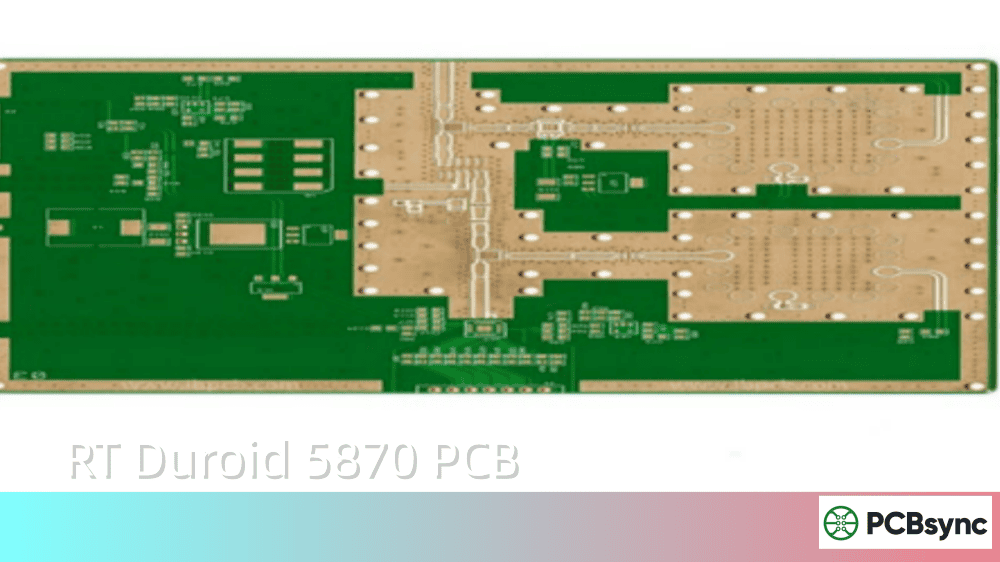
Rogers Corporation developed the RT/Duroid 5870 PCB material specifically for engineers who need predictable, low-loss performance at microwave and millimeter-wave frequencies. After working with this material on numerous projects—from commercial broadband antennas to military guidance systems—I can tell you it delivers where FR-4 simply cannot.
This guide covers everything you need to know about RT/Duroid 5870: the technical specifications, design considerations, fabrication guidelines, and real-world applications. Whether you’re specifying material for a new project or trying to understand why your RF engineer keeps requesting “that expensive Rogers stuff,” this article has you covered.
RT/Duroid 5870 is a glass microfiber reinforced PTFE (polytetrafluoroethylene) composite laminate manufactured by Rogers Corporation. Unlike woven glass reinforcement used in standard materials, the randomly oriented microfibers in RT/Duroid 5870 provide exceptional dielectric constant uniformity across the entire panel.
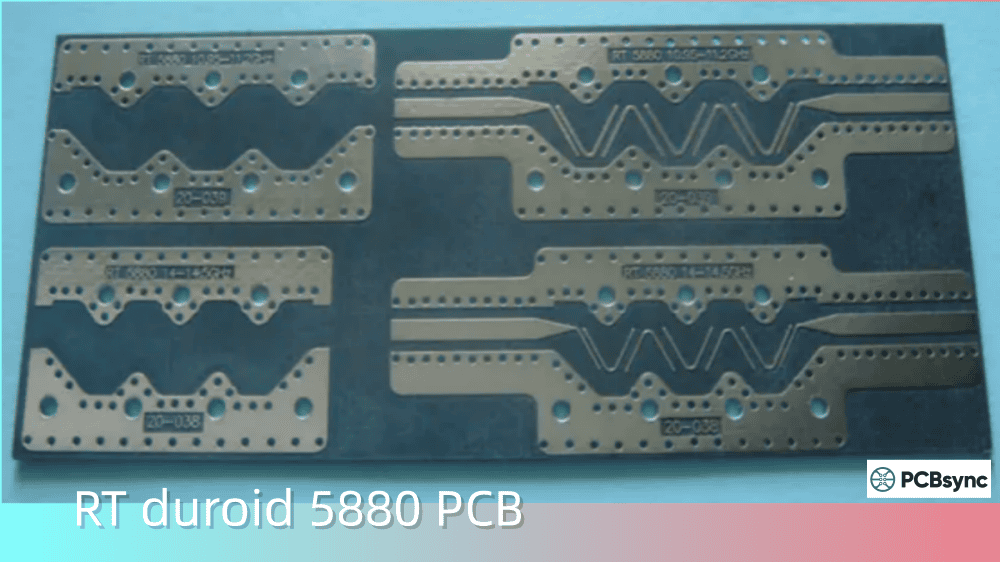
The material belongs to Rogers’ RT/Duroid family of high-frequency laminates, sitting alongside its close sibling, the RT/Duroid 5880. Both materials share similar construction but differ in their dielectric constant values—a distinction that matters significantly in RF design.
Why Engineers Choose RT/Duroid 5870 PCB
The primary reasons for selecting RT/Duroid 5870 over standard PCB materials come down to three factors: dielectric constant stability, low loss tangent, and consistent panel-to-panel performance.
When you’re designing a filter with a 2% bandwidth at 24 GHz, you cannot tolerate the ±10% Dk variation typical of FR-4. RT/Duroid 5870 delivers ±0.02 tolerance on its dielectric constant—that’s the difference between a working design and an expensive paperweight.
The material also exhibits isotropic properties due to its randomly oriented microfiber reinforcement. This means the electrical characteristics remain consistent regardless of signal propagation direction, which simplifies design calculations for complex antenna structures.
RT/Duroid 5870 PCB Electrical Properties
Understanding the electrical specifications is critical for accurate RF simulation and design. Here’s what the datasheet tells us:
The dielectric constant of 2.33 represents one of the lowest Dk values available in reinforced PTFE materials. This low Dk enables wider trace widths for a given impedance, which can improve power handling and reduce conductor losses in microstrip configurations.
The dissipation factor of 0.0012 at 10 GHz classifies RT/Duroid 5870 among the lowest-loss reinforced PTFE materials on the market. This extends the practical usefulness of the material well into Ku-band and beyond—Rogers specifies performance up to millimeter-wave frequencies.
Frequency Stability
One characteristic that sets RT/Duroid 5870 apart is its frequency-stable dielectric constant. Unlike some ceramic-filled PTFE materials that exhibit Dk drift with frequency, RT/Duroid 5870 maintains consistent Dk from panel to panel and across a wide frequency range.
This stability matters enormously for broadband applications. When designing a wideband antenna covering 2-18 GHz, you need confidence that your impedance matching network will perform consistently across the entire band.
RT/Duroid 5870 Mechanical and Thermal Properties
RF performance alone doesn’t make a usable PCB material. The mechanical and thermal properties determine whether your boards will survive manufacturing, assembly, and field deployment.
Mechanical Specifications
Property
Value
Direction
Test Method
Tensile Modulus
1034 MPa
X
ASTM D638
Tensile Strength
27.6 MPa
X
ASTM D638
Specific Gravity
2.33
—
ASTM D792
Peel Strength
26.3 N/mm
—
IPC-TM-650
Thermal Specifications
Property
Value
Test Method
CTE (X-axis)
22 ppm/°C
ASTM E831
CTE (Y-axis)
28 ppm/°C
ASTM E831
CTE (Z-axis)
173 ppm/°C
ASTM E831
Thermal Conductivity
0.22 W/m/K
ASTM C518
Td (Decomposition Temperature)
>500°C
TGA
Moisture Absorption
0.02%
IPC-TM-650
The low Z-axis CTE compared to non-reinforced PTFE improves plated through-hole reliability during thermal cycling. The glass microfiber reinforcement constrains expansion in the laminate plane while allowing controlled expansion through the thickness.
Moisture absorption of only 0.02% makes RT/Duroid 5870 excellent for applications in humid environments or outdoor installations. Unlike some ceramic-filled materials that can absorb moisture and shift Dk, this material maintains stable electrical properties even in tropical conditions.
Rogers supplies RT/Duroid 5870 in various thicknesses and copper cladding options to accommodate different design requirements.
Standard Dielectric Thicknesses
Thickness (inch)
Thickness (mm)
Tolerance
0.005
0.127
±0.0005″
0.010
0.254
±0.0007″
0.020
0.508
±0.0015″
0.031
0.787
±0.0020″
0.062
1.575
±0.0030″
Copper Cladding Options
RT/Duroid 5870 is available with several copper foil options:
Electrodeposited (ED) Copper: Standard offering in 1/2 oz (18μm), 1 oz (35μm), and 2 oz (70μm) weights. ED copper provides good adhesion and is suitable for most applications.
Rolled Copper Foil: Available in 1/2 oz and 1 oz weights for applications requiring lower insertion loss. Rolled copper has smoother surface finish, reducing conductor losses at higher frequencies.
Reverse Treated ED Copper: Provides enhanced adhesion to the PTFE substrate while maintaining good electrical performance.
Standard Panel Sizes
Panels are typically available in sizes up to 24″ x 18″ (610mm x 457mm), though specific availability should be confirmed with distributors.
RT/Duroid 5870 vs RT/Duroid 5880: Key Differences
Engineers often ask which material to specify—5870 or 5880. The choice depends on your specific requirements.
Comparison Table
Property
RT/Duroid 5870
RT/Duroid 5880
Dielectric Constant (Dk)
2.33 ± 0.02
2.20 ± 0.02
Dissipation Factor (Df)
0.0012
0.0009
Frequency Stability
Excellent
Excellent
Cost
Moderate
Higher
Primary Application
General RF/Microwave
Ultra-low loss applications
When to Choose RT/Duroid 5870
Select RT/Duroid 5870 when you need a well-established, cost-effective solution for high-frequency applications up to Ku-band. The material offers the best balance of electrical performance, mechanical properties, and cost for most radar, antenna, and communication applications.
When to Choose RT/Duroid 5880
Opt for RT/Duroid 5880 when you’re designing ultra-low-loss circuits where every 0.0003 reduction in Df matters—think satellite transponders, low-noise amplifiers, or systems where thermal noise is a critical concern.
RT/Duroid 5870 vs FR-4: Why the Premium?
For engineers accustomed to FR-4 pricing, the cost of RT/Duroid 5870 can cause sticker shock. Here’s why the premium is justified for high-frequency work.
Performance Comparison
Property
RT/Duroid 5870
Standard FR-4
Dielectric Constant
2.33 ± 0.02
4.2-4.8 ± 10%
Dissipation Factor
0.0012
0.02-0.025
Dk Stability vs Frequency
Excellent
Poor above 1 GHz
Moisture Absorption
0.02%
0.1-0.3%
Maximum Usable Frequency
40+ GHz
~2 GHz
At 10 GHz, FR-4’s dissipation factor is roughly 20 times higher than RT/Duroid 5870. This translates directly to insertion loss—a critical parameter in any RF system.
For applications below 1-2 GHz where loss isn’t critical, FR-4 remains a sensible choice. Above that frequency range, the performance degradation makes specialized materials essential.
For more information about high-frequency Rogers materials, check out this comprehensive guide on Rogers PCB options.
RT/Duroid 5870 PCB Design Guidelines
Designing with RT/Duroid 5870 requires understanding its unique characteristics. Here are practical guidelines based on real-world experience.
Impedance Control Considerations
The low Dk of RT/Duroid 5870 results in wider traces for a given characteristic impedance compared to higher-Dk materials. For 50Ω microstrip on 0.031″ (31 mil) substrate, you’re looking at trace widths around 85-90 mils—significantly wider than FR-4.
Design Tip: Use Rogers’ MWI-2017 Impedance Calculator or similar tools with the actual Design Dk value of 2.33. Don’t rely on generic PTFE assumptions.
Maintain at least 3x dielectric thickness spacing between unshielded conductors for adequate isolation. For most designs, this prevents unwanted coupling and maintains signal integrity.
RT/Duroid 5870 PCB Fabrication Guidelines
Fabricating RT/Duroid 5870 requires different techniques than standard FR-4 processing. Here’s what PCB manufacturers need to know.
Drilling Parameters
PTFE-based materials require specific drilling approaches:
Use carbide drills with 130° included lip angle
Surface speeds: 150-250 SFM (45-75 m/min)
Chip loads: 0.001-0.002″ per revolution
Maximum stack height: 0.240″ (6.1mm)
New or precision-ground drills strongly recommended
Critical Point: PTFE tends to smear into drilled holes. Plasma desmear or sodium treatment is essential before plating.
Etching Considerations
Chemical etching is the preferred method for RT/Duroid 5870:
For high-frequency applications where surface roughness affects conductor loss, ENIG or immersion silver typically provides the best performance.
Lead-Free Assembly Compatibility
RT/Duroid 5870’s decomposition temperature exceeds 500°C, well above lead-free soldering temperatures (typically 260°C peak). The material is fully compatible with RoHS-compliant assembly processes.
RT/Duroid 5870 PCB Applications
The unique properties of RT/Duroid 5870 make it suitable for demanding applications across multiple industries.
Aerospace and Defense Applications
Military Radar Systems: The stable Dk and low loss make RT/Duroid 5870 ideal for phased array radar, fire control systems, and airborne surveillance radar. Consistent performance across temperature extremes is essential in these applications.
Missile Guidance Systems: Antenna and RF circuit boards in guidance systems require materials that maintain electrical properties under vibration and thermal stress. RT/Duroid 5870’s mechanical stability and moisture resistance serve well here.
Electronic Warfare: Broadband performance from the material supports wideband receivers and jamming systems requiring consistent response across multiple octaves.
Commercial Communications
Commercial Airline Broadband Antennas: Aircraft connectivity systems use RT/Duroid 5870 for antenna elements and feed networks. The low moisture absorption prevents Dk shifts in varying humidity conditions encountered during flight.
Point-to-Point Digital Radio: Backhaul links operating at 18-80 GHz rely on low-loss substrates for acceptable link budgets. RT/Duroid 5870 extends the practical range of these systems.
5G and mmWave Applications: As 5G networks deploy millimeter-wave spectrum, demand for appropriate PCB materials increases. RT/Duroid 5870 supports these frequency bands with acceptable losses.
Test and Measurement
Calibration Standards: RF calibration substrates require precisely known dielectric properties. The tight Dk tolerance of RT/Duroid 5870 makes it suitable for reference standards.
High-Frequency Probes: Test fixtures and probes for millimeter-wave measurement systems benefit from the low loss and predictable behavior.
Microstrip and Stripline Circuits
The material excels in classic RF circuit topologies:
Filter networks
Directional couplers
Power dividers
Matching networks
Baluns and transformers
How to Order RT/Duroid 5870
When specifying RT/Duroid 5870 for your project, include these parameters:
Dielectric thickness and tolerance
Copper type: Electrodeposited, rolled, or reverse treated
Copper weight: 1/2 oz, 1 oz, or 2 oz
Panel size requirements
Any special processing requirements
Typical Lead Times and Costs
Lead times for production volumes typically run 4-6 weeks through authorized distributors. Prototype quantities are often available from stock.
Cost runs approximately $150-250 per square foot depending on thickness and configuration—significantly more than FR-4 but justified by the performance requirements of high-frequency applications.
Useful Resources
Here are authoritative sources for RT/Duroid 5870 technical information:
Line Width Calculator for Characteristic Impedances
Frequently Asked Questions About RT/Duroid 5870 PCB
What is the maximum operating frequency for RT/Duroid 5870 PCB?
RT/Duroid 5870 performs well through Ku-band (12-18 GHz) and remains usable into millimeter-wave frequencies. Rogers specifies applications including millimeter-wave systems, and practical designs operate successfully at 40+ GHz. The low dissipation factor of 0.0012 at 10 GHz maintains acceptable losses even at higher frequencies, though conductor losses become increasingly significant and may dominate total insertion loss above 30 GHz.
Can RT/Duroid 5870 be used for multilayer PCB construction?
Yes, RT/Duroid 5870 supports multilayer construction through both fusion bonding and adhesive bonding techniques. Fusion bonding creates a monolithic structure without adhesives, providing optimal electrical performance. Alternatively, Rogers offers compatible bonding films like RO4450F prepreg for multilayer stackups. Hybrid constructions combining RT/Duroid 5870 with other materials are also possible when designs require different properties for different layers.
How does RT/Duroid 5870 compare to ceramic substrates for RF applications?
RT/Duroid 5870 costs approximately 50% less than ceramic substrates while delivering electrical performance that approaches ceramic-level quality. Ceramic substrates offer slightly lower losses and better thermal conductivity but are brittle and more difficult to fabricate. RT/Duroid 5870 can be cut, drilled, and machined using standard PCB equipment, making it more practical for complex circuit geometries and volume production.
Is RT/Duroid 5870 compatible with standard PCB manufacturing processes?
RT/Duroid 5870 can be processed using equipment found in any PCB fabrication facility, but PTFE-based materials require modified procedures. Key differences include the need for surface treatment before plating (sodium etch or plasma), specific drilling parameters to minimize smear, and careful handling due to the soft material. Fabricators experienced with high-frequency materials typically achieve good results without major equipment changes.
What surface finishes work best for high-frequency RT/Duroid 5870 PCB applications?
ENIG (Electroless Nickel Immersion Gold) and immersion silver provide the smoothest surfaces, minimizing conductor losses at high frequencies where skin effect concentrates current at the trace surface. HASL creates rougher surfaces that can increase losses above 10 GHz. For applications up to Ku-band, any standard finish works acceptably; for millimeter-wave designs, smooth finishes become more critical to overall performance.
Inquire: Call 0086-755-23203480, or reach out via the form below/your sales contact to discuss our design, manufacturing, and assembly capabilities.
Quote: Email your PCB files to Sales@pcbsync.com (Preferred for large files) or submit online. We will contact you promptly. Please ensure your email is correct.
Notes: For PCB fabrication, we require PCB design file in Gerber RS-274X format (most preferred), *.PCB/DDB (Protel, inform your program version) format or *.BRD (Eagle) format. For PCB assembly, we require PCB design file in above mentioned format, drilling file and BOM. Click to download BOM template To avoid file missing, please include all files into one folder and compress it into .zip or .rar format.