Inquire: Call 0086-755-23203480, or reach out via the form below/your sales contact to discuss our design, manufacturing, and assembly capabilities.
Quote: Email your PCB files to Sales@pcbsync.com (Preferred for large files) or submit online. We will contact you promptly. Please ensure your email is correct.
Notes: For PCB fabrication, we require PCB design file in Gerber RS-274X format (most preferred), *.PCB/DDB (Protel, inform your program version) format or *.BRD (Eagle) format. For PCB assembly, we require PCB design file in above mentioned format, drilling file and BOM. Click to download BOM template To avoid file missing, please include all files into one folder and compress it into .zip or .rar format.
If you’ve been tasked with designing a 77GHz automotive radar sensor, you’ve probably already discovered that standard FR-4 just won’t cut it at millimeter-wave frequencies. The signal losses are brutal, and your antenna performance suffers dramatically. That’s exactly where RO4830 PCB material comes into play.
I’ve worked with various high-frequency laminates over the years, and Rogers RO4830 stands out as one of the most practical choices for automotive radar applications. It bridges the gap between premium PTFE materials and cost-conscious production requirements—something that matters a lot when you’re looking at volume manufacturing for the automotive industry.
In this guide, I’ll walk you through everything you need to know about RO4830 PCB design, from material properties to fabrication considerations, based on real-world experience and Rogers’ official specifications.
RO4830 is a thermoset laminate developed by Rogers Corporation specifically for millimeter-wave applications, particularly 76-81 GHz automotive radar sensors. Unlike traditional PTFE-based high-frequency materials, RO4830 uses an optimized hydrocarbon resin system combined with ceramic fillers and flat woven E-glass reinforcement.
What makes RO4830 PCB material particularly attractive is that it can be processed using standard FR-4 fabrication methods. If you’ve ever dealt with PTFE materials, you know the headaches involved—special drilling procedures, sodium etch treatments for via preparation, and modified lamination cycles. RO4830 eliminates most of these complications while still delivering the electrical performance needed at 77GHz.
The material belongs to Rogers’ RO4000 series, which has become the go-to platform for engineers who need high-frequency performance without the manufacturing complexity of pure PTFE substrates. For a broader understanding of Rogers materials and their applications, you can explore our comprehensive Rogers PCB guide.
RO4830 PCB Material Properties and Specifications
Understanding the electrical and mechanical properties of RO4830 is essential before starting your design. Here’s a breakdown of the key specifications that matter for 77GHz radar applications.
The dielectric constant of 3.24 at 77GHz is slightly higher than traditional PTFE-woven glass laminates, but this is well within acceptable limits for most radar antenna designs. What really sets RO4830 apart is the insertion loss performance—2.2 dB per inch at 77GHz is remarkably good for a non-PTFE material, and this is largely thanks to the LoPro reverse-treated copper foil that comes standard with RO4830 laminates.
The low Z-axis CTE of 32 ppm/°C is particularly important for plated through-hole reliability. In automotive applications where the radar module experiences significant temperature cycling, this translates to better long-term reliability of your via structures.
Available Thicknesses and Panel Sizes
Rogers offers RO4830 PCB material in two standard dielectric thicknesses:
Thickness
Imperial
Metric
Standard
0.005″ (5 mil)
0.127 mm
Standard
0.0094″ (9.4 mil)
0.239 mm
Standard panel sizes include 12″ × 18″ (305 × 457 mm), 24″ × 18″ (610 × 457 mm), and 48″ × 36″ (1220 × 914 mm). The material comes clad with 0.5 oz (18 µm) or 1.0 oz (35 µm) LoPro reverse-treated electrodeposited copper foil.
Why RO4830 PCB is Ideal for 77GHz Automotive Radar
The automotive radar market has exploded in recent years, driven by ADAS (Advanced Driver Assistance Systems) requirements and the push toward autonomous vehicles. Most modern vehicles now incorporate multiple radar sensors operating in the 76-81 GHz band for functions like adaptive cruise control, collision avoidance, blind spot detection, and cross-traffic alerts.
The Challenge of Millimeter-Wave PCB Design
At 77GHz, the wavelength is approximately 3.9mm in free space—and even shorter in your PCB substrate. This creates several challenges that standard PCB materials simply cannot address:
Signal Loss Considerations: At millimeter-wave frequencies, conductor losses and dielectric losses both become significant. The skin effect forces current to flow in an extremely thin layer on the conductor surface, making copper roughness a critical factor. Standard ED copper foil with its relatively rough surface can add several dB of additional loss per inch at 77GHz.
Dielectric Consistency: Antenna performance at 77GHz is highly sensitive to variations in dielectric constant. Even small variations across a panel can shift your antenna pattern and degrade radar detection accuracy. This is why RO4830’s optimized filler and flat glass construction—which provides consistent within-sheet dielectric constant—is so valuable.
Manufacturing Compatibility: Automotive tier-1 suppliers need materials that can be processed at volume without specialized equipment. The ability to use standard FR-4 fabrication processes makes RO4830 PCB manufacturing far more accessible than PTFE alternatives.
RO4830 PCB in Automotive Radar Applications
RO4830 laminates are specifically designed for the cap layer in FR-4 multilayer board designs. This hybrid construction is common in 77GHz automotive radar sensors, where the antenna and RF front-end circuitry reside on the RO4830 layer, while lower-frequency digital and power circuitry uses standard FR-4.
Typical applications include:
Front-facing long-range radar (LRR) for adaptive cruise control
Corner radar sensors for blind spot detection
Short-range radar (SRR) for parking assistance
In-cabin sensing radar at 60GHz for occupancy detection
Cross-traffic alert systems
The cost advantage over pure PTFE constructions is substantial. When you’re designing for automotive volumes—potentially millions of units—even small per-unit savings translate to significant program cost reductions.
RO4830 vs Other Rogers High-Frequency Materials
Choosing the right laminate for your 77GHz design involves understanding how RO4830 compares to other options in the Rogers portfolio and beyond.
Both materials share the same advanced anti-oxidant package, making them significantly more resistant to oxidation than other hydrocarbon-based laminates. However, RO4830 is specifically optimized for 77GHz performance with its flat woven glass and smaller, more uniform filler particles.
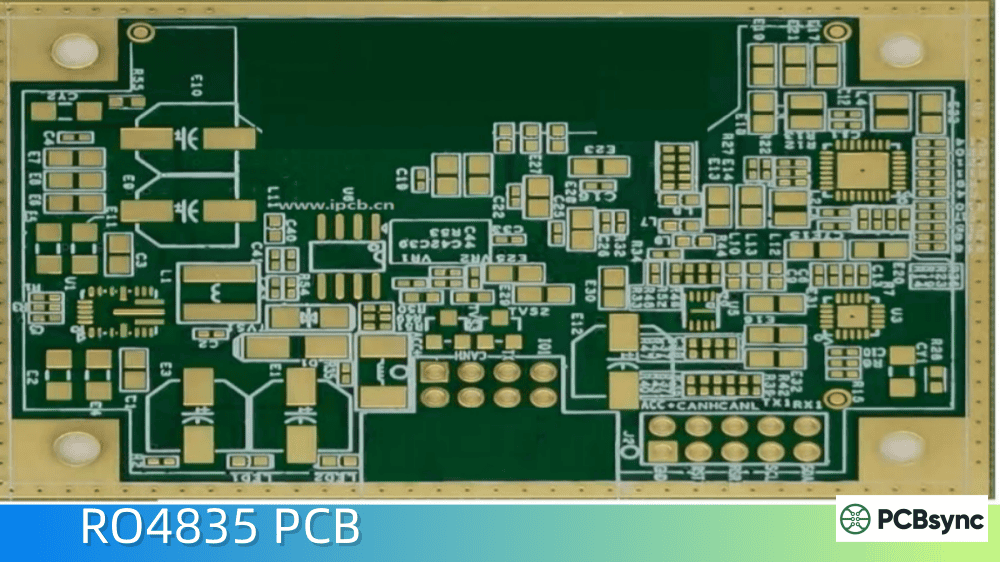
RO4835 remains an excellent choice for applications up to 40GHz, and it’s often preferred for inner layer designs in multilayer RF boards. If your radar design also includes lower-frequency components, you might use RO4835 for those layers while reserving RO4830 for the critical 77GHz antenna layer.
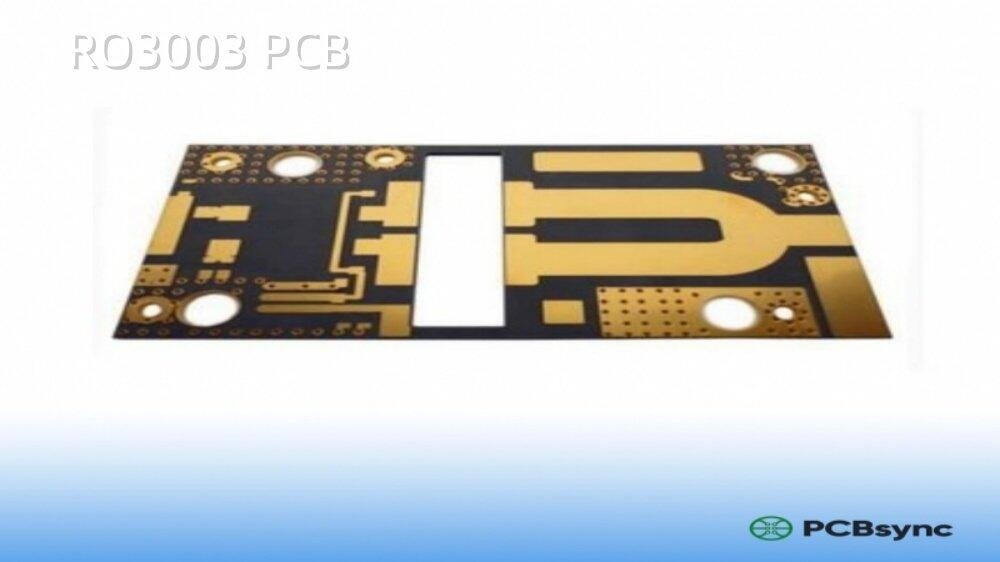
PTFE-based materials like RO3003 with rolled copper foil still offer the absolute lowest insertion loss at 77GHz. For long-range front collision warning (FCW) radar where maximum detection distance (150m+) is critical, PTFE materials may be worth the additional cost and manufacturing complexity.
However, for blind spot detection (BSD) and other applications where detection range requirements are more modest, RO4830 PCB provides an excellent balance of performance and manufacturability. Many OEMs use this “high-low matching” strategy—RO3003 for FCW, RO4830 for BSD—to optimize overall system cost.
RO4830 vs RO4830 Plus
Rogers has also introduced RO4830 Plus, an enhanced version with some notable differences:
RO4830 Plus eliminates the woven glass entirely, resulting in improved laser drilling performance and better CAF (Conductive Anodic Filament) resistance. The lower Dk and reduced insertion loss make it attractive for designs pushing the performance envelope. It’s also PFAS-free, which addresses emerging environmental regulations.
RO4830 PCB Design Guidelines
Designing with RO4830 requires attention to several factors that may differ from your experience with standard FR-4 or even other high-frequency materials.
Stackup Design for Automotive Radar
The most common approach for 77GHz automotive radar uses RO4830 as the cap layer on an FR-4 multilayer construction. A typical 6-layer stackup might look like this:
The key is using RO4450 bondply to laminate the RO4830 layer to the FR-4 stack. This Rogers bonding material is specifically designed for hybrid constructions and maintains good RF performance at the critical interface.
Impedance Control at 77GHz
Achieving accurate impedance at millimeter-wave frequencies requires tighter tolerances than you might be accustomed to at lower frequencies. For RO4830 PCB designs:
Line Width Calculations: Use the design Dk of 3.24 at 77GHz for your impedance calculations. Be aware that the actual Dk may vary slightly depending on your specific stackup and measurement method. Rogers provides the MWI (Microwave Impedance) calculator tool to help with accurate predictions.
Trace Geometry: For 50Ω microstrip on 5-mil RO4830, expect trace widths around 10-12 mils depending on your copper weight. Always verify with your fab house’s impedance modeling capabilities.
Reference Plane Distance: The thin dielectric options (5 mil and 9.4 mil) are ideal for millimeter-wave designs where you want tight coupling to the ground plane for controlled impedance and reduced radiation losses.
Via Design Considerations
At 77GHz, via transitions become significant sources of reflection and loss if not properly designed:
Via Diameter: Keep via diameters as small as your manufacturing process allows—typically 8-10 mils for standard drilling. Laser drilling enables even smaller vias (4-6 mils), which RO4830’s flat glass construction handles well.
Via Fencing: Consider via fencing around critical RF traces to prevent parallel plate mode propagation in the substrate.
Ground Via Placement: Place ground vias close to RF signal vias for microstrip-to-stripline transitions. The via stub length becomes significant at 77GHz and can detune your matching networks.
Copper Foil Selection
RO4830 comes standard with LoPro (Low Profile) reverse-treated copper foil, and there’s a good reason for this. At 77GHz, the skin depth in copper is approximately 0.24 micrometers. This means all your current flows in an incredibly thin layer at the conductor surface, making surface roughness a dominant factor in conductor loss.
The LoPro foil has a surface roughness (Rz) of approximately 2-3 micrometers, compared to 6-10 micrometers for standard ED copper. This smoother surface directly translates to the excellent insertion loss performance that makes RO4830 viable for 77GHz applications.
Manufacturing and Fabrication of RO4830 PCB
One of RO4830’s biggest advantages is its compatibility with standard FR-4 processing equipment. However, some process adjustments optimize results.
Drilling Recommendations
Mechanical Drilling: RO4830 can be drilled using standard carbide tools. Recommended parameters include spindle speeds of 60,000-80,000 RPM with appropriate feed rates. Entry and backer materials should be selected based on your shop’s standard practices for high-frequency materials.
Laser Drilling: The flat woven E-glass and uniform filler particles provide good laser drilling performance. For blind vias in hybrid stackups, CO2 or UV laser drilling works well. RO4830 Plus offers even better laser drilling characteristics due to its glass-free construction.
Lamination Process
For hybrid constructions with FR-4:
Use RO4450 bondply as the bonding layer between RO4830 and FR-4
Follow standard high-frequency lamination profiles provided by Rogers
Ensure proper vacuum during lamination to prevent voids
Post-lamination baking is generally not required, similar to FR-4
Plating and Surface Finish
RO4830 does not require the sodium etch treatment needed for PTFE materials. Standard electroless copper and electrolytic copper plating processes work well.
For surface finish, consider the end application:
ENIG (Electroless Nickel Immersion Gold): Good for general RF applications, but the nickel layer adds some loss at 77GHz.
Immersion Silver: Excellent RF performance with lower loss than ENIG. Preferred for demanding millimeter-wave designs.
Oxidation Resistance: RO4830 includes the same advanced anti-oxidant package found in RO4835, providing significantly better oxidation resistance than other hydrocarbon-based materials. This is particularly important for automotive applications where the radar module may experience elevated temperatures during vehicle operation.
Lead-Free Compatibility: RO4830 is compatible with lead-free solder processes, meeting automotive industry requirements for RoHS compliance.
Flame Retardancy: The UL 94 V-0 rating satisfies automotive safety requirements without compromising electrical performance.
Cost Analysis: RO4830 PCB vs Alternatives
Cost is always a consideration in automotive design, where even small savings multiply across production volumes.
Material Cost Comparison
While exact pricing varies by supplier and volume, here’s a general comparison of relative material costs:
Material Type
Relative Cost Index
Notes
Standard FR-4
1.0×
Baseline
RO4830
3-5×
FR-4 processing compatible
RO4835
3-4×
General RF applications
RO3003 (PTFE)
8-12×
Premium performance
Specialty PTFE
10-15×
Ultra-low loss
Total Cost of Ownership
The material cost is only part of the equation. When comparing RO4830 PCB to PTFE alternatives, consider:
Processing Costs: PTFE materials require specialized via preparation (sodium etch), modified drilling parameters, and sometimes dedicated lamination equipment. RO4830’s FR-4 compatibility eliminates these added processing steps.
Yield Rates: Standard processing generally means higher yields and fewer quality issues compared to specialized PTFE fabrication.
Supplier Options: More fabricators are equipped to handle RO4830 than pure PTFE materials, giving you more options for competitive bidding.
Inventory and Lead Times: FR-4-compatible materials typically have better availability and shorter lead times than specialty PTFE laminates.
For high-volume automotive radar applications, the combination of competitive material cost and standard processing makes RO4830 PCB an economically attractive choice.
RO4830 PCB Resources and Downloads
Having access to accurate design data is crucial for successful millimeter-wave designs. Here are the key resources for RO4830:
Official Rogers Corporation Resources
Datasheet: The official RO4830 High Frequency Laminates datasheet contains complete specifications, typical values, and application notes. Available from Rogers’ Advanced Electronics Solutions documentation portal.
MWI Calculator: Rogers’ Microwave Impedance calculator (MWI-2018) includes RO4830 material models for accurate impedance and loss calculations. This free tool is invaluable for transmission line design.
Laminate Properties Tool: Rogers’ online tool allows filtering and comparison of all their high-frequency materials, making material selection easier.
Technical Papers: Rogers publishes white papers on topics like “Steering Circuit Materials for 77 GHz Automotive Radar” that provide detailed application guidance.
Industry Standards and References
IPC-4103: This specification covers base materials for high-speed and high-frequency applications. RO4830 conforms to relevant slash sheets within this standard.
AEC-Q200: For automotive qualification, passive component stress test qualification, which applies to PCB substrates used in automotive applications.
Manufacturer Sample Requests
Rogers offers a sample request system through their website for engineers evaluating RO4830 for new designs. Samples typically include standard panel sizes in both available thicknesses with LoPro copper cladding.
Frequently Asked Questions About RO4830 PCB
What is the dielectric constant of RO4830 at 77GHz?
The design dielectric constant of RO4830 is 3.24 at 77GHz, as measured using the microstrip differential phase length method. This value is optimized for millimeter-wave radar antenna designs. At lower frequencies (10 GHz), the Dk is approximately 3.48. Always use the frequency-appropriate Dk value for your impedance calculations.
Can RO4830 PCB be processed with standard FR-4 equipment?
Yes, RO4830 is specifically designed for compatibility with standard epoxy/glass (FR-4) fabrication processes. Unlike PTFE-based materials, it doesn’t require specialized via preparation treatments like sodium etch, and it can be drilled, routed, and plated using conventional equipment. This significantly reduces manufacturing complexity and cost.
What is the difference between RO4830 and RO4830 Plus?
RO4830 Plus is an enhanced version that eliminates the woven glass reinforcement found in standard RO4830. This results in a lower dielectric constant (3.03 vs 3.24 at 77GHz), reduced insertion loss (1.5 vs 2.2 dB/inch), and improved laser drilling performance. RO4830 Plus is also PFAS-free, addressing environmental compliance concerns. Choose RO4830 Plus when you need maximum performance or have specific environmental requirements.
Yes, RO4830 is fully compatible with lead-free solder processes. The material has a glass transition temperature (Tg) greater than 280°C, which provides adequate thermal stability for lead-free reflow profiles that typically peak around 245-260°C. This makes RO4830 suitable for automotive applications requiring RoHS compliance.
What copper foil options are available for RO4830 laminates?
RO4830 comes standard with LoPro (Low Profile) reverse-treated electrodeposited copper foil in either 0.5 oz (18 µm) or 1.0 oz (35 µm) weights. The LoPro foil is essential for achieving low insertion loss at 77GHz, as its smooth surface minimizes conductor losses caused by the skin effect. Using standard rough ED copper would significantly degrade the material’s millimeter-wave performance.
Conclusion
RO4830 PCB material has established itself as a practical, cost-effective solution for 77GHz automotive radar applications. Its combination of good millimeter-wave electrical performance, standard FR-4 processing compatibility, and competitive pricing addresses the real-world requirements of automotive tier-1 suppliers designing ADAS radar sensors.
The key takeaways for engineers considering RO4830:
The material delivers proven performance at 77GHz with insertion loss of 2.2 dB/inch, adequate for most automotive radar antenna designs. Its thermoset construction and advanced anti-oxidant package ensure long-term reliability in demanding automotive environments. Standard FR-4 fabrication compatibility dramatically simplifies manufacturing and reduces costs compared to PTFE alternatives. The thin dielectric options (5 mil and 9.4 mil) work well as cap layers in hybrid FR-4 multilayer constructions.
For applications demanding absolute minimum loss, PTFE-based materials like RO3003 remain the performance benchmark. However, for the majority of automotive radar applications—particularly blind spot detection and corner radar sensors—RO4830 provides an excellent balance of performance, manufacturability, and cost.
As the automotive industry continues its push toward autonomous driving, the demand for cost-effective millimeter-wave PCB solutions will only grow. RO4830 is well-positioned to meet this demand, and understanding its capabilities and design requirements will help you deliver successful radar products.
Inquire: Call 0086-755-23203480, or reach out via the form below/your sales contact to discuss our design, manufacturing, and assembly capabilities.
Quote: Email your PCB files to Sales@pcbsync.com (Preferred for large files) or submit online. We will contact you promptly. Please ensure your email is correct.
Notes: For PCB fabrication, we require PCB design file in Gerber RS-274X format (most preferred), *.PCB/DDB (Protel, inform your program version) format or *.BRD (Eagle) format. For PCB assembly, we require PCB design file in above mentioned format, drilling file and BOM. Click to download BOM template To avoid file missing, please include all files into one folder and compress it into .zip or .rar format.