Inquire: Call 0086-755-23203480, or reach out via the form below/your sales contact to discuss our design, manufacturing, and assembly capabilities.
Quote: Email your PCB files to Sales@pcbsync.com (Preferred for large files) or submit online. We will contact you promptly. Please ensure your email is correct.
Notes: For PCB fabrication, we require PCB design file in Gerber RS-274X format (most preferred), *.PCB/DDB (Protel, inform your program version) format or *.BRD (Eagle) format. For PCB assembly, we require PCB design file in above mentioned format, drilling file and BOM. Click to download BOM template To avoid file missing, please include all files into one folder and compress it into .zip or .rar format.
If you’ve been wrestling with FR-4’s limitations in your RF designs, you’re not alone. I spent years dealing with inconsistent insertion loss and Dk drift in wireless projects before Rogers introduced Kappa 438. This material sits in a sweet spot that didn’t really exist before—offering genuine high-frequency performance while maintaining FR-4 processing compatibility.
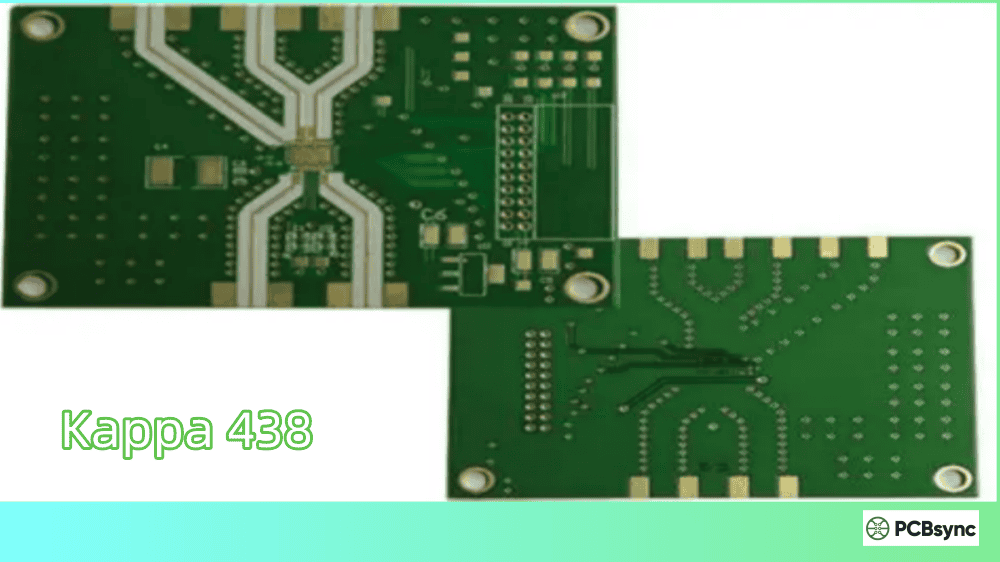
In this guide, I’ll walk you through everything you need to know about Kappa 438: the specifications that matter, how it actually compares to FR-4 in real applications, fabrication considerations, and whether it’s the right choice for your next project.Kappa 438
Kappa 438 is a glass-reinforced hydrocarbon ceramic thermoset laminate developed by Rogers Corporation specifically for wireless circuit designers who need better RF performance than FR-4 can deliver, but don’t want to deal with the processing headaches of PTFE-based materials.
The “438” in the name isn’t arbitrary—it refers to the material’s dielectric constant of 4.38, which Rogers intentionally matched to standard FR-4. This seemingly small detail is actually crucial: it means you can migrate existing FR-4 designs to Kappa 438 without recalculating your trace widths, impedances, or stack-ups. Your simulation models stay valid, your designs transfer over, and you get the RF performance upgrade you need.
Rogers introduced Kappa 438 in 2017 to address a gap in the market. The wireless industry was (and still is) facing exponential growth in data demand. Small cells, carrier-grade WiFi, and LAA deployments were pushing FR-4 beyond its comfortable operating range, but jumping to premium PTFE materials wasn’t always cost-justified. Kappa 438 fills that middle ground.
Kappa 438 Key Properties and Specifications
Let me break down the numbers that actually matter for your designs. These values come directly from the Rogers datasheet and represent typical performance you can expect.
The standout number here is that 0.005 dissipation factor at 10 GHz. Compare that to typical FR-4 which runs 0.015-0.025 at similar frequencies—that’s roughly a 3x to 5x improvement in loss tangent. In practical terms, you’re looking at significantly reduced insertion loss in your RF chains.
That Tg above 280°C is particularly important for lead-free assembly processes. You’ve got plenty of thermal headroom during reflow, and the 42 ppm/°C Z-axis CTE means your plated through-holes won’t experience the barrel cracking that can plague higher-CTE materials under thermal cycling.
Available Kappa 438 Thicknesses and Configurations
Standard Thickness
Tolerance
10 mil (0.254 mm)
±0.001″
20 mil (0.508 mm)
±0.0015″
30 mil (0.762 mm)
±0.002″
40 mil (1.016 mm)
±0.003″
60 mil (1.524 mm)
±0.004″
Non-standard thicknesses of 90 mil and 120 mil are also available on request. Standard panel sizes include 24″ × 18″ and 48″ × 36″, with copper cladding options of ½ oz (18µm) and 1 oz (35µm) electrodeposited copper foil.
Kappa 438 vs FR-4: A Practical Comparison
This is where Kappa 438 really shows its value. I’ve put together a head-to-head comparison based on the specs that impact real-world RF performance.
Kappa 438 vs FR-4 Comparison Table
Parameter
Kappa 438
Standard FR-4
Advantage
Dielectric Constant (Dk)
4.38
4.2-4.8 (varies)
Kappa 438 – tighter tolerance
Dk Tolerance
±0.05
±0.15 to ±0.35
Kappa 438 – 3-7x better
Loss Tangent (Df) at 10 GHz
0.005
0.015-0.025
Kappa 438 – 3-5x lower loss
Tg
>280°C
130-180°C
Kappa 438 – significantly higher
Z-axis CTE
42 ppm/°C
60-80 ppm/°C
Kappa 438 – better PTH reliability
Moisture Absorption
0.07%
0.10-0.20%
Kappa 438 – lower
Fabrication Process
FR-4 compatible
Standard
Equal
Cost
Higher
Lower
FR-4
What This Means for Your Designs
The Dk tolerance difference deserves special attention. When you’re designing controlled impedance traces for 50Ω or 75Ω systems, Dk variation directly impacts your impedance accuracy. A ±0.35 Dk tolerance on FR-4 can swing your impedance by several ohms. With Kappa 438’s ±0.05 tolerance, your designs hit their targets more consistently.
A 2020 research study published in the International Journal of Computer Science and Mobile Computing compared Kappa 438 and FR-4 substrates for microstrip patch antennas. The findings showed that the Kappa 438 antenna achieved better radiation efficiency, higher gain, and smaller overall dimensions compared to its FR-4 equivalent at 1.8 GHz. The researchers attributed these improvements primarily to the lower loss tangent of Kappa 438.
When Should You Choose Kappa 438 Over FR-4?
Based on my experience, here’s when Kappa 438 makes sense:
Choose Kappa 438 when:
Your operating frequency exceeds 1 GHz and insertion loss matters
You need consistent RF performance across production batches
Rogers designed Kappa 438 specifically for the wireless infrastructure market, and the application list reflects that focus.
Small Cells and Distributed Antenna Systems (DAS)
Small cell deployments are proliferating in urban environments to handle 5G densification. These compact base stations need PCB materials that deliver consistent RF performance in a cost-sensitive design envelope. Kappa 438’s combination of low loss and FR-4-compatible processing makes it well-suited for small cell power amplifiers, filters, and antenna feed networks.
DAS installations—both indoor and outdoor—share similar requirements. The material’s thermal stability handles the temperature swings that ceiling-mounted equipment experiences, while the tight Dk tolerance ensures predictable performance across the distributed network.
Carrier-Grade WiFi and Licensed Assisted Access (LAA)
Enterprise WiFi access points and LAA equipment operate in increasingly congested spectrum. The lower loss tangent of Kappa 438 helps maintain signal integrity in these demanding RF environments. The material is particularly useful for access point antenna designs where efficiency directly impacts coverage area and battery life in client devices.
V2X Communications (Vehicle-to-Vehicle and Vehicle-to-Infrastructure)
Automotive applications add another layer of requirements: temperature extremes, vibration, and long product lifecycles. Kappa 438’s high Tg and controlled CTE make it suitable for V2X modules that need to survive the automotive environment while maintaining RF performance.
Internet of Things (IoT) and Smart Home
For IoT devices where cost matters but so does wireless range, Kappa 438 offers a middle path. Smart meters, building automation sensors, and similar devices benefit from the improved RF efficiency without the premium pricing of PTFE materials.
Kappa 438 PCB Fabrication Guidelines
One of Kappa 438’s key selling points is FR-4-compatible processing. Here’s what you need to know for fabrication.
Drilling Kappa 438 PCBs
Kappa 438 machines similarly to FR-4, but with a few considerations:
Use standard cover plates (aluminum or thin phenolic) and backing boards
Standard drilling parameters work well, but keep surface speeds below 500 SFM
For medium and large diameter drills, use feed rates greater than 0.002″
For small holes (<0.0135″ diameter), reduce feed rate below 0.002″
Multiple panels can be stacked for production drilling
Lamination and Multilayer Builds
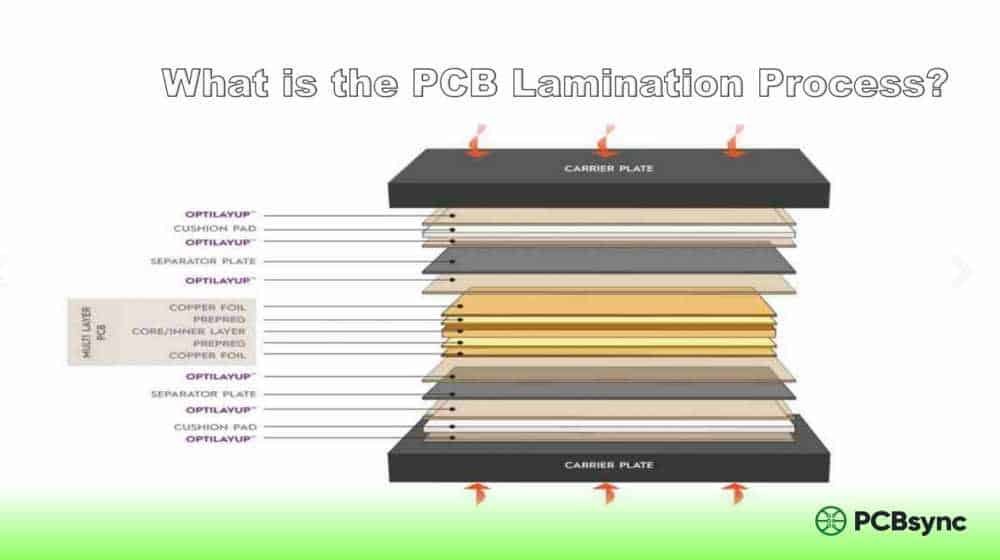
Kappa 438 is compatible with conventional FR-4 bondplies, which simplifies multilayer fabrication. Rogers also offers compatible prepregs like RO4450B and RO4450F for hybrid constructions requiring different Dk values in different layers.
The high Tg means standard lamination temperatures won’t cause issues, and the material’s melting point of 315°C provides margin for multilayer processing.
Surface Finishes
All standard surface finishes work with Kappa 438:
The material is fully lead-free solder process compatible and carries a UL 94 V-0 flame retardant rating.
Compliance and Standards
Kappa 438 conforms to IPC-4103A, slash sheet /250. It’s RoHS compliant and uses halogen-free flame retardant technology—important considerations for products shipping to regulated markets.
Design Tips for Kappa 438 RF Circuits
After working with Kappa 438 on multiple projects, here are some practical design recommendations:
Leverage the matched Dk: Since Kappa 438’s Dk of 4.38 matches common FR-4 values, you can use existing simulation models and design rules. If you’re migrating from FR-4, verify your stack-up calculations but don’t expect major changes.
Design for the tighter tolerances: You’re paying for that ±0.05 Dk tolerance—take advantage of it. Design tighter impedance budgets than you would with FR-4. The material will deliver.
Consider hybrid stack-ups: For complex multilayer RF designs, you can combine Kappa 438 cores with Rogers prepregs (RO4450B/F) to create optimized stack-ups with different Dk values where needed.
Mind the CTE matching: When using Kappa 438 in hybrid builds with other materials, check that CTE values are compatible to avoid warpage or delamination stress.
Account for moisture absorption: While Kappa 438’s 0.07% moisture absorption is low, it’s still good practice to bake boards before assembly if they’ve been stored in humid conditions.
Kappa 438 Datasheet and Technical Resources
For detailed specifications and the latest data, here are the official Rogers resources:
Rogers Laminate Properties Tool: An online tool for comparing Rogers materials at rogerscorp.com
IPC-4103A Standard: Reference specification for laminate properties
Rogers Technical Support: Contact Rogers directly for application engineering support
Kappa 438 Pricing and Availability
Kappa 438 pricing varies based on thickness, copper weight, and panel size. Typical pricing ranges from $100 to $600 USD per sheet depending on configuration. This positions it above standard FR-4 but well below premium PTFE-based Rogers materials like RO4350B or RO4003C.
Most major PCB fabricators familiar with Rogers materials can source Kappa 438, and several maintain stock. Lead times are generally reasonable, but it’s worth confirming availability early in your project timeline for production volumes.
Frequently Asked Questions About Kappa 438
What is the dielectric constant of Kappa 438?
Kappa 438 has a design dielectric constant (Dk) of 4.38 at 2.5 GHz, with a tolerance of ±0.05. This value was intentionally matched to standard FR-4 to facilitate easy design migration. At 10 GHz using the stripline method (IPC TM-650 2.5.5.5), the measured Dk is 4.10 ±0.08, which Rogers uses for internal QA testing.
Can Kappa 438 be processed using standard FR-4 fabrication methods?
Yes, this is one of Kappa 438’s primary advantages. The material can be drilled, routed, laminated, and finished using standard FR-4 processes. It’s compatible with conventional bondplies, works with all common surface finishes, and supports both leaded and lead-free solder assembly. No specialized equipment or modified processes are required.
Is Kappa 438 suitable for lead-free soldering?
Absolutely. Kappa 438 has a glass transition temperature (Tg) above 280°C and a decomposition temperature (Td) of 414°C. The material maintains integrity through multiple lead-free reflow cycles at 260°C or higher. Rogers specifically designed Kappa 438 to be lead-free process compatible.
What thicknesses are available for Kappa 438 laminates?
Standard thicknesses include 10, 20, 30, 40, and 60 mil (0.254 mm to 1.524 mm). Non-standard thicknesses of 90 mil and 120 mil are available by request. All thicknesses come with controlled tolerances tighter than standard FR-4 specifications.
How does Kappa 438 compare to RO4350B and RO4003C?
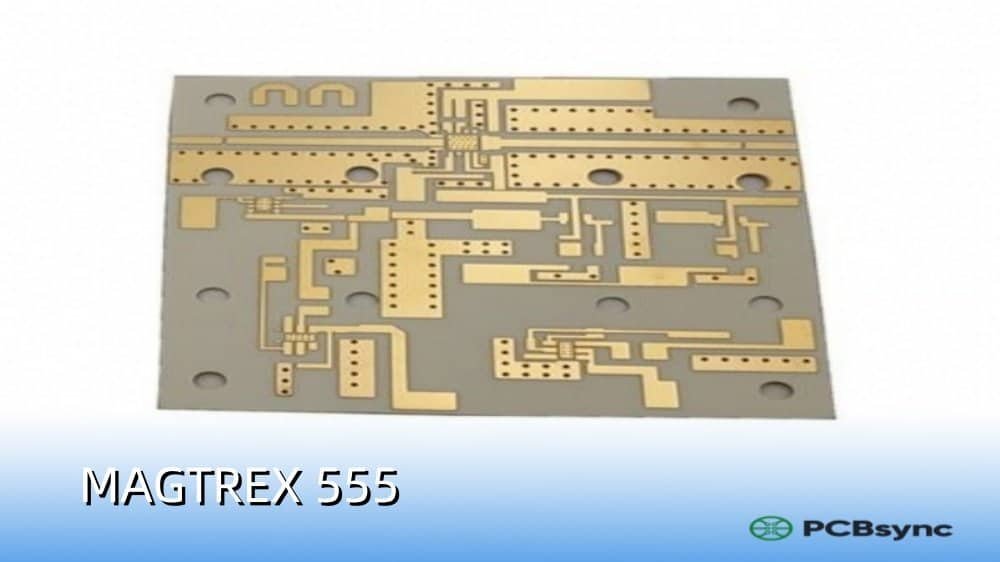
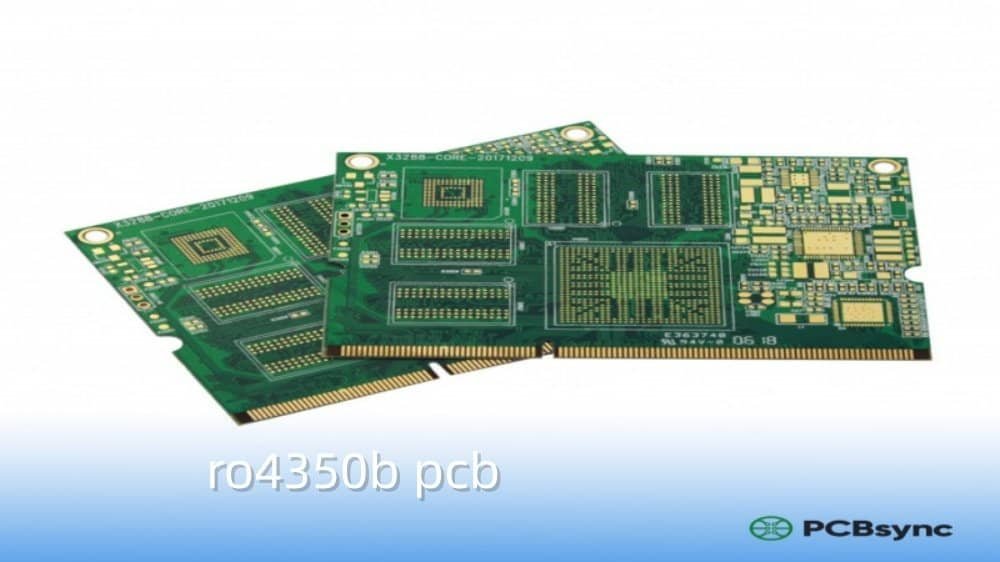
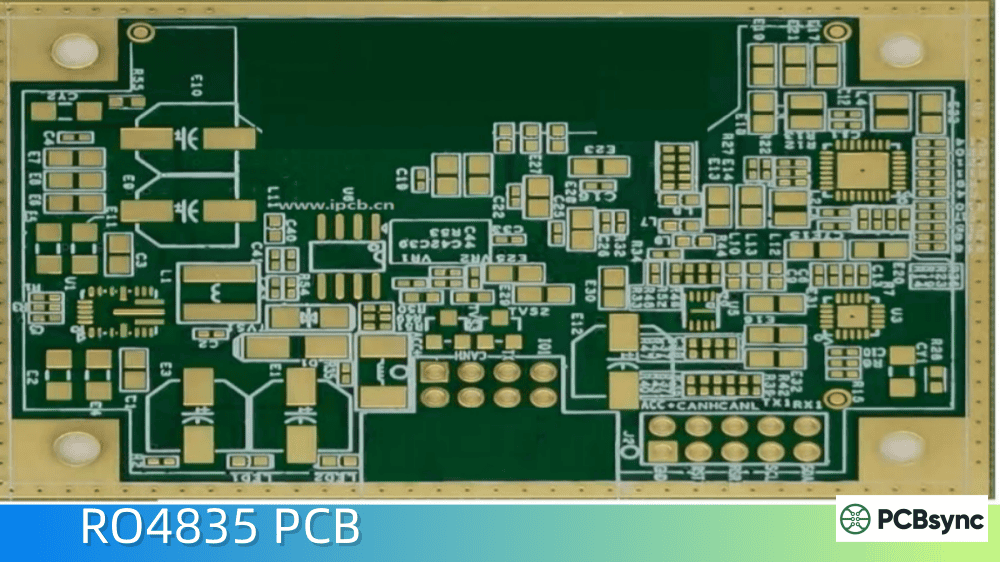
Kappa 438 is positioned as an entry-level RF material, sitting between standard FR-4 and premium Rogers materials like RO4350B (Dk 3.48) and RO4003C (Dk 3.38). The key differences: RO4350B and RO4003C offer lower Dk values and slightly lower loss, but at higher cost. Kappa 438’s advantage is its FR-4-matched Dk which simplifies design migration, plus lower material cost. For applications where you need better performance than FR-4 but don’t require sub-4.0 Dk values, Kappa 438 often hits the optimal price/performance balance.
Understanding Signal Loss: Why Kappa 438’s Low Df Matters
One aspect that deserves deeper discussion is why that 0.005 dissipation factor makes such a practical difference in your circuits.
Signal loss in PCB traces comes from two primary sources: conductor loss (related to copper properties and surface roughness) and dielectric loss (related to the substrate’s loss tangent). At frequencies below 1 GHz, conductor loss typically dominates. But as you move into the multi-gigahertz range common in modern wireless applications, dielectric loss becomes increasingly significant—often becoming the dominant loss mechanism.
The relationship is straightforward: dielectric loss scales directly with frequency and with the material’s dissipation factor. Double your operating frequency, double your dielectric loss. Triple your Df value, triple your dielectric loss.
So when you compare Kappa 438’s Df of 0.005 against typical FR-4 values of 0.015-0.025, you’re looking at real insertion loss savings of 0.5 dB to 1.5 dB per inch at 10 GHz for a typical microstrip trace. In a signal chain with multiple inches of trace routing, that adds up fast.
For a power amplifier designer, lower insertion loss means less gain compensation required, potentially allowing a smaller PA device or better efficiency. For a filter designer, it means sharper skirts and less in-band loss. For an antenna feed network, it means more radiated power and better system range.
Kappa 438 in Hybrid and Multilayer Stack-Ups
Many real-world RF designs don’t use a single material throughout the stack-up. Kappa 438 works well in hybrid constructions where different layers have different requirements.
Mixed Material Considerations
A common approach is using Kappa 438 for RF signal layers where low loss matters most, combined with standard FR-4 for power distribution and digital control layers. This hybrid approach optimizes cost while delivering performance where it counts.
When designing hybrid stack-ups, pay attention to CTE compatibility. Kappa 438’s Z-axis CTE of 42 ppm/°C is lower than standard FR-4 (typically 60-80 ppm/°C). Significant CTE mismatches between layers can cause warpage during thermal cycling or even delamination at bondline interfaces.
Rogers offers compatible prepregs specifically designed for use with Kappa 438:
RO4450B: A bondply option for multilayer constructions
RO4450F: An alternative prepreg formulation
These prepregs have matched thermal properties and are designed to bond reliably with Kappa 438 cores.
Impedance Control in Multilayer Designs
The tight Dk tolerance of Kappa 438 (±0.05) becomes even more valuable in multilayer designs where impedance control must be maintained across multiple layer transitions. Cumulative Dk variations from layer to layer can wreak havoc on controlled impedance designs—Kappa 438’s consistency helps minimize this effect.
Comparing Kappa 438 to Other Rogers High-Frequency Materials
Rogers offers an extensive portfolio of RF/microwave laminates. Here’s how Kappa 438 fits into the broader lineup:
Kappa 438 occupies the entry-level position in terms of RF performance, but that’s intentional. It’s designed for applications where absolute minimum loss isn’t required, but consistent, cost-effective RF performance is essential. The FR-4-matched Dk simplifies the transition for designers moving up from standard epoxy-glass materials.
Summary: Is Kappa 438 Right for Your Project?
Kappa 438 represents Rogers Corporation’s answer to the RF designer’s dilemma: how do you get meaningful performance improvements over FR-4 without blowing your BOM budget or learning new fabrication processes?
The material delivers on its core promise. You get roughly 3x lower loss tangent than FR-4, significantly tighter Dk control, excellent thermal stability for lead-free processing, and all of this with standard FR-4-compatible fabrication. The matched Dk of 4.38 means your existing designs can migrate over without starting from scratch.
For small cell, DAS, enterprise WiFi, V2X, and IoT applications where RF performance matters but cost sensitivity remains, Kappa 438 deserves serious consideration. It won’t replace RO4350B for your most demanding microwave designs, but it fills a valuable niche that was previously underserved.
The wireless infrastructure market continues to grow, with 5G densification, Wi-Fi 6/6E expansion, and IoT proliferation driving demand for RF PCBs that balance performance and cost. Kappa 438 is positioned squarely to serve this market.
If you’re still fighting FR-4’s limitations in your wireless designs—dealing with inconsistent impedances, excessive insertion loss, or reliability concerns in thermal cycling—Kappa 438 might be exactly the upgrade path you’ve been looking for. The transition is straightforward, your fabricator already knows how to work with it, and your designs will thank you.
Inquire: Call 0086-755-23203480, or reach out via the form below/your sales contact to discuss our design, manufacturing, and assembly capabilities.
Quote: Email your PCB files to Sales@pcbsync.com (Preferred for large files) or submit online. We will contact you promptly. Please ensure your email is correct.
Notes: For PCB fabrication, we require PCB design file in Gerber RS-274X format (most preferred), *.PCB/DDB (Protel, inform your program version) format or *.BRD (Eagle) format. For PCB assembly, we require PCB design file in above mentioned format, drilling file and BOM. Click to download BOM template To avoid file missing, please include all files into one folder and compress it into .zip or .rar format.