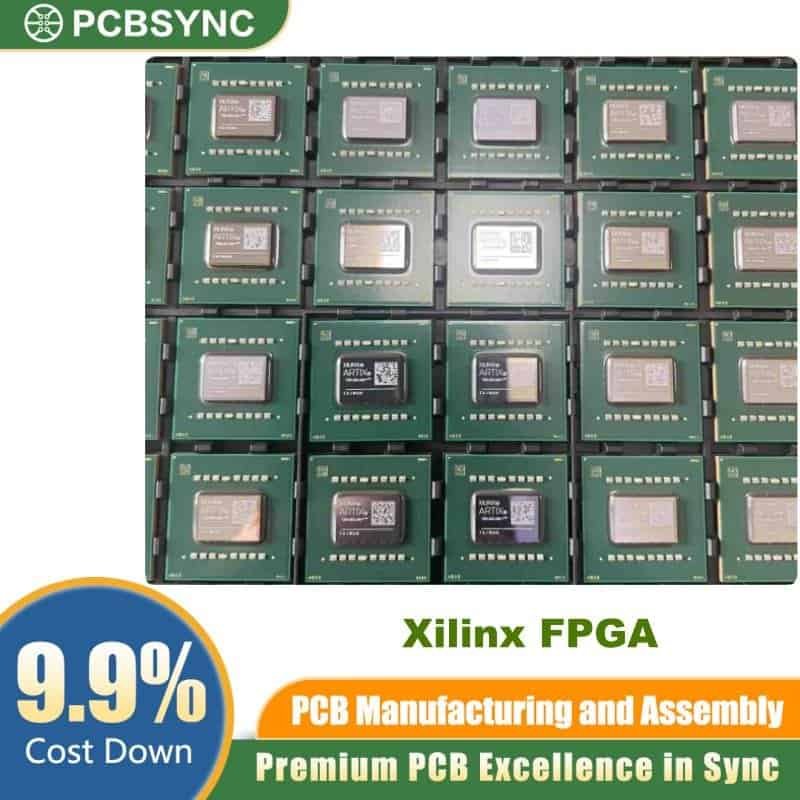
The XC2C64A-7CP56C is a cutting-edge Complex Programmable Logic Device (CPLD) from AMD Xilinx’s renowned CoolRunner-II family. This ultra-low-power programmable logic solution combines 64 macrocells with exceptional speed performance, making it the ideal choice for battery-operated devices, portable electronics, and space-constrained embedded systems. Designed with advanced 0.18µm CMOS technology, the XC2C64A-7CP56C delivers industry-leading power efficiency while maintaining robust functionality in a compact 56-pin CSBGA package.
Key Features and Benefits of XC2C64A-7CP56C
Advanced Architecture for Maximum Efficiency
The XC2C64A-7CP56C incorporates AMD Xilinx’s innovative design philosophy, offering designers a powerful yet energy-conscious programmable logic solution. This CPLD stands out in the Xilinx FPGA product portfolio with its unique combination of performance and power savings.
Core Architecture Highlights:
- 64 Macrocells organized in 4 function blocks for flexible logic implementation
- 1,500 System Gates providing substantial logic density for complex designs
- Advanced Interconnect Matrix (AIM) ensuring efficient signal routing with minimal power consumption
- 159 MHz Maximum Operating Frequency enabling high-speed synchronous operations
- 45 User-Configurable I/O Pins for versatile system connectivity
Ultra-Low Power Consumption Technology
The XC2C64A-7CP56C features industry-leading power efficiency characteristics:
- Zero-Power Standby Mode drastically reducing idle power consumption
- Dynamic Power Management optimizing power usage during active operation
- DataGATE Technology minimizing unnecessary signal switching
- DualEDGE Flip-Flop Capability allowing high-performance operation with lower frequency clocking
Technical Specifications Table
| Specification |
Details |
| Part Number |
XC2C64A-7CP56C |
| Manufacturer |
AMD (Xilinx) |
| Product Family |
CoolRunner-II CPLD |
| Number of Macrocells |
64 |
| Logic Gates |
1,500 |
| Function Blocks |
4 |
| Maximum Frequency |
159 MHz |
| Propagation Delay |
7.5 ns |
| Technology |
0.18µm CMOS |
| Core Voltage |
1.8V (1.7V ~ 1.9V) |
| I/O Voltage Support |
3.3V, 2.5V, 1.8V, 1.5V |
| User I/O Pins |
45 |
| Package Type |
56-Pin CSBGA (Chip Scale BGA) |
| Package Dimensions |
6mm x 6mm |
| Operating Temperature |
0°C ~ 70°C (Commercial) |
| Programming Interface |
IEEE 1149.1/1532 JTAG |
| In-System Programmable |
Yes (ISP) |
Package and Pin Configuration
56-Pin CSBGA Package Specifications
| Package Feature |
Specification |
| Package Type |
56-CSBGA (Chip Scale Ball Grid Array) |
| Pitch |
Fine-pitch ball grid array |
| Package Size |
6mm x 6mm |
| Total Pins |
56 pins |
| User I/O |
45 configurable I/O pins |
| Supply Pins |
VCC and GND distribution |
| Programming Pins |
JTAG interface (TDI, TDO, TCK, TMS) |
| RoHS Compliant |
Yes |
| Lead-Free |
Available |
Performance Characteristics and Speed Grades
Electrical Performance Parameters
| Parameter |
Specification |
Condition |
| tPD (Propagation Delay) |
7.5 ns |
Maximum |
| tSU (Setup Time) |
3.5 ns |
Typical |
| tCO (Clock-to-Output) |
5.0 ns |
Typical |
| fMAX (Maximum Frequency) |
159 MHz |
System clock |
| fTOGGLE |
Up to 250 MHz |
With DualEDGE |
| ICC (Supply Current) |
Ultra-low |
Standby and active |
| VCC Range |
1.7V – 1.9V |
Core voltage |
Speed Grade Information
The “-7” speed grade designation indicates:
- Standard commercial performance optimized for most applications
- 7.5 ns propagation delay for reliable timing closure
- Cost-effective solution balancing performance and price
- Wide temperature tolerance across commercial range
Functional Block Diagram and Architecture
Internal Architecture Overview
The XC2C64A-7CP56C consists of four primary architectural elements:
Function Block Structure
Each of the 4 function blocks contains:
- 40 x 56 Product Term PLA for flexible logic implementation
- 16 Macrocells per block with configurable operation modes
- Programmable clock, reset, and set signals for each macrocell
- Output enable control on a per-macrocell basis
Advanced Interconnect Matrix (AIM)
- Routes signals between all function blocks efficiently
- Provides 40 true and complement inputs to each function block
- Minimizes propagation delays through optimized routing
- Reduces power consumption during signal transmission
Global Resources
- Global Clock Networks for system-wide timing
- Global Set/Reset (GSR) for initialization control
- Global Output Enable (GTS) for three-state management
- Input/Output Banks supporting multiple voltage standards
Programming and Configuration
In-System Programmability Features
| Feature |
Description |
| ISP Capable |
Program and reprogram without removing from PCB |
| JTAG Standard |
IEEE 1149.1/1532 boundary-scan support |
| Programming Time |
Milliseconds for full device configuration |
| Non-Volatile Storage |
Flash-based configuration memory |
| Instant-On |
Immediate operation after power-up |
| Unlimited Reprogramming |
Field updates without device degradation |
Development Tool Compatibility
- Xilinx ISE Design Suite – Legacy tool support
- Vivado Design Suite – Modern design environment
- Platform Cable USB – Standard programming hardware
- Third-Party Programmers – Compatible JTAG programmers supported
I/O Standards and Banking
Supported I/O Standards
The XC2C64A-7CP56C supports multiple JEDEC I/O standards:
| Standard |
Voltage |
Application |
| LVCMOS33 |
3.3V |
General purpose logic |
| LVCMOS25 |
2.5V |
Medium voltage systems |
| LVCMOS18 |
1.8V |
Low voltage applications |
| LVCMOS15 |
1.5V |
Ultra-low power designs |
| LVTTL |
3.3V |
TTL compatibility |
| PCI |
3.3V |
PCI bus interface |
I/O Banking Architecture
- Two independent I/O banks for voltage flexibility
- Separate VCCIO supplies per bank
- Mixed-voltage interface capability on single device
- Schmitt-trigger inputs for noise immunity at 1.5V
Target Applications and Use Cases
Industrial and Commercial Applications
Communication Systems
- Protocol converters for multi-standard interfaces
- Bus arbitration logic in communication networks
- Signal conditioning circuits for data transmission
- Timing generators for synchronous protocols
Portable and Battery-Operated Devices
- Handheld instruments requiring ultra-low power
- Medical monitoring devices with extended battery life
- Portable test equipment needing compact solutions
- IoT edge devices with power constraints
Consumer Electronics
- Display controllers for LCD/LED panels
- User interface logic for button and sensor processing
- Power management controllers in battery systems
- Audio/video processing for multimedia applications
Industrial Automation
- Motor control logic for precision positioning
- Sensor interface controllers in factory automation
- Safety interlock systems requiring fail-safe operation
- PLC expansion modules for distributed control
Comparison with Alternative Devices
XC2C64A Family Variants
| Part Number |
Package |
Speed Grade |
Temperature Range |
Application Focus |
| XC2C64A-7CP56C |
56-CSBGA |
-7 (7.5ns) |
0°C to 70°C |
Commercial, compact designs |
| XC2C64A-7CP56I |
56-CSBGA |
-7 (7.5ns) |
-40°C to 85°C |
Industrial extended temp |
| XC2C64A-5CP56C |
56-CSBGA |
-5 (5.0ns) |
0°C to 70°C |
High-speed applications |
| XC2C64A-7CPG56C |
56-VFBGA |
-7 (7.5ns) |
0°C to 70°C |
Alternative package option |
Design Considerations and Implementation
Power Supply Requirements
| Supply |
Voltage Range |
Typical Current |
Purpose |
| VCC |
1.7V – 1.9V |
Ultra-low |
Core logic power |
| VCCIO Bank 1 |
1.5V – 3.6V |
Varies by I/O |
I/O voltage supply |
| VCCIO Bank 2 |
1.5V – 3.6V |
Varies by I/O |
I/O voltage supply |
| GND |
0V |
N/A |
Ground reference |
PCB Layout Guidelines
Recommended Design Practices:
- Place bypass capacitors (0.1µF) close to each VCC pin
- Use solid ground plane for noise reduction
- Route high-speed signals with controlled impedance
- Separate analog and digital ground domains when applicable
- Follow CSBGA mounting and reflow guidelines
Thermal Management
- Junction Temperature: Monitor for reliable operation
- Thermal Resistance: Consult datasheet for θJA values
- Cooling Requirements: Minimal due to low power consumption
- Airflow Considerations: Natural convection typically sufficient
Ordering Information and Packaging
Complete Part Number Breakdown
XC2C64A-7CP56C
- XC2C64A = CoolRunner-II 64 macrocell CPLD
- -7 = Speed grade (7.5 ns propagation delay)
- CP56 = 56-pin Chip Scale BGA package
- C = Commercial temperature range (0°C to 70°C)
Available Packaging Options
| Packaging Type |
Quantity per Unit |
Moisture Sensitivity Level |
| Tray |
360 devices |
MSL 3 |
| Tape & Reel |
Standard reel quantities |
MSL 3 |
| Cut Tape |
Custom quantities |
MSL 3 |
Quality and Compliance Standards
Certifications and Standards
| Standard |
Status |
Notes |
| RoHS |
Compliant |
Lead-free options available |
| REACH |
Compliant |
EU chemical regulation adherence |
| Export Classification |
ECCN 3A001.a.7 |
U.S. export control |
| HTS Code |
8542.39.0000 |
Harmonized tariff schedule |
| JEDEC Standards |
Compliant |
Industry-standard I/O levels |
Development Resources and Support
Documentation and Tools
Available Resources:
- CoolRunner-II CPLD Family Datasheet (DS311)
- Application Notes for power optimization
- Reference designs for common applications
- Design constraints files (UCF/XDC)
- Timing models and simulation libraries
Technical Support Channels
- AMD Xilinx online documentation portal
- Community forums for design discussions
- Application engineering support team
- Authorized distributor technical assistance
- Third-party design service providers
Training and Learning Materials
- Online webinars covering CPLD fundamentals
- Video tutorials for design tool usage
- Example projects and code repositories
- Getting started guides for beginners
- Advanced optimization techniques documentation
Purchasing and Availability
Authorized Distribution Network
The XC2C64A-7CP56C is available through major electronic component distributors including:
- Digi-Key Electronics
- Mouser Electronics
- Arrow Electronics
- Avnet
- Newark/element14
Pricing Considerations
Pricing varies based on:
- Order quantity – Volume discounts available
- Market conditions – Semiconductor pricing fluctuations
- Package type – Standard vs. special options
- Lead time – Stock vs. factory order
Typical Price Range: Contact authorized distributors for current pricing
Frequently Asked Questions (FAQ)
Q: What is the difference between XC2C64A-7CP56C and XC2C64A-7CP56I?
A: The primary difference is the operating temperature range. The “C” grade operates from 0°C to 70°C (commercial), while the “I” grade supports -40°C to 85°C (industrial) for harsh environment applications.
Q: Can I use 3.3V I/O with this 1.8V core device?
A: Yes, the XC2C64A-7CP56C supports multiple I/O voltage standards including 3.3V through the independent VCCIO banking architecture. Each bank can be powered separately.
Q: What programming hardware is required?
A: The device supports standard JTAG programming through Platform Cable USB, Digilent programmers, or any IEEE 1149.1-compliant programming adapter.
Q: Is in-system programming supported?
A: Yes, the XC2C64A-7CP56C features full In-System Programmability (ISP) capability, allowing field updates without board removal.
Q: What design tools are compatible?
A: Use Xilinx ISE Design Suite (legacy) or Vivado Design Suite (modern) for design entry, synthesis, and implementation.
Why Choose XC2C64A-7CP56C?
The XC2C64A-7CP56C represents the optimal solution for designers seeking:
✓ Ultra-low power consumption for battery-operated applications
✓ Compact form factor in space-constrained designs
✓ High-speed performance up to 159 MHz operation
✓ Flexible I/O standards supporting multiple voltage levels
✓ Instant-on capability with non-volatile configuration
✓ Cost-effective implementation for moderate complexity designs
✓ Proven reliability from AMD Xilinx CoolRunner-II family
✓ Easy field updates through in-system programming
Conclusion: Your Ideal CPLD Solution
The XC2C64A-7CP56C CoolRunner-II CPLD delivers exceptional value for embedded system designers requiring a balance of performance, power efficiency, and compact packaging. With 64 macrocells, 1,500 gates, and support for multiple I/O standards in a miniature 56-pin CSBGA package, this device excels in applications ranging from portable medical devices to industrial control systems.
Whether you’re developing the next generation of IoT edge devices, handheld instrumentation, or communication equipment, the XC2C64A-7CP56C provides the programmable logic capability you need with the power efficiency modern designs demand.
Ready to get started? Contact authorized distributors for current pricing, request samples for evaluation, or download the complete datasheet to begin your design today.