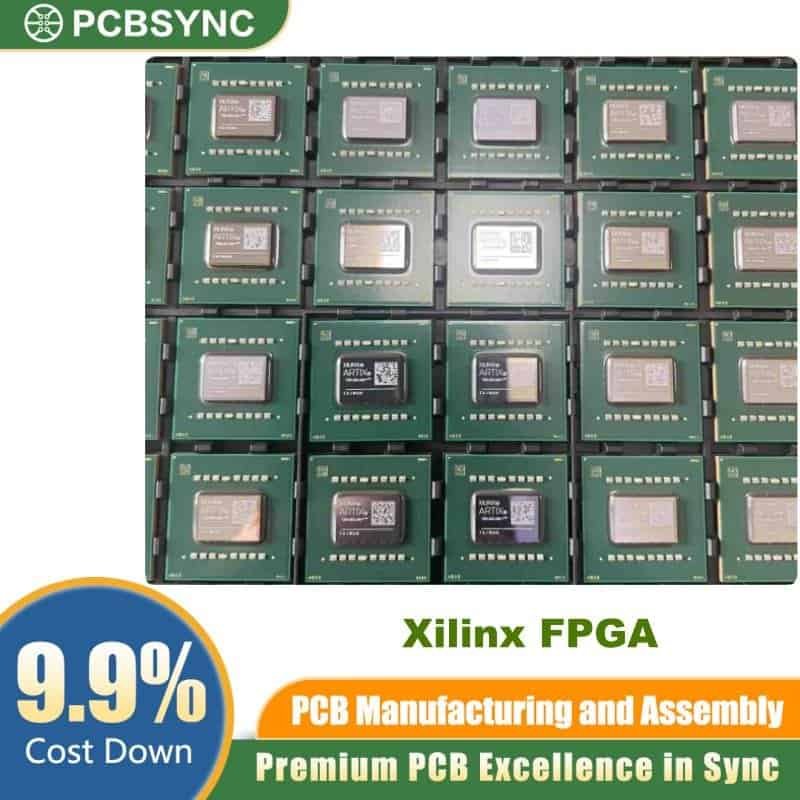
The XCF32PV048C is a high-density Platform Flash PROM from Xilinx (now AMD), designed specifically for storing and configuring Xilinx FPGA bitstreams. This 32Mbit in-system programmable configuration memory offers engineers an easy-to-use, cost-effective, and reprogrammable solution for complex FPGA designs. Whether you’re developing industrial automation systems, telecommunications equipment, or embedded computing applications, the XCF32PV048C delivers reliable non-volatile storage with advanced features like built-in data decompression and design revision capabilities.
XCF32PV048C Key Features and Benefits
The XCF32PV048C belongs to the XCFxxP Platform Flash PROM family, which represents Xilinx’s high-density configuration memory solution. This device stands out due to its versatile configuration modes and robust programming capabilities.
In-System Programmable Flash Memory
One of the primary advantages of the XCF32PV048C is its in-system programmability. Engineers can reprogram the device without removing it from the circuit board, significantly reducing development time and enabling field upgrades. The device supports IEEE Standard 1149.1/1532 Boundary-Scan (JTAG) protocol for programming, prototyping, and testing.
Built-In Data Decompressor
The XCF32PV048C includes an integrated data decompressor compatible with Xilinx Advanced Compression Technology. This feature allows designers to store compressed FPGA bitstreams, effectively providing up to 50% more storage capacity. For example, a configuration file originally requiring a 32Mbit PROM can potentially fit into a 16Mbit device when compressed.
Design Revision Technology
This Platform Flash PROM supports multiple design revisions storage, enabling engineers to store up to four different FPGA configurations in a single device. This capability proves invaluable during prototyping, debugging, and for systems requiring multiple operational modes.
XCF32PV048C Technical Specifications
| Parameter |
Specification |
| Part Number |
XCF32PV048C |
| Manufacturer |
Xilinx (AMD) |
| Memory Type |
Flash PROM |
| Memory Density |
32Mbit |
| Operating Voltage (VCCINT) |
1.8V |
| I/O Voltage Compatibility |
1.5V to 3.3V |
| Maximum Clock Frequency |
33MHz (external clock) |
| Internal Oscillator |
Up to 50MHz |
| Package Type |
48-Pin TSOP (VO48) |
| Operating Temperature |
Commercial Grade |
| Data Retention |
20 years minimum |
| Endurance |
20,000 program/erase cycles |
Supported FPGA Configuration Modes
The XCF32PV048C supports multiple configuration modes, providing flexibility for various system architectures.
| Configuration Mode |
Description |
| Master Serial |
PROM controls clock and data output to FPGA |
| Slave Serial |
External clock source controls configuration timing |
| Master SelectMAP |
8-bit parallel mode with PROM-controlled clock |
| Slave SelectMAP |
8-bit parallel mode with external clock control |
XCF32PV048C Pin Configuration Overview
| Pin Category |
Pin Names |
Function |
| Data Output |
D[7:0] |
8-bit parallel data output for SelectMAP mode |
| Serial Data |
D0 |
Serial data output for serial configuration |
| Clock |
CLK |
Configuration clock input |
| Chip Enable |
CE |
Active-low chip enable |
| Output Enable |
OE |
Active-low output enable |
| Reset |
INIT |
Initialization/reset control |
| JTAG Interface |
TCK, TDI, TDO, TMS |
IEEE 1149.1 boundary-scan interface |
| Power |
VCCINT, VCCO, VCCJ |
Power supply pins |
| Ground |
GND |
Ground connections |
Compatible Xilinx FPGA Families
The XCF32PV048C is designed to configure various Xilinx FPGA families, making it a versatile choice for multiple applications.
| FPGA Family |
Compatibility |
| Virtex-4 |
Fully Compatible |
| Virtex-II Pro |
Fully Compatible |
| Virtex-II |
Fully Compatible |
| Spartan-3E |
Fully Compatible |
| Spartan-3 |
Fully Compatible |
| Spartan-3A |
Fully Compatible |
XCF32PV048C Application Areas
This configuration PROM finds applications across numerous industries and use cases:
- Telecommunications Equipment: Base stations, routers, and network switches requiring reliable FPGA configuration
- Industrial Automation: PLCs, motor controllers, and factory automation systems
- Medical Devices: Diagnostic equipment and patient monitoring systems
- Aerospace and Defense: Avionics systems and radar equipment
- Consumer Electronics: High-end audio/video processing equipment
- Automotive Systems: Advanced driver assistance systems (ADAS) and infotainment
Programming and Development Tools
Engineers can program the XCF32PV048C using several Xilinx development tools and third-party programmers.
| Tool/Software |
Purpose |
| Xilinx ISE Design Suite |
PROM file generation and programming |
| Xilinx iMPACT |
Direct device programming via JTAG |
| Third-Party Programmers |
Production programming support |
| Xilinx Platform Cable USB |
Hardware programming interface |
XCF32PV048C Ordering Information
| Part Number |
Package |
Temperature Grade |
Lead-Free |
| XCF32PV048C |
48-Pin TSOP |
Commercial (0°C to +70°C) |
Yes |
| XCF32PVOG48C |
48-Pin TSOP |
Commercial, Lead-Free |
Yes |
| XCF32PFS48C |
48-Pin TFBGA |
Commercial |
Yes |
Design Considerations for XCF32PV048C
When implementing the XCF32PV048C in your design, consider these important factors:
Power Supply Decoupling
Proper decoupling is essential for reliable operation. Place 0.1μF ceramic capacitors close to each VCCINT and VCCO power pin to ensure stable power delivery and minimize noise.
JTAG Chain Configuration
The XCF32PV048C can be cascaded with other Platform Flash PROMs or included in a JTAG chain with FPGAs. Ensure proper TDI-TDO chain connections and appropriate pull-up resistors on TMS and TDI signals.
Clock Signal Integrity
For high-frequency SelectMAP configuration, maintain clean clock signal routing with controlled impedance traces. The BUSY pin handshaking may be required for maximum-speed parallel configuration.
Conclusion
The XCF32PV048C Platform Flash PROM offers a comprehensive solution for Xilinx FPGA configuration needs. With its 32Mbit density, built-in decompression, design revision support, and multiple configuration modes, this device provides the flexibility and reliability required for demanding applications. Its IEEE 1149.1/1532 JTAG compliance ensures easy integration into existing development and production workflows, while the 20-year data retention and 20,000-cycle endurance guarantee long-term reliability.