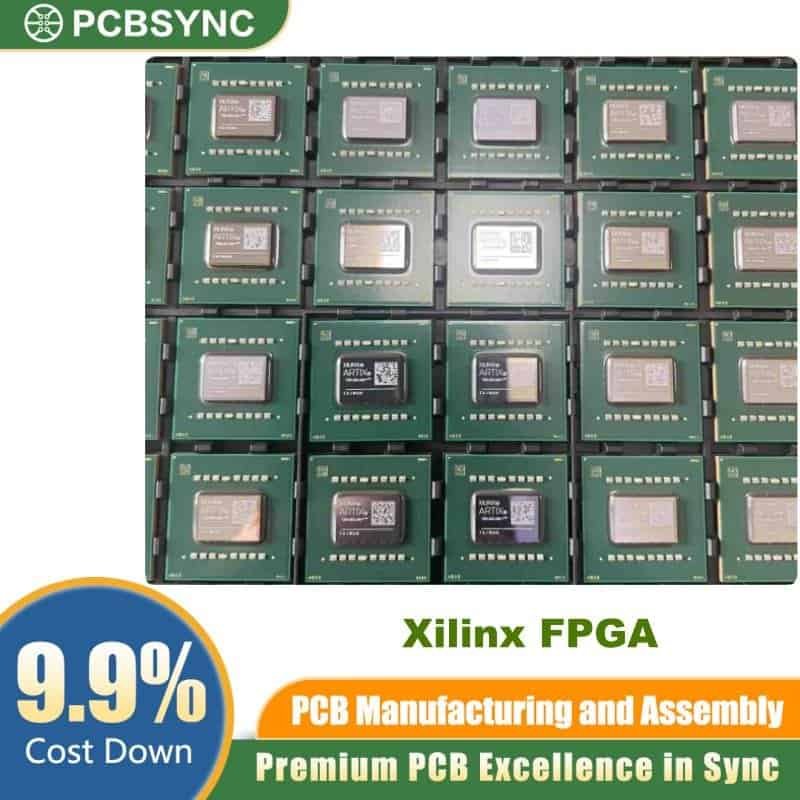
Suggested SEO Title: Xilinx XC7Z045-1FBG676I Zynq-7000 SoC FPGA: Specs & Overview
The Xilinx XC7Z045-1FBG676I is a highly advanced System-on-Chip (SoC) that seamlessly integrates superior processing power with flexible programmable logic. Belonging to the renowned Zynq-7000 family, this component is meticulously designed for hardware acceleration, complex industrial control, and demanding high-bandwidth applications. If you are engineering sophisticated electronic systems, integrating a Xilinx FPGA like the XC7Z045-1FBG676I provides an unmatched blend of software programmability and real-time hardware optimization.
Why Choose the Xilinx XC7Z045-1FBG676I?
When embedded engineers require exceptional processing bandwidth combined with deterministic logic execution, the XC7Z045-1FBG676I stands out as a premium choice. Its innovative architecture effectively eliminates the data bottlenecks traditionally found in two-chip discrete solutions by embedding both the processor and logic elements onto a single silicon die. This integration reduces overall board space, lowers power consumption, and simplifies your Bill of Materials (BOM).
Powerful Dual-Core ARM Processing
At the core of the XC7Z045-1FBG676I is a robust Processing System (PS). It features a dual-core ARM® Cortex®-A9 MPCore™ with CoreSight™, capable of operating at a clock speed of 667 MHz (designated by the -1 speed grade). This powerful processor easily manages operating systems, high-speed network routing, and complex application code. Furthermore, the integrated peripherals include CANbus, Gigabit Ethernet, I2C, SPI, UART, and USB 2.0 OTG, delivering comprehensive connectivity right out of the box.
High-Performance Kintex-7 Programmable Logic
The Programmable Logic (PL) section of the Xilinx XC7Z045-1FBG676I is built upon the highly efficient 28nm Kintex™-7 architecture. Featuring 350,000 logic cells and 900 DSP slices, it provides the essential headroom needed for intensive video processing pipelines, AI inference, and multi-channel data acquisition. Engineers can achieve over 3000 MB/s of internal bandwidth between the PS and PL via high-speed AXI ports. Additionally, the chip includes 19.2 Mb of embedded Block RAM, minimizing the need for external memory access and drastically reducing latency.
Xilinx XC7Z045-1FBG676I Technical Specifications
To better understand the extensive capabilities of the XC7Z045-1FBG676I, please review the detailed technical parameters outlined in the tables below.
Table 1: Processing System (PS) Details
| Feature |
Specification |
| Core Processor |
Dual-core ARM® Cortex®-A9 MPCore™ |
| Max Clock Speed |
667 MHz (Speed Grade -1) |
| L1 Cache |
32KB Instruction + 32KB Data per core |
| L2 Cache |
512KB Shared |
| On-Chip RAM |
256KB |
Table 2: Programmable Logic (PL) Resources
| Feature |
Specification |
| Logic Cells |
350,000 |
| Block RAM |
19.2 Mb |
| DSP Slices |
900 |
| Architecture Base |
Kintex™-7 FPGA |
Table 3: Packaging and Environmental Ratings
| Feature |
Specification |
| Package Type |
676-FCBGA (27×27 mm) |
| Operating Temp. |
-40°C to +100°C (Industrial Grade “I”) |
| Total I/O Pins |
130 Dedicated I/O |
| Lead-Free Status |
RoHS3 Compliant |
Key Application Areas
With its industrial-grade temperature rating (-40°C to +100°C), the XC7Z045-1FBG676I thrives in harsh and demanding operating environments. Its massive logic capacity and dual-core processing capabilities are heavily utilized across multiple industries:
-
Industrial Automation: High-speed machine vision systems, robotics, and advanced motor controllers.
-
Medical Devices: High-resolution endoscopy equipment and diagnostic ultrasound machines.
-
Automotive: Advanced driver-assistance systems (ADAS) utilizing multi-camera inputs.
-
Communications: Small cell base stations, robust networking infrastructure, and secure data routing.
-
Broadcast & Video: 4K2K Ultra-HDTV video processing and encoding pipelines.
Conclusion
Whether you are scaling an existing embedded design or prototyping a next-generation industrial device, the Xilinx XC7Z045-1FBG676I delivers uncompromised processing power and unmatched versatility. By fully mastering its technical specifications and taking advantage of its unified ARM and FPGA architecture, hardware developers can significantly accelerate their time-to-market while maintaining the highest standards of performance and reliability.