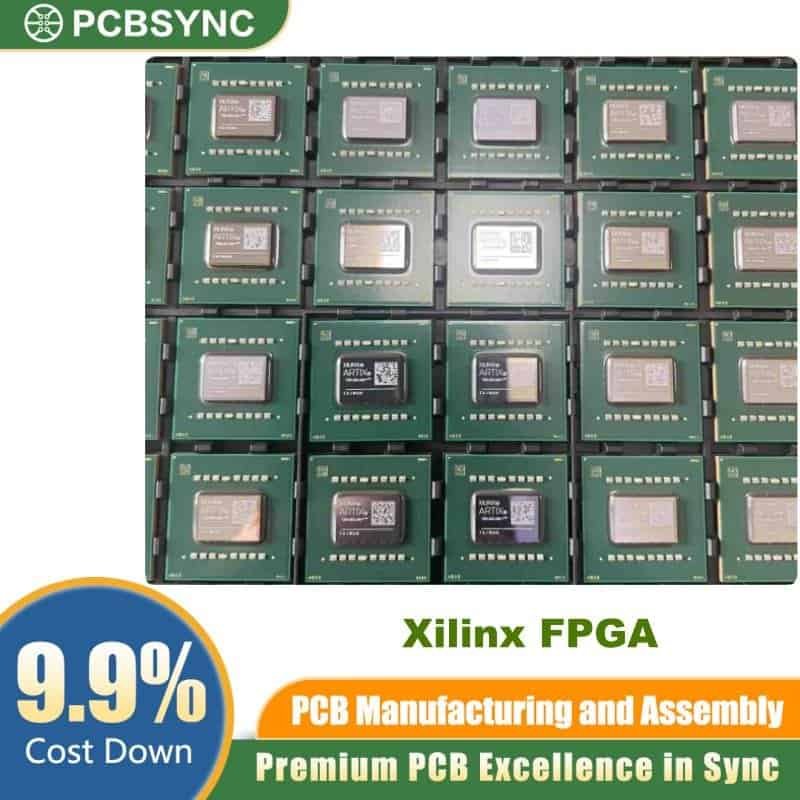
The XC2S200-6FGG1385C belongs to the renowned Xilinx Spartan-II family, offering a cost-effective solution for high-volume consumer electronics and industrial applications. This Field Programmable Gate Array (FPGA) provides a balance between performance and power consumption, making it a staple for designers who need 200,000 system gates in a flexible architecture.
As part of the 2.5V Spartan-II series, the XC2S200-6FGG1385C delivers high-speed logic and extensive memory resources. Consequently, it remains a reliable choice for legacy system support and modern low-cost digital signal processing.
Key Technical Specifications of XC2S200-6FGG1385C
Understanding the technical boundaries of the XC2S200-6FGG1385C is essential for optimizing your hardware design. Below is a comprehensive overview of its core parameters:
| Parameter |
Specification |
| Logic Cells |
5,292 |
| System Gates |
200,000 |
| CLB Array (Rows x Cols) |
28 x 42 |
| Total CLBs |
1,176 |
| Distributed RAM Bits |
75,264 |
| Block RAM Bits |
57,344 |
| Speed Grade |
-6 (High Performance) |
| Core Voltage |
2.5V |
| Operating Temperature |
0°C to 85°C (Commercial) |
Advanced Architecture and Logic Capabilities
The XC2S200-6FGG1385C is built on a 0.22µm/0.18µm CMOS process, which allows for high logic density without excessive thermal output. Furthermore, the architecture is designed to support multiple I/O standards, ensuring compatibility with various peripheral components.
Flexible I/O and Storage Resources
The Spartan-II architecture features versatile Configurable Logic Blocks (CLBs). These blocks enable the implementation of complex logic functions efficiently. Additionally, the device includes dedicated Block RAM, which is crucial for applications requiring local data buffering or FIFO implementations.
| Resource Type |
Capacity/Standard |
| Max User I/O |
High-Density Package Dependent |
| I/O Standards |
LVTTL, LVCMOS, PCI, GTL, SSTL, HSTL |
| On-Chip RAM |
Block RAM & Distributed RAM |
| Clock Management |
Four Dedicated DLLs |
High-Speed Performance with -6 Speed Grade
The “-6” designation in the XC2S200-6FGG1385C indicates its speed grade. This specific grade is optimized for timing-critical paths, allowing for faster clock frequencies and reduced propagation delays. As a result, engineers can achieve tighter synchronization in high-speed communication interfaces.
Applications and Industry Use Cases
Due to its versatility, the XC2S200-6FGG1385C is found in a variety of sectors. Its ability to handle complex digital logic at a low price point makes it ideal for several niches:
-
Telecommunications: Used for protocol conversion, line card interfacing, and data packet processing.
-
Industrial Automation: Ideal for motor control systems, sensor fusion, and programmable logic controllers (PLCs).
-
Consumer Electronics: Supporting video processing tasks and high-speed display interfaces.
-
Legacy System Upgrades: Serving as a reliable replacement in systems requiring long-term availability.
Similarly, if you are looking for alternatives or higher-density options within the Xilinx ecosystem, you can explore the Xilinx FPGA LINK for more information on available stock and technical comparisons.
Advantages of Using the XC2S200-6FGG1385C
Choosing the XC2S200-6FGG1385C provides several strategic advantages for development teams:
-
Low Power Consumption: The 2.5V core voltage significantly reduces the power profile compared to older 5V or 3.3V FPGAs.
-
Abundant Logic: With 200k gates, it provides enough headroom for sophisticated state machines and arithmetic units.
-
Lead-Free Packaging: The “FGG” suffix indicates a Fine-pitch BGA package that is RoHS compliant, meeting global environmental standards.
-
Robust Tool Support: It is supported by established Xilinx design suites, ensuring a stable development environment.
In conclusion, the XC2S200-6FGG1385C remains a powerhouse in the Spartan-II lineup. Whether you are maintaining existing infrastructure or designing cost-sensitive new hardware, this FPGA offers the reliability and performance required for modern digital systems. Notably, its combination of high gate count and flexible I/O makes it a standout choice for various embedded applications.