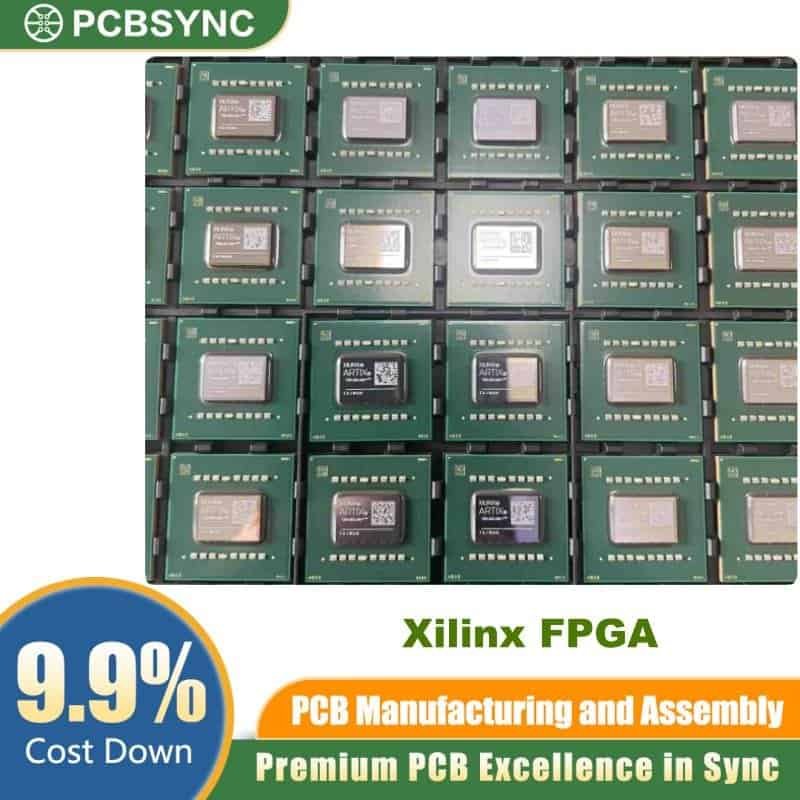
The XC2S200-6FGG1335C is a prominent member of the Xilinx Spartan-II family, designed to bridge the gap between high-end FPGA performance and the affordability required for high-volume consumer electronics. By leveraging an advanced 0.15-micron process, this Field Programmable Gate Array (FPGA) provides a robust platform for designers who need flexible, reprogrammable logic without the premium price tag.
Whether you are working on industrial automation, telecommunications, or consumer interface bridging, the XC2S200-6FGG1335C offers a versatile architecture that supports a wide range of I/O standards and high-speed logic operations.
Key Features of the XC2S200-6FGG1335C
The XC2S200-6FGG1335C is engineered to deliver high system performance while maintaining low power consumption. Below are the primary technical highlights:
-
High Logic Density: Features approximately 200,000 system gates and 5,292 logic cells.
-
Flexible I/O Options: Supports 16 high-performance I/O standards, including LVTTL, LVCMOS, and PCI.
-
Advanced Memory Architecture: Includes dedicated block RAM and distributed RAM for efficient data buffering.
-
Clock Management: Equipped with fully digital Delay-Locked Loops (DLLs) for precise clock de-skewing and frequency multiplication.
-
Cost-Efficient Packaging: The FGG (Fine-Pitch Ball Grid Array) packaging ensures a small footprint with high thermal stability.
Technical Specifications Table
To better understand the capabilities of the XC2S200-6FGG1335C, refer to the detailed technical specifications in the table below:
| Feature |
Specification |
| Series |
Spartan-II |
| Part Number |
XC2S200-6FGG1335C |
| Logic Cells |
5,292 |
| System Gates |
200,000 |
| Block RAM (Bits) |
57,344 |
| Maximum User I/O |
Up to 284 |
| Supply Voltage (Core) |
2.5V |
| Speed Grade |
-6 |
| Temperature Range |
0°C to +85°C (Commercial) |
Why Choose the Spartan-II Series?
The Spartan-II series, including the XC2S200-6FGG1335C, was revolutionized by inheriting the proven architecture of the Virtex series. This allows developers to access high-end features at a fraction of the cost.
High-Performance Architecture
The internal structure consists of a regular array of Configurable Logic Blocks (CLBs), surrounded by a perimeter of programmable Input/Output Blocks (IOBs). This symmetry simplifies the routing process, leading to faster design cycles and more predictable timing results.
Power Management and Efficiency
Operating at a core voltage of 2.5V, the XC2S200-6FGG1335C is designed for low power consumption. This makes it an ideal choice for systems where heat dissipation is a concern or where battery life is critical. For those looking for comprehensive hardware solutions, exploring a reliable Xilinx FPGA provider can ensure you receive genuine parts with verified performance benchmarks.
XC2S200-6FGG1335C Application Use Cases
Due to its versatility, this FPGA is utilized across various industries. Its ability to handle complex logic while interfacing with different voltage levels makes it a “Swiss Army knife” for hardware engineers.
-
Industrial Control: Used for motion control, motor drivers, and sensor data processing.
-
Communications: Ideal for protocol conversion, data encryption, and local area network (LAN) controllers.
-
Consumer Electronics: Powering high-definition displays, set-top boxes, and digital imaging equipment.
-
Legacy System Support: Often used to replace obsolete ASICs in long-lifecycle industrial products.
Ordering and Package Information
When sourcing the XC2S200-6FGG1335C, it is essential to note the package type and speed grade to ensure compatibility with your PCB design.
| Parameter |
Detail |
| Package Type |
FGG (Fine-Pitch BGA) |
| Lead Count |
Contact Manufacturer for Specifics |
| RoHS Status |
Lead-Free / RoHS Compliant |
| Mounting Type |
Surface Mount |
Conclusion
The XC2S200-6FGG1335C remains a top-tier choice for engineers seeking a balance between performance, flexibility, and cost. By utilizing the Spartan-II architecture, you gain access to a powerful logic environment capable of meeting the demands of modern digital systems.