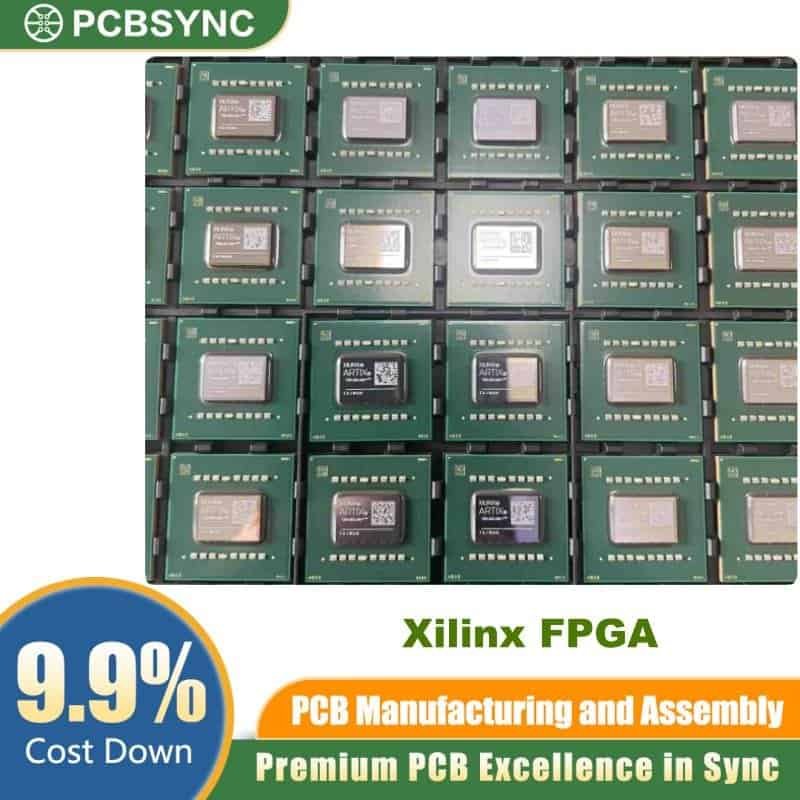
Meta Description: Buy the XC2S200-6FGG1307C Xilinx Spartan-II FPGA with 200,000 system gates, 5,292 logic cells, speed grade -6, and 1307-ball Pb-free Fine-Pitch BGA package. Read full specs, pinout, and applications.
The XC2S200-6FGG1307C is a high-performance Field-Programmable Gate Array (FPGA) from Xilinx’s proven Spartan-II family, engineered for cost-sensitive, performance-critical embedded design applications. Combining 200,000 system gates with a robust 1307-ball Fine-Pitch Ball Grid Array (FGG) package, Pb-free (RoHS-compliant) construction, and a commercial operating temperature range, this device delivers exceptional flexibility for industrial control, telecommunications, digital signal processing, and embedded computing systems.
Whether you are sourcing the XC2S200-6FGG1307C for legacy system maintenance, production replacement, or new design prototyping, this guide covers everything you need — from technical specifications and pinout details to application notes and ordering information.
For a full overview of compatible Xilinx programmable logic devices, visit our Xilinx FPGA product resource page.
What Is the XC2S200-6FGG1307C? Part Number Breakdown
Understanding the part number is the first step toward selecting the right device for your design.
| Code Segment |
Meaning |
| XC2S200 |
Xilinx Spartan-II series, 200,000 system gates |
| -6 |
Speed grade -6 (fastest available for Commercial range) |
| FGG |
Fine-Pitch Ball Grid Array, Pb-free (G = Green/RoHS) |
| 1307 |
1,307-ball package pinout |
| C |
Commercial temperature range (0°C to +85°C) |
The -6 speed grade is the fastest offered in the Spartan-II XC2S200 lineup and is exclusively available in the Commercial temperature range. The double “G” in FGG denotes a Pb-free, RoHS-compliant package — a critical distinction for manufacturers shipping products into EU markets or adhering to WEEE and RoHS directives.
XC2S200-6FGG1307C Key Specifications at a Glance
| Parameter |
Value |
| Manufacturer |
Xilinx (now AMD) |
| Family |
Spartan-II |
| Part Number |
XC2S200-6FGG1307C |
| System Gates |
200,000 |
| Logic Cells |
5,292 |
| CLB Array |
28 × 42 |
| Total CLBs |
1,176 |
| Max User I/O |
284 |
| Distributed RAM |
75,264 bits |
| Block RAM |
56K bits |
| Speed Grade |
-6 (fastest) |
| Max System Frequency |
Up to 200 MHz |
| Core Voltage |
2.5V |
| Process Technology |
0.18 µm |
| Package Type |
FGG (Fine-Pitch BGA, Pb-free) |
| Ball Count |
1,307 |
| Temperature Range |
Commercial: 0°C to +85°C |
| RoHS Compliance |
Yes (Pb-free package) |
XC2S200-6FGG1307C Architecture & Core Features
Configurable Logic Block (CLB) Architecture
The Spartan-II XC2S200 is built around a matrix of 1,176 Configurable Logic Blocks (CLBs) arranged in a 28×42 array. Each CLB contains two slices, and each slice includes two 4-input Look-Up Tables (LUTs) and two flip-flops. This architecture enables:
- Efficient implementation of combinational and sequential digital logic
- Distributed RAM using LUT-based memory configurations (75,264 bits total)
- Fast carry and arithmetic logic for high-speed math-intensive designs
Input/Output Blocks (IOBs) and User I/O
The XC2S200-6FGG1307C provides 284 maximum user I/O pins, making it one of the most I/O-rich variants in the Spartan-II XC2S200 family. Each IOB supports:
- Programmable slew rate control
- Optional output inversion
- 3-state output enable
- Multiple I/O standards for flexible system integration
Block RAM and Distributed Memory
| Memory Type |
Total Capacity |
| Distributed RAM (LUT-based) |
75,264 bits |
| Block RAM |
56,000 bits (56K) |
| Total On-Chip RAM |
~131K bits |
Block RAM is implemented in two dedicated columns on the die, offering high-speed, dual-port memory access ideal for FIFOs, lookup tables, and embedded buffers in DSP and communication designs.
Delay-Locked Loops (DLLs)
The XC2S200 incorporates four Delay-Locked Loops (DLLs), one positioned at each corner of the die. DLLs provide:
- Clock deskew and phase alignment
- Frequency synthesis (multiply/divide)
- Duty-cycle correction for clean clock distribution
- Zero propagation delay for internal clock networks
Spartan-II Family Comparison: Where XC2S200 Fits
| Device |
Logic Cells |
System Gates |
CLB Array |
Max User I/O |
Block RAM |
| XC2S15 |
432 |
15,000 |
8×12 |
86 |
16K |
| XC2S30 |
972 |
30,000 |
12×18 |
92 |
24K |
| XC2S50 |
1,728 |
50,000 |
16×24 |
176 |
32K |
| XC2S100 |
2,700 |
100,000 |
20×30 |
176 |
40K |
| XC2S150 |
3,888 |
150,000 |
24×36 |
260 |
48K |
| XC2S200 |
5,292 |
200,000 |
28×42 |
284 |
56K |
The XC2S200 sits at the top of the Spartan-II family, offering the largest logic capacity, the highest I/O count, and the most on-chip memory resources in the lineup.
XC2S200-6FGG1307C Package Information
FGG1307 Package Details
| Package Attribute |
Detail |
| Package Code |
FGG (Fine-Pitch Ball Grid Array) |
| Ball Count |
1,307 |
| Pb-Free |
Yes (“G” designation) |
| Package Shape |
Square BGA |
| Mounting Type |
Surface Mount |
| Ball Configuration |
Fine-Pitch BGA grid |
The FGG1307 package is the largest pinout available for the XC2S200 device, maximizing accessible I/O and power/ground connections. The Pb-free construction (indicated by the double “G” in FGG) satisfies RoHS requirements while the fine-pitch BGA layout ensures excellent signal integrity and thermal dissipation.
PCB Layout Note: Fine-Pitch BGA packages require controlled impedance PCB design, proper via fanout strategies, and careful attention to decoupling capacitor placement. Refer to the Xilinx Spartan-II Hardware User Guide (UG384) for detailed PCB design recommendations.
Electrical Characteristics
| Parameter |
Min |
Typical |
Max |
Unit |
| Core Supply Voltage (VCCINT) |
2.375 |
2.5 |
2.625 |
V |
| I/O Supply Voltage (VCCO) |
— |
2.5 / 3.3 |
— |
V |
| Input Low Voltage (VIL) |
— |
— |
0.8 |
V |
| Input High Voltage (VIH) |
2.0 |
— |
— |
V |
| Operating Temperature |
0 |
— |
+85 |
°C |
| Maximum System Frequency |
— |
— |
200 |
MHz |
Configuration and Programming
The XC2S200-6FGG1307C supports multiple FPGA configuration modes, providing flexibility for both development and production environments:
Supported Configuration Modes
| Mode |
Description |
| Master Serial |
Device controls configuration clock; reads bitstream from PROM |
| Slave Serial |
External controller provides configuration clock and data |
| Master Parallel (SelectMAP) |
Byte-wide parallel interface for fast configuration |
| Slave Parallel (SelectMAP) |
Processor-controlled parallel configuration |
| JTAG (Boundary Scan) |
IEEE 1149.1 boundary scan for testing and configuration |
Compatible Configuration PROMs
Xilinx XCF-series and XC18V-series Platform Flash PROMs are fully compatible with the XC2S200-6FGG1307C for standalone operation without an external host processor.
Design Tools Support
| Tool |
Version |
| Xilinx ISE Design Suite |
Recommended for Spartan-II legacy designs |
| Xilinx WebPACK |
Free edition; supports XC2S200 synthesis and implementation |
| ModelSim / XSIM |
HDL simulation for VHDL and Verilog designs |
| ChipScope Pro |
On-chip logic analysis during hardware debug |
Note: The Spartan-II family is not supported by Xilinx Vivado Design Suite. Use Xilinx ISE 14.7 for all XC2S200 design flows.
Supported I/O Standards
The XC2S200-6FGG1307C IOBs support a wide range of industry-standard I/O voltage levels:
| I/O Standard |
VCCO Voltage |
| LVTTL |
3.3V |
| LVCMOS33 |
3.3V |
| LVCMOS25 |
2.5V |
| LVCMOS18 |
1.8V |
| PCI (3.3V) |
3.3V |
| GTL |
3.3V |
| SSTL2 (Class I & II) |
2.5V |
| SSTL3 (Class I & II) |
3.3V |
| HSTL (Class I & IV) |
1.5V |
Applications of the XC2S200-6FGG1307C
The XC2S200-6FGG1307C is widely deployed across multiple industries owing to its combination of high gate density, abundant I/O, and proven reliability.
#### Industrial Automation and Control
- Motor drive controllers and servo systems
- Programmable logic replacement (replacing aging PLCs)
- Machine vision preprocessing pipelines
- Industrial fieldbus interfaces (CAN, RS-485, Profibus)
#### Telecommunications and Networking
- Framer and mapper ICs for SONET/SDH systems
- Line card logic in telephony switches
- Protocol conversion between legacy serial interfaces
- T1/E1 channelized interface controllers
#### Embedded Computing and SoC Prototyping
- Custom peripheral controllers (UART, SPI, I²C accelerators)
- FPGA-based soft-core processor implementations (e.g., PicoBlaze)
- Co-processing acceleration alongside embedded CPUs
- ASIC prototyping and pre-silicon verification
#### Digital Signal Processing (DSP)
- FIR/IIR digital filter implementations
- FFT engines for radar and sonar systems
- Custom audio processing pipelines
- Data acquisition front ends
#### Defense and Aerospace (Legacy System Maintenance)
- Ruggedized avionics control systems
- Radar signal processing (commercial temp range components)
- Navigation system controller logic
- Secure communication system FPGAs
Advantages Over Mask-Programmed ASICs
The XC2S200-6FGG1307C offers compelling advantages over fixed-function ASIC solutions:
| Criterion |
XC2S200-6FGG1307C (FPGA) |
Mask-Programmed ASIC |
| NRE (Non-Recurring Engineering) Cost |
$0 |
$500K–$5M+ |
| Time to First Prototype |
Hours to Days |
6–18 Months |
| Field Upgradability |
Yes (reconfigurable) |
No (fixed silicon) |
| Risk on Design Error |
Low (reprogram) |
High (respin required) |
| Volume Cost Efficiency |
High at low-medium volume |
High only at very high volume |
| IP Protection |
Bitstream encryption options |
Built into silicon |
Ordering Information: XC2S200 Speed Grade and Package Options
| Part Number |
Speed Grade |
Package |
Balls |
Temperature |
Pb-Free |
| XC2S200-6FGG1307C |
-6 (fastest) |
FGG1307 |
1,307 |
Commercial (0°C to +85°C) |
Yes |
| XC2S200-6FGG456C |
-6 |
FGG456 |
456 |
Commercial |
Yes |
| XC2S200-6FG456C |
-6 |
FG456 |
456 |
Commercial |
No |
| XC2S200-5FGG456C |
-5 |
FGG456 |
456 |
Commercial |
Yes |
| XC2S200-5FGG456I |
-5 |
FGG456 |
456 |
Industrial |
Yes |
| XC2S200-6PQG208C |
-6 |
PQG208 |
208 |
Commercial |
Yes |
Key Reminder: The -6 speed grade is available only in the Commercial (C) temperature range. If your design requires an Industrial (-40°C to +85°C) operating range, select the -5 speed grade.
Frequently Asked Questions (FAQ)
What is the difference between XC2S200-6FGG1307C and XC2S200-6FGG456C?
Both devices share the same XC2S200 die with identical logic resources, speed grade (-6), and commercial temperature range. The key difference is the package: the FGG1307 offers 1,307 solder balls, providing significantly more I/O connections and power/ground pins, while the FGG456 has 456 balls in a smaller footprint. The FGG1307 is preferred in high-density PCB designs requiring maximum available I/O.
Is the XC2S200-6FGG1307C RoHS compliant?
Yes. The double “G” in the FGG package designator confirms this part uses Pb-free (lead-free) solder balls, making it fully compliant with RoHS (Restriction of Hazardous Substances) and WEEE directives.
What design software supports the XC2S200-6FGG1307C?
Use Xilinx ISE Design Suite 14.7 (the final release). The Spartan-II family is not supported by Xilinx Vivado. ISE 14.7 is freely available for download from the AMD/Xilinx website as a legacy tool.
Can the XC2S200-6FGG1307C be used in industrial temperature applications?
No. The “C” suffix denotes a Commercial temperature range (0°C to +85°C). For industrial environments (-40°C to +100°C), select a variant with an “I” suffix and speed grade -5, as -6 is not offered in the Industrial range.
What is the maximum operating frequency of the XC2S200-6FGG1307C?
The XC2S200 at speed grade -6 supports system frequencies up to 200 MHz, with internal clock distributions managed via the four on-chip DLLs. Actual achievable frequency depends on logic utilization, routing, and design constraints.
Is this part recommended for new designs?
The XC2S200 Spartan-II family is a mature, end-of-life product line from Xilinx. It is listed as “Not Recommended for New Design” (NRND) in current AMD/Xilinx documentation. It is widely sourced for legacy system maintenance, spare parts inventory, and retrofit applications. For new designs, consider migrating to Xilinx Artix-7 or Spartan-7 families.
Related Xilinx Spartan-II Devices
| Part Number |
Gates |
Package |
Speed Grade |
Temperature |
| XC2S150-6FGG456C |
150,000 |
FGG456 |
-6 |
Commercial |
| XC2S100-6FGG256C |
100,000 |
FGG256 |
-6 |
Commercial |
| XC2S50-6FGG256C |
50,000 |
FGG256 |
-6 |
Commercial |
| XC2S200-5FGG456I |
200,000 |
FGG456 |
-5 |
Industrial |
Conclusion: Is the XC2S200-6FGG1307C Right for Your Project?
The XC2S200-6FGG1307C remains one of the most capable devices in the Spartan-II lineup. Its combination of 200,000 system gates, 5,292 logic cells, 284 user I/O pins, dual DLL clocking, on-chip block RAM, and fastest -6 speed grade makes it a reliable workhorse for legacy system support, retrofit projects, and low-to-mid complexity digital design work.
With Pb-free FGG1307 packaging ensuring regulatory compliance and the commercial temperature range covering the majority of benign-environment applications, this FPGA continues to fulfill demanding roles across telecommunications, industrial automation, embedded computing, and DSP platforms.
For sourcing, datasheet downloads, pinout diagrams, and additional Xilinx FPGA resources, visit our Xilinx FPGA resource page.