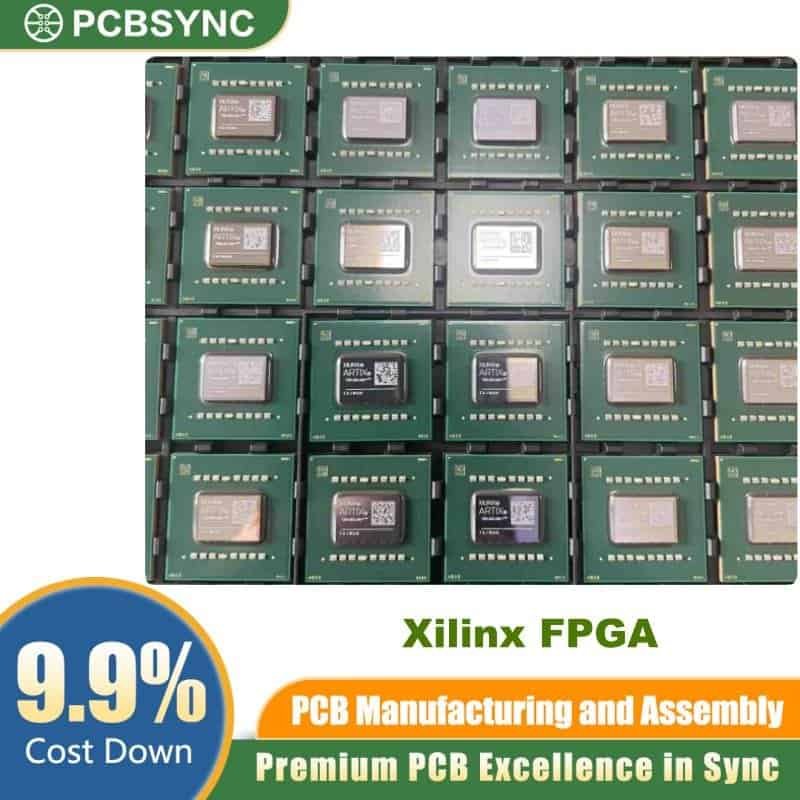
Meta Description: The XC2S200-6FGG1300C is a Xilinx Spartan-II FPGA with 200K system gates, 5,292 logic cells, -6 speed grade, and a 1300-ball Pb-free FGG BGA package. Full specs, pinout, and applications inside.
The XC2S200-6FGG1300C is a commercial-grade Field-Programmable Gate Array (FPGA) from Xilinx’s Spartan-II device family. Engineered for high-density, cost-efficient programmable logic applications, this part delivers 200,000 system gates, 5,292 configurable logic cells, a 1300-ball Fine-Pitch BGA (FGG) lead-free package, and the fastest -6 commercial speed grade available in the Spartan-II lineup. For engineers designing telecommunications equipment, industrial automation systems, or embedded processing pipelines, the XC2S200-6FGG1300C provides a proven, production-tested FPGA platform backed by decades of Xilinx silicon expertise.
What Is the XC2S200-6FGG1300C?
The XC2S200-6FGG1300C is the top-tier member of the Xilinx Spartan-II FPGA family, manufactured on 0.18-micron CMOS process technology and optimized for volume commercial deployments. The component’s part number encodes critical design-time information:
| Part Number Segment |
Decoded Meaning |
| XC2S200 |
Spartan-II family, 200,000 system gates (largest in family) |
| -6 |
Speed grade -6 — fastest commercial timing performance |
| FGG |
Fine-Pitch Ball Grid Array, Pb-free / RoHS-compliant package |
| 1300 |
1,300 solder ball count |
| C |
Commercial temperature range: 0°C to +85°C |
Note: Per the Xilinx Spartan-II datasheet (DS001), the -6 speed grade is exclusively available in the Commercial temperature range and is not offered in industrial variants. This makes the XC2S200-6FGG1300C the maximum-performance commercial option for high-throughput system designs.
XC2S200-6FGG1300C Complete Technical Specifications
Core Logic Architecture
| Parameter |
XC2S200-6FGG1300C Value |
| Logic Cells |
5,292 |
| System Gates (Logic + RAM) |
200,000 |
| CLB Array (Rows × Columns) |
28 × 42 |
| Total Configurable Logic Blocks |
1,176 |
| Maximum User I/O Pins |
284 |
| Distributed RAM (bits) |
75,264 |
| Block RAM (bits) |
56,000 (56K) |
| Delay-Locked Loops (DLLs) |
4 |
Electrical & Performance Specifications
| Parameter |
Value |
| Core Supply Voltage (VCCINT) |
2.5V |
| I/O Supply Voltage (VCCO) |
2.5V or 3.3V (per bank) |
| Process Node |
0.18 µm CMOS |
| Maximum Operating Frequency |
Up to 263 MHz |
| Speed Grade |
-6 (Fastest Commercial) |
| Architecture |
SRAM-based, volatile (requires config at power-up) |
Package & Compliance Details
| Parameter |
Value |
| Package Designator |
FGG (Fine-Pitch BGA, Pb-free) |
| Ball Count |
1,300 |
| Package Type |
Fine-Pitch Ball Grid Array (FBGA) |
| Lead-Free / RoHS |
Yes — “G” suffix denotes Pb-free solder |
| Temperature Grade |
Commercial (0°C to +85°C) |
| Moisture Sensitivity |
Per JEDEC J-STD-020 |
XC2S200-6FGG1300C Architecture Deep Dive
#### Configurable Logic Blocks (CLBs) — The Programmable Core
The XC2S200-6FGG1300C contains 1,176 CLBs tiled across a 28-column by 42-row array. Each CLB is made up of two slices, and each slice contains:
- Two 4-input Look-Up Tables (LUTs) — implement any combinatorial logic function
- Two D-type flip-flops — enable clocked sequential logic storage
- Fast carry logic — accelerates arithmetic operations like adders and counters
- Wide-function multiplexers — support functions larger than 4 inputs
This architecture gives designers a flexible building block that efficiently maps both random logic and regular structures such as state machines, counters, and data path elements.
#### Distributed RAM — Speed-Optimized On-Fabric Memory
The 75,264 bits of distributed RAM in the XC2S200-6FGG1300C are implemented directly within the CLB LUTs and can be configured as:
- 16×1 single-port or dual-port synchronous RAM
- 16-bit shift registers for data streaming pipelines
- Read-only ROM for constant lookup tables
Because distributed RAM sits within the CLB fabric, access latency is extremely low — making it ideal for register files, small FIFOs, and cycle-accurate caching logic.
#### Block RAM — Dedicated High-Capacity Storage
Two columns of dedicated Block RAM flank the CLB array on opposite sides of the die, providing 56K bits of synchronous, dual-port storage. Each Block RAM module supports:
| Block RAM Mode |
Description |
| Simple Dual-Port |
One read port + one write port |
| True Dual-Port |
Simultaneous independent R/W on both ports |
| Configurable Width |
×1, ×2, ×4, ×8, ×16, or ×18 bit widths |
Block RAM is ideal for packet buffering, DSP coefficient storage, video line buffers, and look-up table acceleration.
#### Delay-Locked Loops (DLLs) — Precision Clock Management
Four on-chip DLL circuits — placed one at each corner of the die — provide powerful clock management:
| DLL Feature |
Benefit |
| Clock Deskewing |
Eliminates board-level clock distribution delay |
| Frequency Synthesis |
Divide or multiply incoming clock frequencies |
| Phase Shifting |
Adjust clock phase in 90°/180°/270° increments |
| Duty Cycle Correction |
Maintains 50% duty cycle after division |
#### Flexible I/O Banks & Supported Standards
The 284 user I/O pins are organized into independently powered I/O banks. Each bank’s VCCO voltage determines which logic levels are supported on those pins.
| Supported I/O Standard |
Description |
| LVTTL |
3.3V Low Voltage TTL |
| LVCMOS 3.3V / 2.5V |
Low Voltage CMOS |
| PCI 3.3V |
PCI Local Bus compatible |
| GTL / GTL+ |
Gunning Transceiver Logic |
| HSTL Class I |
High-Speed Transceiver Logic |
| SSTL2 / SSTL3 |
Stub-Series Terminated Logic for DDR |
| AGP |
Accelerated Graphics Port compatible |
How the XC2S200-6FGG1300C Compares to Other Spartan-II Devices
| Device |
Logic Cells |
System Gates |
CLBs |
Max I/O |
Block RAM |
Dist. RAM |
| XC2S15 |
432 |
15,000 |
96 |
86 |
16K |
6,144 bits |
| XC2S30 |
972 |
30,000 |
216 |
92 |
24K |
13,824 bits |
| XC2S50 |
1,728 |
50,000 |
384 |
176 |
32K |
24,576 bits |
| XC2S100 |
2,700 |
100,000 |
600 |
176 |
40K |
38,400 bits |
| XC2S150 |
3,888 |
150,000 |
864 |
260 |
48K |
55,296 bits |
| XC2S200 |
5,292 |
200,000 |
1,176 |
284 |
56K |
75,264 bits |
The XC2S200-6FGG1300C sits at the absolute top of this family in every resource category — logic cells, gate count, CLBs, I/O count, Block RAM, and distributed RAM.
Top Applications for the XC2S200-6FGG1300C
#### 1. Telecommunications Line Cards & Protocol Bridging
The -6 speed grade and 284-pin I/O capacity make the XC2S200-6FGG1300C well-suited for multi-protocol serial interfaces, line-rate data multiplexing, and Ethernet frame processing. Engineers can implement SONET framers, ATM cell processors, and custom MAC layer logic entirely within the FPGA fabric.
#### 2. Industrial Machine Control & Motion Systems
Industrial applications benefit from the device’s multi-bank I/O architecture and fast CLB response times. Common use cases include servo drive controllers, encoder interfaces, multi-axis CNC logic, and industrial fieldbus bridges (PROFIBUS, DeviceNet, CANopen).
#### 3. Digital Signal Processing Engines
The combination of 75K distributed RAM and 56K Block RAM, paired with the fast -6 speed grade, enables FIR/IIR digital filters, FFT processors, digital up/down converters, and echo cancellers running at near-maximum CLB clock rates.
#### 4. Video & Image Processing Systems
The XC2S200-6FGG1300C can process parallel video data streams using its wide CLB fabric. Applications include video capture front-ends, frame synchronizers, pixel pipeline accelerators, and format converters for broadcast video or machine vision.
#### 5. Embedded Co-Processor Acceleration
When paired with a CPU or DSP, the XC2S200-6FGG1300C acts as a hardware co-processor — handling tasks such as CRC computation, data encryption, protocol parsing, and custom DMA control.
#### 6. Test & Measurement Instruments
With flexible I/O standard support and high pin counts, this FPGA is frequently used in logic analyzers, waveform generators, protocol exercisers, and ATE pin electronics that interface with multiple electrical standards.
XC2S200-6FGG1300C vs. Custom ASICs: Why Choose FPGA?
| Consideration |
Custom ASIC |
XC2S200-6FGG1300C FPGA |
| NRE Costs |
$500K–$5M+ |
$0 |
| Design Iteration |
Requires silicon re-spin |
Reprogram in minutes |
| Time to First Silicon |
12–24 weeks |
Immediate (use existing stock) |
| Field Updates |
Not possible |
Yes — JTAG or PROM |
| Volume Break-Even |
Very high volumes |
Any production scale |
| Risk on Design Error |
Extremely high |
Minimal |
For Xilinx FPGA engineers who need ASIC-class gate density but cannot afford the NRE investment or schedule risk, the XC2S200-6FGG1300C is the definitive Spartan-II answer.
Development Tools & Configuration Methods
#### Software Design Tools
| Tool |
Role |
| Xilinx ISE Design Suite 14.7 |
RTL synthesis, place-and-route, bitstream generation |
| ModelSim / ISim |
Functional and timing simulation |
| ChipScope Pro |
In-system debugging via JTAG |
| FPGA Editor |
Manual placement and routing inspection |
| XPower Analyzer |
Power estimation for specific designs |
Xilinx ISE 14.7 is the last official release with full Spartan-II device support, freely downloadable from AMD’s legacy software archive.
#### Configuration Methods
The XC2S200-6FGG1300C is SRAM-based and requires configuration at every power-up. Supported modes:
| Configuration Mode |
Description |
| JTAG (Boundary Scan) |
Direct bitstream download during development |
| Master Serial |
Automatic load from serial PROM (e.g., XCF02S) |
| Slave Serial |
Driven by external microcontroller |
| SelectMAP (Byte-Parallel) |
Fast parallel configuration for production |
| Master Parallel (×8) |
Load from parallel PROM |
#### Compatible Configuration PROMs
| PROM Part |
Capacity |
Recommended Use |
| XCF01S |
1 Mbit |
Small or partial designs |
| XCF02S |
2 Mbit |
Standard XC2S200 bitstream (~1.75 Mbit) |
| XCF04S |
4 Mbit |
Multi-image / dual-boot configurations |
| XCF08P |
8 Mbit |
Extended storage with revision management |
Full Ordering & Product Reference
| Parameter |
Details |
| Full Part Number |
XC2S200-6FGG1300C |
| Manufacturer |
Xilinx, Inc. (now AMD) |
| Product Family |
Spartan-II |
| Device |
XC2S200 (200K Gates) |
| Package |
FGG — 1300-Ball Fine-Pitch BGA, Pb-Free |
| Speed Grade |
-6 (Maximum Commercial Performance) |
| Temperature Range |
Commercial: 0°C to +85°C |
| Core Voltage (VCCINT) |
2.5V |
| I/O Voltage (VCCO) |
2.5V / 3.3V (configurable per bank) |
| RoHS / Pb-Free |
Yes (FGG suffix = Pb-free solder balls) |
| Product Status |
End-of-Life (legacy inventory available) |
| Supported Toolchain |
Xilinx ISE 14.7 (legacy), ModelSim, ChipScope Pro |
Frequently Asked Questions (FAQ)
Q: What is the difference between XC2S200-6FGG1300C and XC2S200-5FGG1300C? A: The two parts share identical silicon and package, but differ in speed grade. The -6 suffix indicates superior timing performance with lower propagation delays and higher maximum frequencies. The -5 grade is available in both commercial and industrial temperature ranges, while the -6 is commercial-only.
Q: What does “FGG” mean in the package name? A: The first “G” stands for the Fine-Pitch BGA package geometry. The second “G” indicates Pb-free (lead-free) solder balls, making the part RoHS-compliant. Standard FG parts use leaded solder; FGG parts are the drop-in Pb-free replacement with the same footprint.
Q: Is the XC2S200-6FGG1300C still being manufactured? A: The Spartan-II family has reached End-of-Life (EOL) status. Xilinx/AMD no longer manufactures new units, but authorized distributors and licensed brokers continue to supply the part from existing inventory for legacy board production and warranty repairs.
Q: What HDL languages can I use to program the XC2S200-6FGG1300C? A: The device supports VHDL, Verilog HDL, and schematic-based entry in Xilinx ISE. Third-party tools such as Synplify Pro and Precision RTL Synthesis also support the Spartan-II target family.
Q: Can the XC2S200-6FGG1300C interface directly with 3.3V logic? A: Yes. When the relevant I/O bank’s VCCO supply is tied to 3.3V, the device supports LVTTL and LVCMOS 3.3V signaling with no external level translation required. This enables direct connection to most 3.3V microcontrollers, DSPs, and bus interfaces.
Q: How do I calculate power consumption for my design? A: Use Xilinx’s XPower Analyzer tool, included in ISE Design Suite 14.7. XPower estimates static and dynamic power based on design utilization, clock frequencies, and switching activity derived from your post-route simulation results.
Summary
The XC2S200-6FGG1300C stands as the highest-performance commercial device in the Xilinx Spartan-II FPGA portfolio. Featuring 200,000 system gates, 5,292 logic cells, 284 user I/O pins, 56K bits of Block RAM, 75,264 bits of distributed RAM, and four on-chip Delay-Locked Loops — all packaged in a RoHS-compliant 1300-ball FGG BGA operating at a maximum frequency of 263 MHz from a 2.5V supply — this device is a production-proven, extensively documented FPGA for commercial-grade designs. Whether you are sustaining an existing Spartan-II-based product line or evaluating the device for a new application, the XC2S200-6FGG1300C delivers unmatched logic resources within the Spartan-II generation at a competitive total cost of ownership.