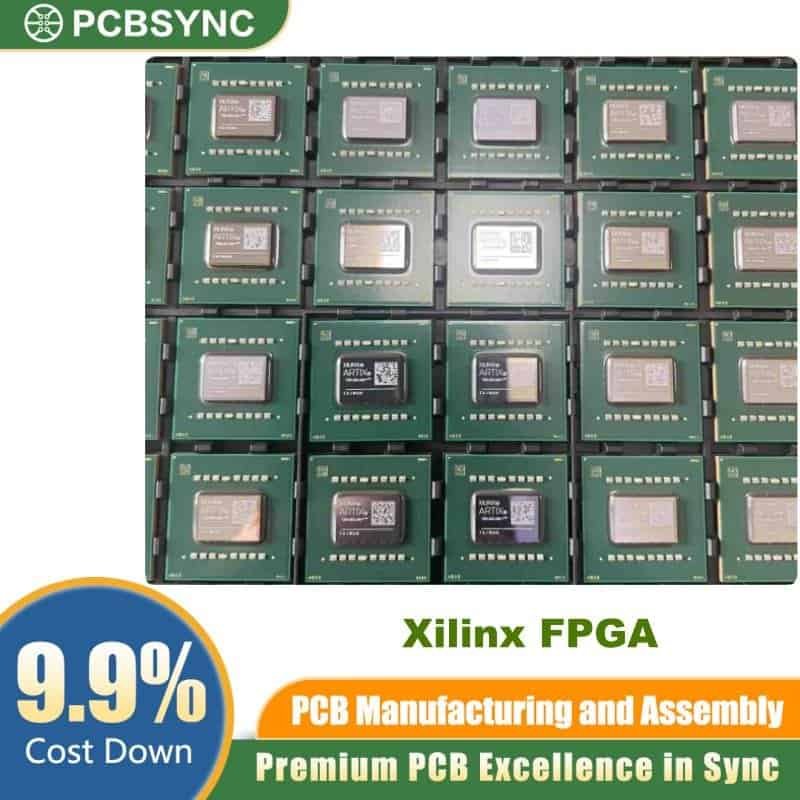
Meta Description: The XC2S200-6FGG1299C is a Xilinx Spartan-II FPGA with 200K system gates, 5,292 logic cells, -6 speed grade, and a 1299-ball Pb-free FGG BGA package. Full specs, pinout, and applications.
The XC2S200-6FGG1299C is a top-tier Field-Programmable Gate Array (FPGA) from Xilinx’s Spartan-II family, designed for engineers who demand maximum programmable logic performance in a compact, RoHS-compliant package. Featuring 200,000 system gates, 5,292 logic cells, a -6 (fastest) commercial speed grade, and a 1299-ball Fine-Pitch BGA (FGG) Pb-free package, this device represents the highest-density device in the entire Spartan-II product line. From high-speed telecommunications logic to industrial automation and embedded signal processing, the XC2S200-6FGG1299C provides the logic resources, memory bandwidth, and I/O flexibility required for demanding production-grade designs.
What Is the XC2S200-6FGG1299C?
Understanding the Part Number
The XC2S200-6FGG1299C is a member of Xilinx’s Spartan-II FPGA family, built on a cost-optimized 0.18-micron CMOS process. Its part number carries a precise technical meaning that tells engineers exactly what they are receiving:
| Part Number Segment |
Meaning |
| XC2S200 |
Spartan-II family, 200,000 system gate density |
| -6 |
Speed Grade -6 — the fastest commercial Spartan-II variant |
| FGG |
Fine-Pitch Ball Grid Array, Pb-free (lead-free / RoHS compliant) |
| 1299 |
1299 solder ball count |
| C |
Commercial temperature range: 0°C to +85°C |
The “G” suffix in FGG distinguishes this part from the standard FG leaded variant. Both share the same die, footprint, and electrical behavior — the only difference is the lead-free solder ball composition, making the FGG variant fully RoHS and WEEE directive compliant for global distribution.
XC2S200-6FGG1299C: Full Technical Specifications
Core Logic Resources
The XC2S200 is the largest member of the Spartan-II family, offering densities up to 200,000 system gates and up to 5,292 logic cells. The table below summarizes all core logic parameters:
| Parameter |
XC2S200-6FGG1299C Value |
| Logic Cells |
5,292 |
| System Gates (Logic + RAM) |
200,000 |
| CLB Array |
28 Rows × 42 Columns |
| Total CLBs |
1,176 |
| Maximum User I/O Pins |
284 |
| Distributed RAM (SelectRAM) |
75,264 bits |
| Block RAM |
56K bits (56,000 bits) |
| Delay-Locked Loops (DLLs) |
4 (one per die corner) |
Electrical & Timing Characteristics
The Spartan-II family provides system clock rates up to 200 MHz, with a core supply of 2.5V and I/Os powered at 1.5V, 2.5V, or 3.3V.
| Parameter |
Value |
| Core Supply Voltage (VCCINT) |
2.5V |
| I/O Supply Voltage (VCCO) |
1.5V / 2.5V / 3.3V (per bank) |
| Maximum System Clock |
Up to 263 MHz (speed-grade -6) |
| Process Node |
0.18 µm CMOS |
| Speed Grade |
-6 (Fastest Commercial) |
| Configuration Technology |
Static SRAM-based (unlimited reprogramming) |
Package & Compliance Details
| Parameter |
Value |
| Package Type |
FGG — Fine-Pitch BGA, Pb-Free |
| Total Ball Count |
1,299 |
| Temperature Grade |
Commercial (0°C to +85°C) |
| RoHS Compliance |
Yes — Pb-free solder balls |
| WEEE Compliant |
Yes |
| Boundary Scan |
IEEE 1149.1 (JTAG) compatible |
Architecture Deep Dive: How the XC2S200-6FGG1299C Works
Configurable Logic Blocks (CLBs)
The Spartan-II family features a regular, flexible, programmable architecture of Configurable Logic Blocks (CLBs) surrounded by a perimeter of programmable Input/Output Blocks (IOBs). The XC2S200’s 1,176 CLBs are arranged in a 28×42 matrix — the largest in the Spartan-II lineup. Each CLB contains:
- Four Look-Up Tables (LUTs) — each capable of implementing any 4-input Boolean function
- Four flip-flops — with programmable set, reset, and clock enable
- Dedicated carry logic — for high-speed ripple-carry arithmetic
- Cascade chains — for wide-input combinatorial functions
SelectRAM: Hierarchical Dual-Mode Memory
The Spartan-II family includes SelectRAM hierarchical memory: 16 bits per LUT as distributed RAM and configurable 4K-bit block RAM, with fast interfaces to external RAM.
| Memory Type |
Total Capacity |
Best Use Case |
| Distributed RAM |
75,264 bits |
Speed-critical small buffers, FIFOs, register files |
| Block RAM (×4K) |
56,000 bits |
Large synchronous dual-port memory, data buffering |
Delay-Locked Loops (DLLs)
There are four Delay-Locked Loops (DLLs), one at each corner of the die. These on-chip DLLs provide:
- Clock deskewing — eliminates PCB-level clock distribution delay
- Frequency synthesis — multiply or divide the input clock
- Phase shifting — fine-tune phase relationships between clock domains
- Zero-delay buffering — maintain precise timing margins across the full device
Flexible I/O Banks & Supported Standards
With 284 user I/O pins and independently powered I/O banks, the XC2S200-6FGG1299C supports 16 high-performance I/O interface standards, including:
| I/O Standard |
Voltage Level |
Typical Application |
| LVTTL |
3.3V |
General-purpose digital I/O |
| LVCMOS 2.5V / 3.3V |
2.5V / 3.3V |
Low-voltage MCU interfaces |
| PCI (3.3V) |
3.3V |
PCI bus compliance |
| GTL / GTL+ |
1.2V / 1.5V |
High-speed point-to-point links |
| HSTL (Class I–IV) |
1.5V |
Memory and ASIC interfaces |
| SSTL2 / SSTL3 |
2.5V / 3.3V |
SDRAM/DDR SDRAM interfaces |
XC2S200-6FGG1299C vs. Spartan-II Family Comparison
The table below places the XC2S200 in the context of the full Spartan-II family to help engineers right-size their device selection:
| Device |
Logic Cells |
System Gates |
CLB Array |
Max User I/O |
Block RAM |
| XC2S15 |
432 |
15,000 |
8×12 |
86 |
16K |
| XC2S30 |
972 |
30,000 |
12×18 |
92 |
24K |
| XC2S50 |
1,728 |
50,000 |
16×24 |
176 |
32K |
| XC2S100 |
2,700 |
100,000 |
20×30 |
176 |
40K |
| XC2S150 |
3,888 |
150,000 |
24×36 |
260 |
48K |
| XC2S200 (this device) |
5,292 |
200,000 |
28×42 |
284 |
56K |
The XC2S200-6FGG1299C is the undisputed top performer in the Spartan-II family — offering 12× more logic cells than the entry-level XC2S15 and 75% more block RAM.
Top Applications for the XC2S200-6FGG1299C
#### Telecommunications & Protocol Processing
The combination of 284 I/O pins, on-chip DLLs, and -6 speed grade makes the XC2S200-6FGG1299C a natural fit for line card controllers, multi-protocol bridges, ATM cell processors, and Ethernet MAC logic. Its CLB fabric can implement multi-channel UART/SPI/I²C interfaces in parallel without external ASICs.
#### Industrial Automation & Motion Control
In industrial settings, the XC2S200-6FGG1299C is deployed in PLC controllers, servo amplifiers, multi-axis motion coordinators, and safety I/O modules. The device’s real-time responsiveness and abundant I/O banks eliminate the need for dedicated glue logic ICs.
#### Digital Signal Processing (DSP)
The device supports efficient implementations of FIR filters, IIR filters, FFT engines, and digital up/down converters. Pipelined arithmetic is accelerated by the dedicated carry chain logic built into every CLB row, enabling multiply-accumulate structures that run at the full device clock rate.
#### Embedded Hardware Acceleration
When paired with a soft-core processor (such as Xilinx’s PicoBlaze) or an external MCU, the XC2S200-6FGG1299C acts as a dedicated hardware accelerator — offloading tasks like CRC computation, encryption co-processing, DMA engines, and real-time bus arbitration.
#### Medical Imaging & Diagnostics
The high I/O count and 16 supported I/O standards make this device an excellent interface hub in ultrasound front-ends, CT scanner data pipelines, and laboratory diagnostic instruments where multiple voltage domains and high-speed ADC/DAC interfaces must coexist on a single PCB.
#### Aerospace & Defense (Industrial Temp Variants)
While the XC2S200-6FGG1299C targets commercial temperature ranges, the Spartan-II architecture is also offered in industrial variants. The core design skills and toolchain remain identical, simplifying re-qualification efforts for regulated applications.
Why the XC2S200-6FGG1299C Outperforms Mask-Programmed ASICs
The Spartan-II family is a superior alternative to mask-programmed ASICs. The FPGA avoids the initial cost, lengthy development cycles, and inherent risk of conventional ASICs. FPGA programmability also permits design upgrades in the field with no hardware replacement necessary — something that is impossible with ASICs.
Here is a side-by-side comparison:
| Factor |
XC2S200-6FGG1299C (FPGA) |
Mask-Programmed ASIC |
| NRE Cost |
$0 |
$500K–$5M+ |
| Time-to-First-Silicon |
Same day (program in-circuit) |
12–26 weeks |
| Design Iterations |
Unlimited |
Costly re-spin each time |
| Field Updates |
Yes — reprogram remotely |
No |
| Minimum Order Quantity |
1 unit |
Often 10,000+ units |
| Risk Level |
Low |
High |
For teams building low-to-medium volume systems or products that require iterative firmware updates, the XC2S200-6FGG1299C delivers a fundamentally better total cost of ownership than custom silicon.
Development Tools & Configuration Methods
Supported EDA Tools
The Spartan-II family is fully supported by the powerful Xilinx ISE development system, including fully automatic mapping, placement, and routing.
| Tool |
Role |
| Xilinx ISE Design Suite 14.7 |
RTL synthesis, implementation, bitstream generation |
| ModelSim / ISIM |
HDL simulation and functional verification |
| ChipScope Pro |
In-system signal monitoring and logic debugging |
| JTAG Programmer / iMPACT |
Bitstream download and device configuration |
Configuration Modes
Configuration data can be read from an external serial PROM (master serial mode), or written into the FPGA in slave serial, slave parallel, or Boundary Scan modes.
| Mode |
Method |
Typical Use |
| Master Serial |
Reads from SPI/Serial PROM at power-up |
Standalone production systems |
| Slave Serial |
Host MCU streams bitstream in |
Managed embedded systems |
| Slave Parallel |
Parallel bus from MCU |
High-speed configuration needed |
| JTAG / Boundary Scan |
IEEE 1149.1 via debug probe |
Development, prototyping, ISP |
Compatible Configuration PROMs
- XCF01S (1 Mbit)
- XCF02S (2 Mbit)
- XCF04S (4 Mbit) ← Recommended for XC2S200 bitstream storage
Ordering & Product Information
Full Part Number Breakdown
| Field |
Value |
| Full Part Number |
XC2S200-6FGG1299C |
| Manufacturer |
Xilinx (now AMD) |
| Product Family |
Spartan-II |
| Series |
XC2S200 |
| Package |
1299-Ball Fine-Pitch BGA (FGG), Pb-Free |
| Speed Grade |
-6 (Fastest Commercial) |
| Temperature Range |
Commercial: 0°C to +85°C |
| Core Supply Voltage |
2.5V (VCCINT) |
| I/O Supply Voltage |
1.5V / 2.5V / 3.3V (VCCO, per bank) |
| Configuration |
SRAM-based, unlimited reprogramming |
| RoHS Status |
Compliant (Pb-Free) |
| Lifecycle Status |
End-of-Life (legacy support stocked) |
For engineers sourcing or designing with this device, visiting a Xilinx FPGA specialist supplier is the recommended path to verifying stock availability and lead times for the XC2S200-6FGG1299C.
Frequently Asked Questions (FAQ)
What does the “-6” speed grade mean on the XC2S200-6FGG1299C?
The -6 speed grade is the fastest timing variant available in the Spartan-II commercial family. It delivers the lowest propagation delays across all CLB, IOB, routing, and DLL paths — enabling system clock frequencies up to 263 MHz for the XC2S200 device. The -6 grade is only available in the commercial temperature range (0°C to +85°C).
What is the difference between the FG and FGG packages?
Both packages share an identical die, ball map, and electrical characteristics. The FG suffix indicates standard leaded (Pb-containing) solder balls, while the FGG suffix signifies a Pb-free (lead-free) variant, compliant with RoHS and WEEE regulations. The FGG package is required for products sold in the European Union and many other markets.
Is the XC2S200-6FGG1299C still in production?
The Xilinx Spartan-II family has reached End-of-Life (EOL) status. Xilinx no longer manufactures new units; however, authorized component distributors and franchised electronics brokers maintain stock for legacy board support, system maintenance, and authorized replacement purposes.
What programming language is used to design for the XC2S200-6FGG1299C?
The XC2S200-6FGG1299C is programmed using standard HDL (Hardware Description Language) — either VHDL or Verilog. The design flow runs through Xilinx ISE Design Suite, which handles synthesis, technology mapping, place-and-route, timing analysis, and bitstream generation.
Can the XC2S200-6FGG1299C be used as a drop-in replacement for other Spartan-II devices?
Spartan-II devices share footprint compatibility in common packages across the family, but the XC2S200’s 1299-ball FGG package is specific to the XC2S200 density. Engineers looking to upgrade from a smaller Spartan-II device should verify PCB pad layout and I/O bank voltage assignments before substituting.
Summary
The XC2S200-6FGG1299C is the most logic-dense and fastest commercial variant in the Xilinx Spartan-II FPGA family. With 200,000 system gates, 5,292 configurable logic cells, 284 user I/O pins, 56K bits of Block RAM, 75,264 bits of Distributed RAM, four on-chip Delay-Locked Loops, and a lead-free 1299-ball FGG BGA package, this device provides the performance, integration, and RoHS compliance required for professional-grade commercial applications. Whether you are sustaining a legacy product line, prototyping a new embedded design, or replacing a discontinued ASIC with programmable logic, the XC2S200-6FGG1299C is a battle-tested, well-documented, and widely supported FPGA solution.