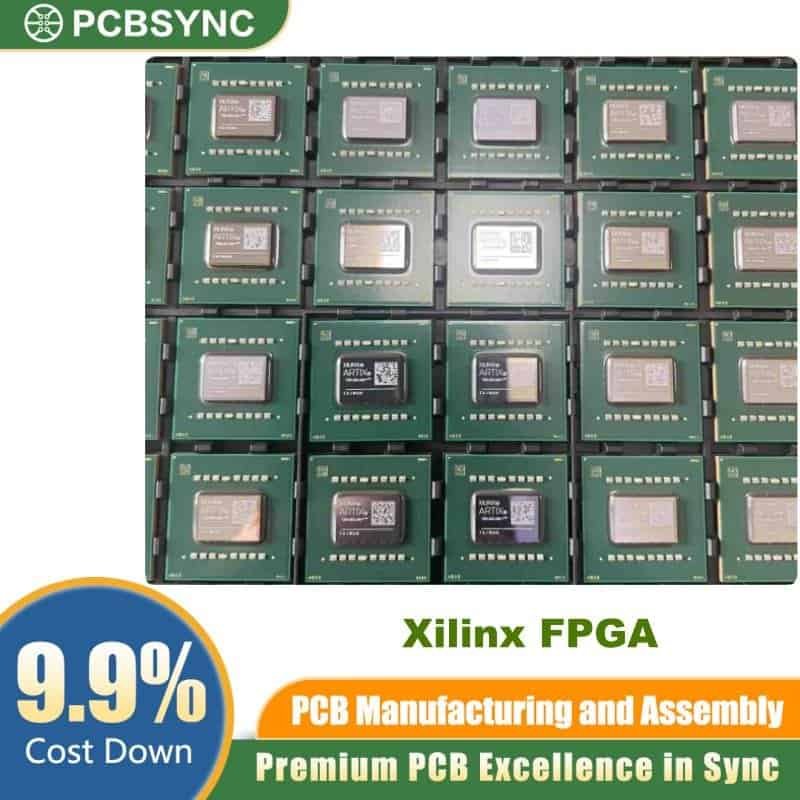
The XC2S200-6FGG1288C is a cornerstone of the Xilinx Spartan-II family, designed to provide a high-performance, cost-effective solution for logic integration. As a Field Programmable Gate Array (FPGA), it bridges the gap between high-density complex PLDs and expensive high-end FPGAs. This specific part number, the XC2S200-6FGG1288C, features 200,000 system gates and is optimized for volume-driven consumer electronics, industrial control systems, and telecommunications infrastructure.
By utilizing a 0.22µm/0.18µm CMOS process, the Spartan-II series offers a perfect balance of power efficiency and logic density. Below, we provide an in-depth technical analysis of this component, its architecture, and its primary use cases.
Key Features of the Spartan-II XC2S200-6FGG1288C
The XC2S200-6FGG1288C is engineered for versatility. Unlike traditional ASICs, this Xilinx FPGA offers the flexibility of field programmability, allowing engineers to update hardware logic even after the product has been deployed.
-
High Logic Density: With 5,292 logic cells and 200,000 system gates, it handles complex digital signal processing (DSP) and control logic with ease.
-
Speed Grade -6: This indicates the performance tier of the device, ensuring reliable timing closure for high-speed synchronous designs.
-
Flexible I/O Standards: Supports multiple voltage levels and signaling standards including LVTTL, LVCMOS, PCI, and GTL.
-
Abundant Block RAM: Features 56,216 bits of dedicated Block RAM, essential for buffering and data storage in high-throughput applications.
Technical Specifications and Parameters
For hardware designers and procurement specialists, understanding the precise electrical and physical parameters of the XC2S200-6FGG1288C is critical for PCB layout and power sequencing.
Table 1: Core Technical Parameters
| Parameter |
Specification |
| Product Series |
Spartan-II |
| Part Number |
XC2S200-6FGG1288C |
| System Gates |
200,000 |
| Logic Cells |
5,292 |
| CLB Array (Rows x Cols) |
28 x 42 |
| Total Block RAM Bits |
56,216 |
| Maximum User I/O |
284 (Package dependent) |
| Core Voltage (VCCINT) |
2.5V |
| I/O Voltage (VCCO) |
1.5V to 3.3V |
| Package Type |
FGG1288 (Fine-pitch BGA) |
| Operating Temperature |
0°C to +85°C (Commercial Grade) |
Internal Architecture and Logic Resources
The architecture of the XC2S200-6FGG1288C is based on the proven Virtex fabric, scaled for cost-sensitive applications. It consists of an inner matrix of Configurable Logic Blocks (CLBs) surrounded by a ring of programmable Input/Output Blocks (IOBs).
Configurable Logic Blocks (CLBs)
Each CLB in the XC2S200-6FGG1288C contains two slices. Each slice includes a 4-input Look-Up Table (LUT), carry logic, and storage elements (flip-flops). This structure allows for the efficient implementation of both combinatorial logic and registered synchronous circuits.
Block RAM and Memory Capabilities
One of the standout features of this FPGA is its dedicated Block RAM. Unlike Distributed RAM (which uses LUTs), Block RAM provides large, synchronous memory blocks that do not consume logic resources. This is vital for implementing FIFO buffers, circular queues, and small lookup tables for mathematical functions.
Table 2: Memory and Logic Resource Distribution
| Resource Type |
Quantity/Capacity |
Benefit |
| Typical Gates |
150,000 – 200,000 |
Sufficient for medium-scale SOC integration. |
| Distributed RAM Bits |
75,264 |
High-speed, localized memory for shift registers. |
| Dedicated Block RAM |
14 Blocks (4K bits each) |
Ideal for deep data buffering and packet processing. |
| Digital DLLs |
4 |
Provides precise clock management and deskewing. |
Applications of XC2S200-6FGG1288C in Modern Industry
While the Spartan-II family is a legacy series, the XC2S200-6FGG1288C remains highly relevant for maintenance, repair, and long-lifecycle industrial products. Its reliability and deterministic performance make it a preferred choice for:
-
Industrial Automation: Used in PLC (Programmable Logic Controller) modules for real-time motor control and sensor fusion.
-
Legacy System Support: Providing glue logic and interface conversion for older telecommunication protocols.
-
Medical Instrumentation: High-reliability processing for imaging equipment and patient monitoring systems.
-
Defense and Aerospace: Utilized in non-mission-critical subsystems that require stable, long-term component availability.
Design and Development Support
To implement a design using the XC2S200-6FGG1288C, developers typically use Xilinx ISE Design Suite. Although newer Xilinx FPGAs utilize the Vivado Design Suite, the Spartan-II series is fully supported by the classic ISE toolchain, which handles:
-
Synthesis: Converting VHDL or Verilog code into a netlist.
-
Place and Route (PAR): Mapping the logic onto the physical CLB resources of the XC2S200.
-
Bitstream Generation: Creating the configuration file used to program the FPGA via JTAG or PROM.
Power Management and PCB Layout
Designing with the XC2S200-6FGG1288C requires careful attention to power-on sequencing. The 2.5V core voltage (VCCINT) should ideally stabilize before the I/O voltage (VCCO) to ensure proper initialization of the internal configuration memory. Additionally, because the FGG1288 is a fine-pitch BGA package, high-density interconnect (HDI) PCB design techniques are recommended to manage the escape routing for the high number of I/O pins.
Conclusion: Why Choose the XC2S200-6FGG1288C?
The XC2S200-6FGG1288C represents a mature, stable, and highly predictable silicon platform. For projects where cost is a primary driver and logic requirements do not necessitate the extreme performance of the Kintex or Virtex lines, this Spartan-II FPGA remains an excellent candidate. Its combination of 200k gates, dedicated Block RAM, and robust I/O flexibility ensures it can meet the demands of diverse digital design challenges.