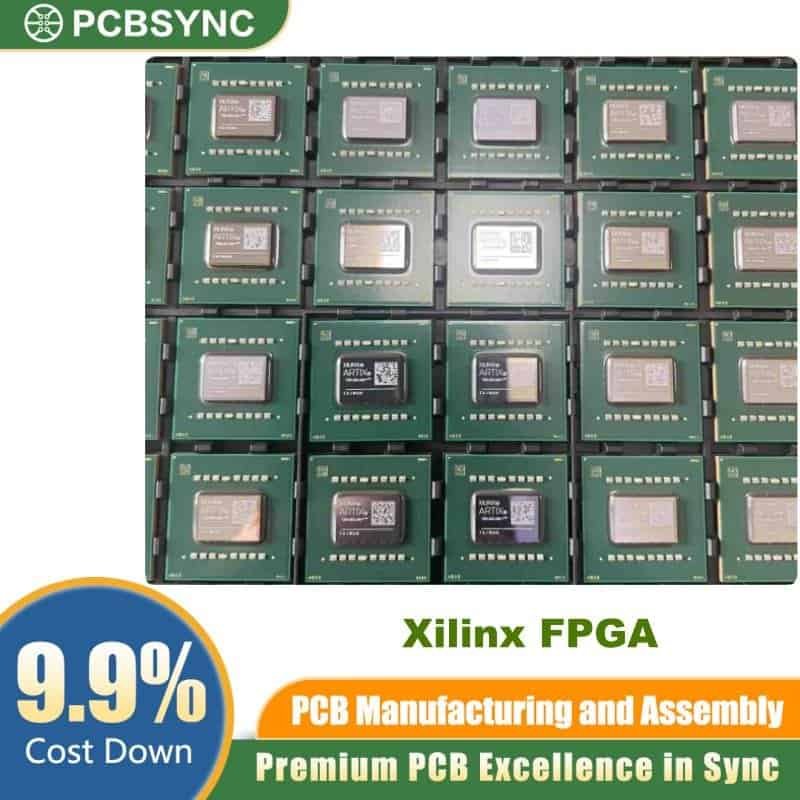
The XC2S200-6FGG1259C is a high-density, commercially graded Field Programmable Gate Array (FPGA) from the Xilinx Spartan-II family. Featuring 200,000 system gates, 5,292 logic cells, and a massive 1,259-ball Fine-Pitch BGA (FGG) package, this device delivers exceptional logic density and I/O flexibility for demanding digital design applications. Whether you are developing telecommunications equipment, industrial automation systems, or advanced signal processing solutions, the XC2S200-6FGG1259C offers the programmable performance and cost efficiency engineers rely on.
What Is the XC2S200-6FGG1259C? A Complete Overview
The XC2S200-6FGG1259C is part of AMD Xilinx’s Spartan-II FPGA series — a family engineered as a cost-optimized, high-performance alternative to traditional mask-programmed ASICs. The part number breaks down as follows:
| Part Number Segment |
Meaning |
| XC2S200 |
Spartan-II family, 200,000 system gates |
| -6 |
Speed grade -6 (Commercial, fastest in family) |
| FGG |
Fine-Pitch Ball Grid Array package (Pb-free “G” suffix) |
| 1259 |
1,259 total ball count |
| C |
Commercial temperature range (0°C to +85°C) |
For engineers looking for a broader selection of programmable logic devices, explore the full range of Xilinx FPGA products available.
XC2S200-6FGG1259C Key Specifications at a Glance
| Parameter |
Value |
| Manufacturer |
AMD Xilinx |
| Series |
Spartan-II |
| Part Number |
XC2S200-6FGG1259C |
| System Gates |
200,000 |
| Logic Cells |
5,292 |
| CLB Array |
28 × 42 |
| Total CLBs |
1,176 |
| Max User I/O |
284 |
| Distributed RAM |
75,264 bits |
| Block RAM |
56K bits (56,000 bits) |
| Speed Grade |
-6 (Fastest available) |
| Core Supply Voltage |
2.5V |
| Technology Node |
0.18 µm |
| Max Clock Frequency |
263 MHz |
| Package |
FGG1259 (Fine-Pitch BGA, Pb-free) |
| Ball Count |
1,259 |
| Temperature Range |
Commercial: 0°C to +85°C |
| RoHS Compliance |
Pb-free (G designation) |
Spartan-II Family Comparison: Where Does the XC2S200 Fit?
Understanding the XC2S200’s position within the Spartan-II family helps engineers make informed design choices. The table below compares all six family members:
| Device |
Logic Cells |
System Gates |
CLB Array |
Total CLBs |
Max User I/O |
Distributed RAM |
Block RAM |
| XC2S15 |
432 |
15,000 |
8×12 |
96 |
86 |
6,144 bits |
16K |
| XC2S30 |
972 |
30,000 |
12×18 |
216 |
92 |
13,824 bits |
24K |
| XC2S50 |
1,728 |
50,000 |
16×24 |
384 |
176 |
24,576 bits |
32K |
| XC2S100 |
2,700 |
100,000 |
20×30 |
600 |
176 |
38,400 bits |
40K |
| XC2S150 |
3,888 |
150,000 |
24×36 |
864 |
260 |
55,296 bits |
48K |
| XC2S200 |
5,292 |
200,000 |
28×42 |
1,176 |
284 |
75,264 bits |
56K |
The XC2S200 is the largest and most capable device in the Spartan-II family, making the XC2S200-6FGG1259C the top choice when maximum logic density and I/O count are required within this product line.
Core Architecture & Internal Features
H3: Configurable Logic Blocks (CLBs)
The XC2S200-6FGG1259C contains 1,176 Configurable Logic Blocks arranged in a 28×42 grid. Each CLB includes Look-Up Tables (LUTs), flip-flops, and multiplexers, enabling flexible implementation of any combinatorial or sequential digital logic function. The LUT-based architecture supports fast and efficient synthesis of complex Boolean expressions.
H3: Block RAM Architecture
With 56K bits of dual-port block RAM, the XC2S200-6FGG1259C provides high-speed, on-chip data storage. Block RAM is organized in two columns on opposite sides of the die, enabling efficient access for buffering, FIFO queues, lookup tables, and co-processor data storage. This is critical for applications requiring rapid data throughput without relying on slower external memory.
H3: Distributed RAM
Beyond block RAM, the device offers 75,264 bits of distributed RAM embedded within the CLB array. Distributed RAM is synthesized from LUTs and is ideal for small, latency-sensitive data structures that need to be distributed throughout the logic fabric.
H3: Delay-Locked Loops (DLLs)
The XC2S200-6FGG1259C features four Delay-Locked Loops (DLLs), one positioned at each corner of the die. DLLs enable:
- Clock deskewing to eliminate clock distribution delays
- Frequency synthesis to generate clock multiples or sub-multiples
- Phase shifting for precise multi-clock domain designs
H3: Input/Output Blocks (IOBs)
With up to 284 user-configurable I/O pins, the XC2S200-6FGG1259C supports a wide variety of single-ended and differential I/O standards including LVTTL, LVCMOS, GTL, SSTL, and more. The large 1,259-ball FGG package maximizes the available I/O for board-level integration in dense, multi-interface designs.
Configuration Modes
The XC2S200-6FGG1259C supports four standard configuration modes, giving designers flexibility in how the FPGA loads its bitstream at power-up:
| Configuration Mode |
M0 |
M1 |
M2 |
CCLK Direction |
Data Width |
Serial DOUT |
| Master Serial |
0 |
0 |
0 |
Output |
1-bit |
Yes |
| Slave Parallel |
0 |
1 |
0 |
Input |
8-bit |
No |
| Boundary-Scan (JTAG) |
1 |
0 |
0 |
N/A |
1-bit |
No |
| Slave Serial |
1 |
1 |
0 |
Input |
1-bit |
Yes |
Note: During power-on and throughout configuration, all I/O drivers remain in a high-impedance state to protect connected circuitry.
Speed Grade -6: What It Means for Your Design
The -6 speed grade is the fastest available in the Spartan-II family and is exclusively offered in the Commercial temperature range. Key performance advantages of the -6 speed grade include:
- Maximum system operating frequency up to 263 MHz
- Shorter setup and hold times for high-speed synchronous designs
- Reduced clock-to-output propagation delays on I/O pins
- Optimized for performance-critical datapaths in communications and DSP
When timing margins are tight and your design demands the maximum throughput the XC2S200 architecture can deliver, the -6 speed grade is the definitive choice.
FGG1259 Package: Why Pin Count Matters
The FGG1259 Fine-Pitch Ball Grid Array package sets this variant apart from other XC2S200 configurations. Compared to smaller packages like the FG256 or FGG456:
| Package |
Ball Count |
Max User I/O |
Typical Application |
| FG256 |
256 |
176 |
Compact/space-constrained boards |
| FGG456 |
456 |
284 |
Mid-density I/O designs |
| FGG1259 |
1,259 |
284 |
High I/O density, complex multi-bus designs |
The FGG1259 package uses a fine-pitch BGA footprint that enables more signal routing channels on a PCB and is the preferred choice for high-pin-count system-on-board (SoB) designs. The “G” suffix confirms Pb-free (RoHS-compliant) packaging, aligning with modern environmental and regulatory requirements.
XC2S200-6FGG1259C Applications & Use Cases
H3: Communications & Networking
The XC2S200-6FGG1259C’s high gate count and fast DLLs make it well-suited for implementing network routers, line cards, protocol converters, and high-speed serial/parallel interface bridges. It handles complex data framing, protocol state machines, and high-bandwidth FIFO buffering with ease.
H3: Industrial Automation & Control
In industrial environments, this FPGA enables the deterministic, real-time execution of motor control algorithms, machine vision pre-processing, fieldbus protocol (CAN, Profibus, EtherCAT) implementation, and safety-critical PLC logic — tasks where timing precision is non-negotiable.
H3: Signal Processing & DSP Applications
The combination of distributed RAM, block RAM, and high CLB density allows efficient implementation of FIR/IIR filters, FFT engines, correlation engines, and custom arithmetic datapaths for radar, sonar, and software-defined radio (SDR) front-ends.
H3: Medical & Instrumentation Equipment
Medical imaging systems, diagnostic analyzers, patient monitoring equipment, and laboratory instruments benefit from the XC2S200’s reconfigurability, allowing firmware updates to add features or correct issues without hardware redesign — a significant advantage over fixed-function ASICs.
H3: Aerospace & Defense
The Spartan-II architecture’s proven reliability and design flexibility make the XC2S200-6FGG1259C a practical choice for test & measurement equipment, avionics interface cards, and signal acquisition hardware. (Note: for radiation-tolerant applications, evaluate appropriate hardened alternatives.)
Ordering Information & Part Number Decoder
| Field |
Code |
Description |
| Device |
XC2S200 |
Spartan-II, 200K gates |
| Speed Grade |
6 |
Fastest commercial grade |
| Package Type |
FGG |
Fine-Pitch BGA, Pb-free |
| Pin Count |
1259 |
1,259 solder balls |
| Temperature |
C |
Commercial (0°C – +85°C) |
| Full Part Number |
XC2S200-6FGG1259C |
Complete ordering code |
Design Tool Support
The XC2S200-6FGG1259C is supported by the Xilinx ISE Design Suite — the primary design environment for legacy Spartan-II devices. The workflow covers:
- HDL Entry: VHDL or Verilog RTL design
- Synthesis: XST (Xilinx Synthesis Technology)
- Implementation: Translate, Map, Place & Route
- Timing Analysis: Static timing analysis with timing constraints
- Bitstream Generation: Configuration file creation for all supported modes
- Programming: iMPACT programmer for JTAG and other configuration methods
Designers migrating from the XC2S200 to newer Xilinx families (e.g., Spartan-6, Artix-7) should use the Vivado Design Suite for those target devices.
Frequently Asked Questions (FAQ)
H4: What is the maximum operating frequency of the XC2S200-6FGG1259C?
The XC2S200-6FGG1259C supports a maximum system clock frequency of 263 MHz at the -6 speed grade, making it the fastest variant in the Spartan-II XC2S200 lineup.
H4: Is the XC2S200-6FGG1259C RoHS compliant?
Yes. The “G” in the FGG package designation confirms this is a Pb-free, RoHS-compliant component.
H4: What temperature range does the XC2S200-6FGG1259C support?
The “C” suffix designates the Commercial temperature range: 0°C to +85°C. Note that the -6 speed grade is only available in the Commercial range. For industrial temperature (-40°C to +85°C) designs, the -5 or -4 speed grades in the XC2S200 family should be considered.
H4: How does the XC2S200-6FGG1259C compare to the XC2S200-6FGG456C?
Both devices use the same XC2S200 die with identical logic resources and speed grade. The key difference is the package: the FGG456 has 456 balls, while the FGG1259 has 1,259 balls. The larger FGG1259 package provides more PCB routing flexibility and is preferred for highly integrated, multi-interface board designs.
H4: What configuration PROM is compatible with the XC2S200-6FGG1259C?
Xilinx XCF (Platform Flash) PROMs and XC18V series serial PROMs are commonly used to configure the XC2S200 in Master Serial mode. Consult the Xilinx XAPP notes and datasheets for specific PROM sizing based on your bitstream length (1,335,840 configuration bits for the XC2S200).
Summary: Why Choose the XC2S200-6FGG1259C?
The XC2S200-6FGG1259C delivers a compelling combination of logic density, memory resources, I/O flexibility, and high-speed performance in a Pb-free, production-proven package. It represents the pinnacle of the Spartan-II family — a trusted platform for engineers who need reliable, reprogrammable logic at a competitive cost point. Its 200,000 system gates, 284 user I/O pins, four DLLs, and 263 MHz maximum clock frequency make it a versatile choice for communications, industrial, medical, and instrumentation applications worldwide.