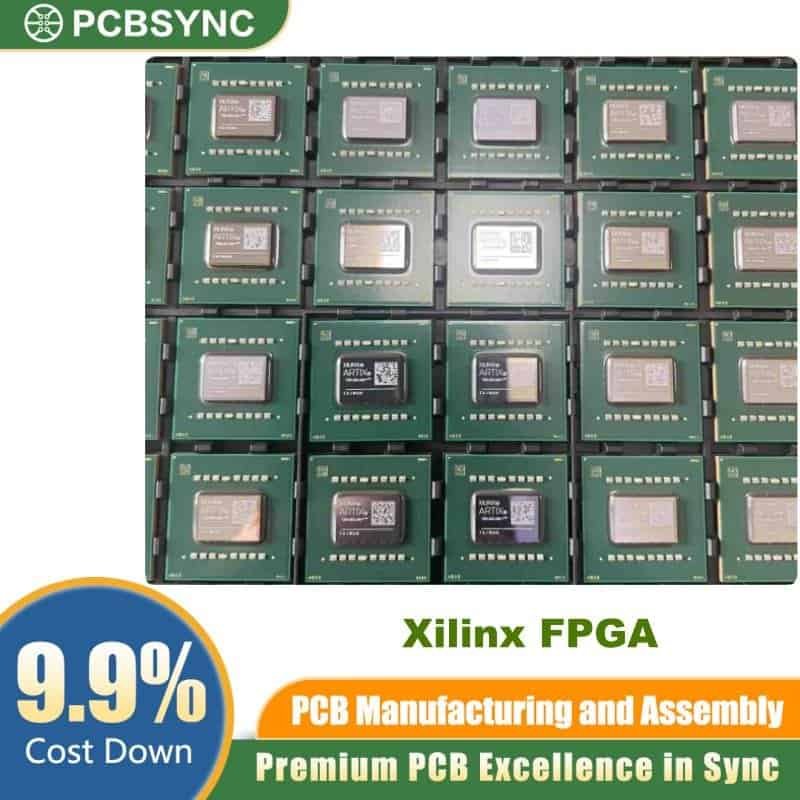
The XC7VX690T-1FFG1157C is a high-performance Field Programmable Gate Array (FPGA) from Xilinx’s Virtex-7 XT family, now under AMD. Built on a 28nm High-K Metal Gate (HKMG) process technology, this device delivers exceptional logic density, ultra-fast serial connectivity, and massive DSP throughput — making it one of the most capable commercial FPGAs available for demanding applications in networking, high-performance computing, and signal processing.
Whether you are designing next-generation data center hardware, advanced communications systems, or high-reliability military-grade electronics, the XC7VX690T-1FFG1157C offers the programmable logic capacity and I/O bandwidth to meet the challenge.
What Is the XC7VX690T-1FFG1157C?
The XC7VX690T-1FFG1157C is a member of the Xilinx FPGA Virtex-7 XT family — the highest-performance tier of the 7-series FPGA product line. It integrates 693,120 logic cells within a 1157-pin Fine-Pitch Ball Grid Array (FCBGA) package, enabling complex, large-scale digital designs without the time-to-market delays of ASIC development.
The “1” in the part number denotes the commercial speed grade (-1), while “FF1157” refers to the 1157-pin FCBGA package, and “C” indicates a commercial temperature range (0°C to 85°C junction temperature).
XC7VX690T-1FFG1157C Key Specifications
General Product Overview
| Parameter |
Value |
| Manufacturer |
AMD Xilinx |
| Series |
Virtex-7 XT |
| Part Number |
XC7VX690T-1FFG1157C |
| Technology Node |
28nm HKMG |
| Logic Cells |
693,120 |
| Package |
1157-Pin FCBGA (1156-BBGA) |
| Mounting Type |
Surface Mount |
| RoHS Status |
RoHS3 Compliant |
| Product Status |
Active |
| Packaging |
Tray |
Logic and Fabric Resources
| Resource |
Quantity |
| Logic Cells |
693,120 |
| CLBs (Configurable Logic Blocks) |
54,150 |
| LUT6 (6-Input Look-Up Tables) |
433,200 |
| Flip-Flops |
866,400 |
| Max Distributed RAM |
10,888 Kb |
The XC7VX690T-1FFG1157C uses true 6-input LUT (LUT6) technology, configurable as distributed memory. This architecture enables higher logic utilization and more efficient mapping compared to older 4-input LUT families.
Memory Resources
| Memory Type |
Specification |
| Block RAM (BRAM) |
52,920 Kb total |
| 36Kb Dual-Port Block RAM tiles |
1,470 |
| 18Kb Block RAM (derived) |
2,940 |
| Built-in FIFO Logic |
Yes |
Each 36Kb dual-port block RAM tile supports built-in FIFO logic, making on-chip data buffering highly efficient without consuming additional fabric resources.
DSP Performance
| DSP Parameter |
Value |
| DSP48E1 Slices |
3,600 |
| DSP Throughput |
4.7 TMAC/s |
| Max Clock Rate |
710 MHz |
With 3,600 DSP48E1 slices, the XC7VX690T-1FFG1157C delivers 4.7 TMAC/s (Tera Multiply-Accumulate Operations per Second) — ideal for applications such as FFT engines, FIR filters, radar signal processing, and machine learning inference pipelines.
I/O and Connectivity
| I/O Parameter |
Value |
| User I/O Pins |
600 |
| Max I/O Bandwidth |
1.4 Tb/s |
| SelectIO Standards Supported |
LVCMOS, LVDS, SSTL, HSTL, and more |
| DDR3 Support |
Up to 1,866 Mb/s |
| High-Speed Serial (GTX) Transceivers |
20 |
| Transceiver Speed Range |
600 Mb/s – 6.6 Gb/s (up to 11.3 Gb/s) |
| Transceiver Low-Power Mode |
Yes (chip-to-chip optimized) |
| PCIe Blocks |
1x Gen3 x8 |
The device supports SelectIO technology compatible with DDR3 interfaces at up to 1,866 Mb/s, along with 20 GTX multi-gigabit transceivers spanning a wide bandwidth range.
Power and Electrical Characteristics
| Electrical Parameter |
Value |
| Core Supply Voltage (VCCINT) |
0.97V – 1.03V (nominal 1.0V) |
| I/O Supply Voltage |
Up to 3.3V |
| Operating Temperature |
0°C – 85°C (TJ) |
| Power Reduction vs. Prior Generation |
~50% |
The 28nm HPL (High-Performance Low-Power) process allows the XC7VX690T-1FFG1157C to deliver flagship performance while consuming approximately 50% less power than previous-generation Virtex-6 FPGAs, making it suitable for power-constrained system designs.
Clock Management
| Clock Resource |
Quantity |
| MMCMs (Mixed-Mode Clock Managers) |
14 |
| PLLs (Phase-Locked Loops) |
14 |
| Global Clock Buffers |
32 |
| Regional Clock Buffers |
28 |
Fourteen MMCMs and fourteen PLLs provide highly flexible, low-jitter clock generation, multiplication, and deskewing for even the most timing-critical designs.
Analog and Monitoring
| Analog Feature |
Detail |
| XADC (Xilinx Analog-to-Digital Converter) |
Dual 12-bit, 1 MSPS |
| On-chip Sensors |
Temperature + Supply Voltage |
| External Analog Inputs |
Yes (up to 17 auxiliary channels) |
The user-configurable XADC block incorporates dual 12-bit 1 MSPS ADCs with on-chip thermal and supply sensors, enabling built-in system health monitoring without external components.
XC7VX690T-1FFG1157C Part Number Decoder
Understanding the part number helps engineers quickly identify the correct variant for their design:
| Field |
Code |
Meaning |
| Family |
XC7VX |
Virtex-7 XT |
| Logic Density |
690T |
~693K logic cells |
| Speed Grade |
-1 |
Commercial (slowest, most power-efficient) |
| Package Type |
FF |
Fine-Pitch Ball Grid Array (FCBGA) |
| Pin Count |
1157 |
1157 total balls |
| Temperature Grade |
C |
Commercial (0°C – 85°C TJ) |
Note on Part Numbering: The DigiKey listing uses the alternate notation XC7VX690T-1FFG1157C (with “G”), which refers to the same device as the base marking XC7VX690T-1FF1157C. Both designations refer to the same physical part in a 1157-ball FCBGA package.
Virtex-7 XT Family: Where Does the XC7VX690T Fit?
The Virtex-7 XT family is Xilinx’s high-bandwidth, transceiver-optimized 7-series tier. The XC7VX690T sits in the mid-to-upper range of this lineup:
| Device |
Logic Cells |
GTX Transceivers |
Package Options |
| XC7VX415T |
415,200 |
20 |
FCBGA |
| XC7VX485T |
485,760 |
20 |
FCBGA |
| XC7VX550T |
554,240 |
20 |
FCBGA |
| XC7VX690T |
693,120 |
20 |
FCBGA |
| XC7VX980T |
979,200 |
36 |
FCBGA |
The XC7VX690T-1FFG1157C offers the best balance of logic capacity, transceiver count, and package size for systems that need high throughput without moving up to the largest and most expensive 980T devices.
Key Features and Technical Highlights
Advanced 6-Input LUT Architecture
The Virtex-7 architecture uses true 6-input LUT technology, which can be configured as distributed RAM or shift registers. This results in significantly better performance per slice compared to 4-input LUT architectures, enabling denser designs with fewer routing delays.
High-Speed Serial Connectivity with GTX Transceivers
The XC7VX690T-1FFG1157C integrates 20 GTX multi-gigabit transceivers capable of operating from 600 Mb/s up to 6.6 Gb/s, with maximum rates reaching 11.3 Gb/s in extended modes. A dedicated low-power mode is optimized for high-density chip-to-chip links, helping system designers manage thermal budgets in tightly packed PCBs.
Supported serial protocols include: PCIe Gen3, SATA, Ethernet (1G/10G/40G/100G), Interlaken, Aurora, CPRI, JESD204B, and custom high-speed links.
DDR3 Memory Interface Support
The SelectIO interface fabric supports DDR3 memory at up to 1,866 Mb/s, with built-in primitives for write leveling and read data capture, simplifying compliance with DDR3 electrical standards.
Integrated PCIe Gen3 Hard Block
A hard PCIe Gen3 x8 block is embedded in the device, enabling direct connection to CPU systems, NVMe storage, and PCIe-based expansion without consuming programmable fabric resources.
XADC: On-Chip Analog Monitoring
The XADC (Xtreme Analog-to-Digital Converter) provides a dual 12-bit 1 MSPS analog measurement system directly inside the FPGA. It can monitor up to 17 external analog channels in addition to on-chip temperature and supply rail sensors — enabling active thermal management and power regulation in closed-loop designs.
28nm HKMG Process Technology
Built on 28nm High-K Metal Gate (HKMG) process technology, the XC7VX690T-1FFG1157C achieves the highest performance in the 7-series while significantly reducing static and dynamic power consumption. The result is approximately 50% lower power than the previous-generation Virtex-6 FPGAs.
Supported Applications
The XC7VX690T-1FFG1157C is well-suited for the following demanding application domains:
| Application Area |
Use Case Examples |
| High-Performance Computing |
FPGA accelerators, HPC co-processors |
| Networking & Communications |
40G/100G packet processing, optical transport, routing |
| Defense & Aerospace |
Radar processing, EW systems, secure communications |
| Scientific Instrumentation |
High-speed data acquisition, test & measurement |
| Financial Technology |
Ultra-low latency trading, market data processing |
| Broadcast & Video |
4K/8K video processing, broadcast infrastructure |
| Medical Imaging |
CT, MRI, ultrasound signal processing |
| Oil & Gas |
Seismic data processing, downhole electronics |
Development Tools and Design Flow
Xilinx/AMD recommends the following toolchain for designing with the XC7VX690T-1FFG1157C:
| Tool |
Purpose |
| Vivado Design Suite |
Synthesis, implementation, bitstream generation |
| Vivado IP Integrator |
Block-level design entry with IP cores |
| Vivado Simulator |
RTL and post-implementation simulation |
| ChipScope Pro / ILA |
On-chip debug and signal monitoring |
| SDK / Vitis |
Embedded software development (if using MicroBlaze) |
Vivado Design Suite is the primary tool for the 7-series device family and provides full support for the XC7VX690T-1FFG1157C, including timing closure, power analysis, and bitstream generation.
Ordering Information
| Parameter |
Value |
| Manufacturer Part Number |
XC7VX690T-1FFG1157C |
| Alternate PN |
XC7VX690T-1FF1157C |
| Manufacturer |
AMD Xilinx |
| Packaging |
Tray |
| Typical Lead Time |
~40 weeks (order early) |
| RoHS Compliance |
Yes – RoHS3 |
| Export Classification |
ECCN applies – check for your region |
Procurement Note: Due to the complexity and specialized nature of this device, lead times can vary significantly. It is strongly recommended to engage authorized distributors or specialized FPGA suppliers with verified stock, especially for volume orders.
Frequently Asked Questions
Q: What is the difference between XC7VX690T-1FFG1157C and XC7VX690T-2FFG1157C? The only difference is the speed grade. The “-1” variant is the standard commercial speed grade (lower maximum frequency, slightly lower power), while the “-2” variant achieves higher operating frequencies. Both devices share the same logic resources, package, and temperature range.
Q: Is the XC7VX690T-1FFG1157C RoHS compliant? Yes. The device is RoHS3 compliant and uses lead-free ball grid array solder balls.
Q: What package is used for the XC7VX690T-1FFG1157C? It uses a 1157-pin Fine-Pitch Chip Ball Grid Array (FCBGA), also listed as 1156-BBGA in some documentation. The package pitch is 1.0mm.
Q: Can the XC7VX690T-1FFG1157C be used for industrial temperature applications? The “C” suffix indicates commercial temperature range (0°C to 85°C TJ). For industrial or extended temperature ranges, look for the “I” suffix variants (e.g., XC7VX690T-1FF1157I).
Q: What programming file format does the XC7VX690T-1FFG1157C use? The device is programmed using a bitstream file (.bit) generated by Vivado. For production, devices are typically programmed via JTAG or through a configuration memory device (SPI/BPI flash).
Summary
The XC7VX690T-1FFG1157C represents one of Xilinx’s most capable mid-to-high-end commercial FPGAs in the Virtex-7 XT family. With 693,120 logic cells, 3,600 DSP slices, 52,920 Kb of block RAM, 20 GTX transceivers, and a 28nm HKMG process, it delivers the logic density, bandwidth, and processing power required for the most demanding FPGA applications — while cutting power consumption in half compared to prior generations.
Its 1157-pin FCBGA package provides 600 user I/Os with full support for DDR3, high-speed serial, and analog monitoring, making it a versatile platform for high-performance computing, networking, defense, and scientific applications.