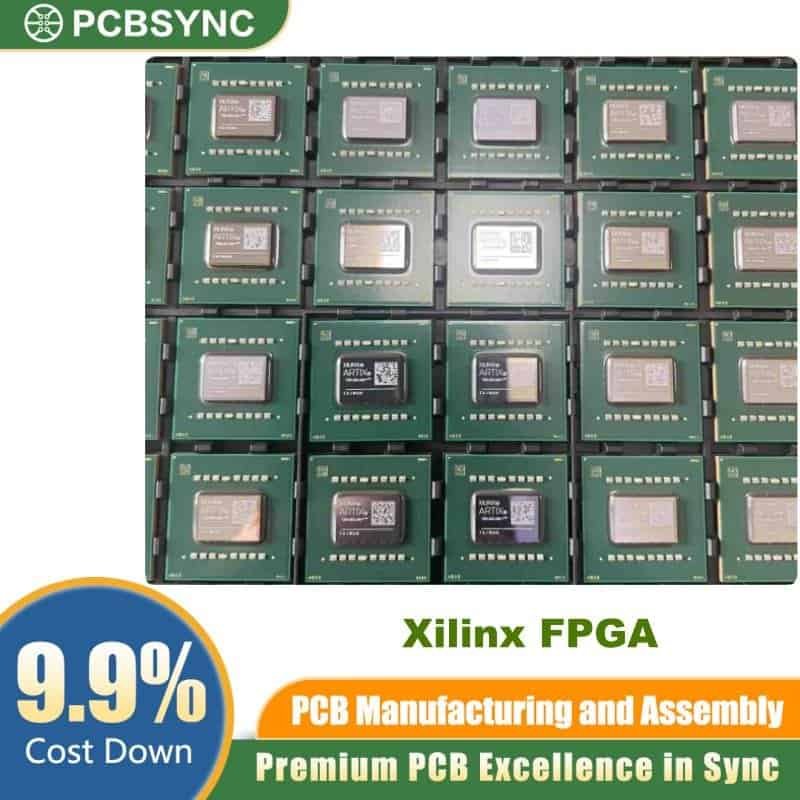
The XC7VX690T-L2FFG1930E is a high-performance, low-power Xilinx FPGA from AMD’s Virtex-7 XT family. Built on an advanced 28nm high-k metal gate (HKMG) process technology, this device delivers exceptional logic density, DSP throughput, and I/O bandwidth — making it an ideal choice for signal processing, high-speed networking, and demanding embedded applications.
This product description covers everything engineers and procurement teams need to know: part number decoding, full technical specifications, key features, application use cases, and ordering information.
What Is the XC7VX690T-L2FFG1930E?
The XC7VX690T-L2FFG1930E is a member of the Virtex-7 XT (Extended Transceiver) FPGA family from Xilinx (now AMD). The “XT” designation indicates this device is optimized for high-speed serial connectivity, featuring GTX and GTH transceivers capable of reaching up to 11.3 Gb/s per channel.
The “L2” speed grade denotes a low-power variant of the -2 speed grade, balancing performance with power efficiency. This makes the XC7VX690T-L2FFG1930E particularly attractive for power-sensitive deployments such as telecommunications infrastructure, aerospace systems, and high-density computing platforms.
Part Number Breakdown
Understanding the part number helps engineers quickly identify the exact device characteristics:
| Field |
Value |
Meaning |
| XC |
XC |
Xilinx Commercial |
| 7V |
7V |
7 Series, Virtex Family |
| X |
X |
XT (Extended Transceiver) Sub-Family |
| 690T |
690T |
Density/Configuration (693,120 Logic Cells) |
| L2 |
L2 |
Low-Power Speed Grade (-2 equivalent) |
| FFG |
FFG |
Flip-Chip Fine-Pitch BGA Package |
| 1930 |
1930 |
1930-pin Package |
| E |
E |
Extended Temperature Range (0°C to +100°C) |
Key Technical Specifications
Core Logic Resources
| Parameter |
Value |
| FPGA Family |
Virtex-7 XT |
| Logic Cells |
693,120 |
| Configurable Logic Blocks (CLBs) |
108,300 |
| LUT6 Elements |
433,200 |
| Flip-Flops |
866,400 |
| Process Node |
28nm HPL (High-Performance Low-Power) |
| Core Voltage (VCCINT) |
0.97V – 1.03V |
Memory Resources
| Parameter |
Value |
| Block RAM (36Kb each) |
1,470 |
| Total Block RAM |
52,920 Kbits |
| Distributed RAM |
Configurable via LUTs |
| FIFO Support |
Built-in FIFO logic in each Block RAM |
DSP Performance
| Parameter |
Value |
| DSP48E1 Slices |
3,600 |
| Peak DSP Performance |
4.7 TMAC/s |
| DSP Arithmetic Width |
25×18 multiplier with 48-bit accumulator |
I/O and Connectivity
| Parameter |
Value |
| Maximum User I/O |
1,000 |
| Package Pins |
1,930 (FCBGA) |
| SelectIO Standards Supported |
LVDS, SSTL, HSTL, LVCMOS, and more |
| DDR3 Interface Support |
Up to 1,866 Mb/s |
| I/O Bandwidth |
Up to 1.4 Tb/s |
High-Speed Serial Transceivers
| Parameter |
Value |
| GTX Transceivers |
80 |
| GTH Transceivers |
0 (GTX-only variant) |
| Transceiver Speed Range |
600 Mb/s to 11.3 Gb/s |
| Low-Power Mode |
Yes (optimized for chip-to-chip links) |
Clocking
| Parameter |
Value |
| CMT (Clock Management Tiles) |
14 |
| MMCMs per CMT |
1 |
| PLLs per CMT |
1 |
| Maximum Clock Frequency |
710 MHz (fabric) |
Package and Physical Characteristics
| Parameter |
Value |
| Package Type |
FCBGA (Flip-Chip Ball Grid Array) |
| Package Code |
FFG1930 |
| Pin Count |
1,930 |
| Temperature Grade |
E (Extended: 0°C to +100°C) |
| RoHS Compliance |
Yes |
| Pb-Free |
Yes |
XC7VX690T-L2FFG1930E vs. Similar Speed Grades
Engineers often compare the L2, -2, and -3 speed grades. Here’s a quick comparison:
| Part Number |
Speed Grade |
Temperature |
Use Case |
| XC7VX690T-L2FFG1930E |
L2 (Low-Power -2) |
Extended (E) |
Power-sensitive systems |
| XC7VX690T-2FFG1930C |
-2 (Standard) |
Commercial (C) |
General commercial use |
| XC7VX690T-3FFG1930E |
-3 (Fastest) |
Extended (E) |
Maximum performance apps |
| XC7VX690T-1FFG1930I |
-1 (Economy) |
Industrial (I) |
Cost-sensitive industrial |
Top Features of the XC7VX690T-L2FFG1930E
Advanced 6-Input LUT Architecture
The device uses real 6-input Look-Up Tables (LUT6) configurable as distributed memory, enabling compact, high-speed logic implementations that reduce routing overhead compared to older 4-LUT architectures.
High-Speed GTX Transceivers
With 80 GTX transceivers capable of operating from 600 Mb/s up to 11.3 Gb/s, the XC7VX690T-L2FFG1930E can handle demanding serial protocols including PCIe, 10G/40G/100G Ethernet, Interlaken, OTN, and CPRI/OBSAI in wireless backhaul applications.
Integrated PCIe Interface Block
The device includes a hardened PCIe Gen 3 x8 interface block, reducing resource utilization and design complexity when interfacing with host CPUs and SSD controllers.
XADC Analog Interface
An on-chip Xilinx Analog-to-Digital Converter (XADC) provides dual 12-bit, 1 MSPS ADC channels with integrated thermal and voltage supply sensors — enabling real-time system health monitoring without external components.
Low-Power “L2” Operation
The “L2” speed grade is engineered to deliver the same switching performance as a standard -2 device while consuming significantly less static and dynamic power — a key advantage in deployments where thermal management and power budgets are tightly constrained.
SSI (Stacked Silicon Interconnect) Technology
The XC7VX690T family leverages AMD’s Stacked Silicon Interconnect technology, which connects multiple silicon dies using a passive silicon interposer, enabling logic densities that exceed what is practical on a single die.
Supported I/O Standards
The XC7VX690T-L2FFG1930E supports a wide range of I/O voltage standards:
| Standard |
Voltage |
Application |
| LVCMOS33 |
3.3V |
General purpose logic |
| LVCMOS18 |
1.8V |
Low-power interfaces |
| LVDS |
1.2–1.8V |
High-speed differential |
| SSTL15 |
1.5V |
DDR3 memory interfaces |
| HSTL |
1.2–1.5V |
High-speed parallel buses |
| LVPECL |
2.5V |
Clock distribution |
Typical Applications
Wireless Base Station and LTE/5G Infrastructure
The combination of GTX transceivers and DSP density makes this device well-suited for CPRI/eCPRI fronthaul, baseband processing, and beamforming in 4G/5G radio equipment.
100G Optical Networking
With support for OTN (Optical Transport Network) and high-speed Ethernet line cards, the XC7VX690T-L2FFG1930E is widely used in data center switch fabrics and long-haul optical transport systems.
High-Performance Computing (HPC) Acceleration
The FPGA’s large DSP slice count and high memory bandwidth make it effective for accelerating financial analytics, genomics, AI inference, and matrix operations in HPC environments.
Military and Aerospace
The extended temperature range (E-grade) and high reliability of the Virtex-7 platform make it a strong fit for radar signal processing, electronic warfare, and satellite communication payloads.
Medical Imaging
High-speed data acquisition, real-time image reconstruction, and connectivity to sensor arrays make this FPGA suitable for CT, MRI, and ultrasound imaging systems.
Design Tool Support
The XC7VX690T-L2FFG1930E is fully supported by AMD’s Vivado Design Suite, which provides:
- Synthesis and place-and-route
- IP integrator for rapid subsystem assembly
- Timing closure and power analysis
- In-circuit debug via ILA (Integrated Logic Analyzer)
- High-Level Synthesis (HLS) for algorithm designers
Legacy designs using Xilinx ISE 14.7 are also supported.
Ordering Information
| Parameter |
Detail |
| Manufacturer |
AMD / Xilinx |
| Part Number |
XC7VX690T-L2FFG1930E |
| FPGA Family |
Virtex-7 XT |
| Package |
1930-pin FCBGA |
| Speed Grade |
L2 (Low-Power) |
| Temperature Range |
Extended (0°C to +100°C) |
| Lifecycle Status |
Active |
| Moisture Sensitivity Level (MSL) |
3 |
| Packaging |
Tray |
Frequently Asked Questions
Q: What is the difference between the XC7VX690T-L2FFG1930E and XC7VX690T-2FFG1930C? The L2 variant is a low-power version of the -2 speed grade intended for extended temperature range applications (0°C to +100°C). The -2C is a standard commercial grade device rated 0°C to +85°C. They share the same die and package but differ in validated operating conditions and power profiles.
Q: Is the XC7VX690T-L2FFG1930E pin-compatible with the XC7VX690T-2FFG1930C? Yes — both use the FFG1930 package, making them footprint-compatible for PCB design reuse.
Q: What transceiver protocols are natively supported? The GTX transceivers support PCIe Gen 3, 10GbE, CPRI, OTN (OTU2/OTU3), SATA/SAS, and custom serial protocols. Soft IP cores from AMD’s IP catalog expand support further.
Q: Which Vivado version should I use? AMD recommends using Vivado 2018.3 or later for best device support and IP compatibility with the Virtex-7 family.
Summary
The XC7VX690T-L2FFG1930E offers an exceptional balance of logic density, transceiver performance, DSP throughput, and power efficiency within the Virtex-7 XT family. Its 693,120 logic cells, 80 GTX transceivers (up to 11.3 Gb/s), 3,600 DSP slices, and 52,920 Kbits of block RAM make it one of the most capable mid-to-high-density FPGAs available in the 28nm generation. The L2 low-power speed grade and extended temperature rating further extend its suitability across a broad range of demanding applications, from wireless infrastructure and 100G networking to aerospace signal processing and HPC acceleration.