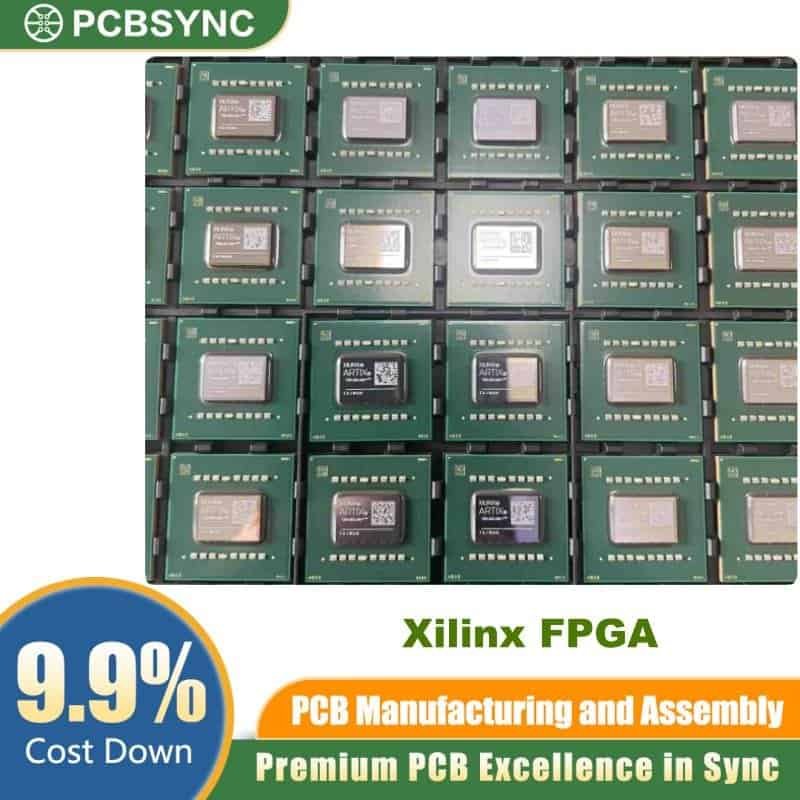
The XC7VX980T-2FFG1930C is a high-performance Field Programmable Gate Array (FPGA) from AMD’s Xilinx Virtex-7 XT family. Designed for demanding applications that require massive logic capacity, ultra-fast serial connectivity, and power efficiency, this device is a top choice for engineers working on 10G–100G networking, ASIC prototyping, portable radar, and compute-intensive signal processing systems.
Whether you are sourcing components for high-end industrial, communications, or defense-grade applications, the XC7VX980T-2FFG1930C delivers an exceptional balance of speed, density, and energy efficiency — all within a mature, well-supported design ecosystem.
What Is the XC7VX980T-2FFG1930C?
The XC7VX980T-2FFG1930C is part of the Virtex-7 XT Series, Xilinx’s flagship 7-Series FPGA family optimized for maximum system performance and integration at the 28nm node. The “XC7VX980T” designates the device type (980K logic cell capacity in the Virtex-7 family), while “2FFG1930C” identifies the speed grade (-2), package type (FFG / FCBGA), pin count (1930), and temperature grade (C = Commercial, 0°C to 85°C).
Built on a 28nm High-Performance Low-Power (HPL) process using High-K Metal Gate (HKMG) technology, this FPGA enables a 50% reduction in power consumption compared to previous Virtex-6 generation devices, while simultaneously delivering higher logic density and bandwidth.
For engineers requiring a proven programmable logic solution, Xilinx FPGA devices like the XC7VX980T-2FFG1930C remain among the most capable and supported options available on the market today.
XC7VX980T-2FFG1930C Key Specifications at a Glance
| Parameter |
Value |
| Manufacturer |
AMD (formerly Xilinx) |
| Part Number |
XC7VX980T-2FFG1930C |
| FPGA Family |
Virtex-7 XT |
| Number of Logic Cells |
979,200 |
| Number of Logic Blocks |
153,000 |
| User I/O Pins |
900 |
| Total RAM Bits |
54,000 Kbit (54 Mb) |
| Package Type |
1924-BBGA, FCBGA |
| Number of Pins |
1,930 |
| Speed Grade |
-2 |
| Maximum Operating Frequency |
710 MHz |
| Core Supply Voltage |
0.97V – 1.03V |
| I/O Supply Voltage |
Up to 3.3V |
| Operating Temperature |
0°C to 85°C (TJ) — Commercial Grade |
| Mounting Type |
Surface Mount |
| Clock Management |
MMCM, PLL |
| Process Node |
28nm HPL HKMG |
| RoHS Status |
RoHS3 Compliant |
| Product Status |
Active |
| Packaging |
Tray |
Detailed Technical Features of the XC7VX980T-2FFG1930C
Advanced 6-Input LUT Logic Architecture
At the heart of the XC7VX980T-2FFG1930C is Xilinx’s advanced 6-input Look-Up Table (LUT) architecture. Unlike earlier FPGA generations that relied on 4-input LUTs, the 6-input LUT enables more complex logic functions to be implemented in a single LUT cell, drastically reducing the number of routing stages and improving both speed and area efficiency. These LUTs are also configurable as distributed memory, making them highly flexible for data-path implementations where embedded RAM and logic are tightly interleaved.
High-Density Block RAM with FIFO Support
The device integrates an extensive array of 36 Kb dual-port block RAMs, each with built-in FIFO logic for on-chip data buffering. This is essential for high-speed data streaming and packet-processing applications. The total on-chip memory capacity reaches 54 Mb (54,000 Kbit), sufficient for large look-up tables, frame buffers, and deep FIFOs without requiring external memory access for many common data storage tasks.
High-Speed Serial Transceivers (GTX/GTH)
One of the most differentiated features of the XC7VX980T-2FFG1930C is its complement of multi-gigabit transceivers (MGTs). These transceivers support line rates ranging from 600 Mb/s up to 11.3 Gb/s (GTH variant), with a special low-power mode optimized for chip-to-chip links. This makes the device well-suited for:
- 10GbE / 40GbE / 100GbE network interfaces
- Serial RapidIO and Interlaken links
- JESD204B high-speed ADC/DAC interfaces
- PCIe Gen3 data fabric interconnects
Integrated PCIe Gen3 Hard Block
The XC7VX980T-2FFG1930C includes an integrated PCI Express (PCIe) block supporting up to x8 Gen3 Endpoint and Root Port configurations. Hardening this function in silicon rather than implementing it in fabric LUTs significantly reduces resource utilization and power, freeing up programmable logic for the actual application workload. This is especially valuable in embedded computing, FPGA-accelerated server, and test-and-measurement applications.
SelectIO Technology with DDR3 Support
The device’s 900 user I/O pins leverage Xilinx’s SelectIO technology, supporting a wide range of I/O standards including LVCMOS, LVDS, SSTL, HSTL, and others. Of particular importance is native support for DDR3 SDRAM interfaces at up to 1,866 Mb/s, enabling direct memory attachment for bandwidth-hungry applications without requiring external PHY chips. This translates to a total I/O bandwidth of 1.4 Tb/s across the device.
DSP Performance: 4.7 TMAC/s
The device integrates a large number of DSP48E1 slices, delivering a peak DSP throughput of 4.7 TMAC/s (Tera Multiply-Accumulate operations per second). This makes the XC7VX980T-2FFG1930C highly attractive for digital signal processing pipelines including FIR/IIR filters, FFT engines, radar signal processing chains, and machine learning inference accelerators.
Clock Management: MMCM and PLL
The device provides comprehensive clock management resources through Mixed-Mode Clock Managers (MMCMs) and Phase-Locked Loops (PLLs). These resources allow designers to derive multiple precisely-phased clock domains from a reference input, filter clock jitter, and synthesize frequencies not directly available from the board’s oscillators. This is critical in multi-protocol systems that must interface with different clock domains simultaneously.
XC7VX980T-2FFG1930C Performance Summary
| Performance Metric |
Value |
| Logic Cell Capacity |
979,200 cells |
| Total I/O Bandwidth |
1.4 Tb/s |
| Peak DSP Throughput |
4.7 TMAC/s |
| Max Serial Transceiver Line Rate |
Up to 11.3 Gb/s |
| Max DDR3 Interface Speed |
1,866 Mb/s |
| Max Operating Frequency |
710 MHz |
| Block RAM Capacity |
54 Mb |
| PCIe Support |
Up to x8 Gen3 |
| Power vs. Previous Generation |
~50% reduction |
Package Information: 1924-BBGA / FCBGA-1930
| Package Attribute |
Detail |
| Package Type |
Flip-Chip Ball Grid Array (FCBGA) |
| Total Ball Count |
1,930 |
| User I/O Count |
900 |
| Mounting Style |
Surface Mount Technology (SMT) |
| Body Size |
45mm × 45mm (nominal) |
| Ball Pitch |
1.0mm |
The 1924-BBGA, FCBGA package is a flip-chip ball grid array format with 1,930 total solder balls. Its 1.0mm ball pitch places it in the range of advanced PCB manufacturing, typically requiring controlled impedance routing, via-in-pad or microvias, and 6+ layer stackups with dedicated power and ground planes. Designers should consult AMD’s PCB design guidelines and use Xilinx Vivado I/O planning tools to manage the complexity of bringing out 900 high-speed I/Os from this package.
XC7VX980T-2FFG1930C Applications and Use Cases
#### High-Speed Networking and Telecommunications
The combination of integrated GTX/GTH transceivers, a PCIe Gen3 hard block, and 1.4 Tb/s of I/O bandwidth makes the XC7VX980T-2FFG1930C a natural fit for line cards, traffic managers, and network processing units in 10G to 100G infrastructure equipment.
#### ASIC Prototyping and Emulation
With 979K logic cells, this device can host large ASIC gate-level netlists for pre-silicon verification. Multiple XC7VX980T devices can be cascaded using high-speed inter-device links to prototype even larger ASICs in multi-FPGA partitioned designs.
#### Defense and Aerospace Signal Processing
The device’s DSP density (4.7 TMAC/s), wide I/O bus support, and tolerance for ruggedized implementations make it suitable for radar signal processing, electronic warfare systems, and software-defined radio (SDR) platforms. Note that this “-C” suffix part is Commercial-grade (0°C–85°C); industrial or defense temperature ranges require the “-I” variants.
#### High-Performance Computing and Data Center Acceleration
The PCIe Gen3 x8 interface allows direct integration into server PCIe slots, enabling use as an FPGA-based accelerator card for tasks including database query offload, video transcoding, and real-time AI inference.
#### Test and Measurement Equipment
High channel counts (900 I/Os), flexible I/O standards, and DDR3 support make the XC7VX980T-2FFG1930C suitable for logic analyzers, mixed-signal oscilloscopes, and protocol analyzers requiring deep capture memory and high pin count interfaces.
Part Number Decoder: Understanding XC7VX980T-2FFG1930C
| Code Segment |
Meaning |
| XC |
Xilinx FPGA product |
| 7V |
7-Series Virtex family |
| X |
XT sub-family (extended transceiver count) |
| 980 |
~980K logic cell density |
| T |
Standard transistor feature (transceiver-optimized) |
| -2 |
Speed grade -2 (standard commercial speed) |
| FF |
Fine-pitch Flip-Chip package |
| G |
Lead-free (Green / RoHS-compliant) |
| 1930 |
1930-pin package |
| C |
Commercial temperature grade (0°C to 85°C TJ) |
Ordering and Availability
| Attribute |
Detail |
| Product Status |
Active |
| RoHS Compliance |
RoHS3 Compliant |
| Temperature Grade |
Commercial (0°C to 85°C) |
| Packaging Form |
Tray |
| Manufacturer Lead Time |
Typically 16 weeks (check with distributor for current availability) |
| Authorized Distributors |
Digi-Key, Mouser, Newark, Arrow, Avnet |
Note: The XC7VX980T-2FFG1930C is classified as Non-Cancellable and Non-Returnable (NCNR) by many distributors due to its high value and long lead times. Always confirm lead time and stock before design commitment.
Design Tools and Software Support
AMD Xilinx supports the XC7VX980T-2FFG1930C with a full suite of professional design tools:
| Tool |
Purpose |
| Vivado Design Suite |
Synthesis, implementation, P&R, timing analysis |
| Vivado IP Integrator |
Block-level design with AXI4 IP cores |
| Vivado Simulator |
RTL and post-implementation simulation |
| ChipScope Pro / ILA |
On-chip logic analysis and debugging |
| PlanAhead / Floorplanner |
Physical placement guidance for timing closure |
| SDK / Vitis |
Embedded software development (if MicroBlaze soft-core used) |
The Vivado Design Suite is the recommended toolchain for all Virtex-7 devices, offering significant improvements in synthesis QoR and implementation runtime over the legacy ISE tools. It supports HDL languages including VHDL, Verilog, and SystemVerilog, as well as high-level synthesis (HLS) via Vitis HLS.
Frequently Asked Questions (FAQ)
Q: What is the difference between XC7VX980T-2FFG1930C and XC7VX980T-1FFG1930C? The “-2” in XC7VX980T-2FFG1930C denotes a faster speed grade than the “-1” variant, enabling higher operating frequencies (up to 710 MHz) at the cost of a slightly higher price. Both are commercial-grade (0°C–85°C) in the same 1930-pin FCBGA package.
Q: Is the XC7VX980T-2FFG1930C still in production? Yes. As of 2026, AMD lists the Virtex-7 XC7VX980T series as an Active product, with a stated product longevity extending through at least 2040 for 7-Series FPGAs.
Q: What is the core supply voltage for this FPGA? The core supply voltage (VCCINT) ranges from 0.97V to 1.03V, centered around a nominal 1.0V. Maintaining tight voltage regulation is important for both performance and device longevity.
Q: Can this FPGA be used for machine learning (ML) inference? Yes. While not purpose-built for ML inference, the 4.7 TMAC/s DSP throughput and large on-chip memory make the XC7VX980T-2FFG1930C viable for implementing quantized neural network inference pipelines, particularly using Xilinx’s FINN or xfOpenCV frameworks in Vivado HLS.
Q: What PCB layer count is recommended for routing the 1930-pin FCBGA? AMD’s design guidelines recommend a minimum of 8 PCB layers for the 1930-pin FCBGA, with controlled-impedance traces for high-speed signals and dedicated power/ground planes for VCCINT and VCCAUX power domains.
Summary: Why Choose the XC7VX980T-2FFG1930C?
The XC7VX980T-2FFG1930C stands out in the high-end FPGA market for several reasons:
- Massive Logic Capacity: 979,200 logic cells in a single device eliminates the need for multi-FPGA partitioning in many designs
- Proven 28nm Process: Mature, stable process with well-characterized timing and power models
- Integrated Hard Blocks: PCIe Gen3 and multi-gigabit transceivers reduce fabric utilization and improve power efficiency
- Rich I/O Flexibility: 900 user I/Os with DDR3, LVDS, and multi-standard support
- Long Product Longevity: AMD has committed Virtex-7 availability through 2040
- Full Tool Support: Vivado Design Suite provides a comprehensive, actively maintained design flow
For design teams requiring the ultimate in programmable logic performance within the mature 28nm Virtex-7 ecosystem, the XC7VX980T-2FFG1930C remains a compelling and well-supported choice.