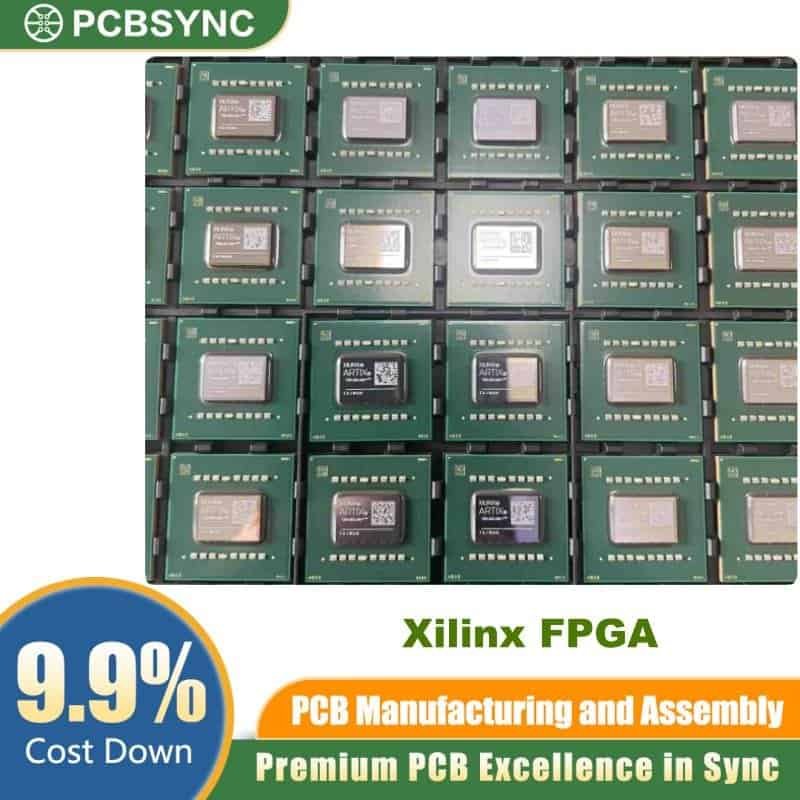
The XCKU115-2FLVA1517C is a high-performance Xilinx FPGA from the Kintex® UltraScale™ family, manufactured by AMD (formerly Xilinx). Designed for demanding signal processing, 100G networking, and data center applications, this device delivers an industry-leading balance of DSP compute power, logic density, and transceiver bandwidth — all within a cost-effective 1517-pin FCBGA package.
This product guide covers everything engineers and procurement teams need to know about the XCKU115-2FLVA1517C, including full technical specifications, key features, application use cases, ordering information, and comparisons with related variants.
What Is the XCKU115-2FLVA1517C?
The XCKU115-2FLVA1517C is part of AMD’s Kintex UltraScale FPGA family, built on a 20nm fabrication process using both monolithic and stacked silicon interconnect (SSI) technology. The part number breaks down as follows:
| Part Number Segment |
Meaning |
| XCKU115 |
Kintex UltraScale, device 115 (largest in family) |
| -2 |
Speed grade 2 (mid-speed, commercial) |
| FLVA |
Fine-pitch land grid array, low voltage, automotive-qualified process |
| 1517 |
1517-pin package |
| C |
Commercial temperature range (0°C to +100°C) |
This device is the commercial-temperature, mid-speed-grade version of the XCKU115 in the 1517-pin FCBGA package — making it a cost-optimized choice for high-performance commercial and industrial designs that do not require extended temperature operation.
XCKU115-2FLVA1517C Key Specifications
General Device Specifications
| Parameter |
Value |
| Manufacturer |
AMD (Xilinx) |
| Part Number |
XCKU115-2FLVA1517C |
| FPGA Family |
Kintex® UltraScale™ |
| Technology Node |
20nm |
| Speed Grade |
-2 (Mid) |
| Temperature Grade |
Commercial (0°C to +100°C) |
| Core Supply Voltage |
0.95V |
| Package |
1517-Pin FCBGA (BBGA) |
| Package Dimensions |
45mm × 45mm |
| RoHS Compliant |
Yes |
Logic Resources
| Resource |
Count |
| System Logic Cells |
1,451,100 |
| CLB Flip-Flops |
1,326,720 |
| CLB LUTs (6-Input) |
663,360 |
| Logic Slices |
165,840 |
| DSP Slices |
5,520 |
| Block RAM Tiles |
2,160 |
| Total Block RAM |
75.9 Mb |
| Total RAM Bits |
77,721,600 |
I/O and Transceiver Specifications
| Parameter |
Value |
| User I/O Pins |
624 |
| Maximum Differential Pairs |
312 |
| GTH Transceivers |
64 |
| Max Transceiver Line Rate |
16.3 Gb/s |
| Min Transceiver Line Rate |
500 Mb/s |
| PCIe Gen3 Hard Blocks |
4 |
| CMAC (100G Ethernet) Cores |
2 |
| ILKN (Interlaken) Cores |
2 |
Clock and Timing Resources
| Resource |
Count |
| MMCM (Mixed-Mode Clock Manager) |
12 |
| PLL (Phase-Locked Loop) |
12 |
| Global Clock Buffers |
528 |
| Max Operating Frequency |
725 MHz (fabric) |
| DDR4 Interface Speed |
Up to 2400 Mb/s |
XCKU115-2FLVA1517C: Key Features and Architecture Highlights
#### 20nm UltraScale Architecture
The XCKU115-2FLVA1517C is built on AMD’s first-generation UltraScale architecture at 20nm — the first ASIC-class “All Programmable” architecture enabling multi-hundred Gbps system performance. Unlike previous FPGA generations, UltraScale uses next-generation routing and ASIC-like clocking to dramatically reduce hold-time violations and routing congestion common in large designs.
#### Industry-Leading DSP Compute Performance
With 5,520 DSP48E2 slices, the XCKU115-2FLVA1517C delivers up to 8.2 TeraMACs of DSP compute performance. This makes it one of the most powerful mid-range FPGAs available for signal-processing-intensive workloads such as radar, software-defined radio, medical imaging, and machine learning inference.
#### 64 GTH High-Speed Transceivers
The device integrates 64 GTH transceivers capable of operating between 500 Mb/s and 16.3 Gb/s. These next-generation transceivers support 16G backplane signaling, PCIe Gen3, 100G Ethernet (via integrated CMAC), and Interlaken interfaces — all within the same device, significantly reducing system BOM cost and board complexity.
#### Stacked Silicon Interconnect (SSI) Technology
The XCKU115 utilizes second-generation 3D IC SSI technology, connecting multiple FPGA dies on a single interposer substrate. This enables the device to scale beyond the reticle limit of the 20nm process while maintaining die-to-die communication performance that exceeds what is achievable with standard multi-chip module approaches.
#### Up to 40% Lower Power vs. Previous Generation
Compared to Xilinx 28nm FPGAs, the UltraScale family delivers up to 40% lower power through fine-grained clock gating, improved logic packing efficiency, and optimized I/O power management. The XCKU115-2FLVA1517C operates at a core supply voltage of just 0.95V.
#### Integrated PCIe Gen3 Hard Blocks
Four integrated PCIe Gen3 hard blocks allow the device to interface directly with host CPUs and high-performance interconnect fabrics without consuming programmable logic resources. Each block supports x1, x2, x4, and x8 lane configurations, with data rates up to 8 GT/s per lane.
#### DDR4 Memory Interface Support
The device supports DDR4 memory interfaces operating at up to 2400 Mb/s — a mid-speed grade improvement over prior-generation devices. This provides the memory bandwidth needed for applications such as packet buffering, video frame processing, and real-time data acquisition.
XCKU115-2FLVA1517C Applications
The XCKU115-2FLVA1517C is engineered for high-throughput, latency-sensitive applications across multiple industries:
#### 100G Networking and Data Center
The integrated dual CMAC (100G Ethernet MAC) cores and four PCIe Gen3 blocks make this device ideal for high-density line cards, network interface cards (NICs), and SmartNICs. The device supports packet processing at 100G with on-chip MAC offload, eliminating the need for external MACs and reducing system complexity.
#### Wireless Infrastructure and Remote Radio Head (RRH)
With its high DSP density and low-latency transceiver architecture, the XCKU115-2FLVA1517C is well-suited for 4G/5G baseband processing, Digital Front End (DFE) designs, and heterogeneous wireless infrastructure where DSP-to-logic ratios are critical.
#### Next-Generation Medical Imaging
Applications such as CT, MRI, and ultrasound reconstruction demand massive parallel processing. The device’s 1.4 million logic cells and 5,520 DSP slices enable real-time 3D image reconstruction pipelines at resolutions up to 8K×4K.
#### Defense and Aerospace Signal Processing
The combination of high logic density, transceiver bandwidth, and commercial-grade temperature range makes the XCKU115-2FLVA1517C suitable for radar signal processing, electronic warfare (EW), and SIGINT systems operating in controlled environments.
#### High-Performance Computing (HPC) Acceleration
As an FPGA accelerator in heterogeneous HPC clusters, the device can be paired with CPUs via PCIe Gen3 to offload compute-intensive kernels including FFT, matrix multiplication, compression, and encryption.
Part Number Variants Comparison
The XCKU115 in the 1517-pin FLVA package is available in multiple speed grades and temperature ranges. The table below compares the primary variants:
| Part Number |
Speed Grade |
Temperature Range |
Use Case |
| XCKU115-1FLVA1517C |
-1 (Slow) |
0°C to +100°C |
Low-power commercial |
| XCKU115-2FLVA1517C |
-2 (Mid) |
0°C to +100°C |
Balanced commercial |
| XCKU115-2FLVA1517E |
-2 (Mid) |
0°C to +100°C |
Extended lifecycle/E-grade |
| XCKU115-2FLVA1517I |
-2 (Mid) |
-40°C to +100°C |
Industrial temperature |
| XCKU115-3FLVA1517I |
-3 (Fast) |
-40°C to +100°C |
High-speed industrial |
Note: The suffix C denotes a standard commercial temperature grade (0°C to +100°C junction temperature). Designs that require operation below 0°C should select the I (industrial) variant.
Ordering and Package Information
| Attribute |
Detail |
| Manufacturer Part Number |
XCKU115-2FLVA1517C |
| Manufacturer |
AMD / Xilinx |
| Package Type |
FCBGA (Fine-pitch Ceramic Ball Grid Array) |
| Pin Count |
1517 |
| Package Body Size |
45mm × 45mm |
| Ball Pitch |
1.0mm |
| Mounting Type |
Surface Mount (SMD) |
| Cancellation Policy |
Non-Cancellable, Non-Returnable (NCNR) |
| Warranty |
12 months from date of purchase |
| RoHS Status |
Compliant |
| ECCN |
Controlled — confirm export regulations |
Design Tools and Software Support
The XCKU115-2FLVA1517C is fully supported by AMD Vivado® Design Suite, the industry-standard design environment for UltraScale and UltraScale+ devices. Vivado provides:
- RTL-to-bitstream flow with synthesis, placement, and routing
- IP Integrator for block-level design using AMD IP cores
- Integrated simulator and hardware debugging (ILA, VIO)
- Power estimation and design closure tools
- UltraFast Design Methodology support
Designers migrating from older Virtex or Kintex-7 families benefit from footprint compatibility between select UltraScale packages, enabling board-level scalability.
Why Choose the XCKU115-2FLVA1517C?
The XCKU115-2FLVA1517C hits the sweet spot for engineers who need the largest Kintex UltraScale device at a commercially-rated temperature range and a balanced -2 speed grade. Compared to higher-end Virtex UltraScale parts, this device provides 80–90% of the capability at a significantly lower cost — making it the preferred choice for cost-sensitive production designs that still demand extreme logic density and DSP throughput.
Key advantages at a glance:
- 1.45 million system logic cells — largest in the Kintex UltraScale family
- 5,520 DSP slices for 8.2 TeraMAC compute performance
- 64 GTH transceivers supporting up to 16.3 Gb/s line rates
- Integrated 100G Ethernet MAC cores reduce external component count
- PCIe Gen3 hard blocks for seamless CPU host connectivity
- 20nm SSI technology enabling lower power and higher density
- Vivado design suite support with an active IP ecosystem
Frequently Asked Questions (FAQ)
Q: What is the difference between XCKU115-2FLVA1517C and XCKU115-2FLVA1517E? Both share the same silicon, speed grade, and package. The “C” suffix typically indicates a standard commercial product orderable through standard distribution channels, while the “E” suffix is often used for extended lifecycle or specific distribution programs. Always verify with your authorized distributor.
Q: Is the XCKU115-2FLVA1517C pin-compatible with Virtex UltraScale devices? Yes. Xilinx designed select Kintex UltraScale and Virtex UltraScale devices to share footprint compatibility in overlapping packages, enabling system designers to scale performance up or down at the board level without a PCB redesign.
Q: What DDR memory standard does this FPGA support? The XCKU115-2FLVA1517C supports DDR3, DDR4, and LPDDR3 interfaces. DDR4 interfaces operate at up to 2400 Mb/s, suitable for high-bandwidth buffering applications.
Q: What PCB design considerations apply to the 1517-pin FCBGA package? The 1.0mm ball pitch FCBGA requires careful signal integrity planning, controlled impedance routing, and proper power delivery network (PDN) design. AMD provides detailed PCB design guidelines in the UltraScale PCB Design User Guide (UG583).