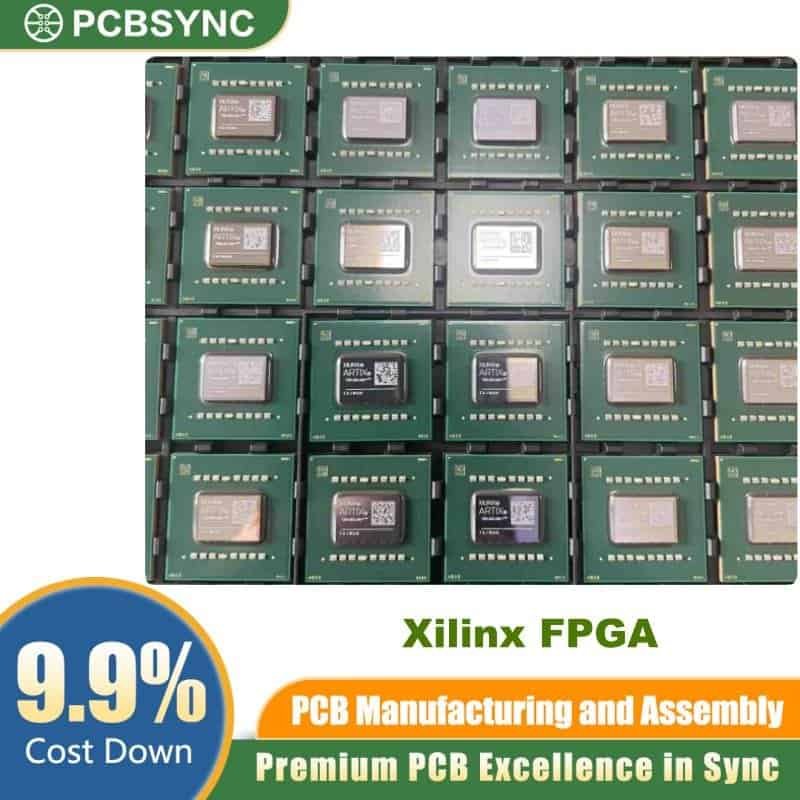
The XC2S200-6FGG1241C is a high-performance Field-Programmable Gate Array (FPGA) from Xilinx’s Spartan-II family, featuring 200,000 system gates, 5,292 logic cells, and a 1241-ball Fine-Pitch BGA (FBGA) package. Engineered for commercial-temperature applications, this device delivers exceptional flexibility for digital design, signal processing, and embedded systems engineering at a cost-efficient price point. Whether you are prototyping or deploying a production design, the XC2S200-6FGG1241C offers a proven, reprogrammable platform that outperforms traditional mask-programmed ASICs.
What Is the XC2S200-6FGG1241C? Understanding the Part Number
Decoding the part number helps engineers and procurement professionals quickly identify the key attributes of this component:
| Segment |
Value |
Meaning |
| XC2S200 |
XC2S200 |
Spartan-II family, 200K system gates |
| -6 |
Speed Grade 6 |
Fastest available speed grade; Commercial range only |
| FGG |
FGG |
Fine-Pitch Ball Grid Array (Pb-Free package, “G” = RoHS-compliant) |
| 1241 |
1241 |
Number of package balls/pins |
| C |
C |
Commercial temperature range (0°C to +85°C) |
This naming convention follows Xilinx’s standard Spartan-II ordering information format. The -6 speed grade is exclusively available in the commercial temperature range, making the XC2S200-6FGG1241C ideal for controlled-environment applications such as enterprise hardware, communications infrastructure, and consumer electronics.
XC2S200-6FGG1241C Key Specifications
Core Device Parameters
| Parameter |
Value |
| Device Family |
Spartan-II |
| Manufacturer |
Xilinx (AMD) |
| System Gates |
200,000 |
| Logic Cells |
5,292 |
| CLB Array |
28 × 42 |
| Total CLBs |
1,176 |
| Maximum User I/O |
284 |
| Distributed RAM |
75,264 bits |
| Block RAM |
56K bits |
| Delay-Locked Loops (DLLs) |
4 |
| Core Voltage (VCCINT) |
2.5V |
| Process Technology |
0.18 µm |
| Max System Performance |
Up to 200 MHz |
Package & Environmental Specifications
| Parameter |
Value |
| Package Type |
Fine-Pitch Ball Grid Array (FBGA) |
| Package Designator |
FGG |
| Pin Count |
1241 |
| Lead-Free (Pb-Free) |
Yes (Pb-free “G” suffix) |
| Temperature Range |
Commercial (0°C to +85°C) |
| Speed Grade |
-6 (fastest for Spartan-II) |
| RoHS Compliance |
Compliant (Pb-free packaging) |
Spartan-II Family Comparison: Where XC2S200 Stands
The XC2S200 sits at the top of the Spartan-II device family, offering the highest logic density and I/O count in the series. The table below shows how it compares across all family members:
| Device |
Logic Cells |
System Gates |
CLB Array |
Total CLBs |
Max I/O |
Distributed RAM |
Block RAM |
| XC2S15 |
432 |
15,000 |
8×12 |
96 |
86 |
6,144 bits |
16K |
| XC2S30 |
972 |
30,000 |
12×18 |
216 |
92 |
13,824 bits |
24K |
| XC2S50 |
1,728 |
50,000 |
16×24 |
384 |
176 |
24,576 bits |
32K |
| XC2S100 |
2,700 |
100,000 |
20×30 |
600 |
176 |
38,400 bits |
40K |
| XC2S150 |
3,888 |
150,000 |
24×36 |
864 |
260 |
55,296 bits |
48K |
| XC2S200 |
5,292 |
200,000 |
28×42 |
1,176 |
284 |
75,264 bits |
56K |
The XC2S200-6FGG1241C’s 1241-pin BGA package provides access to the full complement of 284 user I/O pins while enabling high-density PCB integration for complex, multi-interface designs.
Architecture Overview: Inside the XC2S200-6FGG1241C
Configurable Logic Blocks (CLBs)
The XC2S200 contains 1,176 Configurable Logic Blocks arranged in a 28×42 array. Each CLB includes look-up tables (LUTs), flip-flops, and dedicated carry logic, enabling implementation of complex combinational and sequential circuits.
Block RAM
With 56K bits of dedicated block RAM organized in two columns on opposite sides of the die, the XC2S200-6FGG1241C supports dual-port memory operations, FIFOs, and data buffering without consuming CLB resources.
Delay-Locked Loops (DLLs)
Four on-chip DLLs — one at each corner of the die — provide clock de-skewing, frequency synthesis, and phase adjustment. This is critical for high-speed synchronous designs requiring precise timing margins.
Input/Output Blocks (IOBs)
The IOBs support a wide range of I/O standards including LVTTL, LVCMOS, GTL, SSTL, and AGP. Programmable slew-rate control and drive-strength options allow the designer to manage signal integrity and EMI characteristics.
XC2S200-6FGG1241C vs. Similar Devices: Competitive Comparison
| Feature |
XC2S200-6FGG1241C |
XC2S150-6FGG456C |
XC2S200-6FG456C |
| System Gates |
200,000 |
150,000 |
200,000 |
| Logic Cells |
5,292 |
3,888 |
5,292 |
| Package |
1241-ball FBGA |
456-ball FBGA |
456-ball FBGA |
| Max User I/O |
284 |
260 |
284 |
| Speed Grade |
-6 |
-6 |
-6 |
| Pb-Free |
Yes |
Yes |
No |
| Block RAM |
56K bits |
48K bits |
56K bits |
The XC2S200-6FGG1241C’s 1241-ball package provides a significant I/O routing advantage over the 456-ball alternative for board designs that require dense interconnects, high pin escape routing, or smaller PCB footprints using via-in-pad techniques.
Top Applications for the XC2S200-6FGG1241C FPGA
The XC2S200-6FGG1241C is widely deployed across demanding commercial and industrial applications:
#### Digital Signal Processing (DSP)
The device’s abundant LUTs, distributed RAM, and DLL-enabled clocking make it well-suited for FIR/IIR filters, FFT engines, and real-time audio/image processing pipelines.
#### Communications & Networking
Protocol bridging, SERDES control logic, packet processing, and custom interface controllers benefit from the XC2S200’s high I/O count and flexible clocking architecture.
#### Embedded Systems & Control
When paired with soft-core processors like MicroBlaze (via later ISE flows), or used as a control plane accelerator, the XC2S200-6FGG1241C handles state machines, bus arbitration, and peripheral interfacing efficiently.
#### ASIC Prototyping
The Spartan-II family is a recognized alternative to mask-programmed ASICs. The XC2S200-6FGG1241C avoids the high NRE costs, long lead times, and design-lock risks of custom silicon — and supports in-field design updates without hardware replacement.
#### Test & Measurement Equipment
High I/O density and flexible logic resources make this device a common choice in ATE (Automated Test Equipment), logic analyzers, and signal generators.
Design Tools & Programming Support
The XC2S200-6FGG1241C is supported by Xilinx’s ISE Design Suite (the primary toolchain for legacy Spartan-II devices). Designers can use:
- ISE Project Navigator — synthesis, implementation, and bitstream generation
- CORE Generator — IP core instantiation (FIFOs, multipliers, ROM/RAM)
- iMPACT — programming and device configuration via JTAG or serial interfaces
- ModelSim / ISim — functional and timing simulation
Note: The Spartan-II family predates Vivado. Xilinx Vivado does not support Spartan-II devices. ISE 14.7 is the final supported release and remains available from AMD/Xilinx archives.
For a broader overview of Xilinx programmable logic solutions and portfolio context, visit the Xilinx FPGA resource guide.
Configuration & Programming Modes
| Mode |
Description |
| Master Serial |
FPGA drives configuration clock; data read from serial PROM |
| Slave Serial |
External device drives configuration clock |
| Master Parallel |
FPGA reads byte-wide data from parallel PROM |
| Slave Parallel (SelectMAP) |
Byte-wide configuration via external microprocessor |
| JTAG (Boundary Scan) |
IEEE 1149.1 compliant in-system configuration and debugging |
The device supports in-system reconfiguration, allowing design updates to be deployed in the field without physical hardware replacement — a key advantage over fixed-function ASICs.
Power Supply Requirements
| Supply Rail |
Voltage |
Purpose |
| VCCINT |
2.5V |
Core logic power |
| VCCO |
2.5V / 3.3V (bank-selectable) |
I/O bank output power |
| VREF |
Varies |
Reference voltage for certain I/O standards |
Proper decoupling capacitors on VCCINT and each VCCO bank are essential for signal integrity and EMI compliance. Xilinx application notes recommend bulk and high-frequency bypass capacitors placed as close as possible to each power pin.
Ordering Information & Part Number Variants
| Part Number |
Speed Grade |
Package |
Pins |
Pb-Free |
Temp Range |
| XC2S200-6FGG1241C |
-6 |
FBGA |
1241 |
Yes |
Commercial |
| XC2S200-5FGG1241C |
-5 |
FBGA |
1241 |
Yes |
Commercial |
| XC2S200-5FGG1241I |
-5 |
FBGA |
1241 |
Yes |
Industrial |
| XC2S200-6FG456C |
-6 |
FBGA |
456 |
No |
Commercial |
| XC2S200-6FGG456C |
-6 |
FBGA |
456 |
Yes |
Commercial |
| XC2S200-6PQ208C |
-6 |
PQFP |
208 |
No |
Commercial |
When specifying the XC2S200-6FGG1241C in a BOM, ensure the full part number including the package suffix is captured to avoid substitution with lower pin-count variants.
Frequently Asked Questions (FAQ)
Q: Is the XC2S200-6FGG1241C recommended for new designs? A: The Spartan-II family is classified as mature/not recommended for new designs (NRND) by AMD/Xilinx. It remains available for legacy design support and repair. For new designs, Xilinx Spartan-7 or Artix-7 FPGAs are recommended.
Q: What is the difference between XC2S200-6FGG1241C and XC2S200-6FG1241C? A: The “G” in “FGG” denotes a Pb-free (lead-free) package. The “FG” variant uses standard tin-lead solder balls. Both are electrically identical.
Q: Can the XC2S200-6FGG1241C be programmed with Vivado? A: No. Vivado does not support Spartan-II devices. Use ISE Design Suite 14.7.
Q: What configuration PROM is compatible with this device? A: Xilinx XCF series Platform Flash PROMs (e.g., XCF02S, XCF04S) are commonly used for serial master configuration of Spartan-II FPGAs.
Q: Is the -6 speed grade available in industrial temperature range? A: No. The -6 speed grade is exclusively available in the commercial temperature range (0°C to +85°C).
Summary
The XC2S200-6FGG1241C delivers the maximum logic density and I/O capacity within the Xilinx Spartan-II FPGA family, packaged in a lead-free 1241-ball FBGA for high-density PCB designs. With 200,000 system gates, 5,292 logic cells, 284 user I/O pins, four on-chip DLLs, 75,264 bits of distributed RAM, and 56K bits of block RAM — all operating at a -6 speed grade with up to 200 MHz system performance — this device continues to serve legacy telecommunications, industrial automation, and embedded computing designs where reprogrammability and cost-efficiency are paramount.