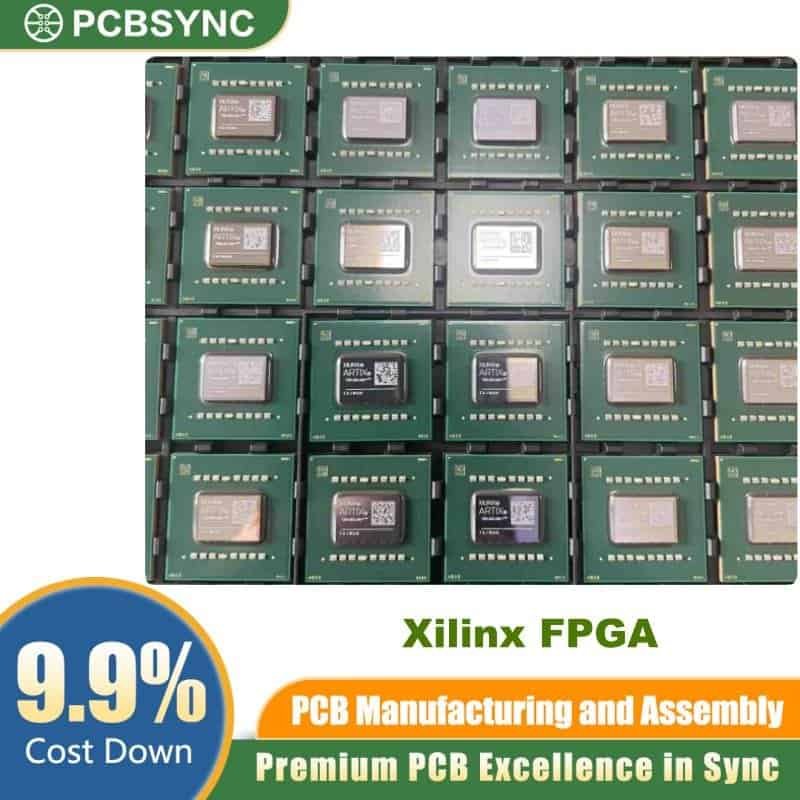
The XC2S200-6FGG1228C is a high-density, cost-effective Field Programmable Gate Array (FPGA) from Xilinx’s Spartan-II family. Designed as a superior alternative to mask-programmed ASICs, this device delivers 200,000 system gates, 5,292 logic cells, and a 1,228-ball Fine Pitch BGA (FBGA) package — making it one of the most capable members of the Spartan-II lineup. Whether you are an embedded systems engineer, PCB designer, or procurement professional, this guide covers everything you need to know about the XC2S200-6FGG1228C.
What Is the XC2S200-6FGG1228C? Decoding the Part Number
Understanding the part number helps engineers quickly identify key attributes:
| Code Segment |
Meaning |
| XC2S200 |
Xilinx Spartan-II, 200K system gates |
| -6 |
Speed Grade 6 (fastest, commercial range only) |
| FGG |
Fine Pitch BGA package (Pb-free “G” variant) |
| 1228 |
1,228 total pins/balls |
| C |
Commercial temperature range (0°C to +85°C) |
The “G” in FGG indicates Pb-free (RoHS-compliant) packaging, distinguishing it from the standard FG variant.
XC2S200-6FGG1228C Key Specifications
Core Logic Specifications
| Parameter |
Value |
| Family |
Spartan-II |
| Manufacturer |
Xilinx (AMD) |
| System Gates |
200,000 |
| Logic Cells |
5,292 |
| CLB Array |
28 × 42 |
| Total CLBs |
1,176 |
| Maximum User I/O |
284 |
| Distributed RAM |
75,264 bits |
| Block RAM |
56K bits |
| Delay-Locked Loops (DLLs) |
4 |
Electrical & Timing Specifications
| Parameter |
Value |
| Supply Voltage (VCCINT) |
2.5V |
| Process Technology |
0.18 µm |
| Maximum Clock Frequency |
263 MHz |
| Speed Grade |
-6 (fastest available) |
| Temperature Range |
Commercial (0°C to +85°C) |
Package Specifications
| Parameter |
Value |
| Package Type |
Fine Pitch BGA (FBGA) |
| Package Code |
FGG1228 |
| Total Pins |
1,228 |
| Lead Finish |
Pb-free (RoHS compliant) |
| Form Factor |
Ball Grid Array |
XC2S200-6FGG1228C Architecture Overview
Configurable Logic Blocks (CLBs)
The XC2S200-6FGG1228C is built around a regular, flexible, programmable architecture. The device contains 1,176 CLBs arranged in a 28 × 42 array. Each CLB contains four logic cells, with each cell made up of two 4-input function generators (LUTs) and two storage elements (flip-flops). This architecture allows designers to implement complex combinational and sequential logic efficiently.
SelectRAM™ Hierarchical Memory
One of the standout features of the Spartan-II architecture is its SelectRAM™ hierarchical memory system, which provides two levels of on-chip storage:
- Distributed RAM — 16 bits per LUT, totaling 75,264 bits on the XC2S200. This RAM is embedded within the CLB fabric and offers single-cycle read/write access.
- Block RAM — Two dedicated columns of 4K-bit block RAM modules, providing 56K bits of true dual-port synchronous memory. Block RAM is ideal for FIFOs, register files, and large lookup tables.
Input/Output Blocks (IOBs)
The XC2S200-6FGG1228C offers up to 284 user-configurable I/O pins. Each IOB supports multiple I/O standards, including LVTTL, LVCMOS, GTL, GTLP, SSTL, HSTL, and CTT. The IOBs include programmable pull-up, pull-down, and keeper circuits, as well as optional slew rate control for signal integrity management.
Delay-Locked Loops (DLLs)
Four Delay-Locked Loops (DLLs) are positioned at each corner of the die. These DLLs eliminate clock distribution delays, provide clock edge alignment, and allow frequency synthesis. They are critical for high-speed synchronous design and meeting tight setup/hold timing requirements.
Spartan-II Family Comparison Table
The XC2S200 is the largest device in the Spartan-II family. Here is how it compares to other family members:
| Device |
Logic Cells |
System Gates |
CLB Array |
Max User I/O |
Distributed RAM |
Block RAM |
| XC2S15 |
432 |
15,000 |
8 × 12 |
86 |
6,144 bits |
16K bits |
| XC2S30 |
972 |
30,000 |
12 × 18 |
92 |
13,824 bits |
24K bits |
| XC2S50 |
1,728 |
50,000 |
16 × 24 |
176 |
24,576 bits |
32K bits |
| XC2S100 |
2,700 |
100,000 |
20 × 30 |
176 |
38,400 bits |
40K bits |
| XC2S150 |
3,888 |
150,000 |
24 × 36 |
260 |
55,296 bits |
48K bits |
| XC2S200 |
5,292 |
200,000 |
28 × 42 |
284 |
75,264 bits |
56K bits |
The XC2S200 offers the highest gate count, the most logic cells, and the largest I/O count in the entire Spartan-II family.
XC2S200-6FGG1228C vs. Other XC2S200 Package Options
Xilinx offers the XC2S200 in several package options. Choosing the right package depends on board space, I/O count requirements, and design constraints:
| Part Number |
Package |
Pins |
Pb-Free |
Speed Grade |
Temp Range |
| XC2S200-6PQ208C |
PQFP |
208 |
No |
-6 |
Commercial |
| XC2S200-6PQG208C |
PQFP |
208 |
Yes |
-6 |
Commercial |
| XC2S200-6FG256C |
FBGA |
256 |
No |
-6 |
Commercial |
| XC2S200-6FG456C |
FBGA |
456 |
No |
-6 |
Commercial |
| XC2S200-6FGG1228C |
FBGA |
1,228 |
Yes |
-6 |
Commercial |
The FGG1228 package provides the highest pin count in the XC2S200 lineup, offering maximum routing flexibility for complex, high-density PCB designs.
Key Features of the XC2S200-6FGG1228C
#### Second-Generation ASIC Replacement Technology
The Spartan-II family was engineered as a second-generation ASIC replacement. Unlike mask-programmed ASICs, the XC2S200-6FGG1228C can be reprogrammed in the field without any hardware replacement. This dramatically reduces NRE (Non-Recurring Engineering) costs and shortens product development cycles.
#### Streamlined Virtex®-Based Architecture
The Spartan-II architecture is a streamlined derivative of Xilinx’s flagship Virtex FPGA architecture. This heritage brings proven, high-performance logic structures to a cost-optimized platform — making the XC2S200-6FGG1228C suitable for production-volume applications that demand both performance and economy.
#### Unlimited Reprogrammability
The XC2S200-6FGG1228C supports unlimited reprogrammability, allowing engineers to revise and update designs even after devices are deployed in the field. This is a critical advantage over one-time-programmable (OTP) or mask-programmed alternatives.
#### Cost-Effective 0.18 Micron Process
Fabricated using a 0.18 µm process technology, the XC2S200-6FGG1228C achieves high logic density at a low per-gate cost. The compact process node also supports faster switching speeds and lower dynamic power consumption.
#### Boundary Scan Support (IEEE 1149.1 JTAG)
Full IEEE 1149.1 JTAG boundary scan support is built in, enabling in-system testing, configuration, and debugging without physical probing of individual pins.
Supported I/O Standards
The XC2S200-6FGG1228C IOBs support a wide range of industry-standard single-ended and differential signaling levels:
| I/O Standard |
Type |
Application |
| LVTTL |
Single-ended |
General purpose logic |
| LVCMOS2 |
Single-ended |
Low-voltage logic interfaces |
| GTL / GTLP |
Single-ended |
Gunning transceiver logic |
| SSTL2 / SSTL3 |
Single-ended |
SDRAM/DDR memory interfaces |
| HSTL |
Single-ended |
High-speed transceiver logic |
| CTT |
Single-ended |
Center-tap terminated |
Configuration Modes
The XC2S200-6FGG1228C supports multiple configuration modes for flexible system integration:
- Master Serial — Single device or daisy-chain with Xilinx PROMs
- Slave Serial — Externally controlled serial configuration
- Slave Parallel (SelectMAP) — Fast, byte-wide parallel configuration
- Boundary Scan (JTAG) — IEEE 1149.1 in-circuit configuration and test
- Master Parallel Up/Down — Parallel configuration from external flash or ROM
Typical Applications for XC2S200-6FGG1228C
The XC2S200-6FGG1228C is well-suited for high-volume, cost-sensitive designs that require significant logic resources and a large number of I/O connections:
- Telecommunications infrastructure — Line cards, switching fabrics, protocol processing
- Industrial automation — Motor control, sensor fusion, real-time data acquisition
- Embedded processing — Custom coprocessors, DMA controllers, bus bridges
- Video and imaging — Frame buffering, pixel pipeline processing, image enhancement
- Medical devices — Data acquisition systems, signal conditioning, patient monitoring equipment
- Military and aerospace legacy support — Replacement and upgrade of legacy ASIC-based designs
- Networking equipment — Packet processing, traffic management, interface bridging
For a comprehensive selection of Xilinx programmable logic devices for these and other applications, explore the full range at Xilinx FPGA.
Design Tools and Software Support
The XC2S200-6FGG1228C is supported by Xilinx’s legacy ISE Design Suite. While the newer Vivado Design Suite targets 7-Series and later devices, ISE provides full support for Spartan-II synthesis, implementation, timing analysis, and configuration file generation.
| Tool |
Purpose |
Notes |
| ISE Design Suite |
Synthesis & Implementation |
Legacy support for Spartan-II |
| PlanAhead |
Floorplanning |
Available within ISE |
| iMPACT |
Device programming |
JTAG and PROM programming |
| ChipScope Pro |
In-circuit debugging |
Logic analyzer on-chip |
| ModelSim / XSIM |
Simulation |
Functional and timing simulation |
Ordering Information & Part Marking
Xilinx uses a structured ordering code for all Spartan-II devices. The XC2S200-6FGG1228C is decoded as follows:
XC2S200 - 6 - FGG - 1228 - C
  |         |    |      |    |
  |         |    |      |    └── Temperature: C = Commercial (0°C to +85°C)
  |         |    |      └─────── Pin Count: 1,228
  |         |    └────────────── Package: FGG = Pb-Free Fine Pitch BGA
  |         └─────────────────── Speed Grade: -6 (fastest)
  └───────────────────────────── Device: Spartan-II, 200K Gates
Note: The speed grade -6 is exclusively available in the Commercial temperature range. Industrial temperature range variants use speed grade -5 or lower.
Frequently Asked Questions (FAQ)
What is the XC2S200-6FGG1228C used for?
The XC2S200-6FGG1228C is used in embedded systems, telecommunications, industrial control, and digital signal processing applications where a cost-effective, high-density, reprogrammable logic solution is required.
What is the difference between XC2S200-6FGG1228C and XC2S200-6FG256C?
The primary difference is the package. The FGG1228 variant uses a 1,228-ball Pb-free Fine Pitch BGA, offering higher pin access and routing flexibility. The FG256C uses a 256-ball FBGA in a smaller footprint with fewer exposed pins.
Is the XC2S200-6FGG1228C RoHS compliant?
Yes. The “G” in FGG indicates a Pb-free, RoHS-compliant package, making it suitable for modern, environmentally regulated designs.
What voltage does the XC2S200-6FGG1228C operate at?
The core supply voltage (VCCINT) is 2.5V. I/O supply voltage (VCCO) depends on the selected I/O standard and may be 3.3V, 2.5V, or lower depending on the interface.
What software do I use to program the XC2S200-6FGG1228C?
The primary development environment is Xilinx ISE Design Suite. The device is programmed using the iMPACT tool via JTAG or through Xilinx PROM-based configuration.
Can the XC2S200-6FGG1228C be used for new designs?
Xilinx has issued product discontinuation notices for some Spartan-II variants. Engineers should verify current availability and consider newer Xilinx families such as Spartan-6 or Spartan-7 for new designs. The XC2S200-6FGG1228C remains valuable for legacy system maintenance and replacement applications.
Summary: Why Choose the XC2S200-6FGG1228C?
The XC2S200-6FGG1228C represents the peak of the Spartan-II family in terms of logic density and I/O capacity. Its combination of 200K system gates, 284 user I/Os, 56K bits of block RAM, four DLLs, and Pb-free 1,228-ball BGA packaging makes it a compelling choice for engineers maintaining legacy FPGA designs or seeking a proven, field-reprogrammable alternative to ASICs in cost-sensitive, high-volume applications.
| Feature |
Benefit |
| 200,000 system gates |
Sufficient logic for complex state machines, bus bridges, and datapath designs |
| Speed grade -6 |
Fastest Spartan-II option — up to 263 MHz system clock |
| 1,228-ball FGG package |
Maximum I/O flexibility with Pb-free compliance |
| 4 DLLs |
Clean clock distribution and frequency synthesis |
| Unlimited reprogrammability |
In-field updates with no hardware change |
| 0.18 µm process |
Cost-optimized production at scale |