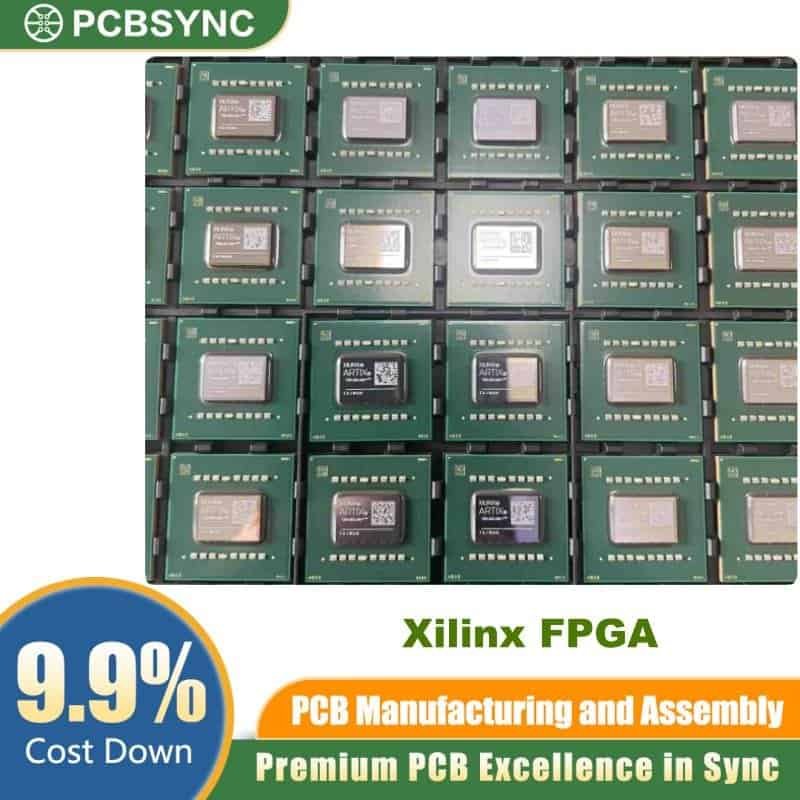
Meta Description: The XC2S200-6FGG1223C is a Xilinx Spartan-II FPGA with 200K system gates, 5,292 logic cells, and a Pb-free 1223-ball BGA package. Read the full specs, pinout, applications, and ordering guide here.
The XC2S200-6FGG1223C is a high-density, cost-optimized Field Programmable Gate Array (FPGA) manufactured by Xilinx (now AMD) as part of the industry-proven Spartan-II family. Designed for engineers who need programmable logic at a low cost, the XC2S200-6FGG1223C delivers 200,000 system gates, 5,292 configurable logic cells, and a maximum operating frequency of 263 MHz — all in a lead-free (Pb-free) 1223-ball Fine-Pitch Ball Grid Array (FGG) package. Whether you are working on digital signal processing, industrial control, or embedded systems, the XC2S200-6FGG1223C offers proven reliability and unlimited reprogrammability that no mask-programmed ASIC can match.
What Is the XC2S200-6FGG1223C? Understanding the Part Number
Before diving into the specifications, it helps to decode the XC2S200-6FGG1223C part number:
| Code Segment |
Meaning |
| XC2S |
Xilinx Spartan-II FPGA family |
| 200 |
200,000 system gates |
| -6 |
Speed grade -6 (fastest commercial grade) |
| FGG |
Fine-Pitch Ball Grid Array, Pb-free (G suffix) |
| 1223 |
1,223-ball pin count |
| C |
Commercial temperature range (0°C to +85°C) |
The double “G” in FGG confirms that the XC2S200-6FGG1223C is RoHS-compliant, using lead-free solder balls — an important distinction for designs targeting the European market or any application requiring environmental compliance.
XC2S200-6FGG1223C Key Specifications at a Glance
The table below summarises the most critical electrical and physical parameters of the XC2S200-6FGG1223C for quick reference during design evaluation.
| Parameter |
Value |
| Manufacturer |
Xilinx (AMD) |
| Family |
Spartan-II |
| Part Number |
XC2S200-6FGG1223C |
| System Gates |
200,000 |
| Logic Cells |
5,292 |
| CLB Array |
28 × 42 |
| Total CLBs |
1,176 |
| Max User I/O |
284 |
| Distributed RAM |
75,264 bits |
| Block RAM |
56K bits |
| Max Frequency |
263 MHz |
| Process Technology |
0.18 µm |
| Core Voltage (VCCINT) |
2.5 V |
| Package |
FGG BGA (Pb-free) |
| Pin Count |
1,223 |
| Temperature Range |
0°C to +85°C (Commercial) |
| Speed Grade |
-6 (fastest) |
| RoHS Compliance |
Yes (Pb-free) |
XC2S200-6FGG1223C Architecture Overview
Configurable Logic Blocks (CLBs)
The XC2S200-6FGG1223C is built around a 28 × 42 array of Configurable Logic Blocks, totalling 1,176 CLBs. Each CLB contains two slices, and each slice includes two four-input Look-Up Tables (LUTs) that can be configured either as logic functions or as 16-bit distributed RAM. This flexible architecture allows designers to efficiently implement complex combinatorial and sequential logic directly in silicon.
CLB Capabilities Summary
| Feature |
Detail |
| LUTs per CLB |
4 (two per slice × two slices) |
| Distributed RAM per LUT |
16 bits |
| Total Distributed RAM |
75,264 bits |
| Flip-flops per CLB |
4 |
| Carry chain support |
Yes |
Block RAM
The XC2S200-6FGG1223C integrates two columns of dedicated block RAM, providing a total of 56K bits of true dual-port synchronous SRAM. Each 4K-bit block RAM is independently configurable in terms of width and depth, making it ideal for FIFOs, look-up tables, and memory buffers in embedded designs.
Input/Output Blocks (IOBs)
With up to 284 user-configurable I/O pins, the XC2S200-6FGG1223C supports a wide range of interface standards. Each IOB includes programmable pull-up/pull-down resistors, slew-rate control, and 3-state output capability. This makes the XC2S200-6FGG1223C highly adaptable for multi-voltage system designs.
Delay-Locked Loops (DLLs)
Four on-chip Delay-Locked Loops are positioned at each corner of the XC2S200-6FGG1223C die. These DLLs provide zero-skew clock distribution, frequency synthesis, and phase shifting, which are critical for high-speed synchronous designs running at the chip’s maximum frequency of 263 MHz.
XC2S200-6FGG1223C Electrical Characteristics
Accurate knowledge of the electrical characteristics of the XC2S200-6FGG1223C is essential for power supply design and signal integrity planning.
| Parameter |
Min |
Typical |
Max |
Unit |
| Core Supply (VCCINT) |
2.375 |
2.5 |
2.625 |
V |
| I/O Supply (VCCO) |
1.14 |
— |
3.6 |
V |
| Input High Voltage (VIH) |
2.0 |
— |
VCCO + 0.5 |
V |
| Input Low Voltage (VIL) |
-0.5 |
— |
0.8 |
V |
| Operating Temperature |
0 |
— |
+85 |
°C |
| Maximum Clock Frequency |
— |
— |
263 |
MHz |
Supported I/O Standards for XC2S200-6FGG1223C
One of the standout strengths of the XC2S200-6FGG1223C is its multi-standard I/O support, enabling seamless integration into mixed-voltage designs.
| I/O Standard |
VCCO Required |
Description |
| LVTTL |
3.3 V |
Low-Voltage TTL |
| LVCMOS33 |
3.3 V |
Low-Voltage CMOS, 3.3 V |
| LVCMOS25 |
2.5 V |
Low-Voltage CMOS, 2.5 V |
| LVCMOS18 |
1.8 V |
Low-Voltage CMOS, 1.8 V |
| LVCMOS15 |
1.5 V |
Low-Voltage CMOS, 1.5 V |
| PCI |
3.3 V |
33/66 MHz PCI compliant |
| GTL |
External |
Gunning Transceiver Logic |
| HSTL Class I |
1.5 V |
High-Speed Transceiver Logic |
| SSTL2 Class I/II |
2.5 V |
Stub Series Terminated Logic |
XC2S200-6FGG1223C vs. Other XC2S200 Package Variants
Designers often compare multiple package options within the same device family. The table below positions the XC2S200-6FGG1223C against its sibling packages.
| Part Number |
Package |
Pins |
Max User I/O |
Pb-Free |
Speed Grade |
| XC2S200-6PQ208C |
PQFP |
208 |
140 |
No |
-6 |
| XC2S200-6PQG208C |
PQFP |
208 |
140 |
Yes |
-6 |
| XC2S200-6FG256C |
FBGA |
256 |
176 |
No |
-6 |
| XC2S200-6FGG256C |
FBGA |
256 |
176 |
Yes |
-6 |
| XC2S200-6FG456C |
FBGA |
456 |
284 |
No |
-6 |
| XC2S200-6FGG1223C |
FGG BGA |
1,223 |
284 |
Yes |
-6 |
The XC2S200-6FGG1223C stands out as the highest pin-count, fully Pb-free option in the XC2S200 range at speed grade -6, making it the preferred choice for high-density board designs that require maximum routing flexibility and RoHS compliance.
XC2S200-6FGG1223C Configuration Modes
The XC2S200-6FGG1223C supports multiple configuration modes, giving system designers the flexibility to choose the most appropriate programming method for their target application.
| Configuration Mode |
Interface |
Description |
| Master Serial |
Serial |
Configures from external Xilinx PROM |
| Slave Serial |
Serial |
Configured by an external controller |
| Master Parallel (SelectMAP) |
8-bit parallel |
High-speed parallel programming |
| Slave Parallel (SelectMAP) |
8-bit parallel |
Controlled external parallel load |
| Boundary Scan (JTAG) |
4-wire JTAG |
IEEE 1149.1 compliant in-system programming |
JTAG-based in-system programming (ISP) is the most commonly used method for prototyping and field updates, as the XC2S200-6FGG1223C can be reconfigured without any hardware replacement.
Why Choose the XC2S200-6FGG1223C Over a Traditional ASIC?
The XC2S200-6FGG1223C was designed from the ground up as a superior alternative to mask-programmed ASICs. Here is why:
- No NRE Costs: Unlike ASICs, the XC2S200-6FGG1223C requires no Non-Recurring Engineering fees, which can save tens of thousands of dollars on low-to-mid volume production runs.
- Unlimited Reprogrammability: Firmware bugs, protocol changes, and feature additions can all be resolved through a simple configuration update — no board respins required.
- Faster Time-to-Market: Using the XC2S200-6FGG1223C eliminates the lengthy ASIC tape-out cycle. A functional prototype can be ready in hours, not months.
- Reduced Risk: If requirements change midway through a project, the XC2S200-6FGG1223C absorbs the change gracefully, whereas an ASIC would require a costly new mask set.
- Cost-Effective 0.18 µm Process: Manufactured on a mature 0.18-micron process, the XC2S200-6FGG1223C delivers a favourable price-to-performance ratio for volume production.
For engineers working with programmable logic at scale, the full range of options is covered in the Xilinx FPGA resource guide.
XC2S200-6FGG1223C Application Areas
The combination of 200K system gates, 284 user I/Os, 56K bits of block RAM, and a compact 2.5 V core supply makes the XC2S200-6FGG1223C well suited for a broad range of industries and use cases.
#### Embedded Systems & SoC Prototyping
The XC2S200-6FGG1223C is widely used for prototyping embedded processor subsystems, custom peripherals, and SoC interconnect fabrics, thanks to its ample logic resources and flexible I/O.
#### Digital Signal Processing (DSP)
With 1,176 CLBs and 75,264 bits of distributed RAM, the XC2S200-6FGG1223C can implement FIR filters, FFT engines, and image-processing pipelines in real time.
#### Communications & Networking
The XC2S200-6FGG1223C’s support for HSTL, SSTL2, and GTL I/O standards, combined with its 263 MHz clock capability, makes it ideal for high-speed serial and parallel data interfaces.
#### Industrial Automation & Control
The commercial temperature range (0°C to +85°C) and robust 2.5 V architecture of the XC2S200-6FGG1223C make it a reliable choice for PLC expansion modules, motion controllers, and sensor fusion applications.
#### Consumer Electronics
The very low cost of the Spartan-II family, combined with the design flexibility of the XC2S200-6FGG1223C, enables cost-sensitive consumer products such as set-top boxes, printers, and multimedia devices.
Development Tools for XC2S200-6FGG1223C
Xilinx provides mature, well-documented toolchains for the XC2S200-6FGG1223C. Since this device belongs to the Spartan-II family, designers should use the following software:
| Tool |
Version |
Purpose |
| Xilinx ISE Design Suite |
14.7 (final) |
Synthesis, implementation, and place-and-route |
| iMPACT |
Included with ISE |
Device programming via JTAG/serial/parallel |
| ModelSim-XE |
Included with ISE |
HDL simulation |
| CORE Generator |
Included with ISE |
IP core instantiation |
| ChipScope Pro |
Included with ISE |
In-system logic analysis |
Note: Xilinx Vivado does not support the Spartan-II family. Designers must use ISE 14.7, which is the last version to support the XC2S200-6FGG1223C.
XC2S200-6FGG1223C Ordering & Availability
The XC2S200-6FGG1223C is considered a legacy / end-of-life component by AMD (Xilinx). While it is no longer in active production, it remains widely available through authorised distributors and specialist independent distributors for board repairs, spares, and legacy maintenance programs.
| Attribute |
Detail |
| Lifecycle Status |
Legacy / End-of-Life |
| Recommended Replacements |
Spartan-3, Spartan-6 families |
| Typical Lead Time |
Stock-dependent (check distributor) |
| Packaging |
Tape & Reel or Tray |
| Minimum Order Quantity |
1 (distributor dependent) |
When sourcing the XC2S200-6FGG1223C, always verify that components come from authorised or reputable distributors to avoid counterfeit parts — a common issue with legacy Xilinx devices.
Frequently Asked Questions About the XC2S200-6FGG1223C
What is the maximum operating frequency of the XC2S200-6FGG1223C?
The XC2S200-6FGG1223C supports a maximum system clock frequency of 263 MHz, thanks to its speed grade -6 rating — the fastest available in the XC2S200 line.
Is the XC2S200-6FGG1223C RoHS compliant?
Yes. The double “G” suffix in FGG confirms that the XC2S200-6FGG1223C uses lead-free (Pb-free) solder balls, making it fully RoHS compliant.
What software do I need to program the XC2S200-6FGG1223C?
You need Xilinx ISE Design Suite 14.7, the final version that supports the Spartan-II family. Vivado does not support this device.
Can the XC2S200-6FGG1223C be reprogrammed in the field?
Yes. Using JTAG (IEEE 1149.1 boundary scan), the XC2S200-6FGG1223C supports full in-system reconfiguration without any hardware changes.
What is the core voltage of the XC2S200-6FGG1223C?
The XC2S200-6FGG1223C operates on a 2.5 V core supply (VCCINT), while I/O banks (VCCO) support voltages from 1.5 V to 3.3 V depending on the selected I/O standard.
What are the recommended replacement parts for the XC2S200-6FGG1223C?
Xilinx recommends migrating to the Spartan-3 or Spartan-6 families for new designs, as both offer significantly higher logic density, lower power consumption, and broader tool support.
Conclusion: Is the XC2S200-6FGG1223C Right for Your Design?
The XC2S200-6FGG1223C remains one of the most capable legacy FPGAs in the Spartan-II family. Its combination of 200,000 system gates, 284 user I/O pins, lead-free 1,223-ball BGA packaging, and a top speed grade of -6 at 263 MHz makes it an excellent choice for maintaining existing designs, building legacy-compatible systems, or prototyping cost-sensitive applications where modern FPGA families may be over-specified. For organisations sourcing XC2S200-6FGG1223C components, always prioritise authorised distributor channels to ensure device authenticity and quality. Consult the official Xilinx Spartan-II datasheet (DS001) for the complete electrical specifications, timing diagrams, and package drawings before finalising your PCB layout.