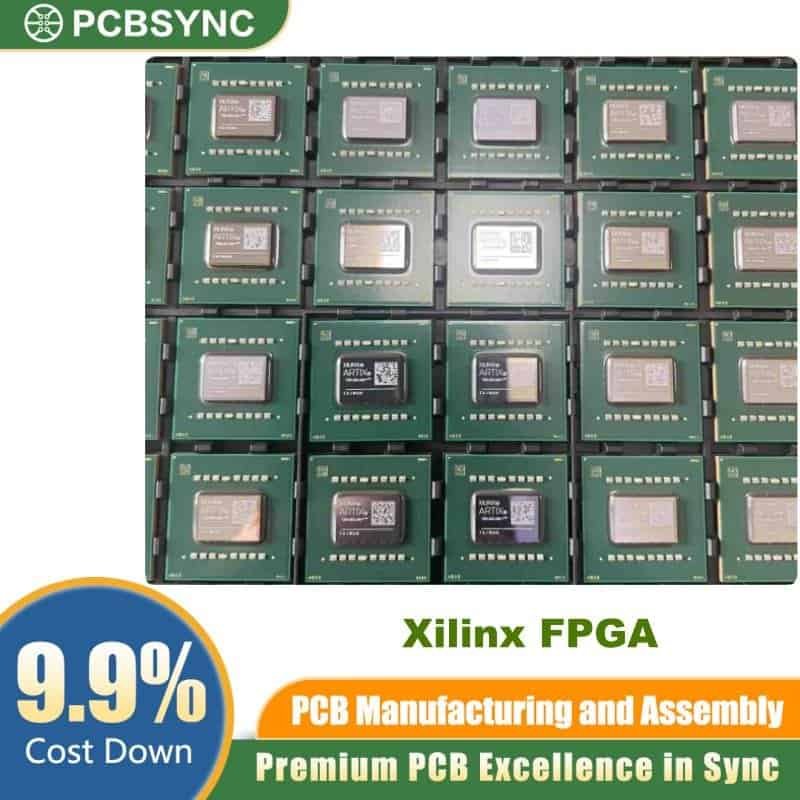
The XC2S200-6FGG1219C is a high-performance Field Programmable Gate Array (FPGA) from Xilinx’s Spartan-II family. Designed for cost-sensitive, high-volume applications, the XC2S200-6FGG1219C delivers 200,000 system gates, 5,292 logic cells, and the fastest commercial speed grade (-6) — all housed in a lead-free 1219-ball Fine Pitch BGA (FBGA) package. Engineers seeking a reliable, reprogrammable alternative to mask-programmed ASICs will find this device an outstanding choice for digital systems requiring compact, dense I/O connectivity.
For a broader overview of Xilinx programmable logic solutions, visit Xilinx FPGA.
What Is the XC2S200-6FGG1219C?
The XC2S200-6FGG1219C belongs to Xilinx’s Spartan-II product line — a family engineered with 0.18µm, eight-layer metal CMOS process technology. Operating from a 2.5V core supply, it is optimized for applications that demand a balance between logic density, speed, and cost efficiency. The “C” suffix confirms commercial temperature operation (0°C to +85°C), making it ideal for consumer, communications, and industrial control environments that do not require extended temperature ranges.
Decoding the XC2S200-6FGG1219C Part Number
Understanding the part number helps engineers select the right variant for their design:
| Field |
Value |
Meaning |
| XC2S |
Spartan-II Family |
Xilinx Spartan-II FPGA series |
| 200 |
200K Gates |
200,000 system gates |
| 6 |
Speed Grade -6 |
Fastest commercial speed grade |
| FGG |
Package Type |
Fine Pitch BGA, Pb-free (RoHS compliant) |
| 1219 |
Pin Count |
1,219 solder balls |
| C |
Temperature Range |
Commercial (0°C to +85°C) |
XC2S200-6FGG1219C Key Specifications
The following table summarizes the core electrical and logic specifications of the XC2S200-6FGG1219C:
| Parameter |
Value |
| Device Family |
Xilinx Spartan-II |
| System Gates |
200,000 |
| Logic Cells |
5,292 |
| CLB Array |
28 × 42 |
| Total CLBs |
1,176 |
| Maximum User I/O |
284 |
| Distributed RAM |
75,264 bits |
| Block RAM |
56K bits (56,000 bits) |
| Core Voltage (VCCINT) |
2.5V |
| Technology Node |
0.18µm CMOS |
| Speed Grade |
-6 (Commercial only) |
| Package |
FGG1219 (1219-ball Fine Pitch BGA) |
| Temperature Range |
0°C to +85°C (Commercial) |
| RoHS Compliance |
Yes (Pb-free, “G” designator) |
| Delay-Locked Loops (DLLs) |
4 |
XC2S200-6FGG1219C Architecture Overview
Configurable Logic Blocks (CLBs)
The XC2S200-6FGG1219C is organized around a 28×42 array of Configurable Logic Blocks. Each CLB contains four logic cells, and every logic cell includes a 4-input function generator (LUT), a carry chain, and a storage element. This architecture delivers efficient logic utilization across a wide range of digital design applications, from finite state machines to DSP pipelines.
Block RAM and Distributed RAM
One of the defining strengths of the XC2S200-6FGG1219C is its dual-port memory infrastructure:
- Distributed RAM: 75,264 bits implemented across the CLB array, suitable for small FIFOs and lookup tables.
- Block RAM: 56K bits organized in dedicated memory blocks along the edges of the die, ideal for larger data buffers and packet storage.
Delay-Locked Loops (DLLs)
The XC2S200-6FGG1219C includes four on-chip Delay-Locked Loops — one at each corner of the die. DLLs eliminate clock distribution skew, enable clock domain crossing, and support clock multiplication and division, simplifying timing closure in high-speed designs.
I/O Block (IOB) Features
The device supports a multivolt I/O interface, enabling the XC2S200-6FGG1219C to interface seamlessly with 2.5V, 3.3V, and other logic families. Each IOB supports programmable slew rate control, optional pull-up/pull-down resistors, and input delay compensation.
XC2S200-6FGG1219C Package: 1219-Ball Fine Pitch BGA
Why Choose the FGG1219 Package?
The FGG1219 package — a 1,219-ball Fine Pitch Ball Grid Array — is the largest and most I/O-dense package available for the XC2S200 die. It is the preferred choice for designs requiring:
- High pin density on compact PCB real estate
- Lead-free (Pb-free) compliance for RoHS-regulated markets
- Reliable solder joint integrity thanks to BGA mounting technology
FGG1219 Package Comparison vs. Other XC2S200 Packages
| Package |
Total Balls/Pins |
Lead-Free |
Max User I/O |
| FGG1219 |
1,219 |
Yes |
284 |
| FGG456 |
456 |
Yes |
284 |
| FG456 |
456 |
No |
284 |
| FG256 |
256 |
No |
198 |
| PQ208 |
208 |
No |
146 |
The FGG1219 package maximizes routing flexibility on complex, multilayer PCBs, while the Pb-free designation ensures compliance with modern environmental standards.
Applications of the XC2S200-6FGG1219C
The XC2S200-6FGG1219C is a versatile solution deployed across numerous industries:
Communications & Networking
- Ethernet switches and routers
- Protocol bridging and packet processing
- Wireless base station control logic
Industrial Automation
- Motor drive control systems
- PLC coprocessor logic
- Sensor interface and data aggregation
Consumer Electronics
- Set-top box signal processing
- Display controller logic
- Audio/video protocol conversion
Medical & Test Equipment
- High-speed data acquisition
- Diagnostic instrument control
- Real-time signal conditioning
Automotive Electronics
- Infotainment system control
- ADAS sensor interface logic
- CAN/LIN bus protocol processing
XC2S200-6FGG1219C vs. Other Spartan-II Devices
| Feature |
XC2S100 |
XC2S150 |
XC2S200-6FGG1219C |
| System Gates |
100K |
150K |
200K |
| Logic Cells |
2,700 |
3,888 |
5,292 |
| CLB Array |
20×30 |
24×36 |
28×42 |
| Max User I/O |
176 |
260 |
284 |
| Block RAM |
40K bits |
48K bits |
56K bits |
| Distributed RAM |
38,400 bits |
55,296 bits |
75,264 bits |
The XC2S200-6FGG1219C represents the highest density device in the Spartan-II family, giving designers the most resources within this proven architecture.
Why Choose the XC2S200-6FGG1219C Over an ASIC?
- Zero NRE costs: No non-recurring engineering fees compared to custom ASIC tape-outs.
- Rapid time-to-market: Program and deploy in days rather than the months required for ASIC fabrication.
- Field upgradability: Update device functionality in-system without hardware replacement — impossible with fixed-function ASICs.
- Reduced design risk: Validate your design in real silicon before committing to production volumes.
Programming and Design Tools for XC2S200-6FGG1219C
Xilinx’s ISE Design Suite (formerly the primary toolchain for Spartan-II devices) supports full synthesis, place-and-route, and bitstream generation for the XC2S200-6FGG1219C. Designers can also use VHDL or Verilog HDL for logic description, with JTAG-based in-circuit configuration supported via the onboard JTAG boundary-scan chain.
Ordering and Availability
When sourcing the XC2S200-6FGG1219C, always verify:
- Authenticity — Purchase from authorized or traceable distributors to avoid counterfeit ICs.
- Pb-free compliance — The “G” in FGG1219 confirms RoHS-compliant, lead-free solder balls.
- Speed grade — The -6 speed grade is exclusively available in the commercial temperature range; it is not offered in the industrial (-40°C to +100°C) variant.
- Date code and lot traceability — Critical for production quality assurance.
Frequently Asked Questions About XC2S200-6FGG1219C
Q: What is the core voltage of the XC2S200-6FGG1219C? A: The device operates from a 2.5V core supply (VCCINT). I/O banks (VCCO) support multiple voltages including 3.3V, 2.5V, and lower levels for mixed-voltage interfacing.
Q: Is the XC2S200-6FGG1219C RoHS compliant? A: Yes. The “G” character in the FGG package designator confirms that the XC2S200-6FGG1219C uses lead-free (Pb-free) solder balls, making it RoHS compliant.
Q: Can the XC2S200-6FGG1219C be reconfigured in the field? A: Yes. Like all Spartan-II FPGAs, the XC2S200-6FGG1219C is fully reconfigurable via JTAG or a configuration PROM, enabling firmware updates without hardware replacement.
Q: What is the maximum operating frequency of the XC2S200-6FGG1219C? A: The -6 speed grade supports internal clock frequencies up to 263 MHz with the on-chip DLL, making it among the fastest devices in the Spartan-II lineup.
Q: How does the FGG1219 package differ from the FGG456 package? A: Both packages are lead-free (Pb-free) BGA formats. The FGG1219 offers 1,219 solder balls vs. 456 on the FGG456, providing greater PCB routing flexibility and more ground/power planes for improved signal integrity on dense boards.