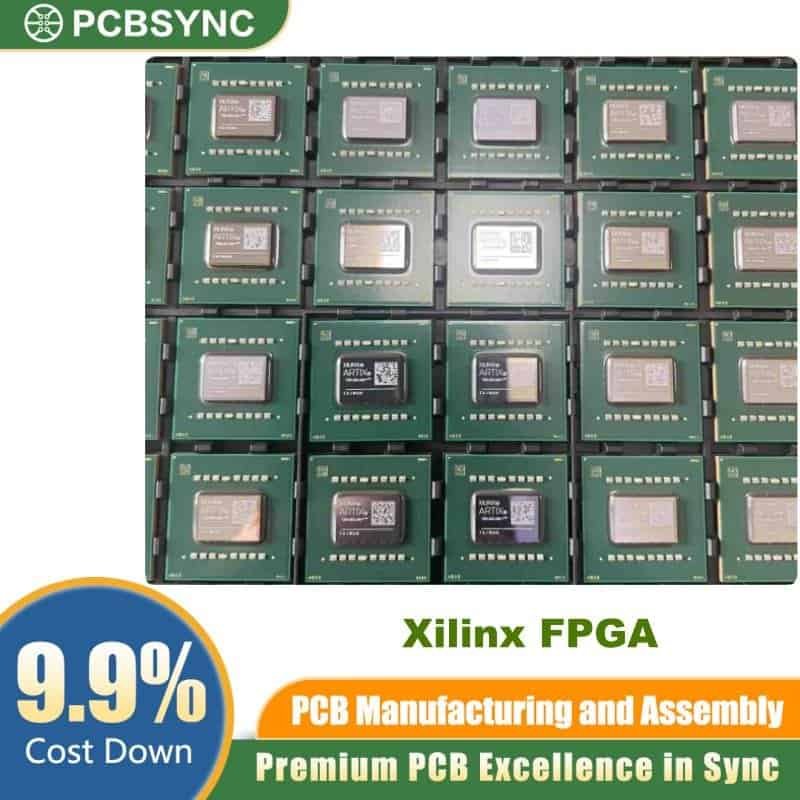
The XC2S200-6FGG1204C is a high-performance Field Programmable Gate Array (FPGA) from Xilinx’s Spartan-II family, offering 200,000 system gates in a large 1204-ball Fine-Pitch Ball Grid Array (FBGA) package. Whether you’re designing embedded systems, telecommunications hardware, or industrial controllers, this device delivers the logic density, I/O flexibility, and cost efficiency your project demands.
What Is the XC2S200-6FGG1204C? A Spartan-II FPGA Overview
The XC2S200-6FGG1204C belongs to Xilinx’s Spartan-II 2.5V FPGA family — a proven, cost-optimized programmable logic platform built on 0.18µm CMOS process technology. The part number decodes as follows:
| Part Number Segment |
Meaning |
| XC2S200 |
Spartan-II device with 200K system gates |
| -6 |
Speed grade -6 (fastest, commercial temp only) |
| FGG |
Fine-Pitch Ball Grid Array, Pb-Free (Green) package |
| 1204 |
1204 total package pins |
| C |
Commercial temperature range (0°C to +85°C) |
As an Xilinx FPGA solution, the XC2S200-6FGG1204C represents one of the largest pin-count variants in the XC2S200 lineup, making it ideal for I/O-intensive designs that require the maximum number of user-accessible signals.
XC2S200-6FGG1204C Key Specifications
Core Logic Resources
| Specification |
Value |
| Device Family |
Spartan-II |
| System Gates |
200,000 |
| Logic Cells |
5,292 |
| CLB Array |
28 × 42 |
| Total CLBs |
1,176 |
| Maximum User I/O |
284 |
| Distributed RAM |
75,264 bits |
| Block RAM |
56K bits (56,000 bits) |
Electrical and Physical Characteristics
| Specification |
Value |
| Core Supply Voltage |
2.5V |
| I/O Voltage Support |
3.3V, 2.5V, 1.8V, 1.5V |
| Process Technology |
0.18µm CMOS |
| Speed Grade |
-6 (fastest available) |
| Package Type |
FGG (Fine-Pitch BGA, Pb-Free) |
| Package Pin Count |
1204 |
| Temperature Range |
0°C to +85°C (Commercial) |
| Configuration Bits |
1,335,840 |
Clock and Timing Resources
| Resource |
Detail |
| Delay-Locked Loops (DLLs) |
4 (one per die corner) |
| Maximum System Clock |
Up to 263 MHz |
| Global Clock Networks |
4 dedicated global clock inputs |
XC2S200-6FGG1204C Architecture Deep Dive
Configurable Logic Blocks (CLBs)
The heart of the XC2S200 is its 1,176 Configurable Logic Blocks arranged in a 28×42 grid. Each CLB contains:
- Two 4-input Look-Up Tables (LUTs) for combinational logic
- Dedicated carry-chain logic for fast arithmetic operations
- Flip-flops with synchronous and asynchronous set/reset
- Wide function multiplexers for complex logic fusion
This CLB architecture enables efficient implementation of state machines, arithmetic units, data paths, and custom logic functions without the overhead of mask-programmed ASICs.
Block RAM and Distributed Memory
The XC2S200-6FGG1204C provides two categories of on-chip memory:
- Distributed RAM (75,264 bits): Formed from CLB LUTs repurposed as synchronous RAM. Ideal for small, latency-sensitive data structures, FIFOs, and register files.
- Block RAM (56K bits): Dedicated true dual-port SRAM blocks capable of operating at full system clock speed. Suitable for frame buffers, large lookup tables, and packet buffers.
Input/Output Blocks (IOBs) and I/O Standards
The XC2S200 IOBs support a wide variety of I/O standards, giving designers interface flexibility:
| I/O Standard |
Description |
| LVTTL |
Low Voltage TTL (3.3V) |
| LVCMOS33 / LVCMOS25 / LVCMOS18 / LVCMOS15 |
Low Voltage CMOS variants |
| SSTL2 / SSTL3 |
Stub Series Terminated Logic |
| GTL / GTLP |
Gunning Transceiver Logic |
| AGP |
Accelerated Graphics Port |
| PCI |
Peripheral Component Interconnect |
| HSTL |
High Speed Transceiver Logic |
Each IOB also includes programmable pull-up, pull-down, and keeper circuits, plus slew-rate control for signal integrity management.
Delay-Locked Loops (DLLs)
Four Delay-Locked Loops — one at each corner of the die — provide:
- Clock deskewing across the chip
- Frequency synthesis (multiply/divide)
- Phase shifting for source-synchronous interfaces
- Duty-cycle correction
DLLs are essential for meeting tight setup and hold timing requirements in high-speed designs.
Configuration Modes for the XC2S200-6FGG1204C
The Spartan-II supports multiple configuration modes to suit different system architectures:
| Configuration Mode |
CCLK Direction |
Data Width |
Serial DOUT |
| Master Serial |
Output |
1-bit |
Yes |
| Slave Serial |
Input |
1-bit |
Yes |
| Slave Parallel (SelectMAP) |
Input |
8-bit |
No |
| Boundary-Scan (JTAG) |
N/A |
1-bit |
No |
For most production designs, Master Serial mode with an external SPI Flash or Xilinx Platform Flash PROM is the most common approach. The Boundary-Scan/JTAG mode is standard for in-system programming and test.
XC2S200-6FGG1204C Applications
Telecommunications and Networking
The XC2S200-6FGG1204C handles multi-gigabit signal processing, protocol bridging (Ethernet, SONET, ATM), and line-card logic. Its 284 user I/Os and high-speed DLLs make it a natural fit for multi-port interface designs in switches and routers.
Industrial Automation and Motor Control
With its wide I/O voltage range and robust CLB architecture, this FPGA excels at real-time control loops, encoder interfaces, PWM generation, and multi-axis motor control. Commercial temperature range suits most factory-floor deployments.
Embedded Systems and SoC Prototyping
Engineers use the XC2S200 to prototype soft-core processor systems (e.g., PicoBlaze, MicroBlaze), custom peripheral controllers, and SoC-like architectures before committing to ASIC production.
Signal and Image Processing
The distributed RAM and block RAM support efficient implementation of FIR/IIR filters, FFT pipelines, video line buffers, and image convolution kernels for machine vision and scientific instrumentation.
Medical and Defense Electronics
The device’s deterministic behavior, reconfigurability, and radiation tolerance (for some applications) make it suitable for medical imaging systems, diagnostic equipment, and avionics test systems.
XC2S200-6FGG1204C vs. Other XC2S200 Package Options
| Part Number |
Package |
Pins |
Lead-Free |
Speed Grade |
Temp Range |
| XC2S200-6FGG1204C |
FGG BGA |
1204 |
Yes (Pb-Free) |
-6 |
Commercial |
| XC2S200-6FGG456C |
FGG BGA |
456 |
Yes (Pb-Free) |
-6 |
Commercial |
| XC2S200-6FG456C |
FG BGA |
456 |
No |
-6 |
Commercial |
| XC2S200-6FG256C |
FG BGA |
256 |
No |
-6 |
Commercial |
| XC2S200-5FGG456C |
FGG BGA |
456 |
Yes (Pb-Free) |
-5 |
Commercial |
| XC2S200-5FG456I |
FG BGA |
456 |
No |
-5 |
Industrial |
The FGG1204C variant offers the highest pin count in the XC2S200 lineup, providing the most routing flexibility for large, multi-bus board designs.
Ordering Information and Part Marking Decoder
The Xilinx Spartan-II ordering code follows a standardized format:
XC2S200 - 6 - FGG - 1204 - C
  |        |    |      |    |
  Device  Speed Pack   Pins  Temp
- Device: XC2S200 = Spartan-II, 200K gates
- Speed Grade: -6 = fastest (commercial only), -5 = standard
- Package: FGG = Fine-Pitch BGA, Pb-Free (“G” suffix = RoHS compliant)
- Pin Count: 1204 total package balls
- Temperature: C = Commercial (0°C to +85°C), I = Industrial (–40°C to +100°C)
Note: The -6 speed grade is exclusively available in the Commercial temperature range for the Spartan-II family.
Why Choose the XC2S200-6FGG1204C?
✅ Maximum I/O Flexibility
The 1204-ball package exposes the full complement of 284 user I/Os plus power, ground, and configuration pins — giving PCB designers maximum signal routing options.
✅ Fastest Available Speed Grade
The -6 speed grade provides the lowest propagation delays in the Spartan-II family, enabling clock rates approaching 263 MHz in optimized designs.
✅ RoHS-Compliant, Pb-Free Packaging
The “FGG” designation confirms lead-free solder ball composition, meeting RoHS and WEEE environmental directives for global market compliance.
✅ Proven 0.18µm CMOS Process
Built on mature, well-characterized 0.18µm technology, the XC2S200 offers excellent long-term supply predictability and stable electrical characteristics.
✅ Cost-Effective ASIC Alternative
The Spartan-II was specifically positioned as a superior alternative to mask-programmed ASICs, eliminating NRE (non-recurring engineering) costs while supporting full in-system reprogramming.
XC2S200-6FGG1204C Design Tools and Support
Xilinx (now AMD) provides a complete design ecosystem for Spartan-II devices:
| Tool |
Purpose |
| ISE Design Suite |
Synthesis, place-and-route, timing analysis |
| ChipScope Pro |
In-system logic analysis via JTAG |
| CORE Generator |
IP core generation (FIFOs, memories, DSP) |
| iMPACT |
Programming and configuration tool |
| ModelSim / Vivado Simulator |
RTL and gate-level simulation |
While the XC2S200 is a mature (legacy) product, the ISE Design Suite continues to support it for maintenance and production designs.
Frequently Asked Questions
Is the XC2S200-6FGG1204C still in production?
The XC2S200 family is classified as mature/legacy by AMD Xilinx. While no longer in active volume production, parts remain available through authorized distributors and component brokers. Engineers should plan long-term supply accordingly.
What is the difference between FG and FGG packages?
The FGG suffix indicates a Pb-Free (lead-free) solder ball composition in compliance with RoHS regulations. The FG designation is the standard (leaded) version. Electrically and functionally, both are identical.
Can I use the XC2S200-6FGG1204C in an industrial temperature application?
The -6 speed grade is available in Commercial temperature range only (0°C to +85°C). For industrial temperature (–40°C to +100°C), choose a -5 speed grade variant.
What configuration storage device is recommended?
Xilinx Platform Flash PROMs (XCF series) are the traditional companion devices. SPI Flash memories from third-party vendors are also commonly used with appropriate configuration circuitry.
Summary
The XC2S200-6FGG1204C delivers 200,000 system gates, 5,292 logic cells, 284 user I/Os, and 56K bits of block RAM in a lead-free, 1204-ball FBGA package at the fastest (-6) commercial speed grade. It is a versatile, proven programmable logic device suited for telecommunications, industrial automation, embedded processing, and signal processing applications where high I/O count and reprogrammability are key design requirements.