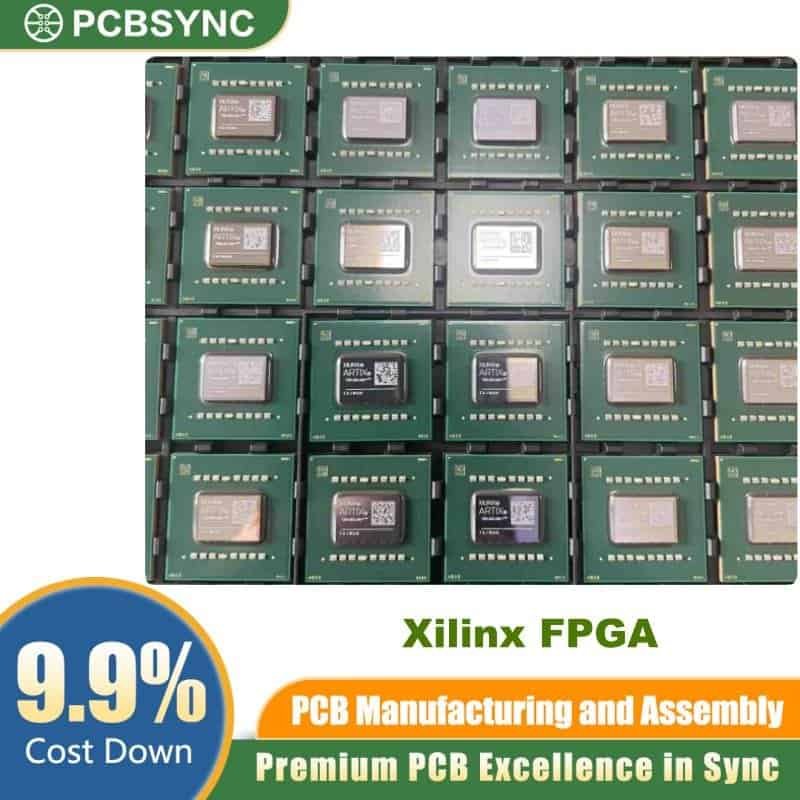
The XCKU040-1FBVA900C is a high-performance Xilinx FPGA from AMD’s Kintex® UltraScale™ family. Built on a 20nm process node, this device delivers an outstanding balance of logic density, DSP bandwidth, and power efficiency — making it an ideal choice for demanding applications in 100G networking, medical imaging, 8K/4K video processing, and heterogeneous wireless infrastructure.
What Is the XCKU040-1FBVA900C?
The XCKU040-1FBVA900C is a Field Programmable Gate Array (FPGA) manufactured by AMD (formerly Xilinx). It belongs to the Kintex UltraScale product line — a mid-range family designed to provide the best price/performance/watt ratio at the 20nm technology node. The part number breaks down as follows:
| Part Number Segment |
Meaning |
| XC |
Xilinx Commercial silicon |
| KU |
Kintex UltraScale family |
| 040 |
Device size (530,250 logic cells) |
| -1 |
Speed grade (-1, standard commercial) |
| FBVA |
Package type: Fine-pitch BGA, 31×31mm body |
| 900 |
Pin count: 900 pins |
| C |
Temperature grade: Commercial (0°C to 85°C) |
XCKU040-1FBVA900C Key Specifications
The table below summarizes the most critical electrical and physical parameters for the XCKU040-1FBVA900C:
| Parameter |
Value |
| Manufacturer |
AMD (Xilinx) |
| Series |
Kintex® UltraScale™ |
| Part Number |
XCKU040-1FBVA900C |
| Technology Node |
20nm |
| Logic Cells / System Logic Cells |
530,250 |
| CLBs (Configurable Logic Blocks) |
242,400 |
| CLB Flip-Flops |
484,800 |
| Total Block RAM |
21,606 Kbits (21.1 Mb) |
| DSP Slices |
1,920 |
| GTH Serial Transceivers |
20 (up to 16.3 Gb/s) |
| Maximum User I/O |
468 |
| PCIe Hard Block |
Gen3 ×8 |
| Clock Management (MMCM/PLL) |
Yes |
| Supply Voltage (VCCINT) |
0.922V – 0.979V |
| I/O Supply Voltage |
Up to 3.3V |
| Operating Temperature |
0°C ~ 85°C (T_J) — Commercial |
| Package |
900-BBGA, FCBGA (31×31mm) |
| Mounting Type |
Surface Mount |
| RoHS Status |
RoHS3 Compliant |
| Product Status |
Active |
XCKU040-1FBVA900C Logic and Memory Resources
Understanding the on-chip resources helps engineers plan their designs effectively. The XCKU040 die provides a generous mix of logic, memory, and arithmetic blocks optimized for both data-path-heavy and control-path-heavy workloads.
Logic Fabric
| Resource |
XCKU040 (All Packages) |
| System Logic Cells |
530,250 |
| CLBs |
242,400 |
| CLB LUTs (6-input) |
242,400 (estimated) |
| CLB Flip-Flops |
484,800 |
| Distributed RAM |
~11.3 Mb |
On-Chip Memory
| Memory Type |
Quantity / Capacity |
| Block RAM (36K tiles) |
600 |
| Block RAM (18K tiles) |
1,200 |
| Total Block RAM |
21,606 Kbits (~21.1 Mb) |
DSP and Arithmetic
| Resource |
Count |
| DSP48E2 Slices |
1,920 |
| Cascade-capable DSP chains |
Yes |
| Peak DSP Throughput |
~2.8 TOPS (typical at -1 speed) |
Package and Pin Information for the XCKU040-1FBVA900C
The FBVA900 package is a 900-ball Fine-pitch Ball Grid Array (FCBGA) with a 31×31mm body. It is one of the more compact footprints available for the XCKU040 die, making it suitable for space-constrained board designs.
| Package Attribute |
Detail |
| Package Code |
FBVA900 |
| Package Style |
FCBGA (Fine-pitch Controlled Collapse Chip Connection BGA) |
| Body Size |
31mm × 31mm |
| Ball Count |
900 |
| Maximum User I/Os in This Package |
468 |
| GTH Transceiver Lanes |
20 |
| I/O Banks |
HP (High Performance) |
| Pitch |
1.0mm ball pitch |
Footprint Compatibility Note: AMD/Xilinx uses a consistent package naming convention. All UltraScale-family devices sharing the “A900” footprint suffix are pin-compatible at the PCB level, enabling board-level migration between device densities without a PCB respin.
High-Speed Serial Connectivity: GTH Transceivers
One of the defining features of the XCKU040-1FBVA900C is its complement of 20 GTH (Gigabit Transceiver High-speed) serial lanes. These next-generation transceivers enable multi-protocol serial connectivity critical for modern system designs.
| GTH Transceiver Attribute |
Value |
| Number of GTH Lanes |
20 |
| Line Rate (in FBVA900 package) |
Up to 12.5 Gb/s |
| Supported Protocols |
PCIe Gen3, JESD204B, CPRI, SRIO, USB 3.0, Ethernet (1G/10G/25G), SATA, DisplayPort, Interlaken |
| Integrated Equalization |
Yes (adaptive) |
| Reference Clock Support |
Yes (dedicated REFCLK pins per quad) |
Note: In the FBVA900 package, the GTH transceivers support line rates up to 12.5 Gb/s. The full 16.3 Gb/s rate is available in the larger FFVA1156 package variant.
Clock Management Resources
The XCKU040-1FBVA900C includes a full suite of clocking primitives to support complex multi-clock domain designs:
| Clock Resource |
Count / Detail |
| MMCMs (Mixed-Mode Clock Managers) |
12 |
| PLLs (Phase-Locked Loops) |
12 |
| Global Clock Buffers (BUFGCE) |
240 |
| Regional Clock Buffers |
Yes |
| VCXO Integration |
Yes (reduces external clocking cost) |
PCIe Hard Block Integration
The XCKU040 integrates a hardened PCIe Gen3 ×8 IP core, enabling high-throughput host connectivity without consuming FPGA fabric resources:
| PCIe Attribute |
Value |
| PCIe Generation |
Gen3 |
| Lane Width |
×8 (can operate at ×1, ×2, ×4, ×8) |
| Maximum Bandwidth |
~64 Gb/s (bidirectional) |
| IP Core Type |
Hardened (not soft logic) |
| Supported Roles |
Root Complex, Endpoint, Switch |
XCKU040-1FBVA900C Operating Conditions
Proper voltage and thermal management is critical for reliable FPGA operation. The table below covers the recommended operating conditions for this commercial-grade part:
| Parameter |
Min |
Typical |
Max |
Unit |
| VCCINT (Core Voltage) |
0.922 |
0.950 |
0.979 |
V |
| VCCAUX |
1.71 |
1.80 |
1.89 |
V |
| VCCO (I/O Banks) |
1.14 |
— |
3.465 |
V |
| Operating Temp (T_J) |
0 |
— |
85 |
°C |
| Max Clock Frequency (-1 speed) |
— |
~630–725 |
— |
MHz |
Supported Development Tools
The XCKU040-1FBVA900C is fully supported in AMD’s current and legacy design toolchains:
| Tool |
Version Support |
Notes |
| Vivado Design Suite |
2014.1 and later |
Primary synthesis, P&R, and timing analysis |
| Vitis (Vitis HLS) |
2019.2 and later |
High-level synthesis for C/C++ |
| Xilinx Power Estimator (XPE) |
All current versions |
Power analysis and estimation |
| Vivado Lab Edition |
All versions |
Programming and debug |
| Chipscope Pro / ILA |
Integrated in Vivado |
On-chip debug |
Typical Applications for the XCKU040-1FBVA900C
The XCKU040-1FBVA900C is well-suited for mid-range to high-performance applications across multiple industries:
Networking and Data Center
- 100G Ethernet MAC/PCS processing
- Packet inspection, classification, and forwarding
- Protocol bridging (Ethernet ↔ Interlaken, SRIO)
Wireless Infrastructure
- LTE-Advanced / 5G baseband processing
- CPRI/eCPRI fronthaul interfaces
- Beamforming and MIMO processing
Video and Imaging
- 8K/4K real-time video encode/decode
- SDI interface processing (3G/6G/12G)
- Machine vision and image pre-processing
Medical and Scientific
- CT/MRI image reconstruction
- High-throughput signal acquisition
- Radiation-tolerant computing (consult AMD for screening)
Defense and Aerospace (Evaluation)
- Radar signal processing
- Software-defined radio (SDR) platforms
- Sensor fusion
XCKU040-1FBVA900C vs. Other XCKU040 Variants
The XCKU040 die is offered in multiple packages and speed/temperature grades. The table below compares the most common variants to help you select the right part:
| Part Number |
Speed Grade |
Package / Pins |
Max I/O |
Temp Grade |
Max GTH Line Rate |
| XCKU040-1FBVA900C |
-1 |
FCBGA-900 |
468 |
Commercial (0–85°C) |
12.5 Gb/s |
| XCKU040-2FBVA900I |
-2 |
FCBGA-900 |
468 |
Industrial (–40–100°C) |
12.5 Gb/s |
| XCKU040-1FFVA1156C |
-1 |
FCBGA-1156 |
520 |
Commercial (0–85°C) |
16.3 Gb/s |
| XCKU040-2FFVA1156I |
-2 |
FCBGA-1156 |
520 |
Industrial (–40–100°C) |
16.3 Gb/s |
| XCKU040-1SFVA784C |
-1 |
FCBGA-784 |
312 |
Commercial (0–85°C) |
12.5 Gb/s |
| XCKU040-1FBVA676C |
-1 |
FCBGA-676 |
312 |
Commercial (0–85°C) |
16.3 Gb/s |
Tip: The “-1” speed grade is the standard commercial performance tier. The “-2” and “-3” grades offer higher maximum clock frequencies. The FBVA900 package offers a good balance between I/O count and board footprint.
Ordering and Availability
| Attribute |
Detail |
| Manufacturer |
AMD (Xilinx) |
| Full Part Number |
XCKU040-1FBVA900C |
| Manufacturer Part Number (MPN) |
XCKU040-1FBVA900C |
| Packaging |
Bulk (tray) |
| Lead Time |
Typically 20–30 weeks (allocation-dependent) |
| RoHS Compliance |
RoHS3 Compliant |
| Product Lifecycle |
Active |
| ECCN |
3E001 (consult export control regulations) |
Frequently Asked Questions (FAQ)
Q: What is the XCKU040-1FBVA900C used for? A: It is a mid-to-high-performance FPGA used in applications such as 100G networking, 4K/8K video processing, medical imaging, wireless infrastructure (5G/LTE), and high-performance computing accelerators.
Q: What is the difference between XCKU040-1FBVA900C and XCKU040-2FBVA900I? A: The primary differences are speed grade (“-1” vs. “-2,” where -2 is faster) and operating temperature range (“C” for commercial 0–85°C vs. “I” for industrial –40–100°C).
Q: Is the XCKU040-1FBVA900C pin-compatible with other devices? A: Yes. All AMD/Xilinx UltraScale devices sharing the “A900” ball pattern (31×31mm, 900-ball FCBGA) maintain PCB footprint compatibility, allowing board-level migration between device families without a PCB redesign.
Q: What design tools does the XCKU040-1FBVA900C require? A: This device is supported by AMD Vivado Design Suite 2014.1 or later. Vitis HLS is supported from 2019.2 onward for high-level synthesis flows.
Q: How many GTH transceivers does the XCKU040-1FBVA900C have? A: The XCKU040 die contains 20 GTH transceivers. In the FBVA900 package, these support line rates up to 12.5 Gb/s.
Q: What PCIe generation does the XCKU040-1FBVA900C support? A: The XCKU040 integrates a hardened PCIe Gen3 ×8 block, supporting up to ~64 Gb/s of total bidirectional bandwidth.
Summary
The XCKU040-1FBVA900C is a commercially-graded, mid-to-high-density FPGA from AMD’s Kintex UltraScale family. With 530,250 logic cells, 21.1 Mb of block RAM, 1,920 DSP slices, 20 GTH transceivers, and a hardened PCIe Gen3 ×8 core — all housed in a compact 900-ball FCBGA package — it delivers exceptional processing capability for a wide range of industrial, networking, video, and wireless applications. Its 20nm architecture ensures a strong balance of performance and power efficiency, while full support in AMD Vivado ensures a mature and productive design experience.