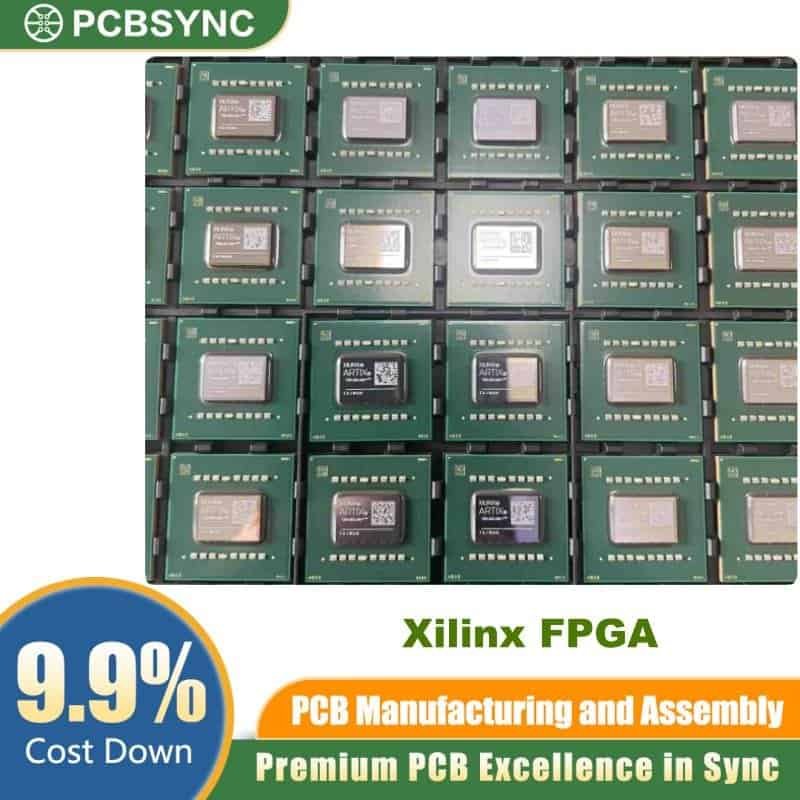
The XCKU040-2FBVA676I is a high-performance field-programmable gate array (FPGA) from AMD (formerly Xilinx), belonging to the Kintex® UltraScale™ family. Built on 20nm process technology, this device delivers an exceptional balance of signal processing performance, power efficiency, and cost-effectiveness — making it a go-to choice for demanding industrial, communications, and video processing applications.
Whether you are an FPGA engineer sourcing components or an engineering manager evaluating mid-range programmable logic devices, this guide covers everything you need to know about the XCKU040-2FBVA676I, from core specifications to real-world use cases.
What Is the XCKU040-2FBVA676I?
The XCKU040-2FBVA676I is part of AMD’s Xilinx FPGA Kintex UltraScale series — a family of mid-range FPGAs that bridges the gap between cost-sensitive Artix devices and the premium Virtex lineup. The part number breaks down as follows:
- XCKU040 — Kintex UltraScale device with 530,250 logic cells
- -2 — Speed grade 2 (standard commercial/industrial performance tier)
- FBVA — Fine-pitch Ball Grid Array package type (FCBGA)
- 676 — 676-pin package
- I — Industrial temperature grade (–40°C to 100°C junction temperature)
This combination makes the XCKU040-2FBVA676I ideal for applications that require industrial-grade reliability in a compact, manageable package footprint.
XCKU040-2FBVA676I Key Specifications
General Device Parameters
| Parameter |
Value |
| Manufacturer |
AMD (Xilinx) |
| Series |
Kintex® UltraScale™ |
| Part Number |
XCKU040-2FBVA676I |
| Technology Node |
20nm |
| Logic Cells |
530,250 |
| System Logic Cells (equivalent) |
424,200 |
| CLBs (Configurable Logic Blocks) |
1,920 |
| Speed Grade |
-2 |
| Temperature Grade |
Industrial (I) |
| Operating Junction Temperature |
–40°C to 100°C TJ |
Package and Interface Specifications
| Parameter |
Value |
| Package Type |
FCBGA (Fine-pitch Ball Grid Array) |
| Package Code |
FBVA676 |
| Pin Count |
676 |
| User I/O Count |
312 |
| Mounting Type |
Surface Mount |
| Core Supply Voltage (VCCINT) |
0.95V (range: 0.922V – 0.979V) |
Memory and Logic Resources
| Resource |
Quantity |
| Block RAM (36Kb tiles) |
600 Kb total (approx.) |
| Total RAM Bits |
21,606,000 bits (21.6 Mb) |
| Distributed RAM |
Included via LUT-as-RAM |
| DSP Slices |
High DSP-to-logic ratio (UltraScale architecture) |
| MMCM (Mixed-Mode Clock Managers) |
Yes |
| PLL (Phase-Locked Loops) |
Yes |
Transceiver and I/O Capabilities
| Parameter |
Value |
| User I/O Pins |
312 |
| Maximum Clock Frequency |
Up to 630 MHz (speed grade dependent) |
| Transceiver Technology |
Next-generation GTH/GTY transceivers |
| PCIe Support |
Yes (integrated hard block) |
| LVDS / SSTL / HSTL I/O Standards |
Supported |
XCKU040-2FBVA676I Architecture Overview
UltraScale Architecture Advantages
The XCKU040-2FBVA676I is built on AMD’s UltraScale architecture, which was the first FPGA architecture designed with ASIC-like routing. Key architectural highlights include:
- ASIC-like clocking: Fine-granular clock gating reduces dynamic power across the fabric.
- Advanced interconnect: Low-latency, high-bandwidth routing with near-zero skew between regions.
- 6-input LUTs: Each CLB contains 6-input look-up tables (LUTs) and flip-flops for maximum logic density.
- DSP48E2 slices: 27×18 multipliers with pre-adders support multiply-accumulate, multiply-add, and pattern detection functions.
- Block RAM with FIFO and ECC: 36Kb block RAMs feature built-in FIFO logic and optional error-correction coding.
Stacked Silicon Interconnect (SSI) Technology
The XCKU040-2FBVA676I uses monolithic die technology (not SSI), which simplifies PCB routing and thermal management compared to larger SSI-based UltraScale devices. This makes it easier to integrate into mid-range system designs without requiring exotic board layout techniques.
Speed Grade –2: What It Means for Your Design
The –2 speed grade on the XCKU040-2FBVA676I sits in the middle tier of AMD’s speed grade offerings (–1 being slowest, –3 being fastest). For most industrial and commercial applications, –2 offers:
- Sufficient performance for 100G networking pipeline stages
- Adequate timing margins for DDR4 memory interfaces
- Reliable operation in demanding DSP workloads like FIR filters and FFTs
- Availability in industrial temperature range for ruggedized environments
If your application requires maximum throughput and you can accept extended temperature (E) vs. industrial (I) grade, the XCKU040-3FBVA676E is the speed-optimized alternative.
Industrial Temperature Grade (I): Designed for Harsh Environments
The “I” suffix indicates the device is rated for industrial temperature range, with a junction temperature of –40°C to +100°C. This contrasts with commercial-grade parts (typically 0°C to 85°C) and is essential for applications deployed in:
- Outdoor telecom cabinets
- Factory automation and robotics
- Medical imaging systems
- Defense and aerospace ground equipment
- Automotive test and measurement
XCKU040-2FBVA676I vs. Related Variants
The KU040 is available across multiple package and speed grade combinations. The table below shows how the XCKU040-2FBVA676I compares to its closest siblings:
| Part Number |
Speed Grade |
Package |
Temperature |
I/O Count |
Use Case |
| XCKU040-1FBVA676I |
-1 |
676-FCBGA |
Industrial |
312 |
Cost-optimized industrial |
| XCKU040-2FBVA676I |
-2 |
676-FCBGA |
Industrial |
312 |
Balanced performance/cost |
| XCKU040-3FBVA676E |
-3 |
676-FCBGA |
Extended |
312 |
High-performance extended temp |
| XCKU040-2FFVA1156E |
-2 |
1156-FCBGA |
Extended |
Higher |
More I/O, larger board footprint |
| XCKU040-2FBVA900I |
-2 |
900-FCBGA |
Industrial |
Higher |
Mid-step I/O expansion |
Primary Applications for the XCKU040-2FBVA676I
1. 100G Networking and Packet Processing
The Kintex UltraScale family was specifically architected for 100G networking workloads. The XCKU040-2FBVA676I’s high-speed transceivers, large block RAM count, and DSP-to-logic ratio make it well-suited for:
- Line-rate packet classification and forwarding
- Deep packet inspection (DPI)
- Network function virtualization (NFV) acceleration
- OTN (Optical Transport Network) framing
2. DSP-Intensive Signal Processing
With a favorable DSP slice density, the XCKU040-2FBVA676I excels at computationally intensive tasks such as:
- Digital predistortion (DPD) for wireless base stations
- Radar signal processing and beamforming
- Software-defined radio (SDR) implementations
- Audio/video codec acceleration
3. Medical Imaging
High-resolution medical imaging systems, including MRI reconstruction and CT data processing, benefit from the XCKU040-2FBVA676I’s combination of block RAM, DSP slices, and reliable industrial-grade operation.
4. 8K/4K Video Processing
The device is listed by AMD as a reference platform for 8K4K video pipeline applications, including format conversion, color space processing, and real-time video analytics.
5. Wireless Infrastructure (Heterogeneous Networks)
Remote radio head (RRH) designs for TD-LTE and next-gen wireless infrastructure leverage the Kintex UltraScale family’s combination of DSP density and transceiver performance.
Power Consumption and Power Management
The XCKU040-2FBVA676I offers several power reduction features:
- Up to 40% lower power compared to the previous-generation Kintex-7 family (as cited by AMD for the UltraScale family)
- Fine-granular clock gating with ASIC-like clocking architecture
- Multiple low-power I/O standards (LVDS, HSTL 1.2V, etc.)
- Vivado Power Analyzer integration for accurate pre- and post-implementation power estimation
For thermal planning, always calculate worst-case TJ based on ambient temperature, airflow, heatsink solution, and actual activity factor using AMD’s Power Advantage Tool (XPA).
Development Tools and Ecosystem
Vivado Design Suite
The XCKU040-2FBVA676I is fully supported by AMD’s Vivado Design Suite, which provides:
- RTL synthesis and implementation
- Timing closure and static timing analysis
- IP integrator for Xilinx IP cores
- In-system debugging via Integrated Logic Analyzer (ILA)
- Power analysis and optimization
Supported IP Cores
| IP Core |
Relevance |
| MIG (Memory Interface Generator) |
DDR4/DDR3 SDRAM interfaces |
| PCIe Gen3 |
High-speed host connectivity |
| Aurora |
High-speed serial link protocol |
| JESD204B/C |
High-speed ADC/DAC interface |
| Tri-Mode Ethernet MAC |
GbE/10GbE networking |
| Video Processing Subsystem |
HDMI, SDI, video stream processing |
Evaluation and Development Boards
Engineers looking to prototype with the XCKU040 device can use platforms such as:
- AMD KCU105 Evaluation Kit — The official AMD evaluation board for Kintex UltraScale
- ALINX AXKU040/AXKU042 — Third-party development boards featuring DDR4, SFP+, PCIe, and FMC expansion
Ordering and Availability Information
| Attribute |
Detail |
| Manufacturer Part Number |
XCKU040-2FBVA676I |
| DigiKey Part Number |
2066-XCKU040-2FBVA676I-ND |
| Package Quantity |
Tray |
| RoHS Status |
Compliant |
| Lifecycle Status |
Production (Active) |
| Typical Market Price |
~$2,879–$2,930 USD (1 unit, subject to market conditions) |
Note: FPGA pricing is highly volume-dependent. Request quotes from authorized distributors (DigiKey, Mouser, Avnet, Arrow) for production quantities.
Frequently Asked Questions (FAQ)
What does the “I” suffix mean on XCKU040-2FBVA676I?
The “I” indicates industrial temperature grade, meaning the device is rated for junction temperatures from –40°C to +100°C. This is critical for applications in harsh or variable-temperature environments.
How does the XCKU040 compare to Kintex-7?
The Kintex UltraScale XCKU040 offers up to 40% lower power consumption, higher DSP and block RAM density, and next-generation high-speed transceivers compared to Kintex-7 devices, while using AMD’s advanced 20nm process node.
Is the XCKU040-2FBVA676I compatible with Vivado?
Yes. The device is fully supported in Vivado Design Suite (versions 2015.1 and later). AMD also supports this device in Vitis for hardware acceleration workflows.
What is the difference between XCKU040-2FBVA676I and XCKU040-2FBVA676E?
The “I” suffix = Industrial temperature (–40°C to 100°C TJ). The “E” suffix = Extended temperature (0°C to 100°C TJ). The industrial grade provides a wider operating range, making it more suitable for rugged deployment environments.
Can I replace XCKU040-2FBVA676I with XCKU040-1FBVA676I?
Functionally, yes — both are pin-compatible in the same 676-FCBGA package. However, the -1 speed grade has tighter timing margins and may not meet timing closure requirements for designs targeting the -2 speed grade performance envelope.
Summary: Why Choose the XCKU040-2FBVA676I?
The XCKU040-2FBVA676I offers a compelling set of characteristics for engineers who need mid-range FPGA performance at scale:
| Benefit |
Why It Matters |
| 530,250 logic cells |
Ample capacity for complex DSP and control pipelines |
| 20nm process node |
Lower power and higher density vs. 28nm predecessors |
| 312 user I/Os |
Sufficient for most mid-range interface designs |
| Industrial temperature (-40°C to 100°C) |
Enables deployment in rugged environments |
| 676-pin FCBGA |
Compact footprint, manageable PCB routing |
| Speed grade -2 |
Strong timing performance without the premium of -3 |
| Vivado & Vitis support |
Full design tool ecosystem from AMD |
| Active production status |
Long-term availability for volume programs |
For design engineers targeting packet processing, DSP, video, wireless infrastructure, or medical imaging applications, the XCKU040-2FBVA676I is a proven, well-documented device with a mature ecosystem and strong supply chain support.