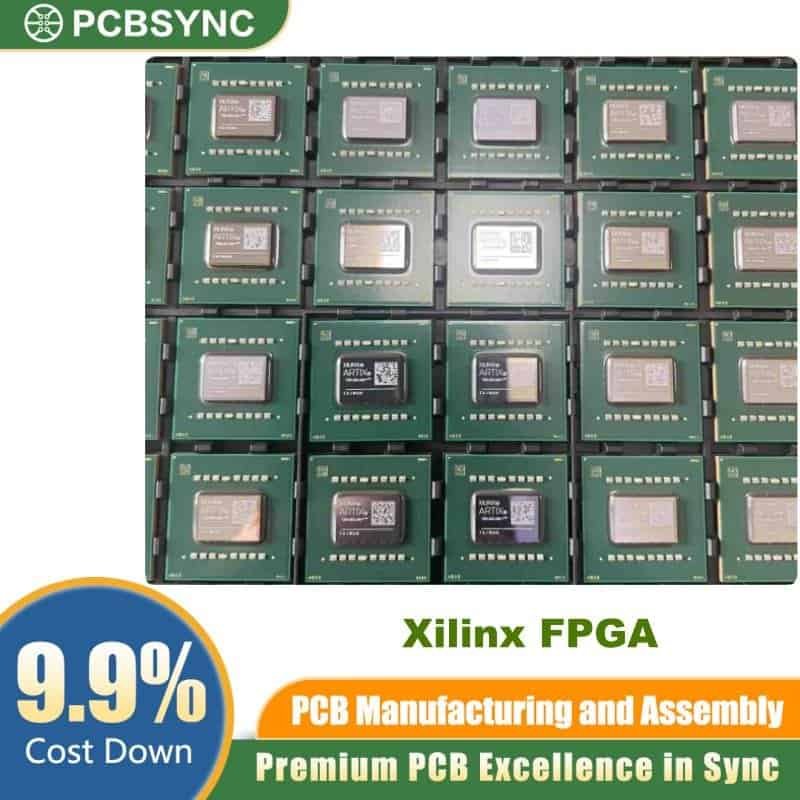
Meta Description: The XC2S200-6FGG1174C is a high-performance Xilinx Spartan-II FPGA with 200,000 system gates, 5,292 logic cells, and a 1174-ball Pb-free BGA package. Learn full specs, pinout, applications, and where to buy.
What Is the XC2S200-6FGG1174C?
The XC2S200-6FGG1174C is a field-programmable gate array (FPGA) manufactured by Xilinx as part of the Spartan-II family. It delivers 200,000 system gates and 5,292 logic cells in a compact, lead-free 1174-ball Fine-Pitch Ball Grid Array (FBGA) package. Designers choose the XC2S200-6FGG1174C because it combines high logic density with a fast -6 speed grade and commercial-temperature operation — all at a cost-effective price point.
This device operates on a 2.5V supply and uses 0.18μm CMOS process technology. It supports system performance up to 200 MHz. As a result, it is well-suited for high-volume, performance-critical embedded applications. If you are exploring programmable logic solutions, browsing the full range of Xilinx FPGA products is an excellent starting point.
XC2S200-6FGG1174C Key Specifications
The table below summarizes the core electrical and logic specifications of the XC2S200-6FGG1174C.
Table 1: Core Specifications
| Parameter |
Value |
| Part Number |
XC2S200-6FGG1174C |
| FPGA Family |
Spartan-II |
| Manufacturer |
Xilinx (now AMD) |
| System Gates |
200,000 |
| Logic Cells |
5,292 |
| CLB Array |
28 × 42 |
| Total CLBs |
1,176 |
| Maximum User I/O |
284 |
| Distributed RAM |
75,264 bits |
| Block RAM |
56K bits |
| Delay-Locked Loops |
4 (one at each die corner) |
| Supply Voltage |
2.5V |
| Process Technology |
0.18μm CMOS |
| Max System Performance |
Up to 200 MHz |
| Speed Grade |
-6 (fastest available) |
| Package Type |
FGG1174 (Fine-Pitch BGA) |
| Number of Pins |
1,174 |
| Lead-Free (Pb-Free) |
Yes (indicated by “G” in code) |
| Temperature Range |
Commercial: 0°C to +85°C |
| RoHS Compliant |
Yes |
Understanding the XC2S200-6FGG1174C Part Number
Decoding the part number helps engineers quickly identify exactly what they are ordering. The table below explains each segment of the XC2S200-6FGG1174C ordering code.
Table 2: Part Number Decoder
| Segment |
Meaning |
| XC2S200 |
Xilinx Spartan-II device with 200,000 system gates |
| -6 |
Speed grade -6 — the fastest grade, commercial range only |
| FG |
Fine-Pitch Ball Grid Array (FBGA) package type |
| G |
Pb-free (RoHS-compliant) lead-free packaging |
| 1174 |
Total number of package pins (1,174 balls) |
| C |
Commercial temperature range (0°C to +85°C) |
Note: The “G” character in the package code specifically indicates a Pb-free option. Devices without this character use standard (non-Pb-free) packaging.
XC2S200-6FGG1174C Architecture Overview
Configurable Logic Blocks (CLBs)
The XC2S200-6FGG1174C contains 1,176 Configurable Logic Blocks arranged in a 28-column by 42-row matrix. Each CLB includes four logic cells. Therefore, the device delivers a total of 5,292 usable logic cells. Each logic cell contains a function generator, carry logic, and storage elements, enabling both combinational and sequential design implementations.
Distributed RAM
The device provides 75,264 bits of distributed RAM. This RAM is embedded directly within the CLB fabric. Consequently, designers can implement fast, small memory structures without consuming dedicated block RAM resources.
Block RAM
Two columns of dedicated block RAM flank the CLB array, one on each side of the die. The XC2S200-6FGG1174C provides 56K bits of block RAM in total. Each block RAM is a true dual-port memory. This makes it ideal for FIFOs, lookup tables, and data buffering in high-throughput applications.
Delay-Locked Loops (DLLs)
Four Delay-Locked Loops are located at the four corners of the die. The DLLs eliminate clock distribution delay. They also support clock frequency synthesis and phase shifting. As a result, the XC2S200-6FGG1174C maintains tight timing margins even at high clock frequencies.
Input/Output Blocks (IOBs)
The XC2S200-6FGG1174C supports up to 284 user I/O pins. Each IOB includes registered and unregistered inputs and outputs. The device supports multiple I/O standards, including LVTTL, LVCMOS, PCI, GTL, and SSTL, offering broad interface compatibility.
XC2S200-6FGG1174C Package Details
Table 3: Package Information
| Parameter |
Detail |
| Package Code |
FGG1174 |
| Package Type |
Fine-Pitch Ball Grid Array |
| Total Balls |
1,174 |
| Lead-Free |
Yes (Pb-free, RoHS compliant) |
| Pitch |
Fine pitch |
| User I/O Pins |
284 |
| Global Clock Pins |
4 (not included in I/O count) |
The 1174-ball FBGA footprint of the XC2S200-6FGG1174C gives PCB designers flexibility in routing high-density boards. The Pb-free “G” designation confirms compliance with RoHS environmental directives. This is a critical requirement for most consumer electronics and industrial products shipped in the EU and other regulated markets.
Spartan-II Family Comparison
Understanding where the XC2S200-6FGG1174C sits within the Spartan-II family helps engineers select the right device for their design requirements.
Table 4: Spartan-II Family Device Comparison
| Device |
Logic Cells |
System Gates |
CLB Array |
Total CLBs |
Max User I/O |
Dist. RAM (bits) |
Block RAM |
| XC2S15 |
432 |
15,000 |
8 × 12 |
96 |
86 |
6,144 |
16K |
| XC2S30 |
972 |
30,000 |
12 × 18 |
216 |
92 |
13,824 |
24K |
| XC2S50 |
1,728 |
50,000 |
16 × 24 |
384 |
176 |
24,576 |
32K |
| XC2S100 |
2,700 |
100,000 |
20 × 30 |
600 |
176 |
38,400 |
40K |
| XC2S150 |
3,888 |
150,000 |
24 × 36 |
864 |
260 |
55,296 |
48K |
| XC2S200 |
5,292 |
200,000 |
28 × 42 |
1,176 |
284 |
75,264 |
56K |
The XC2S200 is the largest device in the Spartan-II family. It offers the most logic cells, the highest I/O count, and the largest memory resources in the lineup. For designs that have outgrown smaller Spartan-II devices, the XC2S200-6FGG1174C provides the maximum available capacity without moving to a different device family.
Speed Grade -6: What It Means for Your Design
Understanding Xilinx Speed Grades
Xilinx assigns speed grades to indicate the performance level of a device. A higher speed grade number (e.g., -6 vs. -5) means the device achieves faster timing. The -6 speed grade in the XC2S200-6FGG1174C represents the fastest performance tier in the Spartan-II family.
Table 5: Available Speed Grades for XC2S200
| Speed Grade |
Performance Level |
Temperature Range Available |
| -5 |
Standard |
Commercial & Industrial |
| -6 |
Fastest |
Commercial only (0°C to +85°C) |
Important: The -6 speed grade is exclusively available in the commercial temperature range. Designers requiring industrial temperature operation (-40°C to +85°C) must use the -5 speed grade instead.
Key Features of the XC2S200-6FGG1174C
The XC2S200-6FGG1174C includes a robust feature set that makes it competitive against more expensive solutions:
- High logic density — 200,000 system gates and 5,292 logic cells in a single device
- Fast operation — -6 speed grade enables system performance up to 200 MHz
- Abundant I/O — 284 user-accessible I/O pins for complex interface designs
- Flexible memory — 75,264 bits of distributed RAM plus 56K bits of dedicated block RAM
- Clock management — Four DLLs for precise clock control and phase shifting
- Broad I/O standard support — LVTTL, LVCMOS, PCI, GTL, SSTL, and more
- Pb-free packaging — RoHS-compliant FGG1174 package for green compliance
- JTAG boundary scan — Full IEEE 1149.1 boundary scan support for board-level testing
- In-field reprogrammability — Design updates require no hardware replacement
- ASIC replacement — Eliminates NRE costs and long ASIC development cycles
XC2S200-6FGG1174C vs. ASIC: Why Choose the FPGA?
Many engineers face the choice between a custom ASIC and an FPGA like the XC2S200-6FGG1174C. The table below highlights the key trade-offs.
Table 6: FPGA vs. ASIC Comparison
| Factor |
XC2S200-6FGG1174C (FPGA) |
Custom ASIC |
| NRE Cost |
None |
Very high (millions) |
| Time to Market |
Fast (weeks) |
Long (months to years) |
| Design Changes |
In-field reprogrammable |
Requires new tape-out |
| Volume Cost |
Higher per unit |
Lower at very high volumes |
| Risk |
Low |
High (respin cost if bugs found) |
| Flexibility |
Full redesign capability |
Fixed after fabrication |
The XC2S200-6FGG1174C is a superior option for low-to-medium volume production and for any design where field upgradeability is a priority.
Typical Applications
The XC2S200-6FGG1174C is used across a broad range of industries and application domains:
Industrial Automation
Motor control, sensor fusion, and real-time signal processing benefit from the device’s high I/O count and deterministic timing behavior.
Telecommunications
Protocol bridging, framing, and line-card interfaces leverage the dual-port block RAMs and high-speed I/O capabilities.
Embedded Processing
Co-processing, hardware accelerators, and custom peripheral implementations take advantage of the large CLB array and distributed memory.
Consumer Electronics
Set-top boxes, digital cameras, and display controllers use the XC2S200-6FGG1174C for its low cost and high logic density.
Test and Measurement
Pattern generation and data capture systems rely on the device’s fast DLLs and flexible I/O standards.
Configuration and Programming
Supported Configuration Modes
The XC2S200-6FGG1174C supports multiple configuration methods, giving system designers flexibility in how they load the bitstream at startup:
- Master Serial — Uses a Xilinx serial PROM (e.g., XCF series)
- Slave Serial — Bitstream provided by an external controller
- Master Parallel (SelectMAP) — 8-bit parallel configuration for faster load times
- Slave Parallel (SelectMAP) — External controller drives parallel configuration
- JTAG — IEEE 1149.1 boundary scan and configuration via JTAG port
Design Tools
Xilinx supports the XC2S200-6FGG1174C through the ISE Design Suite. Designers can use VHDL, Verilog, or schematic entry. The ISE tool chain handles synthesis, place-and-route, timing analysis, and bitstream generation for Spartan-II devices.
Ordering Information
Table 7: XC2S200-6FGG1174C Ordering Summary
| Field |
Value |
| Manufacturer |
Xilinx (AMD) |
| Part Number |
XC2S200-6FGG1174C |
| FPGA Family |
Spartan-II |
| Speed Grade |
-6 |
| Package |
FGG1174 (Pb-free, 1174-ball FBGA) |
| Temperature |
Commercial (0°C to +85°C) |
| Supply Voltage |
2.5V |
| RoHS |
Compliant |
Frequently Asked Questions About the XC2S200-6FGG1174C
What does the “-6” speed grade mean in XC2S200-6FGG1174C?
The -6 speed grade indicates the highest-performance tier within the Spartan-II family. Devices with this grade meet tighter propagation delay specifications. However, this grade is only available in the commercial temperature range (0°C to +85°C).
Is the XC2S200-6FGG1174C RoHS compliant?
Yes. The “G” character in the FGG package code confirms that the device uses Pb-free (lead-free) solder balls, making it fully RoHS compliant.
What is the maximum user I/O count on the XC2S200-6FGG1174C?
The device provides up to 284 user I/O pins. This count does not include the four dedicated global clock/user input pins.
Can the XC2S200-6FGG1174C replace a custom ASIC?
Yes. The Spartan-II family was designed specifically as a cost-effective alternative to mask-programmed ASICs. The XC2S200-6FGG1174C eliminates NRE costs and allows in-field design updates, which are not possible with fixed ASICs.
What design tools support the XC2S200-6FGG1174C?
Xilinx ISE Design Suite is the primary tool for targeting Spartan-II devices, including the XC2S200-6FGG1174C. The tool supports VHDL, Verilog, ABEL, and schematic entry flows.
What is the difference between XC2S200 and XC2S200-6FGG1174C?
XC2S200 refers to the base device (200K gate Spartan-II). The full part number XC2S200-6FGG1174C also specifies the speed grade (-6), the package (FGG1174 — Pb-free 1174-ball FBGA), and the temperature range (C — commercial).
Conclusion
The XC2S200-6FGG1174C is the highest-density, fastest-speed-grade device in the Xilinx Spartan-II family. It delivers 200,000 system gates, 5,292 logic cells, 284 user I/O pins, and 131K bits of total on-chip memory in a Pb-free 1174-ball FBGA package. Its -6 speed grade enables system performance up to 200 MHz, making it an excellent choice for demanding embedded, industrial, and communications applications. For engineers looking to avoid ASIC risk while maintaining flexibility and performance, the XC2S200-6FGG1174C remains a compelling solution.