Meta Description: Buy XC2S200-6FGG1171C – Xilinx Spartan-II FPGA with 200K gates, 5,292 logic cells, -6 speed grade, 1171-pin Pb-free BGA. Full specs, pinout, and datasheet guide.
The XC2S200-6FGG1171C is a high-performance, cost-optimized Field-Programmable Gate Array (FPGA) from Xilinx’s Spartan-II family. Featuring 200,000 system gates, 5,292 logic cells, and a fast -6 speed grade, this device is packaged in a 1171-ball Fine Pitch BGA (FGG1171) in Pb-free format, targeting commercial-temperature applications. Whether you are developing embedded systems, digital signal processing (DSP) pipelines, or communication interfaces, the XC2S200-6FGG1171C delivers proven Xilinx FPGA programmability at a competitive price point.
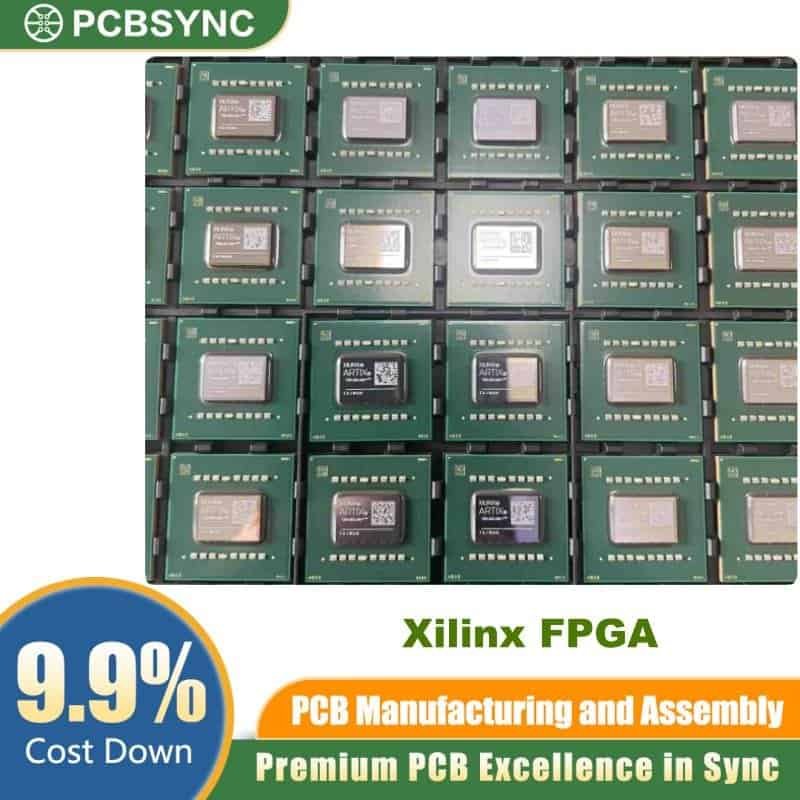
For a broader view of available Xilinx programmable logic devices, visit Xilinx FPGA.
What Is the XC2S200-6FGG1171C? – Product Overview
The XC2S200-6FGG1171C belongs to the Xilinx Spartan-II 2.5V FPGA family, one of the most widely deployed low-cost FPGA product lines for high-volume applications. The device combines a rich fabric of Configurable Logic Blocks (CLBs), dedicated block RAM, Delay-Locked Loops (DLLs), and versatile I/O blocks—all accessible through Xilinx’s ISE design toolchain.
Part Number Decoder: XC2S200-6FGG1171C
Understanding the part number helps engineers select the right variant for their design:
| Field |
Value |
Meaning |
| XC2S |
XC2S |
Xilinx Spartan-II series |
| 200 |
200 |
~200,000 equivalent system gates |
| -6 |
6 |
Speed grade (fastest commercial grade) |
| FGG |
FGG |
Fine Pitch BGA, Pb-Free (RoHS-compliant) |
| 1171 |
1171 |
Package pin count (1171 balls) |
| C |
C |
Commercial temperature range (0°C to +85°C) |
XC2S200-6FGG1171C Key Specifications
Core Logic Resources
| Parameter |
XC2S200 Value |
| System Gates (Logic + RAM) |
200,000 |
| Logic Cells |
5,292 |
| CLB Array |
28 × 42 |
| Total CLBs |
1,176 |
| Maximum User I/O |
284 |
| Distributed RAM (bits) |
75,264 |
| Block RAM (bits) |
56K (56,000) |
| Delay-Locked Loops (DLLs) |
4 |
Electrical & Timing Specifications
| Parameter |
Value |
| Supply Voltage (V_CCINT) |
2.5V |
| Speed Grade |
-6 (fastest commercial) |
| Maximum System Frequency |
Up to 200 MHz |
| Maximum Internal Clock |
Up to 263 MHz |
| Process Technology |
0.18 µm CMOS |
| I/O Standards Supported |
LVTTL, LVCMOS2, PCI, GTL, HSTL, SSTL |
Package Information
| Parameter |
Value |
| Package Type |
Fine Pitch Ball Grid Array (FBGA) |
| Package Code |
FGG1171 |
| Pin Count |
1,171 |
| Package Compliance |
Pb-Free / RoHS (denoted by “G” in FGG) |
| Package Shape |
Square |
| Mounting Type |
Surface Mount |
Environmental & Reliability
| Parameter |
Value |
| Temperature Range |
Commercial: 0°C to +85°C |
| Temperature Grade Code |
C |
| Pb-Free |
Yes (FGG suffix) |
| RoHS Compliant |
Yes |
XC2S200-6FGG1171C Architecture – How It Works
Configurable Logic Blocks (CLBs)
The heart of the XC2S200-6FGG1171C is its 1,176 CLBs arranged in a 28×42 matrix. Each CLB contains four logic cells, with each logic cell consisting of a 4-input function generator (LUT), carry and arithmetic logic, and a storage element. This architecture supports:
- Combinational logic (LUT-based)
- Synchronous and asynchronous flip-flops
- Distributed RAM using LUTs as 16×1 synchronous RAM
Block RAM
The device includes 56Kbits of dedicated block RAM arranged in two columns on either side of the CLB array. Each block RAM can be configured as:
- Single-port RAM
- Dual-port RAM
- Various width-by-depth configurations (e.g., 16K×1, 8K×2, 4K×4, 2K×8, 1K×16)
This embedded memory is ideal for FIFOs, lookup tables, and data buffering without consuming CLB fabric resources.
Delay-Locked Loops (DLLs)
Four on-chip DLLs — one at each corner of the die — eliminate clock distribution skew and allow:
- Clock edge alignment with input signals
- Frequency synthesis (2× and 0.5×)
- Phase shifting in 90° increments
- Deskewing of clock-to-output paths
Input/Output Blocks (IOBs)
Each IOB supports programmable input delays, output slew-rate control, and a wide range of I/O standards. The 284 user I/O pins (in addition to four global clock inputs) support:
- Single-ended standards: LVTTL, LVCMOS2, PCI
- High-speed differential and terminated standards: GTL, HSTL, SSTL2, SSTL3
Spartan-II Family Comparison Table
The XC2S200 is the largest device in the Spartan-II family. Use the table below to compare it against other family members:
| Device |
Logic Cells |
System Gates |
CLB Array |
Total CLBs |
Max User I/O |
Dist. RAM (bits) |
Block RAM (bits) |
| XC2S15 |
432 |
15,000 |
8×12 |
96 |
86 |
6,144 |
16K |
| XC2S30 |
972 |
30,000 |
12×18 |
216 |
92 |
13,824 |
24K |
| XC2S50 |
1,728 |
50,000 |
16×24 |
384 |
176 |
24,576 |
32K |
| XC2S100 |
2,700 |
100,000 |
20×30 |
600 |
176 |
38,400 |
40K |
| XC2S150 |
3,888 |
150,000 |
24×36 |
864 |
260 |
55,296 |
48K |
| XC2S200 |
5,292 |
200,000 |
28×42 |
1,176 |
284 |
75,264 |
56K |
XC2S200-6FGG1171C vs. Similar Variants
Different package and speed grade options exist for the XC2S200 die. This table helps compare the FGG1171 to other common variants:
| Part Number |
Speed Grade |
Package |
Pins |
Pb-Free |
Temp Range |
| XC2S200-5FG456C |
-5 |
FBGA |
456 |
No |
Commercial |
| XC2S200-6FG456C |
-6 |
FBGA |
456 |
No |
Commercial |
| XC2S200-5FGG456C |
-5 |
FBGA |
456 |
Yes |
Commercial |
| XC2S200-6FGG1171C |
-6 |
FBGA |
1,171 |
Yes |
Commercial |
| XC2S200-5FGG1171C |
-5 |
FBGA |
1,171 |
Yes |
Commercial |
The -6 speed grade is the fastest offered and is exclusively available in the commercial temperature range, making the XC2S200-6FGG1171C ideal for high-speed, lab or industrial-enclosure designs operating within 0°C to +85°C.
Key Features & Benefits of the XC2S200-6FGG1171C
1. High Logic Density in a Compact Die
With 5,292 logic cells and 200,000 equivalent system gates, the XC2S200 handles complex digital designs — from full arithmetic cores to state machine controllers — without requiring a larger and more expensive device.
2. Fastest Speed Grade Available (-6)
The -6 speed designation delivers maximum timing performance within the Spartan-II family. This is the right choice for designs with tight setup-time budgets, high-frequency clocking, or demanding signal integrity requirements.
3. Pb-Free (RoHS-Compliant) Packaging
The “G” in the FGG package suffix signifies a Pb-free BGA, complying with RoHS environmental directives. This is critical for products sold in the EU, Japan, and other markets with strict hazardous substance regulations.
4. Large Pin-Count BGA for I/O-Dense Designs
The 1171-ball FGG footprint provides maximum board-level routing flexibility compared to smaller packages. With up to 284 user I/O available, this package is suited for applications requiring a large number of simultaneous data buses, memory interfaces, or peripheral connections.
5. On-Chip Block RAM and Distributed RAM
The combination of 56Kbits of block RAM and 75,264 bits of distributed RAM makes local data storage seamless, reducing the need for external memory in many control-plane and data-plane applications.
6. Four Delay-Locked Loops (DLLs)
DLLs enable zero-skew clock distribution and clock multiplication or division, simplifying multi-clock domain designs and eliminating clock jitter caused by board-level routing.
7. Superior Alternative to Mask-Programmed ASICs
The Spartan-II FPGA avoids the upfront NRE (Non-Recurring Engineering) cost and long fabrication lead times associated with ASICs. Field reprogrammability also means that firmware updates can be deployed in the field without hardware replacement.
Typical Applications for the XC2S200-6FGG1171C
The XC2S200-6FGG1171C is well-suited for a broad range of embedded and digital hardware applications:
| Application Area |
Use Case Example |
| Embedded Systems |
Custom soft-core processor integration (e.g., PicoBlaze) |
| Digital Signal Processing |
FIR/IIR filters, FFT engines, audio processing |
| Communications |
UART, SPI, I²C, Ethernet MAC controllers |
| Industrial Automation |
Motor control, sensor interfacing, PLCs |
| Consumer Electronics |
Display controllers, set-top box logic |
| Test & Measurement |
Logic analyzers, protocol decoders, data capture |
| Networking |
Packet processing, switching fabric control |
| Prototyping / Emulation |
ASIC prototype verification, PCB bring-up tools |
Design Tool Support
Xilinx Spartan-II devices are supported by the following development environments:
| Tool |
Details |
| Xilinx ISE Design Suite |
Primary synthesis, implementation, and bitstream generation tool |
| VHDL / Verilog |
Both HDL languages fully supported |
| JTAG Boundary Scan |
Supported for in-system programming and debugging |
| iMPACT |
Bitstream download and device programming utility |
| ChipScope Pro |
In-system logic analysis and signal monitoring |
Note: For new designs, Xilinx (now AMD) recommends migrating to a current-generation family such as Artix-7 or Spartan-7 for long-term support. The XC2S200-6FGG1171C is best suited for legacy system maintenance, repair, and field replacement applications.
Ordering Information & Part Number Guide
When ordering the XC2S200-6FGG1171C, confirm the following:
| Field |
Specification |
| Manufacturer |
Xilinx (now AMD) |
| Full Part Number |
XC2S200-6FGG1171C |
| Device Family |
Spartan-II |
| Logic Cells |
5,292 |
| Package |
FGG1171 (1171-ball Fine Pitch BGA, Pb-Free) |
| Speed Grade |
-6 |
| Temperature Range |
Commercial (0°C to +85°C) |
| RoHS |
Yes (Pb-Free) |
| Mount Type |
Surface Mount Technology (SMT) |
Frequently Asked Questions (FAQ)
What does the “-6” speed grade mean on the XC2S200-6FGG1171C?
The -6 speed grade is the fastest available speed grade for the Spartan-II XC2S200 device. A lower number means faster propagation delays and higher achievable operating frequencies. The -6 grade is only offered in the commercial temperature range (0°C to +85°C).
What is the difference between FG and FGG packages?
Both FG and FGG refer to Fine Pitch BGA packaging. The “G” in FGG indicates a Pb-free (lead-free) package that complies with RoHS regulations. Standard FG packages use conventional tin-lead solder balls, while FGG packages use RoHS-compliant solder materials.
Is the XC2S200-6FGG1171C still in production?
The Spartan-II family has been through various lifecycle stages. As of AMD’s (formerly Xilinx) product lifecycle documentation, the XC2S200 is considered a mature/legacy product. It remains widely available through authorized distributors and electronic component brokers for repair, maintenance, and legacy system support.
Can the XC2S200-6FGG1171C be reprogrammed in the field?
Yes. Like all Xilinx FPGAs, the XC2S200-6FGG1171C is SRAM-based and can be reconfigured at any time by loading a new bitstream via JTAG or a configuration PROM. This makes it ideal for field-upgradeable designs.
What configuration methods are supported?
The XC2S200-6FGG1171C supports several configuration modes:
- Master Serial (from external serial PROM)
- Slave Serial
- Master Parallel (SelectMAP)
- Slave Parallel
- JTAG (IEEE 1149.1 Boundary Scan)
Summary
The XC2S200-6FGG1171C is the top-tier device in the Xilinx Spartan-II family, combining maximum logic density (5,292 cells / 200K gates), the fastest available -6 speed grade, and a large 1171-pin Pb-free BGA package. Its proven 0.18µm architecture, on-chip DLLs, and rich I/O flexibility make it a reliable choice for legacy embedded system maintenance, communication interfaces, and high-volume digital designs where ASIC-level performance at FPGA-level flexibility is required.
For more Xilinx programmable logic solutions and compatible products, explore the full range at Xilinx FPGA.