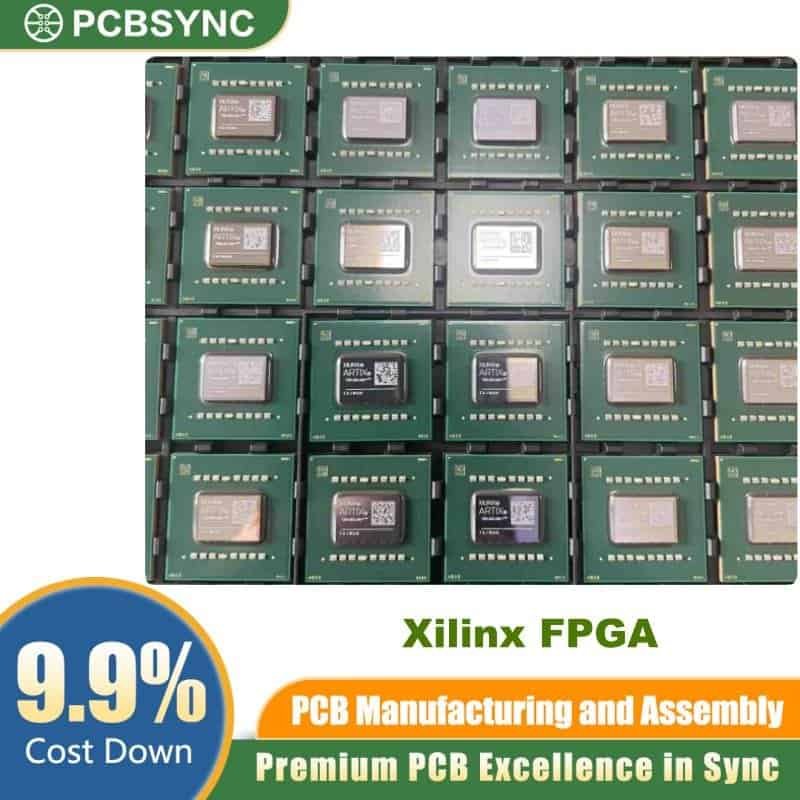
Meta Description: The XC2S200-6FGG1168C is a Xilinx Spartan-II FPGA with 200,000 system gates, 5,292 logic cells, and a 1168-ball Pb-free BGA package. Explore full specs, architecture, applications, and buying guidance here.
What Is the XC2S200-6FGG1168C?
The XC2S200-6FGG1168C is a high-density Field Programmable Gate Array (FPGA) from Xilinx’s Spartan-II family — now part of AMD. It delivers 200,000 system gates and 5,292 logic cells in a robust 1168-ball Fine-Pitch Ball Grid Array (FBGA) Pb-free package, making it one of the most capable devices in the Spartan-II lineup. Operating at a core supply voltage of 2.5V and manufactured on 0.18µm CMOS technology, the XC2S200-6FGG1168C targets cost-sensitive, high-volume applications such as communications, industrial automation, consumer electronics, and embedded processing.
Designed as a direct, reprogrammable alternative to mask-programmed ASICs, this device eliminates long design cycles and upfront NRE costs, while allowing field-upgradeable logic — a feature completely impossible with fixed-function ASICs. For engineers sourcing programmable logic at volume, the XC2S200-6FGG1168C is a proven, battle-tested choice backed by Xilinx’s ISE design toolchain.
For a broader overview of the product family, visit Xilinx FPGA.
XC2S200-6FGG1168C Key Specifications at a Glance
| Parameter |
Value |
| Part Number |
XC2S200-6FGG1168C |
| Manufacturer |
Xilinx (AMD) |
| Family |
Spartan-II |
| Technology Node |
0.18µm CMOS |
| System Gates |
200,000 |
| Logic Cells |
5,292 |
| CLB Array |
28 × 42 (1,176 CLBs) |
| Max User I/O Pins |
284 |
| Distributed RAM |
75,264 bits |
| Block RAM |
56K bits (56,000 bits) |
| Configuration Bits |
1,335,840 |
| Core Voltage (VCCINT) |
2.5V |
| Speed Grade |
-6 (Fastest in family) |
| Package Type |
FGG1168 – 1168-ball Fine-Pitch BGA (Pb-free) |
| Temperature Range |
Commercial (0°C to +85°C) |
| Operating Frequency |
Up to 263 MHz |
| Delay-Locked Loops |
4 (one per die corner) |
| RoHS Compliance |
Pb-free (G suffix in package code) |
Decoding the XC2S200-6FGG1168C Part Number
Understanding the ordering code helps engineers quickly identify device attributes and ensures the correct part is sourced.
XC2S200-6FGG1168C Part Marking Breakdown
| Field |
Code |
Meaning |
| Device Family |
XC2S |
Xilinx Spartan-II |
| Gate Count |
200 |
200,000 system gates |
| Speed Grade |
-6 |
Fastest speed grade in the Spartan-II family (Commercial only) |
| Package Type |
FGG |
Fine-Pitch Ball Grid Array, Pb-free (G = lead-free) |
| Pin Count |
1168 |
1,168 solder balls |
| Temperature Range |
C |
Commercial (0°C to +85°C) |
Note: The “G” in “FGG” denotes a Pb-free (lead-free, RoHS-compatible) package variant. Standard (leaded) packages omit this character. The -6 speed grade is exclusively available in the Commercial temperature range, making the “C” suffix mandatory for this speed grade.
XC2S200 Internal Architecture and Logic Resources
Configurable Logic Blocks (CLBs)
The XC2S200-6FGG1168C contains 1,176 CLBs arranged in a 28-column by 42-row array. Each CLB contains four logic cells, where every logic cell includes:
- A 4-input Look-Up Table (LUT) for combinational logic
- A D-type flip-flop for registered logic
- Fast carry and arithmetic logic for efficient adder/accumulator implementation
- Wide function multiplexers for complex logic reduction
This architecture enables engineers to implement dense finite state machines, arithmetic units, data path logic, and bus interfaces within a single device.
Block RAM (BRAM) and Distributed RAM
The XC2S200 provides two distinct forms of on-chip memory:
| Memory Type |
Total Capacity |
Description |
| Distributed RAM |
75,264 bits |
Synthesized from LUT resources inside CLBs; useful for small FIFOs, register files, and lookup tables |
| Block RAM |
56,000 bits (56K) |
Dedicated dual-port synchronous RAM blocks; ideal for deep FIFOs, frame buffers, and packet buffering |
Block RAM columns are positioned on opposite sides of the CLB array, between the CLBs and the I/O block (IOB) columns, enabling efficient data routing across the design.
Delay-Locked Loops (DLLs)
Four Delay-Locked Loops are integrated into the XC2S200, located one at each corner of the die. DLLs are used for:
- Zero-delay clock distribution (eliminating internal clock skew)
- Clock phase shifting and frequency division/multiplication
- Input data synchronization across high-speed I/O interfaces
DLLs eliminate the need for external PLL chips in many clock-management applications, reducing BOM cost and PCB complexity.
Input/Output Blocks (IOBs)
The XC2S200-6FGG1168C provides up to 284 user I/O pins (plus four dedicated global clock/user input pins). Each IOB supports:
- Programmable pull-up, pull-down, or keeper resistors
- 3-state (tristate) output control
- Registered input and output paths
- Support for multiple I/O standards (LVCMOS, LVTTL, PCI, GTL, and more)
FGG1168 Package Information
The FGG1168 package is a 1,168-ball Fine-Pitch Ball Grid Array (FBGA) with the Pb-free “G” designation. This package is the largest available for the XC2S200 device, providing the maximum pin count and I/O flexibility.
| Package Attribute |
Detail |
| Package Code |
FGG1168 |
| Package Style |
Fine-Pitch Ball Grid Array (FBGA) |
| Total Ball Count |
1,168 |
| RoHS / Pb-free |
Yes (denoted by second “G”) |
| Mounting Type |
Surface Mount (SMT) |
| Recommended for New Design |
Not Recommended for New Design (NRND) – legacy availability |
Procurement Note: The XC2S200-6FGG1168C carries an “NRND” (Not Recommended for New Design) status from AMD Xilinx. Engineers should source from authorized distributors or trusted excess-inventory specialists for maintenance, repair, and legacy system support.
Spartan-II Family Device Comparison
The table below shows how the XC2S200 compares to other members of the Spartan-II family, helping designers select the right device for their gate-count and I/O requirements.
| Device |
Logic Cells |
System Gates |
CLB Array |
Total CLBs |
Max User I/O |
Distributed RAM |
Block RAM |
| XC2S15 |
432 |
15,000 |
8×12 |
96 |
86 |
6,144 bits |
16K |
| XC2S30 |
972 |
30,000 |
12×18 |
216 |
92 |
13,824 bits |
24K |
| XC2S50 |
1,728 |
50,000 |
16×24 |
384 |
176 |
24,576 bits |
32K |
| XC2S100 |
2,700 |
100,000 |
20×30 |
600 |
176 |
38,400 bits |
40K |
| XC2S150 |
3,888 |
150,000 |
24×36 |
864 |
260 |
55,296 bits |
48K |
| XC2S200 |
5,292 |
200,000 |
28×42 |
1,176 |
284 |
75,264 bits |
56K |
The XC2S200 is the top-tier device in the Spartan-II family, offering the most logic cells, highest I/O count, and the most on-chip memory — making it the preferred choice when maximum logic capacity is required.
Configuration Modes for XC2S200-6FGG1168C
Spartan-II FPGAs support multiple configuration modes, selected via the Mode pins (M0, M1, M2) at power-up.
| Configuration Mode |
Pre-config Pull-ups |
M0 |
M1 |
M2 |
CCLK Direction |
Data Width |
Serial DOUT |
| Master Serial |
No |
0 |
0 |
0 |
Output |
1-bit |
Yes |
| Slave Parallel |
Yes |
0 |
1 |
0 |
Input |
8-bit |
No |
| Boundary-Scan (JTAG) |
Yes |
1 |
0 |
0 |
N/A |
1-bit |
No |
| Slave Serial |
Yes |
1 |
1 |
0 |
Input |
1-bit |
Yes |
Configuration bitstream size for XC2S200 is 1,335,840 bits. The device supports external configuration from serial PROMs, parallel flash memories, or directly via JTAG boundary-scan for testing and programming.
Electrical and Thermal Characteristics
Absolute Maximum Ratings
| Parameter |
Min |
Max |
Unit |
| VCCINT (Core Supply) |
–0.5 |
3.0 |
V |
| VCCO (I/O Supply) |
–0.5 |
4.0 |
V |
| Storage Temperature |
–65 |
+150 |
°C |
| Junction Temperature |
— |
+125 |
°C |
DC Operating Conditions (Commercial Grade)
| Parameter |
Min |
Typical |
Max |
Unit |
| VCCINT |
2.375 |
2.5 |
2.625 |
V |
| VCCO (3.3V bank) |
3.135 |
3.3 |
3.465 |
V |
| Operating Temperature (TA) |
0 |
— |
+85 |
°C |
XC2S200-6FGG1168C vs. Similar Variants
Engineers frequently compare variants across speed grades and packages. The table below maps the XC2S200 ordering options:
| Part Number |
Speed Grade |
Package |
Pins |
Temp Range |
Pb-free |
| XC2S200-5FG456C |
-5 |
FBGA |
456 |
Commercial |
No |
| XC2S200-5FGG456C |
-5 |
FBGA |
456 |
Commercial |
Yes |
| XC2S200-6FG456C |
-6 |
FBGA |
456 |
Commercial |
No |
| XC2S200-6FGG456C |
-6 |
FBGA |
456 |
Commercial |
Yes |
| XC2S200-6FG256C |
-6 |
FBGA |
256 |
Commercial |
No |
| XC2S200-6FGG256C |
-6 |
FBGA |
256 |
Commercial |
Yes |
| XC2S200-6FGG1168C |
-6 |
FBGA |
1168 |
Commercial |
Yes |
| XC2S200-6PQ208C |
-6 |
PQFP |
208 |
Commercial |
No |
| XC2S200-6PQG208C |
-6 |
PQFP |
208 |
Commercial |
Yes |
The FGG1168 package provides the maximum pin count available for the XC2S200 device, ideal for designs that need the full 284 user I/Os plus generous power and ground distribution across the BGA array.
Common Applications for XC2S200-6FGG1168C
Communications and Networking
The XC2S200-6FGG1168C is widely deployed in communications infrastructure for protocol bridging, line-rate data processing, and interface adaptation. Its 263 MHz operating frequency and high I/O count support applications including Ethernet MACs, serial link bridges, SONET framing logic, and custom network processor offload engines.
Industrial Automation and Control
In industrial environments, this FPGA enables real-time motor control, multi-axis servo coordination, PLC logic replacement, and sensor fusion. Its reconfigurability allows firmware upgrades in the field without hardware re-spins — a key operational advantage for industrial OEMs supporting long product lifecycles.
Embedded Systems and Co-Processing
The XC2S200 integrates naturally alongside processors as a co-processor or peripheral controller, handling tasks such as DMA engines, custom bus interfaces (ISA, PCI, custom LVDS), memory controllers, and real-time signal conditioning that would saturate a CPU.
Medical and Test Equipment
Medical imaging systems, ECG/EEG front-end processing boards, and automated test equipment (ATE) frequently use Spartan-II devices for their deterministic timing, high I/O count, and flexible digital interfacing. The XC2S200 handles complex data routing between analog front ends and digital back ends with predictable latency.
Consumer Electronics and Set-Top Boxes
Early consumer multimedia platforms used the XC2S200 for video format conversion, HDTV scaler logic, conditional access modules, and remote control decoders — applications that benefit from low-cost, medium-density programmable logic.
Why Choose the XC2S200-6FGG1168C?
Maximum Gate Density in the Spartan-II Family
At 200,000 system gates and 5,292 logic cells, the XC2S200 sits at the top of the Spartan-II device hierarchy. It handles logic complexity that exceeds the capacity of smaller Spartan-II members, without requiring a migration to the more expensive Spartan-IIE or Virtex families.
Fastest Speed Grade Available (-6)
The -6 speed grade delivers the highest operational frequency in the Spartan-II commercial lineup. Combined with the four on-chip DLLs for zero-skew clock distribution, the XC2S200-6 is optimized for timing-critical, high-throughput data paths.
Pb-Free, RoHS-Compatible Packaging
The “G” in the FGG package code confirms this part meets RoHS and WEEE environmental requirements for lead-free solder ball composition — essential for products shipping to European, Japanese, and Chinese markets.
Proven Xilinx ISE Tool Support
The XC2S200 is fully supported by Xilinx ISE Design Suite, with synthesis, place-and-route, static timing analysis, and JTAG-based programming fully available. Legacy designs are easily maintained without migration to newer toolchains.
Frequently Asked Questions (FAQ)
What is the XC2S200-6FGG1168C used for?
The XC2S200-6FGG1168C is used in communications, industrial control, embedded co-processing, medical equipment, and consumer electronics — wherever medium-density programmable logic with high I/O count and fast clock speeds is required.
What is the difference between XC2S200-6FGG1168C and XC2S200-6FGG456C?
Both devices use the same XC2S200 die with identical logic resources. The difference is the package: the FGG1168 has 1,168 BGA balls (larger package, more PCB area, more power/ground distribution) while the FGG456 has 456 BGA balls. Both are Pb-free (-6 speed, Commercial temperature).
Is the XC2S200-6FGG1168C still in production?
Xilinx (AMD) has classified the XC2S200 as Not Recommended for New Designs (NRND). It remains available through authorized distributors and excess-inventory channels for legacy support and maintenance builds.
What software do I use to program the XC2S200-6FGG1168C?
Xilinx ISE Design Suite (version 14.7 is the final supported release) is the primary toolchain for synthesis, implementation, and bitstream generation targeting the XC2S200. JTAG programming is performed using Xilinx iMPACT or a compatible JTAG programmer.
What is the core voltage for XC2S200-6FGG1168C?
The VCCINT (core logic voltage) is 2.5V (nominal), with a tolerance range of 2.375V to 2.625V. I/O banks (VCCO) can be powered at 2.5V or 3.3V depending on the I/O standard selected.
What configuration memory is compatible with XC2S200?
Xilinx XCF serial PROMs (such as the XCF02S) and third-party SPI or parallel flash memories configured in Master or Slave Serial modes are compatible. Boundary-scan (JTAG) configuration via a PC or embedded controller is also supported.
Summary
The XC2S200-6FGG1168C is the highest-gate-count, fastest-speed-grade, maximum-pin-count member of the Xilinx Spartan-II FPGA family in a Pb-free BGA package. With 200,000 system gates, 5,292 logic cells, 284 user I/Os, 75,264 bits of distributed RAM, 56K bits of block RAM, and four on-chip DLLs — all operating at up to 263 MHz from a 2.5V supply — this device remains a capable and cost-effective programmable logic solution for legacy system support, industrial maintenance, and volume-sensitive embedded designs.
For sourcing, technical documentation, and compatible Xilinx FPGA alternatives, visit Xilinx FPGA.