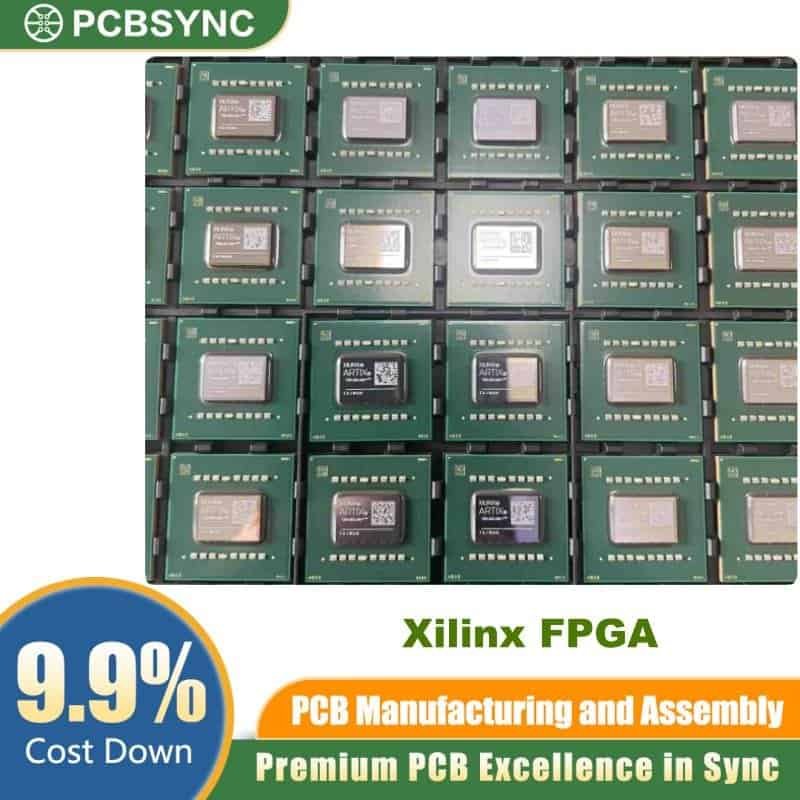
The XC2S200-6FGG1165C is a high-performance Field Programmable Gate Array (FPGA) from the Xilinx Spartan-II family, built on 0.18µm process technology and operating at a 2.5V core voltage. Designed for engineers who demand maximum I/O density, reprogrammable logic flexibility, and proven reliability, this device delivers 200,000 system gates in a 1165-pin Fine-pitch Ball Grid Array (FBGA) Pb-free package — making it one of the largest and most capable configurations in the Spartan-II lineup. Whether you are designing telecommunications equipment, embedded control systems, or high-speed digital interfaces, the XC2S200-6FGG1165C provides the logic resources and pin-count needed to bring complex designs to life.
What Is the XC2S200-6FGG1165C? A Closer Look at the Part Number
Understanding the part number helps engineers quickly identify key device characteristics. Each segment of XC2S200-6FGG1165C carries specific meaning:
| Part Number Segment |
Meaning |
| XC2S200 |
Spartan-II device with 200,000 system gates |
| -6 |
Speed Grade -6 (fastest in the Spartan-II family) |
| FGG |
Fine-pitch Ball Grid Array, Pb-free (RoHS compliant) |
| 1165 |
1165-pin package |
| C |
Commercial temperature range (0°C to +85°C) |
This naming convention, consistent across all Xilinx FPGA product lines, allows design engineers to rapidly decode device capabilities directly from the part number.
XC2S200-6FGG1165C Key Specifications at a Glance
The following table summarizes the core technical specifications of the XC2S200-6FGG1165C:
| Parameter |
Specification |
| Device Family |
Xilinx Spartan-II |
| System Gates |
200,000 |
| Logic Cells |
5,292 |
| CLB Array |
28 × 42 (1,176 CLBs) |
| Distributed RAM |
75,264 bits |
| Block RAM |
57,344 bits (14 × 4K blocks) |
| Max User I/O Pins |
284 (up to 288 in FGG1165 package) |
| Package Type |
FGG1165 — Fine-pitch BGA, Pb-free |
| Total Package Pins |
1,165 |
| Core Voltage (VCCINT) |
2.5V |
| I/O Voltage (VCCO) |
1.5V – 3.3V (selectable) |
| Speed Grade |
-6 (fastest available) |
| Max System Clock |
Up to 263 MHz |
| Process Technology |
0.18µm CMOS |
| Operating Temperature |
0°C to +85°C (Commercial) |
| RoHS Compliance |
Yes (Pb-free, “G” in package code) |
| Configuration Modes |
Master Serial, Slave Serial, Slave Parallel, JTAG |
XC2S200-6FGG1165C Architecture and Logic Resources
Configurable Logic Blocks (CLBs)
The XC2S200-6FGG1165C is organized around a 28 × 42 array of Configurable Logic Blocks (CLBs), totaling 1,176 CLBs. Each CLB contains four logic cells, and each logic cell includes:
- A 4-input Look-Up Table (LUT) for implementing any combinatorial function
- A D-type flip-flop for registering outputs
- Fast carry logic for efficient arithmetic operations
- Dedicated multiplexers for flexible routing
This architecture supports the implementation of complex state machines, arithmetic units, and custom digital signal processing pipelines — all within a single reprogrammable device.
Block RAM and Distributed RAM
Memory is a critical resource in FPGA design, and the XC2S200-6FGG1165C delivers on both fronts:
| Memory Type |
Total Capacity |
Configuration Options |
| Block RAM |
57,344 bits |
14 independent 4K-bit blocks; true dual-port |
| Distributed RAM |
75,264 bits |
Built from CLB LUTs; single or dual-port |
| Combined Total |
132,608 bits |
— |
Block RAM supports true dual-port access, allowing simultaneous reads and writes from two independent clock domains — essential for FIFO buffers, lookup tables, and frame buffers in video and communications applications.
Digital Clock Management (DCM)
The XC2S200-6FGG1165C incorporates dedicated Digital Clock Management (DCM) resources that provide:
- Clock multiplication and division
- Phase shifting (fine-grained, 0° to 360°)
- Clock deskewing to minimize distribution delay
- Duty-cycle correction
These DCM features are critical for synchronous designs that demand precise timing control across multiple clock domains.
I/O Capabilities of the XC2S200-6FGG1165C
Supported I/O Standards
One of the defining strengths of the XC2S200-6FGG1165C is its support for 16 selectable I/O standards, which allows it to interface natively with a wide range of external components and buses:
| I/O Standard |
Voltage Level |
Use Case |
| LVCMOS33 |
3.3V |
General-purpose logic interfaces |
| LVCMOS25 |
2.5V |
Native core-voltage I/O |
| LVCMOS18 |
1.8V |
Low-voltage microprocessor interfaces |
| LVTTL |
3.3V |
TTL-compatible legacy systems |
| SSTL2 Class I/II |
2.5V |
DDR SDRAM interfaces |
| SSTL3 Class I/II |
3.3V |
SDRAM and memory bus interfaces |
| GTL / GTL+ |
Ref-based |
Backplane and high-speed bus |
| HSTL Class I–IV |
1.5V |
High-speed transceiver logic |
| AGP |
1.5V / 3.3V |
Accelerated graphics bus |
| PCI |
3.3V / 5V tolerant |
Standard PCI bus compliance |
| LVDS |
Differential |
High-speed differential signaling |
| BLVDS |
Differential |
Bus LVDS for multi-drop |
| CTT |
1.5V |
Low-power chip-to-chip |
This flexibility makes the XC2S200-6FGG1165C suitable for mixed-voltage board environments and modern high-speed communication protocols.
FGG1165 Package — Maximum I/O Density
The 1165-pin Fine-pitch BGA package is the highest pin-count option available for the XC2S200 device. This package is specifically chosen when designs require the maximum number of user I/O connections. Key package details include:
| Package Detail |
Value |
| Package Type |
Fine-pitch Ball Grid Array (FBGA) |
| Total Pins |
1,165 |
| Max User I/O |
284 |
| Global Clock Inputs |
4 (dedicated) |
| Pb-free (RoHS) |
Yes |
| Package Marking Code |
FGG |
Configuration Modes of the XC2S200-6FGG1165C
The XC2S200-6FGG1165C supports four standard Spartan-II configuration modes, giving designers flexibility in how the device is programmed at power-up:
| Configuration Mode |
M[2:0] Pins |
CCLK Direction |
Data Width |
DOUT Available |
| Master Serial |
000 |
Output |
1-bit |
Yes |
| Slave Serial |
110 |
Input |
1-bit |
Yes |
| Slave Parallel (SelectMAP) |
010 |
Input |
8-bit |
No |
| Boundary-Scan (JTAG) |
100 |
N/A |
1-bit |
No |
The JTAG/Boundary-Scan mode is especially useful for in-system programming and board-level testing, supporting IEEE 1149.1 compliance for full scan chain integration.
Speed Grade -6: What It Means for Your Design
The -6 speed grade is the fastest available within the Spartan-II family. A higher numerical speed grade indicates better (faster) timing performance. For the XC2S200-6FGG1165C, this translates to:
| Performance Metric |
Typical Value (Speed Grade -6) |
| Maximum Toggle Frequency (Flip-Flop) |
~263 MHz |
| CLB-to-CLB Propagation Delay |
Minimized vs. -5 grade |
| Setup Time (Tsu) |
Shorter — enables faster clock rates |
| Clock-to-Out (Tco) |
Reduced output delay |
Choosing the -6 speed grade ensures that setup and hold time margins are maximized, making this part the preferred choice for clock-intensive and high-throughput data path designs.
XC2S200-6FGG1165C Applications and Use Cases
#### Telecommunications and Networking
The combination of high I/O count, fast speed grade, and support for differential I/O standards (LVDS, BLVDS) makes the XC2S200-6FGG1165C ideal for:
- Line card logic in routers and switches
- Protocol bridging between legacy and modern interfaces
- Forward error correction (FEC) implementations
- Multi-channel serial data processing
#### Embedded Control Systems
With its large CLB array and flexible clocking, this FPGA excels in:
- Custom microprocessor implementations using Xilinx MicroBlaze soft-core
- Motor control with PWM generation and encoder decoding
- Industrial I/O controllers requiring multi-standard I/O support
#### Video and Image Processing
The dual-port Block RAM and high-speed I/O are well-suited for:
- Frame buffer storage and pixel pipeline processing
- Real-time video overlay and compositing logic
- Display interface controllers (LVDS panel timing)
#### ASIC Prototyping and Design Verification
As a reprogrammable alternative to mask-programmed ASICs, the XC2S200-6FGG1165C allows design teams to:
- Validate gate-level netlists before tape-out
- Run hardware-in-the-loop simulations at full clock speed
- Perform field upgrades without hardware replacement
Development Tools for the XC2S200-6FGG1165C
The XC2S200-6FGG1165C is supported by the Xilinx ISE Design Suite (Integrated Software Environment). Since the Spartan-II is a legacy family, it is not supported in Vivado. The recommended toolchain includes:
| Tool |
Purpose |
| ISE Design Suite 14.7 |
Synthesis, implementation, and bitstream generation |
| ModelSim / ISim |
Functional and timing simulation |
| ChipScope Pro |
In-system logic analysis via JTAG |
| IMPACT |
Device programming and configuration |
ISE 14.7 is freely available from AMD/Xilinx and remains the definitive tool for Spartan-II programming workflows.
XC2S200-6FGG1165C vs. Other XC2S200 Package Variants
The XC2S200 die is available in multiple packages. The table below compares the FGG1165 against other common options to help engineers select the right variant for their design:
| Part Number |
Package |
Total Pins |
Max User I/O |
Pb-free |
Speed Grade |
| XC2S200-6PQ208C |
PQFP |
208 |
140 |
No |
-6 |
| XC2S200-6FG256C |
FBGA |
256 |
176 |
No |
-6 |
| XC2S200-6FGG256C |
FBGA |
256 |
176 |
Yes |
-6 |
| XC2S200-6FG456C |
FBGA |
456 |
284 |
No |
-6 |
| XC2S200-6FGG456C |
FBGA |
456 |
284 |
Yes |
-6 |
| XC2S200-6FGG1165C |
FBGA |
1165 |
284 |
Yes |
-6 |
The FGG1165 package provides the same 284 user I/O pins as the FGG456 but in a larger 1165-ball footprint — offering improved PCB routing flexibility and thermal distribution across a greater board surface area, which can simplify layout in dense multi-layer board designs.
Ordering and Availability
The XC2S200-6FGG1165C is available through authorized electronic component distributors. When sourcing this device, engineers should verify:
- RoHS / Pb-free compliance — confirmed by the “G” in the package code (FGG)
- Commercial vs. Industrial temperature grade — “C” suffix = 0°C to 85°C
- Authentic sourcing — purchase from franchised or authorized distributors to avoid counterfeit parts
- Date code and lot traceability — important for production builds and quality assurance
Frequently Asked Questions (FAQ)
Q: What is the difference between XC2S200-6FGG456C and XC2S200-6FGG1165C? Both devices contain the same XC2S200 die, the same 284 user I/O pins, and the same logic resources. The primary difference is the physical package size. The FGG1165 uses a larger 1165-ball BGA footprint, which provides a less dense ball pitch — making PCB via escape routing easier on designs with tight layout constraints.
Q: Is the XC2S200-6FGG1165C RoHS compliant? Yes. The “G” character in the package code (FGG) indicates a Pb-free, RoHS-compliant package with lead-free solder balls.
Q: Can I use Vivado to program the XC2S200-6FGG1165C? No. The Spartan-II family is supported only by Xilinx ISE Design Suite 14.7. Vivado does not include support for this legacy device family.
Q: What configuration file format does the XC2S200-6FGG1165C use? The device uses a .bit bitstream file generated by ISE. The bitstream is loaded via one of the four supported configuration modes (Master Serial, Slave Serial, SelectMAP, or JTAG).
Q: What is the core supply voltage for the XC2S200-6FGG1165C? The internal logic core (VCCINT) operates at 2.5V. The I/O banks (VCCO) accept voltages from 1.5V to 3.3V depending on the I/O standard selected.
Conclusion
The XC2S200-6FGG1165C is a proven, high-density Xilinx Spartan-II FPGA that continues to serve demanding applications where reprogrammable logic, a large I/O count, and the fastest available speed grade are required. Its 200,000-gate capacity, 57,344 bits of block RAM, 16 supported I/O standards, and Pb-free 1165-pin BGA package make it a versatile solution for telecommunications, embedded systems, video processing, and ASIC prototyping environments. With support from Xilinx ISE 14.7 and a well-documented architecture, engineers can confidently design, simulate, and deploy with this device in both new and legacy production systems.